Resources › Bag Material Guide

Bag Material Guide: Best Fabric for Gym, Yoga, Running, Swim and Travel Bags

Fabric choice, consumption, lining and finishing affect the unit price. Compare quotations against the same approved specification.
12 fabrics compared · Compare costs in your quotation · 200+ fabric suppliers · Swatches available for review · MOQ starts from 300 pieces
Bag Material Guide-venlinker

12

Fabrics compared

Compare costs in your quotation

Material cost depends on the approved specification

200+

Fabric suppliers

Stock check

Confirm fabric availability before sampling

By quote

Sourcing time confirmed before development

5–7 working days

After specification approval
Fabric table

Bag Material Guide: Fabric-by-Fabric Comparison of Denier, GSM, Water Resistance, Weight and Cost

Ranges are industry-typical for bag-grade fabric at 150 cm width; exact GSM is stated on the swatch card sent with your sample. Cost tier is relative across this table, low to high. Bag types link to the pages where that fabric is standard.
Fabric
Polyester 300D
Denier / thickness
300D
Typical GSM
120–160
Water resistance
Low; PU backing raises to rain-resistant
Weight
Light
Cost tier
Low
Best bag types
Fabric
Polyester 600D
Denier / thickness
600D
Typical GSM
220–280
Water resistance
Medium with PU/PVC backing
Weight
Medium
Cost tier
Low–mid
Fabric
Polyester 900D
Denier / thickness
900D
Typical GSM
300–360
Water resistance
Medium–high with PU backing
Weight
Medium–heavy
Cost tier
Mid
Best bag types
Fabric
Polyester 1680D
Denier / thickness
1680D (ballistic-style)
Typical GSM
400–480
Water resistance
High with PU backing
Weight
Heavy
Cost tier
Mid–high
Fabric
Nylon 210D
Denier / thickness
210D
Typical GSM
80–110
Water resistance
Medium with PU or silicone coating
Weight
Very light
Cost tier
Low–mid
Best bag types
Fabric
Nylon 420D
Denier / thickness
420D
Typical GSM
150–200
Water resistance
Medium–high with PU coating
Weight
Light
Cost tier
Mid
Fabric
Nylon 840D
Denier / thickness
840D
Typical GSM
280–340
Water resistance
High with PU coating
Weight
Medium–heavy
Cost tier
Mid–high
Fabric
Ripstop (nylon or polyester)
Denier / thickness
70D–420D grid
Typical GSM
60–200
Water resistance
Medium–high; tear-stop grid 5–8 mm
Weight
Very light–light
Cost tier
Low–mid
Fabric
Neoprene
Denier / thickness
2–4 mm, polyester-faced
Typical GSM
400–800
Water resistance
Water-resistant, does not absorb
Weight
Medium; insulating
Cost tier
Mid–high
Fabric
RPET (recycled polyester)
Denier / thickness
300D–900D
Typical GSM
120–360
Water resistance
Same as polyester of equal denier
Weight
Light–medium
Cost tier
Low–mid, slightly above virgin
Fabric
TPU / PVC film or laminate
Denier / thickness
0.3–0.8 mm
Typical GSM
300–600
Water resistance
Waterproof when welded
Weight
Medium–heavy
Cost tier
Mid–high
Fabric
Mesh (polyester)
Denier / thickness
3–6 mm hole
Typical GSM
150–300
Water resistance
None; drains and dries fast
Weight
Light
Cost tier
Low
Fabric
Canvas (cotton or poly-cotton)
Denier / thickness
10–16 oz
Typical GSM
340–540
Water resistance
Low unless waxed or PU-backed
Weight
Medium–heavy
Cost tier
Low–mid
Fabric
PU (polyurethane synthetic leather)
Denier / thickness
0.6–1.2 mm on backing
Typical GSM
350–600
Water resistance
Surface water-resistant
Weight
Medium
Cost tier
Mid–high
Best bag types
Work-gym totes, weekenders, trims on any bag
Lightest
Nylon 210D, 80–110 GSM
Heaviest
Polyester 1680D, 400–480 GSM
Waterproof
Welded TPU 0.3–0.8 mm
Lowest cost tier
300D polyester, mesh
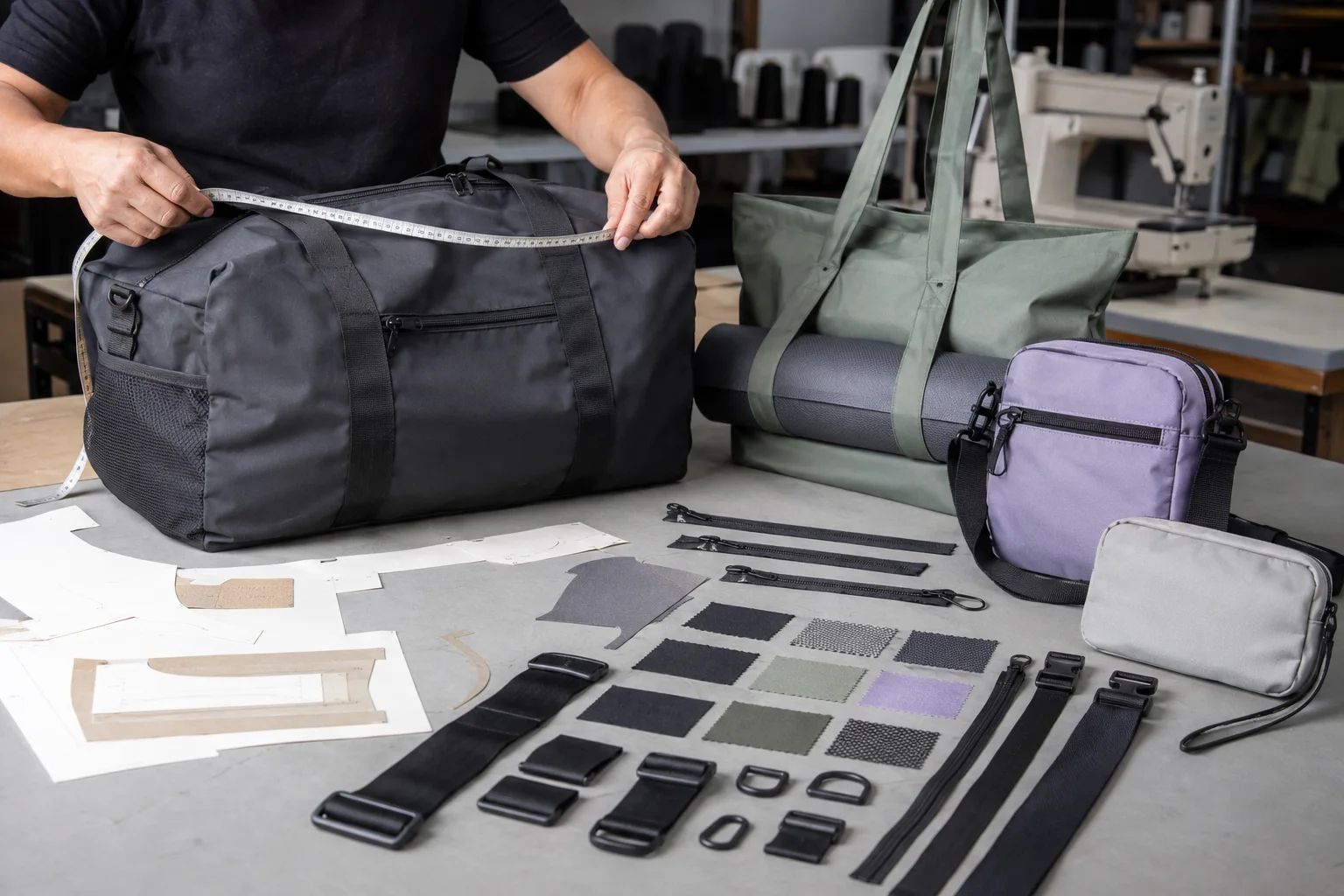
Ask for a swatch set with your sample: 5–8 fabrics cut to 10 × 10 cm with denier and GSM tags.
By bag type

Best Fabric for Gym Bags, Yoga Bags, Running Packs, Swim Bags and Travel Duffels

The fabric that is standard for each category on our lines, with the reason and the usual alternative. Choosing from this list keeps the sample at 5–7 days and MOQ at 300 pcs.

Gym duffels and backpacks

600D polyester with PU backing (220–280 GSM) is the default: enough abrasion resistance for daily floor contact, medium weight, low–mid cost. 900D for wet-dry bags that carry a TPU divider; RPET 600D where the brand asks for recycled content. See gym bags.
600D PU-backed · 220–280 GSM

Yoga mat bags and studio totes

10–16 oz canvas for the studio look and screen print; neoprene 3 mm for a padded mat bag that holds shape; RPET 300D–600D for a lighter tote. Canvas adds 100–200 g per bag over polyester.
Canvas 10–16 oz · Neoprene 3 mm

Running belts, waist packs and hydration

210D–420D nylon (80–200 GSM) keeps a 1–3 L pack under 150 g; ripstop where the pack is packed and unpacked daily. Stretch mesh or Lycra panels for phone pockets. See running waist packs and hydration waist packs.
Nylon 210D–420D · Under 150 g

Swim, wet gear and dry bags

Our Guangzhou team coordinates design, cutting, sewing, printing and packing. Specialist logo or sealed-compartment requirements are reviewed during sampling, with the process and inspection criteria confirmed for your bag. dry bags. wet bags. swim bags. swim duffels.
TPU 0.3–0.5 mm welded · Mesh 3–6 mm

Travel duffels and weekenders

1680D polyester (400–480 GSM) or 840D nylon for a weekender that goes through baggage handling; PU trim on handles and base. 210D nylon ripstop for packable backpacks that fold to 15 × 10 cm.
1680D · 400–480 GSM · PU trim

Team and equipment bags

900D–1680D polyester for team duffels at 60–90 L with a 30 cm embroidery or print area; mesh panels on ball bags for airflow; 600D for drawstring bags at 1,000–20,000 pcs where cost tier matters most.
900D–1680D · 30 cm logo area
Coatings and linings

Bag Fabric Coatings and Linings: PU, PVC, TPU Backing and 210D / 190T Linings

The base fabric sets abrasion and weight; the coating sets water resistance; the lining sets how the inside wears and how the bag looks open. Each is a separate line on the BOM and on the quote.

PU coating

Polyurethane back-coat 0.02–0.05 mm on polyester or nylon. Rain-resistant, keeps the fabric soft, takes screen print and heat transfer. The default on 600D–1680D and 420D–840D. Adds 20–40 GSM. See materials and colours.
+20–40 GSM · Default backing

PVC coating

Heavier vinyl back-coat 0.1–0.3 mm, stiffer hand, higher water resistance and wipe-clean surface. Common on 600D for helmet and gear bags and bases of shoe-compartment bags. Adds 80–150 GSM.
+80–150 GSM · Wipe-clean

TPU film and laminate

Our Guangzhou team coordinates design, cutting, sewing, printing and packing. Specialist logo or sealed-compartment requirements are reviewed during sampling, with the process and inspection criteria confirmed for your bag. waterproof backpacks.
0.3–0.8 mm · Welded seams

210D polyester or nylon lining

The standard lining: 80–110 GSM, PU-backed, in 10+ stock colours. Holds up to daily loading of shoes and bottles and lets a bright interior colour contrast the body. Used in duffels, backpacks and organizers.
80–110 GSM · 10+ stock colours

190T polyester lining

Lighter taffeta lining, 55–70 GSM, for pouches, organizer pouches and drawstring bags where weight and cost matter more than interior wear. Also the usual base for sublimated interior prints.
55–70 GSM · Lowest cost lining

TPU or PEVA wet lining

0.1–0.2 mm waterproof lining in wet pockets and wet pouches, seams taped or welded. Keeps a damp swimsuit or towel from the main compartment. Adds 1–2 min of sewing per pocket and a small cost line.
0.1–0.2 mm · Taped or welded

Fabric Swatches With Your Bag Sample in 5–7 Days

Existing showroom samples are free, with courier paid by the buyer. Custom prototypes take 5–7 working days after the specification is confirmed. We quote the prototype fee, courier charge and any sample-fee credit before work starts.
Nylon vs polyester

Nylon vs Polyester Bags: Side-by-Side Comparison for Sports Bag Buyers

The most common fabric question in RFQs. At equal denier, nylon is lighter and stronger, polyester is cheaper, more colour-stable and easier to print. The table compares the properties that matter for a bag, not for apparel.
Property
Weight at equal denier
Nylon (210D–840D)
Lighter by roughly 10–20%
Polyester (300D–1680D)
Heavier
What it means for the bag
Nylon for running packs under 150 g; polyester where weight is not the brief
Property
Tear and abrasion strength
Nylon (210D–840D)
Higher
Polyester (300D–1680D)
Good; 900D–1680D matches most needs
What it means for the bag
Nylon 420D behaves like polyester 600D–900D in wear
Property
Water absorption
Nylon (210D–840D)
Absorbs more, dries slower
Polyester (300D–1680D)
Absorbs less, dries faster
What it means for the bag
Polyester or TPU-lined for swim and wet gear
Property
UV and colour fastness
Nylon (210D–840D)
Fades faster uncoated
Polyester (300D–1680D)
More stable; sublimation-printable
What it means for the bag
Polyester for all-over prints and beach use
Property
Print and logo
Nylon (210D–840D)
Screen print, heat transfer, embroidery
Polyester (300D–1680D)
Same, plus sublimation
What it means for the bag
Both take all 7 methods in the logo guide
Property
Stretch and shape
Nylon (210D–840D)
More stretch; softer drape
Polyester (300D–1680D)
Holds shape better
What it means for the bag
Polyester for structured duffels; nylon for soft slings
Property
Cost tier
Nylon (210D–840D)
Mid to mid–high
Polyester (300D–1680D)
Low to mid
What it means for the bag
Compare costs in your quotation
Property
Stock colours in-network
Nylon (210D–840D)
6–10 per denier
Polyester (300D–1680D)
10–20 per denier
What it means for the bag
Polyester more often avoids a 5–7 day lab dip
Property
Recycled option
Nylon (210D–840D)
Recycled nylon available, higher cost
Polyester (300D–1680D)
RPET widely stocked
What it means for the bag
RPET is the lower-cost recycled route
Nylon
Lighter, stronger, higher cost
Polyester
Cheaper, printable, colour-stable
Both
PU-backed as standard
Both
Sample 5–7 days
Recycled options

Sustainable Bag Materials: RPET, Recycled Nylon and Lower-Impact Choices Without Certification Claims

Recycled fabrics are stocked through the same 200+ suppliers and run on the same lines. We describe them by fibre content and source; we do not claim certifications on this site, and buyers who need certificates should ask for the mill’s documents on the specific lot.

RPET polyester 300D–900D

Polyester spun from recycled PET bottles, stocked in 300D, 600D and 900D at the same GSM as virgin. Sews, prints and embroiders identically; cost tier slightly above virgin polyester. Standard for yoga totes and sport totes.
300D / 600D / 900D · Same GSM as virgin

Recycled nylon

Available in 210D–420D from a smaller supplier set, with availability and sourcing time confirmed before development and at a higher cost tier than RPET. Used where a brand needs nylon weight and recycled content together, such as packable backpacks.
210D–420D · Sourcing time confirmed by quote

Recycled or organic cotton canvas

10–12 oz canvas with recycled or organic cotton content for retail totes and beach totes. Natural undyed shade avoids a dye lot; printed with water-based screen inks. Mill lot documents on request.
10–12 oz · Undyed avoids lab dip

Design choices that reduce material

Fewer than 8 pattern pieces, a 190T lining instead of 210D, and a single-layer base cut 5–10% of fabric per bag. Polybag-free packing with a paper band removes 1 plastic item per unit. These are BOM decisions, not fabric claims.
−5–10% fabric per bag
Common problems

Bag Material Problems and How the Factory Prevents Them at Incoming Inspection

Six fabric failures that appear after shipment, with the check that catches each before cutting.
Bulk fabric feels thinner than the sample
Cause: bulk bought from a different mill or a lighter GSM. Control: supplier and GSM recorded on the golden sample; every roll weighed at incoming inspection, tolerance ±5% GSM.
Colour differs between duffel and pouch
Cause: two dye lots or two fabric bases. Control: one lot cut for all pieces of a set; where fabrics differ (canvas body, polyester pouch) a lab dip is approved for both under one Pantone.
PU backing peels after a season
Cause: low-grade coating or hydrolysis in humid storage. Control: PU-backed fabric bought from verified suppliers with a hydrolysis test on the roll certificate; taped inner seams on wet pockets so the coating is not the only barrier.
Welded TPU seam leaks
Our Guangzhou team coordinates design, cutting, sewing, printing and packing. Specialist logo or sealed-compartment requirements are reviewed during sampling, with the process and inspection criteria confirmed for your bag. dry bag. inline inspection.
Canvas shrinks and the print distorts
Cause: unwashed cotton canvas. Control: pre-shrunk canvas specified on the BOM; print placed after cutting, checked to ±3 mm on the first 20 pcs.
Mesh tears at the seam
Cause: mesh hole too large for the seam allowance. Control: 3–4 mm mesh with a 1 cm binding tape on all edges for swim bags; 5–6 mm mesh only as panels inside a 600D frame.
Factory

Wet-compartment construction review

Our Guangzhou team coordinates design, cutting, sewing, printing and packing. Specialist logo or sealed-compartment requirements are reviewed during sampling, with the process and inspection criteria confirmed for your bag.

2010

Founded

5,000 m²

Factory floor

500+

Staff

10+

Production lines

50,000+

Bags per month

200+

Fabric suppliers

Get a Quote With Two Fabric Options Side by Side

Fabric choice, consumption, lining and finishing affect the unit price. Compare quotations against the same approved specification.
Related guides

More Custom Bag Buyer Guides: RFQ, MOQ, Samples, Logo, Cost, Shipping

Fabric is decided at stage 1 of the buyer journey. The guides below cover the stages that follow, all with the same verified numbers.

RFQ Checklist for Custom Bags

The 12 fields that let a factory quote in 24 hours: bag type, quantity, dimensions in cm, fabric, colourways, logo file, hardware, packaging, target market, delivery date, incoterm and sample need.
12 points · Quote in 24 h

Custom Bag MOQ Guide

Why the minimum is 300 pieces: cutting lays, 50–100 m fabric rolls and dye lots. How colourways, hardware and print move the number, with 3-colourway math.
MOQ 300 pieces

Sample Cost and Lead Time

Existing showroom samples are free, with courier paid by the buyer. Custom prototypes take 5–7 working days after the specification is confirmed. We quote the prototype fee, courier charge and any sample-fee credit before work starts.
Credit terms agreed in your quote

Logo Method Guide

Define the required test method, conditioning and pass criteria in the specification. Review the chosen material or logo method on the sample, and request an independent test where the programme requires one.
7 methods · Min logo 2 cm

OEM, ODM and Private Label

Three routes compared: your tech pack (OEM, sample 5–7 working days after specification approval), our models modified (ODM, sample 5–7 working days after specification approval) and full private label ranges of 3–8 SKUs under one brand standard.
Same 300 pcs MOQ on every route

Custom Bag Cost Factors

Fabric choice, consumption, lining and finishing affect the unit price. Compare quotations against the same approved specification.
Compare costs in your quotation

Factory vs Trading Company

How to tell a bag factory from a trading company in one visit or one video call: floor area in m², line count, in-house sample room, who answers technical questions, audit access Mon–Sat.
Audits welcome Mon–Sat

Packing and Shipping Terms

Send the current requirements for your marketplace and destination, including barcodes, bagging, warnings, carton size and weight. We confirm the packing specification and its cost before production.
FOB default · Written payment terms

Custom Bag FAQ

Custom samples take 5–7 working days after the specification is confirmed. Bulk production and repeat-order schedules are confirmed in your quotation, based on the construction, materials, quantity and production availability.
MOQ · Samples · Payment · Shipping

Bag Tech Pack Guide

What a bag tech pack contains: dimensioned drawing in cm, BOM with denier and GSM, hardware list, logo placement in cm from a reference edge, packing spec. A complete pack lets us review the specification before starting the 5–7 working day sample schedule.
sample in 5–7 working days after specification approval with a full pack

All Custom Bag Buyer Guides

The hub: 11 guides indexed by buying stage, a 7-stage buyer journey and a one-table reference of venlinker MOQ, sample, payment and lead time terms.
11 guides · 7 buying stages

Blog: Articles on Sports Bag Sourcing

Longer articles on sports bag sourcing: fabric choices by season, gym bag design trends, FBA carton planning and what to check on a factory visit. Written by the venlinker design and merchandising team.
Sourcing articles · Updated monthly
Bag types

Bag Fabrics by Category: Gym, Yoga, Running, Swim, Travel and Team Bags

Each category page lists 6–8 sub-types with the fabric that is standard for it, typical GSM and the logo method that suits that fabric.

Gym & Training Bags

Duffels and backpacks in 600D–900D PU-backed polyester; RPET on request.

Yoga & Studio Bags

Mat bags and totes in 10–16 oz canvas, 3 mm neoprene or RPET.

Running & Outdoor Bags

Waist packs and belts in 210D–420D nylon and ripstop, under 150 g.

Outdoor & Travel Bags

Weekenders in 1680D or 840D nylon; dry bags in welded 0.3–0.5 mm TPU.

Swim & Wet Gear Bags

Mesh 3–6 mm swim bags, TPU wet bags and canvas beach totes.

Team & Equipment Bags

Team duffels in 900D–1680D with 30 cm logo panels; mesh ball bags.

Work-Gym Lifestyle Bags

Commuter backpacks in 840D nylon or 900D polyester with PU trim.

Accessories & Sets

Pouches and sets in 600D, 190T-lined; wet pouches TPU-lined.
Buyer fit

Bag Fabric Selection for Activewear Brands, Startups, Distributors and Private Label

Four buyer groups ask the most fabric questions. Each Who We Serve page shows the fabric decisions that group usually makes and the order size we typically see.

Activewear & Fitness Brands

Fabric named in the tech pack by denier and GSM; lab dips to brand Pantones; 1,000–5,000 pcs across 3–8 SKUs.

Startup & DTC Brands

600D PU-backed polyester in stock colours for order one at 300–1,000 pcs; RPET or custom colour on the reorder.

Distributors & Retailers

Two fabric tiers per style (600D and 1680D) to cover two price points; swatch sets for buyer meetings.

Private Label Programs

One fabric standard across duffels, totes and pouches; supplier locked on the golden sample; 2,000–20,000 pcs a year.
FAQ

Bag Material FAQ: Best Fabric for Gym Bags, Nylon vs Polyester, Neoprene and RPET

600D polyester with PU backing (220–280 GSM) for most gym duffels: abrasion-resistant, medium weight, low–mid cost, takes embroidery and print. Step up to 900D for wet-dry bags with a TPU divider, or 1680D for a duffel that doubles as travel luggage.
Nylon where weight matters: running belts and packable packs in 210D–420D. Polyester where cost, colour stability and printing matter: duffels, totes, drawstrings in 600D–1680D. At equal denier nylon is 10–20% lighter and stronger; polyester is the lower cost tier and takes sublimation.
Denier (D) is the weight of 9,000 m of the yarn in grams; higher denier is a thicker yarn and usually a heavier, more abrasion-resistant fabric. 210D is lining weight, 600D is the standard bag body, 1680D is luggage weight. GSM (grams per m²) measures the finished fabric and is the figure on our swatch tags.
Yes for padded, shape-holding bags: 2–4 mm polyester-faced neoprene is water-resistant, insulating and takes embroidery and heat transfer. It suits yoga mat bags, mini gym bags and pouches. It is heavier (400–800 GSM) and mid–high cost tier, so it is rarely used for a 40 L duffel body.
At equal denier and GSM, yes for bag use: it sews, prints and wears the same. It is stocked in 300D, 600D and 900D at a cost tier slightly above virgin polyester. We state fibre content on the BOM and can request mill lot documents; we do not make certification claims on this site.
Our Guangzhou team coordinates design, cutting, sewing, printing and packing. Specialist logo or sealed-compartment requirements are reviewed during sampling, with the process and inspection criteria confirmed for your bag. Dry bags. wet bags.
Existing showroom samples are free, with courier paid by the buyer. Custom prototypes take 5–7 working days after the specification is confirmed. We quote the prototype fee, courier charge and any sample-fee credit before work starts. sample.
Fabric choice, consumption, lining and finishing affect the unit price. Compare quotations against the same approved specification. cost factors.
Choose the fabric with the factory

Get a Custom Bag Quote With Fabric Swatches From the Factory

Send the bag type, quantity and two fabric candidates from this guide. A quote with both fabric lines comes back within 24 hours; a sample with tagged swatches follows in 5–7 working days.
Tel / WhatsApp
+86 133 6639 6425
MOQ
300 pieces
Sample
5–7 working days
Bag Material Guide-venlinker
Have a Bag Project in Mind?
Share the bag type, quantity and target delivery date. We will review the details with you.