Customization › Materials & Colours

Custom Fabric Bags and Colours: 9 Bag Fabric Options From 200+ Suppliers

Fabric choice, consumption, lining and finishing affect the unit price. Compare quotations against the same approved specification.
200+ verified fabric suppliers·Compare costs in your quotation·Lab dip 5–7 days·In-network fabric: 0 days added·MOQ from 300 pcs per colourway
Custom Materials & Colors-venlinker

200+

Verified fabric suppliers

9

Fabric families in stock

5–7 days

Pantone lab dip

Compare costs in your quotation

Fabric share of unit cost

300 pcs

MOQ per colourway

100%

Rolls checked on arrival
Fabric chart

Bag Fabric Options: Denier, GSM, Water Resistance and Use Cases

The nine fabric families we keep in network. Weights and water-resistance figures are industry-typical ranges; the exact spec is written on your tech pack and checked at incoming inspection. Full descriptions in the bag material guide.
Fabric
Polyester 600D
Weight
200–320 g/m²
Water resistance
Water-resistant with PU coating, 500–1,000 mm
Typical coating / backing
PU or PVC backing
Cost tier
Low
Fabric
Polyester 900D
Weight
280–380 g/m²
Water resistance
Water-resistant with PU coating, 800–1,500 mm
Typical coating / backing
PU coating, twill or ripstop weave
Cost tier
Low–mid
Fabric
Polyester 1680D
Weight
400–520 g/m²
Water resistance
Water-resistant with PU coating, 1,000–2,000 mm
Typical coating / backing
PU coating, ballistic weave
Cost tier
Mid
Fabric
Nylon 420D
Weight
150–200 g/m²
Water resistance
Water-resistant with PU coating; DWR optional
Typical coating / backing
PU coating, ripstop
Cost tier
Mid
Fabric
Nylon 840D
Weight
250–320 g/m²
Water resistance
Water-resistant with PU coating, 1,000–2,000 mm
Typical coating / backing
PU coating, ballistic weave
Cost tier
Mid–high
Fabric
Neoprene 2–4 mm
Weight
500–900 g/m²
Water resistance
Water-resistant, closed-cell; seams not sealed
Typical coating / backing
Nylon or polyester jersey both sides
Cost tier
Mid–high
Fabric
RPET 300D–600D
Weight
180–300 g/m²
Water resistance
Water-resistant with PU coating, 500–1,000 mm
Typical coating / backing
PU coating; supplier content declaration
Cost tier
Low–mid
Fabric
TPU / PVC 0.3–0.6 mm
Weight
300–600 g/m²
Water resistance
Waterproof when high-frequency welded
Typical coating / backing
Optional polyester scrim
Cost tier
Mid
Fabric
Polyester mesh
Weight
80–200 g/m²
Water resistance
Drains; not water-resistant
Typical coating / backing
None; bound edges
Cost tier
Low
Fabric
Canvas 10–16 oz
Weight
340–540 g/m²
Water resistance
Absorbent unless waxed or PU-backed
Typical coating / backing
Wax or PU backing optional
Cost tier
Mid
Fabric
PU leather 0.8–1.2 mm
Weight
500–700 g/m²
Water resistance
Water-resistant surface; wipe-clean
Typical coating / backing
Polyester or microfibre base
Cost tier
Mid–high
Swatches
Sent with every sample
Lab dip
5–7 days
Out-of-network fabric
+7–14 days
Roll check
GSM, denier, shade
Send a target price and a bag type; our sourcing team returns two or three fabric options with swatches in the sample parcel.
Fabric by bag type

Custom Fabric Bags by Bag Type: Which Fabric Fits Which Use

The pairing our designers start from. Each card gives the body fabric, the lining and the reason, with a link to the bag types where that pairing is standard.

Gym & Training Bags

Define the required test method, conditioning and pass criteria in the specification. Review the chosen material or logo method on the sample, and request an independent test where the programme requires one. gym duffels. women’s gym bags.
600D–900D · 210D lining

Yoga & Studio Bags

Canvas 12–14 oz, RPET 600D or neoprene 3 mm; cotton or RPET lining. Studio buyers ask for a matte, non-technical hand feel and a 61–66 cm mat sleeve. See yoga mat bags and yoga totes.
Canvas 12–14 oz · RPET 600D

Running & Light Outdoor

210D–420D nylon ripstop with DWR, 100–150 g/m² mesh back panel, reflective piping 10–15 mm. Weight under 150 g matters more than abrasion on running belts and hydration waist packs.
210D–420D nylon · DWR

Swim & Wet Gear

Our Guangzhou team coordinates design, cutting, sewing, printing and packing. Specialist logo or sealed-compartment requirements are reviewed during sampling, with the process and inspection criteria confirmed for your bag. wet bags. shower caddies.
TPU 0.4–0.6 mm · Welded

Outdoor & Travel

1680D polyester or 840D nylon body, 5–8 mm foam in the base, 210D–420D lining. 1,000–2,000 mm water resistance and a 15–25 kg loaded weight on weekenders and travel gym duffels.
1680D · 840D nylon

Work-Gym & Lifestyle

PU leather 1.0 mm or 900D twill with PU trim, 150D jacquard lining, 5 mm foam laptop sleeve. Office-to-gym buyers weight surface finish over denier; see work-gym backpacks and active crossbody bags.
PU 1.0 mm · 900D twill
Colour process

Custom Colour Bags: Pantone Lab Dip and Colour Approval Process

How a Pantone code becomes a matched fabric roll. Five steps, 5–7 working days for the lab dip, run in parallel with the structure sample.
Day 0

Pantone reference

You send a Pantone TCX or TPG code, or a physical swatch. Screen colours are not used as a reference; if only a screen file exists we propose the nearest 2–3 Pantone codes.
Day 1–5

Lab dip

The mill dyes 2–3 small lots on the actual fabric (600D, canvas or neoprene take colour differently). Dips are checked in a D65 light box against the chip; target ΔE under 1.0.
Day 5–7

Dip approval

Photos under daylight and D65, then the physical dips in the sample parcel. You pick one; that dip is filed under your project code for every repeat order.
Bulk

Bulk dyeing

The mill dyes the production lot in one batch where possible; 7–14 days for in-network fabric. Duffel, pouch and shoe bag in a set are cut from the same lot to avoid shade steps.
Arrival

Incoming shade check

Every roll compared to the approved dip at incoming inspection; GSM and denier measured; shade-banded rolls are separated so one bag never mixes two lots.
Lab dip
5–7 days
Target
ΔE under 1.0
Light source
D65 light box
Repeat colour
Filed under project code
Colour matching across fabrics in a set is covered on the accessories & sets page; logo colour on the logo page.

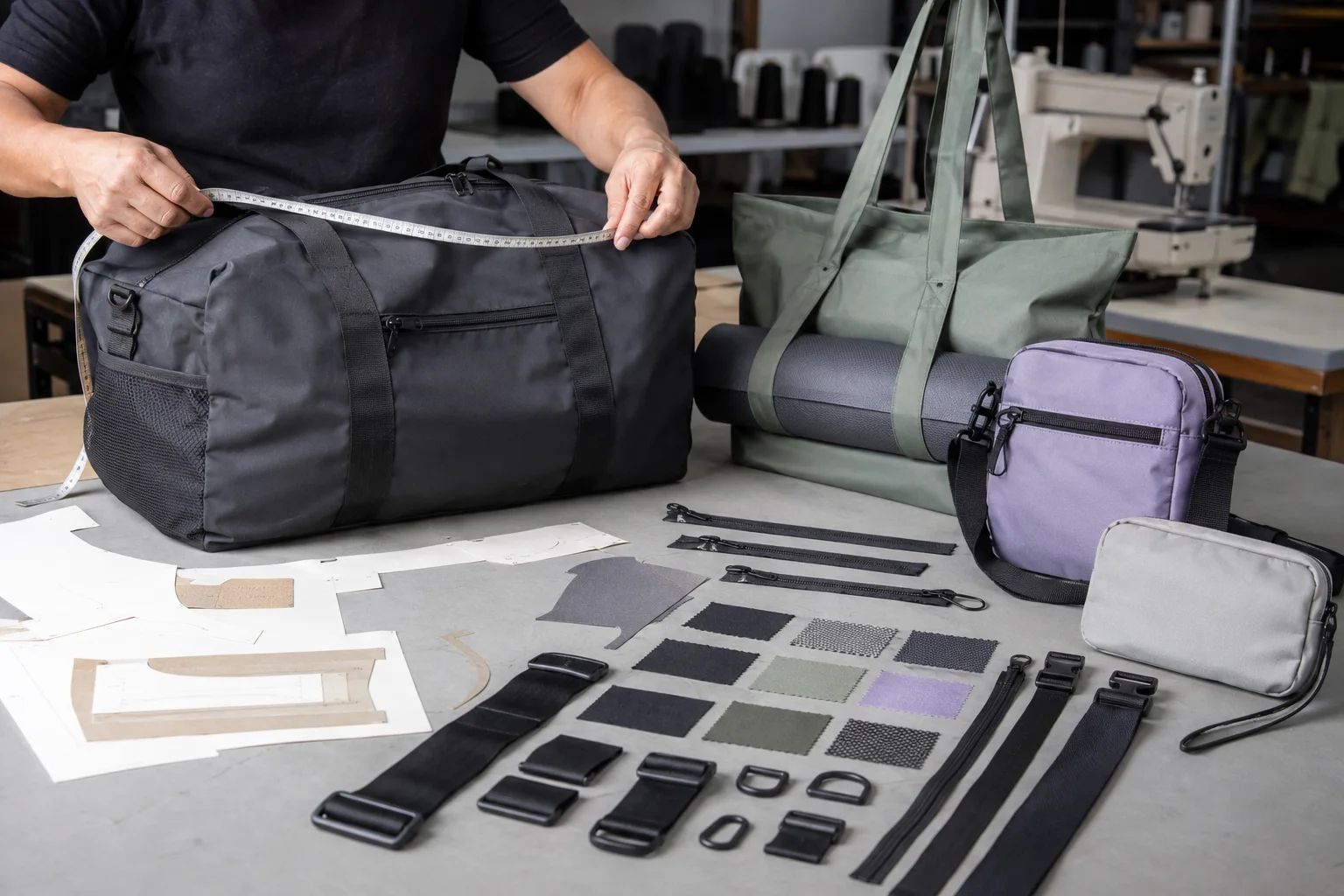
Fabric Swatches and a Lab Dip in the Sample Parcel

Existing showroom samples are free, with courier paid by the buyer. Custom prototypes take 5–7 working days after the specification is confirmed. We quote the prototype fee, courier charge and any sample-fee credit before work starts.
Finishes and linings

Bag Fabric Options: Coatings, Backings, Linings and Padding

The secondary materials that decide water resistance, structure and hand feel. Each is a line on the bill of materials and a checkpoint at incoming inspection.

PU Coating

0.02–0.05 mm polyurethane on the back of polyester or nylon; 500–2,000 mm hydrostatic head depending on passes. The standard on gym bags.
500–2,000 mm

PVC Backing

Heavier 0.1–0.2 mm layer that adds stiffness and wipe-clean interiors; used on beach totes and equipment bags.
+0.1–0.2 mm

TPU Lamination

Film bonded to fabric so seams can be welded; 0.3–0.6 mm on waterproof backpacks.
Weldable · 0.3–0.6 mm

DWR Finish

Define the required test method, conditioning and pass criteria in the specification. Review the chosen material or logo method on the sample, and request an independent test where the programme requires one. running packs.
Test to the agreed specification

Linings 150D–210D

Polyester 150D–210D plain or jacquard; colour-matched or contrast. 210D adds 10–15 g to a duffel and hides seams.
150D–210D

Foam & Padding

EVA 4–10 mm in shoulder pads and laptop sleeves; PE foam 3–5 mm in back panels of gym backpacks.
EVA 4–10 mm

Base Boards

PE board 2–3 mm or EVA 4–6 mm, sewn or removable; keeps a 30–55 L duffel standing empty. See structure.
PE 2–3 mm

Binding & Piping

Polyester binding 20–25 mm, reflective piping 10–15 mm, colour-matched to the lab dip. 8–15 m per bag on a duffel.
20–25 mm binding
Common problems

Custom Fabric Bag Problems and How the Factory Prevents Them

Material defects that account for most fabric-related claims, and the sourcing or inspection control that removes each one.
Duffel and pouch in a set are two shades of the same colour
Cause: cut from different dye lots or different base fabrics. Control: one dye lot per colourway across the set; where fabrics differ, dips are approved side by side in the D65 box.
Bulk fabric is 20–30 g/m² lighter than the swatch
Cause: mill substituted a lighter construction. Control: GSM and denier written on the purchase order and measured on every roll at incoming inspection; rolls outside ±5% are rejected.
Fabric order adds two weeks to the lead time
Cause: fabric outside our supplier network. Control: 200+ verified suppliers cover the nine families above with 0 days added; out-of-network fabric is flagged at quote as +7–14 days. See material sourcing.
PU coating cracks or peels after one season
Define the required test method, conditioning and pass criteria in the specification. Review the chosen material or logo method on the sample, and request an independent test where the programme requires one. wet bags.
Dark body bleeds into a light lining
Cause: unfixed dye on deep shades. Control: colour-fastness rub test on the lab dip (dry and wet) before approval; deep navy, black and red are tested on every bulk lot.
Recycled fabric claim cannot be documented
Cause: no paperwork from the mill. Control: RPET is bought only with the supplier’s content declaration and lot number, filed with the order; see compliance documents.
Factory

Wet-compartment construction review

Our Guangzhou team coordinates design, cutting, sewing, printing and packing. Specialist logo or sealed-compartment requirements are reviewed during sampling, with the process and inspection criteria confirmed for your bag.

2010

Founded

5,000 m²

Factory floor

500+

Staff

10+

Production lines

50,000+

Bags per month

200+

Fabric suppliers

Get a Custom Fabric Bag Quote in 24 Hours

Send bag type, quantity from 300 pcs, target price and Pantone codes. You get fabric options, unit price range and lead time within one working day.
Related customization

More Custom Bag Options: Structure, Logo, Printing, Hardware, Packaging

Materials and colours are one of seven customization layers. Each layer below has its own page with specs, timing and cost effect.

Custom Design & Structure

Dimensions in cm, capacity in litres, compartment and pocket counts, base construction and strap systems. 10+ in-house designers, 100+ new models a month, ±1 cm bulk tolerance.
Sample 5–7 days · 1 free revision

Custom Logo & Branding

Our Guangzhou team coordinates design, cutting, sewing, printing and packing. Specialist logo or sealed-compartment requirements are reviewed during sampling, with the process and inspection criteria confirmed for your bag.
7 logo methods · Min logo 2 cm

Custom Graphics & Printing

Define the required test method, conditioning and pass criteria in the specification. Review the chosen material or logo method on the sample, and request an independent test where the programme requires one.
300 DPI artwork at actual size

Trims, Hardware & Accessories

Zippers #3 to #10 in YKK or SBS, buckles 20–50 mm, webbing 20–50 mm, sliders, feet and pullers. Custom-moulded hardware with your logo adds 10–15 days.
Stock hardware: 0 days added

Packaging & FBA Prep

Send the current requirements for your marketplace and destination, including barcodes, bagging, warnings, carton size and weight. We confirm the packing specification and its cost before production.
FBA-ready cartons · 100% packing check

OEM / ODM Workflow

OEM builds from your tech pack; ODM starts from our 100+ monthly models and modifies fabric, colour, pockets and logo. Same 300 pcs MOQ, same 100% inspection, NDA on request.
sample in 5–7 working days after specification approval · ODM 5–7

All Customization Options

The hub page: 7 layers side by side, with a table of what each one does to price and lead time and an OEM vs ODM comparison. MOQ 300 pieces.
7 layers · 1 factory

Custom Bag Sample in 5–7 Days

Existing showroom samples are free, with courier paid by the buyer. Custom prototypes take 5–7 working days after the specification is confirmed. We quote the prototype fee, courier charge and any sample-fee credit before work starts.
Credit terms agreed in your quote
Bag types

Custom Fabric Bags by Category: Gym, Yoga, Running, Swim, Travel

Every category below has a standard fabric pairing that can be swapped for any of the nine families. Category pages list 6–8 sub-types with fabric, capacity and MOQ.

Gym & Training Bags

600D–900D polyester, PU-coated, 210D lining; TPU wet pockets.

Yoga & Studio Bags

Canvas 12–14 oz, RPET 600D and neoprene 3 mm for studio ranges.

Running & Outdoor Bags

210D–420D nylon ripstop with DWR; mesh back panels.

Outdoor & Travel Bags

1680D polyester, 840D nylon and welded TPU for dry bags.

Swim & Wet Gear Bags

Our Guangzhou team coordinates design, cutting, sewing, printing and packing. Specialist logo or sealed-compartment requirements are reviewed during sampling, with the process and inspection criteria confirmed for your bag.

Team & Equipment Bags

900D–1680D polyester with PVC backing for equipment loads.

Work-Gym Lifestyle Bags

PU leather 1.0 mm, 900D twill, jacquard linings.

Accessories & Sets

Matching fabric and dye lot across pouches, shoe bags and dust bags.
Buyer fit

Custom Fabric Bags for Activewear Brands, Startups, Private Label and Retailers

Who specifies fabric with us, and how the material decision usually runs for each group.

Activewear & Fitness Brands

Seasonal Pantone palettes of 3–6 colours lab-dipped once and reused across duffel, tote and pouch.

Startup & DTC Brands

Two fabric options priced side by side on the first quote; 600D vs 900D typically moves unit cost 8–15%.

Private Label Programs

Repeat-order timing is confirmed against the approved sample, any specification changes and current material and production availability.

Distributors & Retailers

Fabric swaps to hit a shelf price point at 1,000–5,000 pcs; RPET content declarations supplied with the order.
FAQ

Custom Fabric Bags and Colours: Frequently Asked Questions

A main bag and matching pouches can share fabric, colours and labels. Ask for the individual-item prices and the complete-set price before deciding what to include in your launch. cost factors.
Yes, on polyester, nylon, canvas and RPET, with a lab dip in 5–7 days and a target ΔE under 1.0. Neoprene and TPU are matched from a supplier colour card of 20–40 shades, or custom-run from about 1,000 pcs. Send TCX or TPG codes with your RFQ.
300 pieces. A duffel in three colours is 900 pcs. Custom-dyed neoprene, TPU or webbing may need 1,000+ pcs to justify a dye run; stock colours have no extra minimum. See the MOQ guide.
Yes. RPET 300D–600D is in network with 0 days added, plus recycled nylon on request. Each lot ships with the supplier’s content declaration and lot number; we do not claim certifications ourselves. Details under compliance documents.
Yes. Send the roll spec (denier, GSM, width, coating) and the delivery date; we quote cutting, sewing and trims only. Buyer-supplied fabric passes the same incoming inspection, and shortages are reported within 24 hours of arrival.
Our Guangzhou team coordinates design, cutting, sewing, printing and packing. Specialist logo or sealed-compartment requirements are reviewed during sampling, with the process and inspection criteria confirmed for your bag. dry bag.
Existing showroom samples are free, with courier paid by the buyer. Custom prototypes take 5–7 working days after the specification is confirmed. We quote the prototype fee, courier charge and any sample-fee credit before work starts. free sample.
Start your fabric project

Get a Custom Fabric Bag Quote From the Factory

Send bag type, quantity from 300 pcs, target price and Pantone codes. Fabric options with a unit price range come back within 24 hours; swatches and a lab dip ship with the 5–7 day sample.
Tel / WhatsApp
+86 133 6639 6425
MOQ
300 pieces
Sample
5–7 working days
Custom Materials & Colors-venlinker
Have a Bag Project in Mind?
Share the bag type, quantity and target delivery date. We will review the details with you.