* Simply fill out the form below as best you can. And don’t sweat the details. * Your information will be kept strictly confidential. * Share your needs with us, We’ll contact you in very short time.
Planning a Custom Bag Order?
Send your bag type, quantity and target delivery date. We will review the specification and confirm the next step.
Who this guide is for: brand owners, sourcing managers, activewear product managers, distributors and retail buyers who are planning to walk the October–November 2026 session of the Canton Fair in Guangzhou to find bag suppliers, and those still deciding whether the trip is worth making at all.
The autumn session of the Canton Fair 2026, the 140th edition, runs in three phases between 15 October and 4 November at the China Import and Export Fair Complex in Pazhou, Guangzhou, according to Easy Buy China’s autumn 2026 guide. For a buyer of gym, studio, travel or team bags, one of those phases matters more than the other two. Phase 3, from 31 October to 4 November, groups cases and bags with home textiles and with sports, travel and recreation products.
A week at the fair can give a sourcing team twenty or thirty supplier conversations, dozens of samples handled in person and a shortlist to take home. It can also produce a pile of business cards, booth prices for bags that do not match the brand’s spec, and no clear idea which booths run their own sewing lines. The buyer who arrives with the right phase booked, badge and visa sorted, a brief in hand and the same questions for every booth comes home with answers that can be compared.
The sections below cover dates and phases, badges and visas, the booth walk, factory-versus-trader signals, booth prices, samples, factory visits and quote comparison. Venlinker is a bag factory in Huadu District, Guangzhou. It does not exhibit at the fair; buyers in town for Phase 3 can book a separate half-day visit, or send a brief for a quote before they fly. The fair and visa facts below were checked on 29 September 2026. Confirm the dates, the exhibitor categories and the visa rule for your own nationality on official sites before you book anything.
Canton Fair 2026 Dates: Which Phase of the 140th Session Bag Buyers Need
The 140th session splits its exhibitors across three five-day phases, with three-day gaps between them. Each phase has its own theme and exhibitors, so a bag buyer who arrives in the wrong week walks halls full of products they do not buy. The table adds the day of the week to the published dates so you can plan flights and factory visits around them.
Phase
Dates (2026)
Days of the week
Published theme
Relevance for bag buyers
Phase 1
15–19 October
Thursday to Monday
Advanced manufacturing
Low for finished-bag sourcing
Phase 2
23–27 October
Friday to Tuesday
Quality home life
Low; check the exhibitor list for anything adjacent to your range
Phase 3
31 October–4 November
Saturday to Wednesday
“Better life”, including cases and bags, home textiles, and sports, travel and recreation products
Canton Fair autumn 2026: the three phases and the factory-visit windows around Phase 3
Phase dates as published for the 140th session (checked 29 September 2026). Grey cells are Sundays; factory visits in Guangzhou run Monday–Saturday by appointment.
The calendar shows why Phase 3 shapes the whole trip. It opens on a Saturday and closes on a Wednesday, so a buyer flying in for the bag phase has three working days before it (Wednesday 28 to Friday 30 October) and three after it (Thursday 5 to Saturday 7 November) to fit in factory visits. Sunday 1 November falls inside Phase 3 and is not a factory day.
Why Phase 3 is the bag buyer’s phase
Phase 3 is where the published categories line up with a sports-bag range: cases and bags, sports goods, and travel and recreation products all sit in the same phase. A buyer sourcing gym and training bags, yoga and studio bags or outdoor and travel bags can see bag specialists and sports-goods exhibitors in one week. Exhibitor lists change from session to session, so check the official fair website for exhibitors in your category before you fix travel dates. The phase themes above are the published groupings, not a promise that a given supplier will be there.
Is the Canton Fair worth the trip for a bag buyer?
It depends on where the buyer is in the sourcing cycle. The fair suits a brand building a first supplier list, a distributor looking for new catalogue styles, or a sourcing manager who wants to handle fabrics, zips and finishes from many suppliers in one place. A buyer who already has a tech pack, two or three shortlisted factories and a sample schedule gains more from a day on each factory’s floor, or a live video tour, than from five days of booths.
Timing matters too. Orders placed after the fair run into the build-up to Chinese New Year, which falls on Saturday 6 February 2027 (Drip Capital). The Chinese New Year 2027 production planning guide works the calendar backward from a warehouse date.
Canton Fair Registration, Buyer Badges and China Visa Rules for October 2026
Registration and entry paperwork are the two things that can stop a trip outright, and both are easier to sort weeks ahead than at the airport.
Pre-registration and free badges for new overseas buyers
Buyer pre-registration is open year-round on the official Canton Fair website, per the Easy Buy China guide. New overseas buyers can collect a free badge at several points in and around the city:
Guangzhou Baiyun International Airport
Guangzhou South Railway Station
Pazhou Ferry Terminal
Designated hotels
The fair’s Hong Kong representative office
Pre-registering before you travel means the badge desk has your record when you arrive. Check the official site for the documents the desk asks for and for any change to the collection points this session.
China visa rules as of late September 2026
Entry rules for business travellers depend on the passport you hold. The table summarises the routes described by China Briefing’s visa-free travel guide (page modified 27 July 2026), as they stood in late September 2026.
Entry route
Who it covers (as of late September 2026)
Conditions
Fit with a Phase 3 trip
30-day unilateral visa-free entry
Nationals of France, Germany, Italy, Spain, the Netherlands, Australia, Canada and the UK, among others
Stays of up to 30 days for business, tourism, visits, exchanges or transit; in effect for most listed countries until 31 December 2026
A trip from late October into early November sits inside the 30 days and inside the policy period
240-hour visa-free transit
55 nationalities
Onward ticket to a third country required; Guangzhou is an eligible port
Up to 10 days, enough for Phase 3 plus a factory visit if the itinerary meets the onward-ticket rule
Visa issued before travel
Anyone not covered above
Apply through a Chinese embassy or consulate; allow processing time
The route for any nationality outside the two schemes
Check your own nationality before you book. The United States is not on the 30-day visa-free list. US passport holders, and anyone whose country is not named, should confirm with a Chinese embassy or consulate whether the 240-hour transit rule fits their itinerary or whether they need a visa. Lists and end dates change; the only reliable answer is the official one for your passport on the day you book.
The transit route depends on an onward ticket to a third country, so a return flight straight to your home country does not meet it. And because the 30-day scheme runs until 31 December 2026 for most listed countries, a buyer planning a return trip in early 2027 to approve pre-production samples should check the rule again before booking that trip.
How to Work the Canton Fair Phase 3 Bag Halls in Two or Three Days
Phase 3 lasts five days, and most buyers give it two or three. That is enough time if the walk is planned by bag category and every booth gets the same questions.
Plan the route by bag category
Write the categories you buy on one page before you arrive, in order of priority, and give each a target number of booths. A sports-bag buyer might list:
The list also filters booths. A booth showing mostly hard-shell luggage or leather handbags is unlikely to run the right line for a 600D duffel with a welded wet pocket. If you are still deciding which categories to add for 2027, the sports bag trends 2026 hub summarises where demand is moving, and the Pilates bag guide covers one of the categories buyers ask about most.
Bring a tech pack, a reference bag or a one-page brief
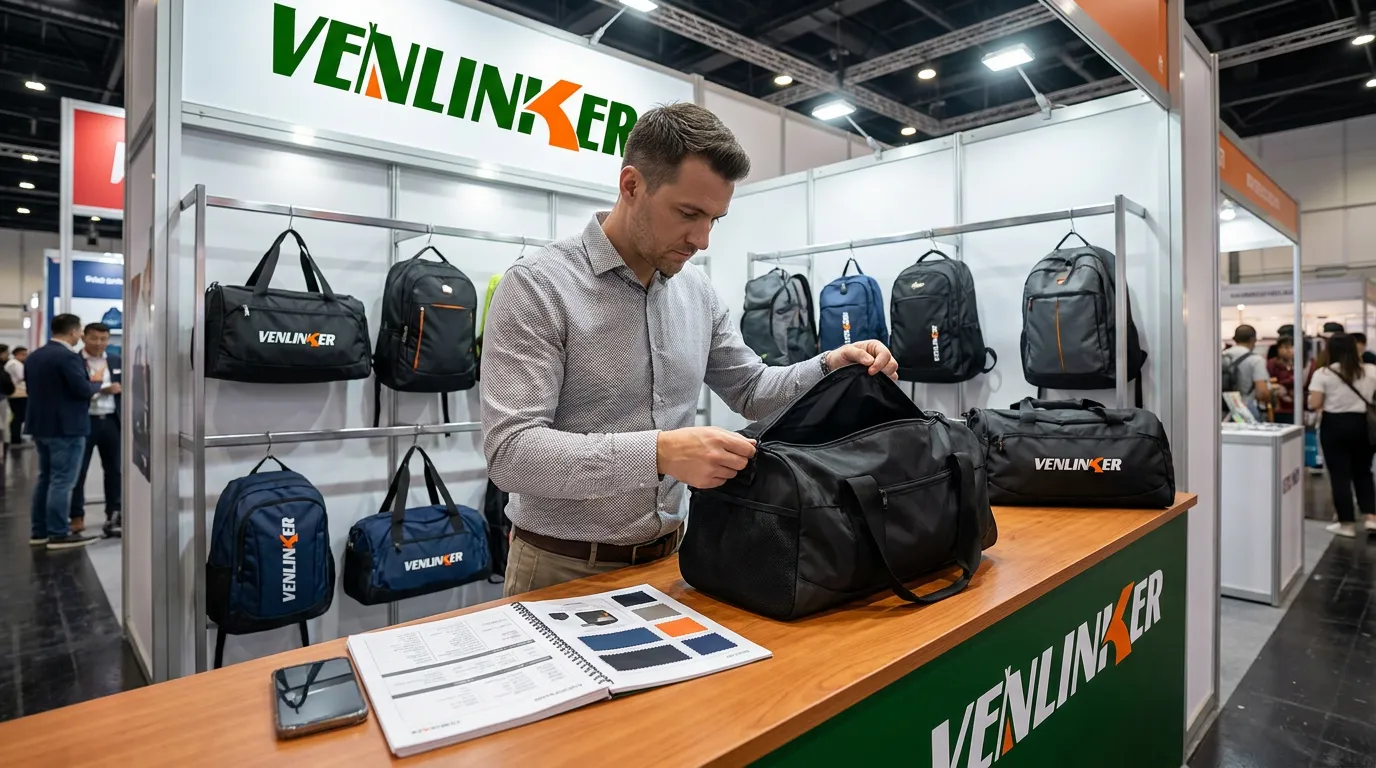
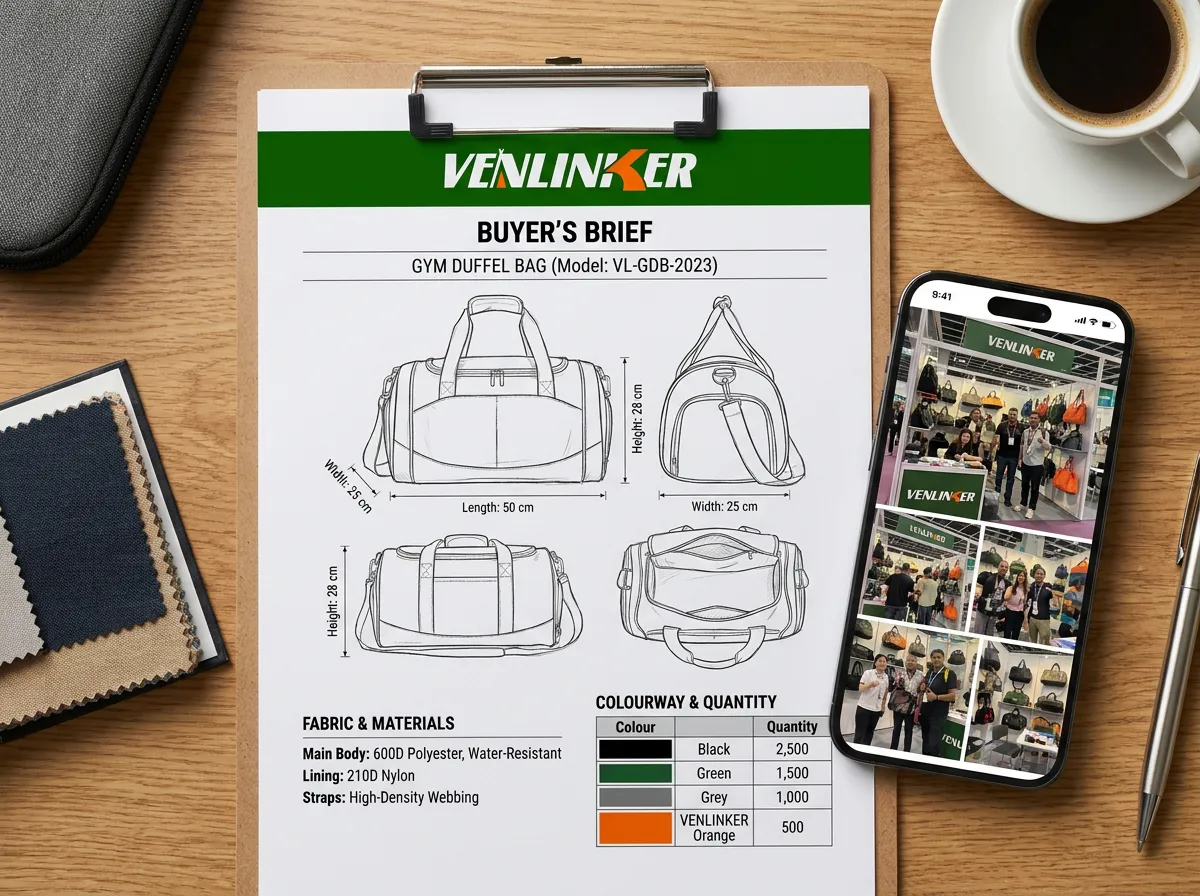
Booth staff answer a specific question better than a general one. A printed one-page brief with a photo or sketch, target dimensions in cm, fabric, colourways, logo method, quantity per colourway and target delivery month turns “what do you make?” into “can you make this, at this quantity, by this date?” A full tech pack is better still; the bag tech pack guide lists what goes in one. A reference bag from your current range lets the booth manager look at your seams and hardware instead of guessing. Leave a copy of the brief at every promising booth, with your email and a reference code the follow-up email can quote.
What to photograph at each booth
Photos are the record you will rely on when forty booths blur together. For each booth worth following up, take:
The booth fascia or sign with the company name, then the business card held against it.
The sample you are interested in, front and back, with its model number or hang tag in frame.
The inside: seam finishing, lining, pocket construction and the base.
The zip puller, buckle and webbing close up.
Any fabric swatch card the booth shows, with the denier and backing written on it.
Ask before photographing; some exhibitors restrict photos of new designs. Type the answers to the booth questions into the same phone straight after each conversation.
A three-day plan
Day one: walk the whole bags and sports area once, marking booths on the floor plan by category with a first score. Day two: return to the best booths, run the full checklist below and collect swatch cards. Day three: go back to the top few for a second conversation and ask each for a visit to the production address. If you have booked a factory visit before or after Phase 3, confirm the time and pickup that day too.
Canton Fair Bag Suppliers: Booth Checklist for Sports and Gym Bags
The checklist below is built for gym, studio and sports bags. Ask every booth the same questions in the same order and record the answers in the same format, so the notes can be read side by side at home.
Topic
What to ask at the booth
A useful answer looks like
Follow up after the fair
MOQ per colourway
“What is your minimum per style, and per colourway within that style?”
A number per style and per colourway, with a physical reason: one fabric roll, one cutting lay, one dye lot
Confirm in writing, and ask how a set of three items counts against the MOQ
Sampling time
“How many working days for a sample of my brief, and how many revisions are included?”
A figure in working days, a stated number of free revisions, and whether the sample is made on site
Ask for in-process photos of your sample being cut and sewn
Fabric sourcing
“Which fabrics do you hold in stock for this bag, and where do custom colours come from?”
Deniers, backings and stock colours named; lab-dip time for a custom colour; extra time for fabric outside the supplier network
Ask for a swatch card with denier, GSM and backing on each swatch
Logo methods
“Which logo methods do you run in-house, and which do you send out?”
Methods named (embroidery, screen print, heat transfer, woven label, PU patch) with in-house versus outsourced stated
Send artwork and ask for a logo strike-off on your fabric
Wet compartments and welding
“Do you weld TPU or PVC in-house for wet pockets and dry bags?”
Yes or no, plus which products the welding line runs
Ask to see a welded seam and how it is leak-tested
QC steps
“Who inspects the bags, at what stages, and who signs the report?”
Incoming material, inline and final inspection named, with a signatory and a sampling plan
Ask for a blank inspection report and whether a buyer-commissioned SGS, BV or TUV inspection can be held on site
Payment terms
“What deposit and balance terms do you use for a first order?”
A deposit percentage and a clear trigger for the balance (before shipment, against documents)
Get the terms in the pro forma invoice, not only in a chat message
Lead-time tiers
“What is the bulk lead time at 300, 1,000 and 5,000 pcs after sample approval?”
Three different figures that rise with quantity
Compare with the other shortlisted suppliers’ tiers; answers that never change with quantity deserve a second question
Packaging
“What packing is standard, and what does FBA-ready or retail packaging add?”
Standard polybag and carton described; options for printed bags, labels and FBA prep listed
Check carton size and weight limits for your channel
The MOQ answer is where most booth conversations go vague. A supplier who quotes a low number without a reason may be pooling orders or planning to buy stock fabric in a colour close to yours; the custom bag MOQ guide explains why the minimum sits where it does on a sewing line. The logo question matters because an outsourced logo method adds a hand-off to the schedule. The custom logo and branding page shows which methods suit which fabrics.
When you get home, the answers slot into the fields of an RFQ checklist, which is the fastest way to send each shortlisted supplier an identical request.
How to Tell a Bag Factory From a Trading Company at a Canton Fair Booth
Many booths at the fair are run by trading companies, and that is not automatically a problem. A good trader consolidates several product categories into one shipment, handles follow-up and may accept a mixed order a single factory would turn down. A buyer who needs bags, bottles and towels in one container may be better served by a trader than by three factories. You do need to know which model you are dealing with, because it decides who controls the line, the lead time and the inspection.
A booth conversation cannot settle the question, but it gives signals you can check on the spot.
Signal at the booth
Leans towards a factory
Leans towards a trading company
How to confirm later
Product range on display
One or two related categories, such as sports bags and travel bags
Many unrelated categories: bags, umbrellas, kitchenware, stationery
Ask which products are made at their own address
Construction answers
Staff explain seam types, stitch density, welding and fabric backings without calling anyone
Answers are general, or staff need to check with “our factory”
Send a technical question by email and see who answers
Business card and address
Address in an industrial district, with a factory name
Office tower address, or no production address given
Ask for the business licence and compare the scope and address
Sample room
“Samples are made in our sample room” with a lead time in working days
Samples “arranged” with an open-ended time
Ask for in-process photos of your sample
MOQ reasoning
MOQ tied to fabric rolls, cutting and line set-up
MOQ that moves easily, or is very low for a custom spec
Ask for the physical reason in writing
Visit offer
Offers a visit to the production floor on a stated day
Offers an office meeting or a showroom visit
Book the visit and walk the lines
Lead time by quantity
Figures change with quantity and line allocation
One figure for every quantity
Request lead time at three quantities in one email
No single signal settles it. Some factories keep capable sales teams in city offices, and some traders employ technicians who know construction well. Read several signals together, then confirm with documents and a visit. The factory vs trading company guide sets out ten verification checks a buyer can run by email, live video and on site, with what a direct factory should be able to show for each. Run them after the fair; the booth is too short a conversation for all ten.
When a trading company is the right booth
A trader earns its margin when the order spans categories one factory does not make, when the buyer has no time to manage production follow-up, or when the trader’s own QC team inspects at the partner factory. Ask a trader the same questions you ask a factory, plus one more: “Which factory will make my bags, and can I visit it?” A trader who names the factory and arranges the visit is being open about the model. One who will not name it leaves you with no view of the line.
What a Canton Fair Booth Price Tells You About Bag Costs
Almost every buyer asks for a price at the booth, and almost every booth gives one. A booth quote is usually an FOB estimate for the showroom sample as displayed: the fabric, lining, hardware, colour and packing on the bag in front of you, at a quantity the supplier assumes, with no logo or a basic one. Use it to place the supplier’s price level against other booths. Your own bag will price differently.
What a booth price tells you
Relative price level. Two booths quoting the same showroom duffel give a sense of where each sits against the other.
The Incoterm the supplier works in. Most booth figures assume FOB at a Chinese port. The packing and shipping terms guide explains FOB, CIF and DDP for bags.
Whether the supplier talks in specifics. A booth that states the fabric, backing and quantity behind its figure is easier to work with than one that states a number and nothing else.
What a booth price does not tell you
The price of your specification. Change 600D to 900D, add a welded TPU wet pocket, swap a standard zip for a heavier gauge, or move from a woven label to embroidery, and the unit cost moves. The cost factors guide shows how fabric, hardware, labour, logo and packaging make up a unit price, with fabric typically 35–50% of it.
The price at your quantity. A figure assumed at a larger quantity than you will order understates your cost; one assumed at a smaller quantity overstates it.
Custom colours and trims. Stock colours avoid a lab dip; a brand colour, custom-moulded puller or printed webbing adds cost and time. The custom trims and hardware page lists the common upgrades.
Packaging, labelling and prep. Retail packaging, barcode labels and FBA prep are separate lines; see custom packaging and FBA prep.
Landed cost. Freight, import duty and local charges sit on top of FOB. US importers in particular face several duty layers on bags from China; the 2026 guide to tariffs on bags from China sets them out.
Treat booth prices as a way to rank suppliers for follow-up, then get a written quote on your own spec before comparing anything.
How to Turn a Canton Fair Booth Contact Into a Bag Sample
A booth conversation becomes a supplier relationship when a sample of your bag, built to your spec, lands on your desk. Buyers often skip the two steps in between.
Send the brief within a few days
Email every shortlisted booth within a few days of the fair. Quote the reference code from the brief you left, attach the booth photos so the contact can place the conversation, and attach the full brief or tech pack. Without a tech pack, the one-page brief described above is enough to start a sample.
Get the sample spec in writing before you pay
Before paying any sample fee, ask the supplier to confirm in writing:
Fabric: denier, backing and colour (stock colour code or lab-dip reference)
Dimensions in cm, with tolerance
Hardware: zip gauge, buckles, webbing width
Logo method, size and position
Sample lead time in working days, and the number of free revisions
The sample fee, whether it is refunded against a production order, and who pays the courier
A written spec protects both sides. When the sample arrives, you check it against the document and list any difference as a revision point. The approved sample then becomes the golden sample that bulk production is inspected against.
At Venlinker, a production-grade sample takes 5–7 working days with one free revision, and the sample fee is refunded on the production order. The sample development page lists what the sample room needs from a buyer, and a first sample can be requested through the free sample page. Buyers who met several suppliers at the fair often ask two or three for a sample of the same brief and compare them on one table to see who listened at the booth.
Guangzhou Bag Factory Visit: What to Check on a Bag Factory Floor
Half a day on the floor of a shortlisted supplier answers questions a booth cannot: who cuts, sews, welds and inspects your bag, and on which line. Plan the visit for a working day, send an agenda ahead, and ask to walk the full route from fabric store to packing.
Roll racks labelled by supplier, denier and dye lot; an incoming inspection bench with a GSM scale
“How do you check a roll before cutting, and what happens if it fails?”
Cutting
Cutting tables, dies or laser cutting, lay length, bundles tagged by size and colour
“How do you keep one dye lot per order, and how are cut panels tracked to a line?”
Sewing lines
Number of lines running, the bag types on each, operators per line, needle and thread types
“Which line would run my bag, and what is it making today?”
HF welding
High-frequency welding machines, TPU or PVC panels, a leak-test station
“Which products run on the welding line, and how do you test a welded seam?”
Logo and print
Embroidery machines, screen-print tables or heat-press stations on site
“Which logo methods run here, and which go out to a subcontractor?”
QC stations
Inline check points on the lines, a final inspection table, inspection reports on file
“Who signs the final report, and can I see a completed one with the client name removed?”
Packing
Carton marking, polybags, labelling, FBA prep, carton weights recorded
“What carton size and weight do you use for this bag, and who checks the packing list?”
Count the lines yourself and compare the number with the monthly output the supplier quoted at the booth. Look for your bag type, or one like it, in production. Open a fabric roll and read the label. If the floor you are shown makes something different from what the booth displayed, ask why.
Questions to ask on a factory visit
Which parts of my bag are made on this floor, and which come from outside?
Who in the sample room will make my sample?
Where would my order sit in the November and December schedule, and how do you plan around Chinese New Year?
Can I see the golden-sample record for a current order, with the client name hidden?
The manufacturing capabilities page lists what a sports-bag floor should hold, and the quality control section describes the inspection stages worth asking to see. A buyer who cannot fit in a visit can ask for a live video tour covering the same route, and then ask the same questions on camera.
Planning a half-day around Phase 3
Phase 3 opens on Saturday 31 October, and Sunday 1 November sits inside it. The cleanest windows for a half-day factory visit are Wednesday 28 to Friday 30 October, before the phase opens, and Thursday 5 to Saturday 7 November, after it closes. A buyer who wants to see the bag halls first and then check the best booths’ floors should book the later window, with a provisional slot agreed before the fair. Confirm the time and the transfer in writing a few days ahead.
After the Canton Fair: Comparing Bag Quotes and What to Ask a Supplier
The quotes that come back after a fair rarely line up. One supplier prices 600D with a PU backing, another 900D; one includes an embroidered logo, another a woven label; one quotes 500 pcs, another 1,000. Set side by side as they arrive, those unit prices describe different bags.
Compare quotes like for like
Send one spec to everyone. Put the chosen fabric, hardware, logo method and packaging into one RFQ and send the same document to every shortlisted supplier. The RFQ checklist lists the fields.
Ask for the same quantity tiers. Request prices at the same two or three quantities from each, so price breaks can be compared.
Fix the Incoterm. Ask everyone for FOB at a named port, then add freight and duty yourself on the same basis.
Ask for an itemised split. Fabric, hardware, labour, logo and packaging as separate lines show where two quotes differ. The cost factors guide gives the typical share of each.
Line up the terms that are not price. Sample time, revisions, sample fee refund, bulk lead time at each tier, payment terms and inspection stages belong in the same comparison sheet.
Weigh the samples. When the samples arrive, weigh them, measure them and check them against the written spec before the price column decides anything.
Timing the order around Chinese New Year 2027
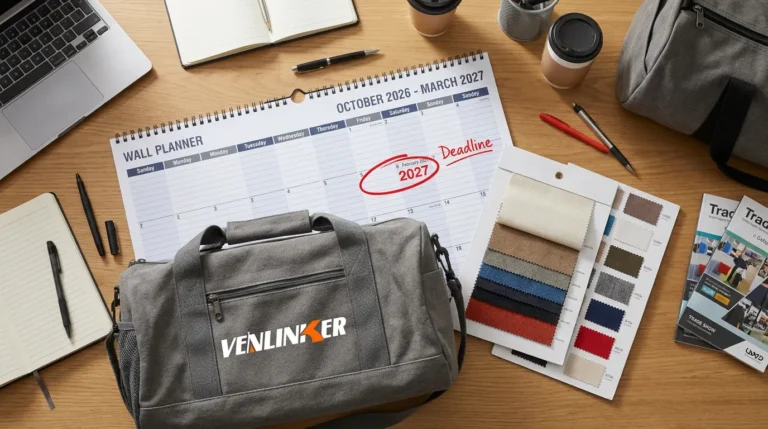
A November sample round, with one revision, puts sample approval into late November or early December for most buyers. Bulk production at Venlinker runs 25–35 days for 300–1,000 pcs, 30–40 days for 1,000–5,000 pcs and 35–50 days for 5,000–20,000 pcs after sample approval, and fabric outside the supplier network adds 7–14 days. With Chinese New Year on 6 February 2027 and factories slowing in the weeks before it, a buyer who wants goods shipped before the holiday has little slack. Build the calendar from the warehouse date backward.
What to ask a supplier before you commit
Is the unit price for my spec, at my quantity, on the Incoterm I asked for?
Will the bulk fabric come from the same supplier and source as the swatch on my sample?
What is the bulk lead time from sample approval, and what triggers the balance payment?
Who signs the final inspection report, and can I commission SGS, BV or TUV on site at my own cost?
How will you show me my bags before they leave the factory if I cannot visit?
What happens if bulk fabric or colour does not match the golden sample?
A supplier who answers these in writing, with figures, is one you can plan around. The OEM/ODM workflow sets out how a custom bag moves from brief to golden sample to bulk, and the custom materials and colours page covers lab dips and stock colours. When the comparison sheet is ready, request a quote on the same spec from every supplier still on the list.
Visiting Venlinker’s Guangzhou Bag Factory During Canton Fair 2026
Venlinker is Your Trusted Custom Sports Bag Manufacturer in China, and its factory in Huadu District, Guangzhou, is a half-day trip for buyers who are in the city for Phase 3 of the Canton Fair. Venlinker does not exhibit at the fair. A visit is arranged separately, by appointment, on any day from Monday to Saturday.
Getting there and booking a half-day
The factory is about 40 minutes from Guangzhou Baiyun International Airport (CAN), with pickup available, and about 20 minutes from Guangzhou North railway station. Buyers flying in or out through Baiyun can add the visit to an arrival or departure day. Others book a slot in the windows before or after Phase 3 and agree the transfer from their hotel when they book. To arrange a date, contact the Venlinker team with your preferred day, the number of visitors and the bag types you want to see on the line. Buyers who cannot travel this autumn can book a live video tour that walks the same route.
What you see on the floor
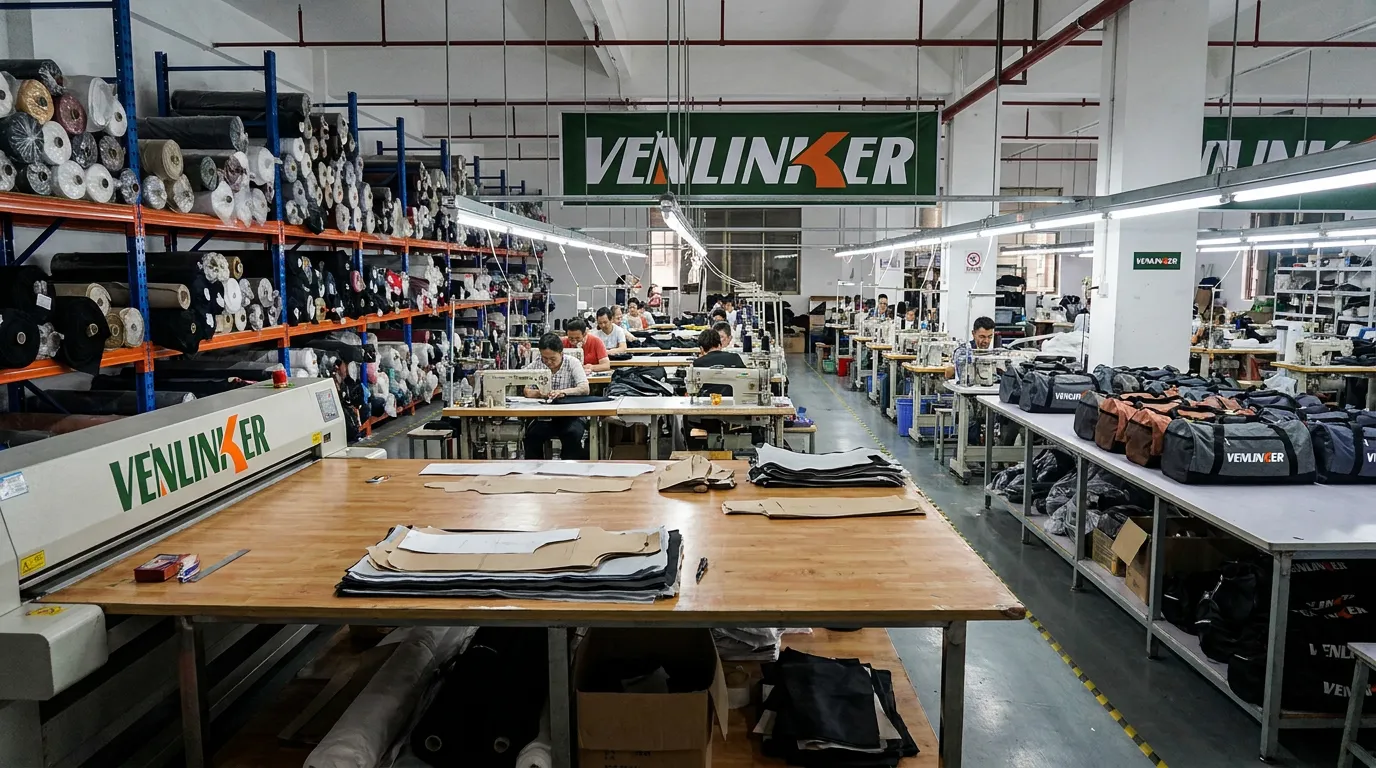
The 5,000 m² factory runs 10+ production lines with 500+ staff and makes 50,000+ bags a month, only in women’s sports, fitness, studio, swim and active-lifestyle categories. A half-day route covers fabric racks stocked from 200+ verified fabric suppliers, the cutting room, the sewing lines, the in-house high-frequency TPU and PVC welding line used for wet pockets and dry bags, the sample room where 10+ in-house designers develop 100+ new models a month, and the QC stations. Every order passes 100% pre-shipment inspection by the factory’s own team, and third-party inspections by SGS, BV or TUV are welcome on any order, commissioned and paid by the buyer.
Terms a visitor can confirm on the day
MOQ from 300 pcs per style per colourway
Samples in 5–7 working days with one free revision, sample fee refunded on the production order
Bulk lead time from 25–35 days (300–1,000 pcs) to 35–50 days (5,000–20,000 pcs); repeat orders 20–30 days
30% deposit, 70% before goods leave the factory; FOB by default, CIF or DDP on request
Free white-background product photography on production orders
Phase 3 of the 140th Canton Fair runs from Saturday 31 October to Wednesday 4 November 2026 at the China Import and Export Fair Complex in Pazhou, Guangzhou. Phase 1 runs 15–19 October and Phase 2 runs 23–27 October. These dates were checked on 29 September 2026; confirm them on the official fair website before booking.
Which Canton Fair phase has bags?
Phase 3. Its published theme, “better life”, includes cases and bags, home textiles, and sports, travel and recreation products. That puts bag specialists and sports-goods exhibitors in the same week. Exhibitor lists change each session, so check the official fair website for exhibitors in your category before fixing dates.
Do I need a visa for the Canton Fair 2026?
It depends on your passport. As of late September 2026, nationals of France, Germany, Italy, Spain, the Netherlands, Australia, Canada, the UK and other listed countries can enter visa-free for up to 30 days for business, with the scheme in effect for most of them until 31 December 2026. The United States is not on that list. A 240-hour transit option covers 55 nationalities holding an onward ticket to a third country, and Guangzhou is an eligible port. Check the rule for your own nationality with a Chinese embassy or consulate before booking.
How do I get a Canton Fair badge as a new buyer?
Pre-register on the official fair website; registration is open year-round. New overseas buyers can then collect a free badge at Guangzhou Baiyun International Airport, Guangzhou South Railway Station, Pazhou Ferry Terminal, designated hotels or the fair’s Hong Kong representative office. Check the official site for the documents the badge desk asks for.
Does Venlinker exhibit at the Canton Fair?
No. Venlinker is a bag factory in Huadu District, Guangzhou, and buyers in town for the fair can visit it separately, Monday to Saturday by appointment. The factory is about 40 minutes from Baiyun airport with pickup available, and about 20 minutes from Guangzhou North railway station. Buyers who cannot travel can book a live video tour through the contact page.
Are Canton Fair booth prices reliable?
As a guide to a supplier’s price level, yes; as a price for your bag, no. A booth price is usually an FOB estimate on the showroom sample’s spec at an assumed quantity, and your fabric, hardware, logo, packaging and quantity will all move it. Get a written, itemised quote on your own spec before comparing suppliers.
Summary: Canton Fair 2026 Planning for Bag Buyers
The autumn Canton Fair 2026 gives bag buyers one concentrated week in Phase 3, from 31 October to 4 November, with working days on either side for factory visits. The trip pays back when the buyer arrives with paperwork sorted, a brief in hand and the same questions for every booth, then follows up with a written spec.
Plan around Phase 3 and confirm the paperwork early. Cases and bags, and sports, travel and recreation products, are all in Phase 3. Pre-register for a badge, and check the visa rule for your own passport: the 30-day visa-free list, as of late September 2026, does not include the United States.
Treat the booth as the start of the conversation. Ask every booth the same checklist, photograph what you discuss, read booth prices as FOB estimates on a showroom spec, and use several signals, then documents and a visit, to tell a factory from a trader.
Turn contacts into samples on your spec, then compare like for like. Send one written brief to every shortlisted supplier, get the sample spec and fee in writing, and compare quotes at the same quantities and Incoterm, with the Chinese New Year 2027 calendar in view.
Buyers who want to add a Guangzhou factory floor to their trip can contact Venlinker to book a half-day visit or a live video tour, or send a brief for a quote before they fly so the numbers are ready to discuss on the day.
In Guangzhou for Canton Fair Phase 3 and Want to See a Bag Factory Floor?
Venlinker makes custom gym, studio, swim and travel bags for activewear brands, distributors and private-label programmes in its own 5,000 m² factory in Huadu District, 40 minutes from Baiyun airport. Book a half-day visit Monday–Saturday or a live video tour: MOQ from 300 pcs per style, samples in 5–7 working days, in-house TPU and PVC welding and 100% pre-shipment inspection.