* Simply fill out the form below as best you can. And don’t sweat the details. * Your information will be kept strictly confidential. * Share your needs with us, We’ll contact you in very short time.
Planning a Custom Bag Order?
Send your bag type, quantity and target delivery date. We will review the specification and confirm the next step.
Who this guide is for: Pilates studio owners and multi-site studio chains building a retail or merchandise range, activewear brand product managers adding a Pilates carry line, and DTC and creator-brand founders who want to sell a custom Pilates bag and need to know what reformer and mat customers carry, which formats sell, and how to order without overcommitting on MOQ.
A pilates bag is a smaller and more specific product than most buyers expect. Reformer members do not carry a mat, because the studio supplies the machine. What they carry is a pair of grip socks, a towel, a bottle, a phone, keys, a card and often a layer to put on after class. Mat Pilates customers carry all of that plus a mat that is usually thicker than a yoga mat. Those two kit lists produce two different bags, and a studio or brand that orders one bag for both ends up with a tote too big for the reformer crowd or too small for anyone carrying a mat.
The commercial pressure behind the category is real. Pilates was the most-booked workout on ClassPass for the third year running in 2025, with Pilates bookings up 66% year on year, according to ClassPass’s 2025 figures reported by SGB Media. Studios are selling more classes, and the reception shelf has become a revenue line in its own right. The bag on that shelf competes with every tote a member already owns, so it has to fit the kit exactly and look like it belongs in the studio.
This guide covers why Pilates changed what women carry to class, how reformer, mat and hybrid customers differ in what they carry, the grip-sock problem, the silhouettes that sell at studio retail, materials and finishes, branding, how to build a small range around a 300-piece minimum, how to write the tech pack, and what to ask a supplier before you request a quote.
Why Pilates Changed What Women Carry to Class
A gym bag was designed around a locker room: trainers, a full change of clothes, a wash bag and a towel, often 35–45 L. A Pilates class runs about 50 minutes, most members arrive dressed for it, and nobody changes shoes because the class is done barefoot or in grip socks. The kit shrinks to something that fits in 12–20 L, and the bag becomes a day bag that happens to go to class.
That shift explains why Pilates studios sell totes rather than duffels. Members want a bag they can carry from the studio to a café or an office without it looking like sports equipment. The studio wants a bag its members will carry around the neighbourhood with the logo showing. Both requirements point to a structured tote in canvas or a soft technical fabric, with a zip top, a sock pocket and a bottle sleeve.
What the ClassPass data shows about format growth
The same ClassPass data splits growth by format. Reformer Pilates bookings rose 71% year on year, mat Pilates rose 114%, and high-intensity Pilates rose 27%, against 66% for Pilates overall. ClassPass also recorded more than 15 million Pilates reservations in 2025 and more than 27 million searches for “Pilates” in the app. The growth figures describe the rate of change and say nothing about the size of each format, so a buyer should not read the mat figure as proof that mat classes now outnumber reformer classes. What the split does show is that mat classes, with their extra carry requirement, are growing quickly alongside reformer, which is why a studio range now needs to answer both.
Pilates booking growth on ClassPass by format, 2025 (year on year)
A higher bar means faster growth in bookings; the chart does not show how many bookings each format has.
Source: ClassPass 2025 booking data, as reported by SGB Media. The dark bar is Pilates overall; the green bars are individual formats.
Why the numbers matter to a bag buyer
A studio that sells more classes has more members walking past the retail shelf each week, and a member who books three classes a week sees that shelf roughly 150 times a year. The same data showed wellness reservations up 37%, which is part of why the studio bag now sits in the same retail conversation as candles, tea and apparel. For the wider context on which sports are pulling bag demand in 2026, the sports bag trends overview puts Pilates alongside the other growth categories.
Reformer vs Mat vs Hybrid Pilates: What Each Pilates Bag Needs to Carry
The kit list decides the bag. A reformer member’s kit weighs well under 2 kg and fits in a small tote. A mat member adds a mat of roughly 0.9–1.4 kg that rolls to 15–19 cm across at 8–10 mm thick. A hybrid customer, who does reformer on weekdays and a mat class at the weekend, wants one bag that handles both without looking empty on reformer days.
Customer
What goes in the bag
Bag formats that fit
Typical capacity
Relative cost
Reformer
Grip socks, small towel, 500–750 ml bottle, phone, keys, cards, a light layer, sometimes a laptop
Structured tote with zip top, compact duffel, sling for minimal carriers
12–20 L tote; 20–25 L compact duffel; 2–5 L sling
Low–mid
Mat
All of the reformer kit plus an 8–10 mm mat, sometimes a small ball or band
Mat carrier with end pocket, tote with external mat straps, duffel with mat straps
Carrier plus 1–3 L pocket; 18–28 L tote; 25–35 L duffel
Mid
Hybrid
Reformer kit most days, a mat one or two days a week, a change of clothes after work
Tote with removable mat straps, duffel with a strap set under the base
20–28 L tote; 25–35 L duffel
Mid–high
Instructor
Several pairs of socks, spare towels, bands, a laptop and a full change of clothes
Duffel or large tote with pocket map and a wet section
30–40 L
Mid–high
Capacities are industry-typical ranges for the formats that sell at studio retail, not measurements of a named product.
Reformer: the kit is small, so the bag is a tote
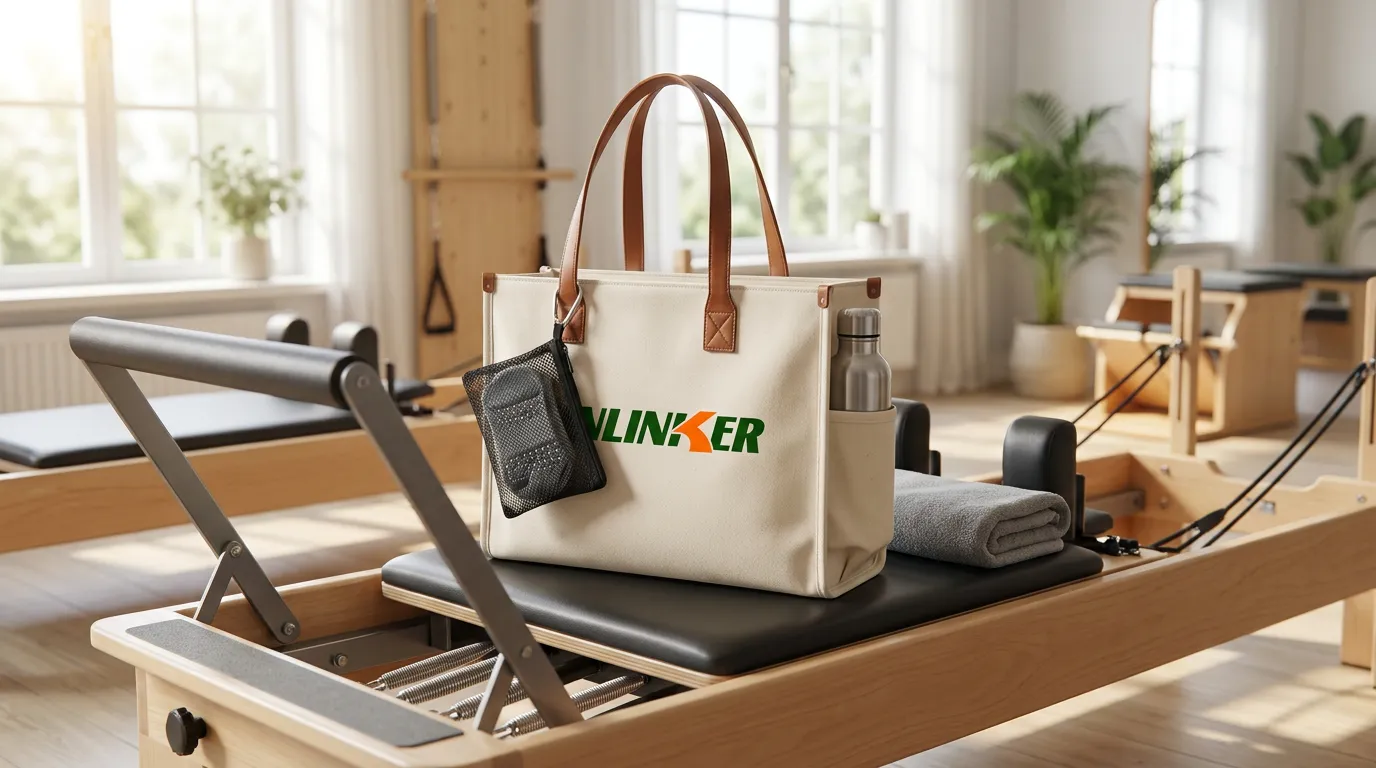
Reformer customers are the easiest to design for and the hardest to impress, because the bag is carried all day and judged as an accessory. A Pilates studio tote at 12–20 L, with a 1.5–2 mm base board, a 12 × 15 cm grip-sock pocket and an internal sleeve for a 750 ml bottle, covers the whole kit with room for a light jumper. A zip top matters more here than on a beach tote, because the bag is set down on a studio floor or a café chair with a phone and cards inside. A compact 20–25 L duffel suits the member who comes straight from work with a change of clothes.
Mat: the mat decides the carry
Mat Pilates mats tend to be thicker than yoga mats, and thickness is what sets the rolled diameter. The geometry, including rolled diameter, internal sleeve length and sling strap reach, is covered in the yoga mat bag design guide, and the same arithmetic applies to a Pilates mat. For a range buyer, the practical choice is between a dedicated mat carrier patterned to an 18–22 cm internal diameter and a tote with two external 25 mm webbing straps that hold a 10–19 cm roll. The strapped tote sells better in most studios because it replaces a handbag; the carrier sells to customers who keep a mat in the car.
Hybrid: one bag, two loads
The hybrid customer is where most studio totes go wrong. A tote with fixed mat straps looks unfinished on the four days a week there is no mat in them. Removable straps on D-rings, or straps that tuck into a base pocket, solve it for a modest cost step. The same logic works on a yoga duffel with straps under the base, which suits the hybrid customer who also carries a change of clothes.
The Grip Sock Pouch Problem in Pilates Bags
Grip socks are the one item in a Pilates kit that every reformer member carries and nobody wants loose in the bag. After a 50-minute class they are damp with sweat, they have been on a studio floor, and they go into a bag next to a phone, a clean layer and sometimes a laptop. A grip sock pouch solves a small, specific hygiene problem, and it is the piece that turns a plain tote into a Pilates bag.
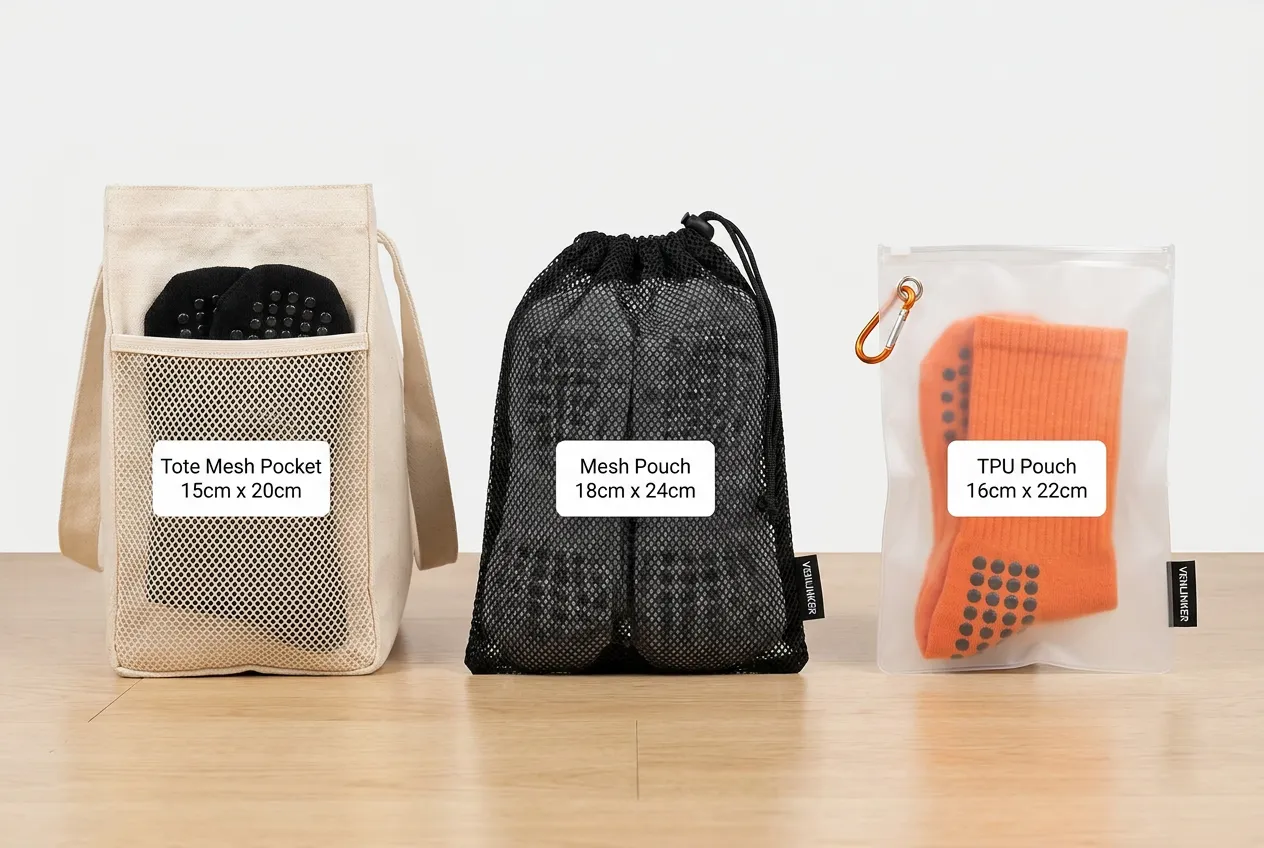
Three ways to hold the socks
An external sock pocket on the tote. A 12 × 15 cm mesh-lined pocket on the outside face or end panel keeps socks away from the main compartment and lets them air. It adds little to unit cost and suits a reformer tote where the socks come out every class.
A mesh sock pouch. A separate 15–20 × 10–12 cm drawstring or zip pouch in 100–200 GSM polyester mesh lets socks dry and can go through a wash with them. Mesh breathes, so it limits odour, but it also lets damp reach whatever sits next to it.
A welded wet pouch. A sealed pouch in 0.10–0.15 mm PEVA or 0.15–0.3 mm TPU, high-frequency welded with no needle holes, keeps moisture and floor dirt contained completely. It suits high-intensity and heated classes where socks come out wet, and it doubles as a swimsuit pouch outside the studio.
Which one a studio should specify
The choice turns on how wet the socks get and whether the pouch is sold separately. For a standard reformer class, an external mesh pocket on the tote plus a mesh pouch as an add-on covers most members. For heated or high-intensity formats, a welded pouch is worth the step up, because a mesh pouch lets a wet towel and wet socks transfer moisture into the tote lining. Wet pouches at 2–4 L are built in both films, and a 20–25 mm swivel clip lets the pouch hang from the tote’s D-ring instead of sitting inside.
The wet-dry gym bag guide explains why a sewn wet pocket leaks at the needle holes and a welded cell does not, which is the same reason a stitched sock pouch in coated fabric still lets damp through at the seams.
A sock pouch is also the easiest add-on to sell. It sits at the lowest price tier on the shelf, it is consumable in the sense that members buy a second one for a gym bag or a travel bag, and it carries a logo into every class. A studio that sells a tote and a sock pouch in the same colour has the beginning of a range.
Pilates Bag Silhouettes That Sell in Studios
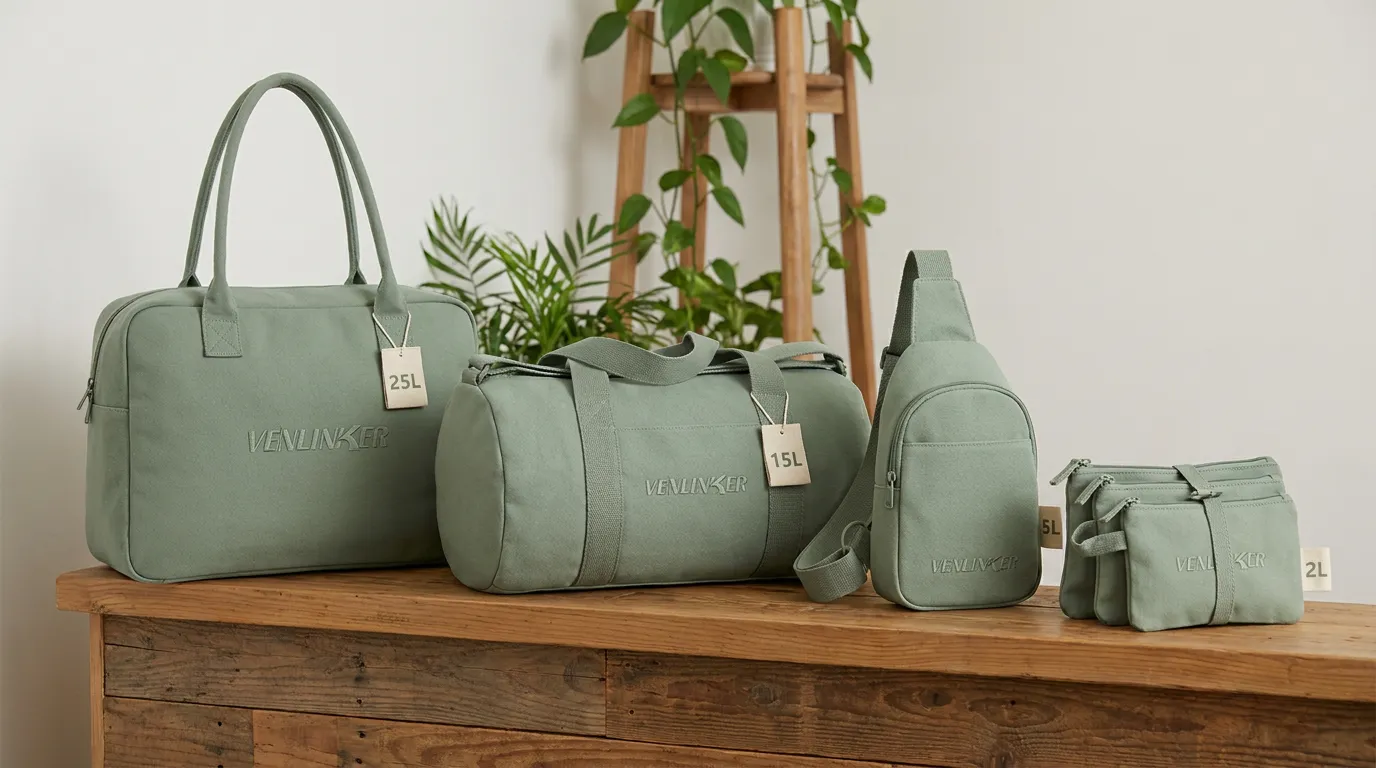
Four silhouettes cover almost every Pilates bag that sells at studio retail. Each one serves a different member, and a range that picks two or three of them covers the reception shelf without overlap.
Tote with a zip top
The structured tote is the core Pilates bag. A 12–20 L body in 14–16 oz canvas or 600D RPET, a 1.5–2 mm base board so it stands on a shelf, 22–26 cm handle drop so it goes over a shoulder with a coat on, a #5 zip top, and an internal pocket map with a bottle sleeve and a zip pocket. Studios selling a larger, unstructured version for members who shop after class use wellness retail totes at 15–25 L, and a yoga tote bag with external mat straps covers the mat customer.
Small duffel
A 20–25 L duffel with a zip top, a padded or webbing shoulder strap and a sock or shoe pocket at one end suits members who come from work with clothes to change. It reads as sportier than a tote, which suits studios with a high-intensity or strength-Pilates timetable. The mini gym bag pattern family covers the 15–25 L range and is usually the quickest route to a compact Pilates duffel.
Sling or crossbody
A 2–5 L sling carries a phone, keys, cards and lip balm, and nothing else. It is the piece for members who walk or cycle to class in their kit and leave a bottle at the studio. It also sells as a gift and as a second purchase. The active crossbody bag range covers 1.5–5 L shapes that suit a studio logo. A mat-only customer who wants to carry just a mat can use a mat sling, which weighs 50–100 g.
Pouch sets
Two or three zip pouches in one fabric, a sock pouch, a small pouch for cards and keys, and a flat pouch for a charger, give a studio a low-cost set that works as a welcome gift, a class-pack reward or a bundle with a tote. Organiser pouches at 15–25 cm cover the flat pieces, and a matched set can ship in one belly band.
Pilates Tote Bag Materials and Finishes for the Studio Look
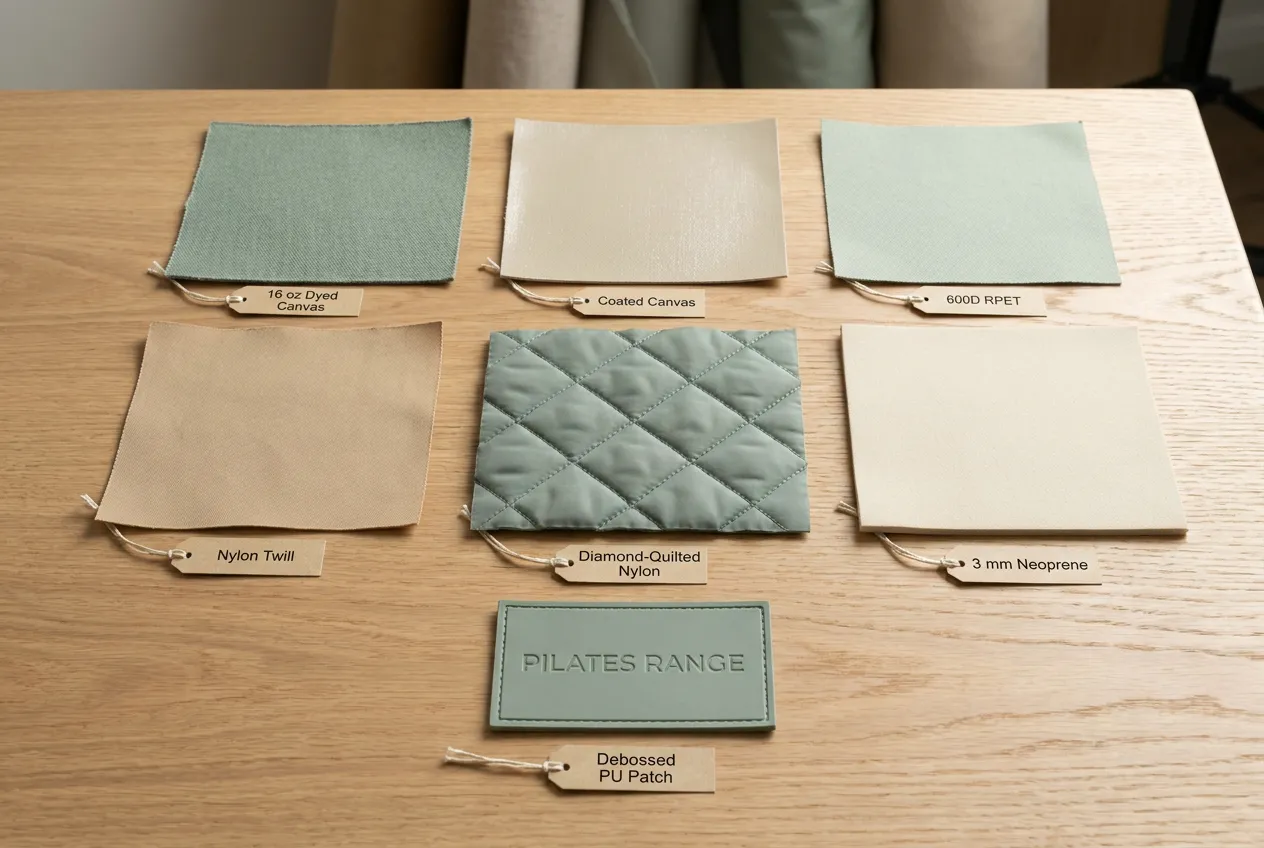
Pilates studios tend to sell a quieter look than gyms: tonal colours, soft textures, small logos. The fabric carries more of that look than any other line on the tech pack, and fabric is typically 35–50% of unit cost in this category, so the choice also sets the price tier. The table compares the materials that appear on most Pilates bag quotes.
Material
Typical spec
Hand
Wipe-clean behaviour
Relative cost
Where it fits
Cotton canvas
12–16 oz, roughly 400–540 GSM
Soft, dry, structured at 14–16 oz
Poor unless coated; spot clean or cold wash; can shrink 2–4%
Low–mid
Structured totes, retail totes, pouch sets
Coated or waxed-look canvas
12–16 oz with a PU or wax finish
Firmer, slight sheen
Fair: wipes clean on the surface
Mid
Totes that sit on studio floors and café chairs
600D polyester or RPET
Roughly 250–320 GSM with PU backing
Dry, light, technical
Good: wipes clean, dries fast
Lowest–low
Chain-wide totes in one colour, duffels, bases
Nylon twill or oxford
210–420D, roughly 120–220 GSM
Smooth, soft sheen, drapes
Good: wipes clean, sheds water
Low–mid
Soft totes, slings, compact duffels
Quilted nylon
20–70D shell over thin wadding, stitched in channels or diamonds
Soft, padded, light
Good on the shell; stitching holds dirt
Mid–high
Statement totes, slings, laptop totes
Neoprene
2–4 mm, roughly 400–700 GSM
Thick, soft, stretchy
Fair: rinses, slow to dry, can hold odour
Mid–high
Sleeve-style totes, bottle sleeves, pouches
PU trim
Roughly 350–600 GSM, smooth or pebble
Leather-effect
Good: wipe clean
Mid
Base panels, handles, debossed logo patches
Canvas for the boutique shelf
Canvas is the default for studios that want the bag to sit next to apparel and candles. At 14–16 oz it holds a structured shape on its own with a base board, takes tonal embroidery well, and piece-dyes to a Pantone reference. The weakness is floor contact: uncoated canvas marks at the base. A PU-coated base panel or a canvas with a light coating solves it at one cost step. The bag material guide compares the canvas weights and coatings in more detail.
Nylon and quilted finishes for the technical look
Nylon twill has a soft sheen that reads as activewear rather than a shopping bag, and it drapes where canvas stands. Quilted nylon over thin wadding is the finish most associated with the current Pilates look: soft, padded, and light enough for a sling. The trade-off is construction time, since channel or diamond quilting adds a sewing stage and some fabric consumption. Nylon typically sits one cost tier above polyester of a similar weight, and most studio buyers choose between the two by handling swatches side by side.
Colour and tone
Studio ranges usually run one or two colourways across every piece, often muted tones matched to the studio interior. Shell, webbing, zip tape and thread are four substrates that each need to hit the same reference, which is done by lab dip before bulk. Stock colours skip the lab dip. The fabrics and stock colours held in each are listed on the custom materials and colours page, and zip pullers, D-rings and feet in matched or metal finishes are on the trims and hardware page.
Pilates studio merchandise sells on restraint. A large printed logo across the panel of a tote reads as a giveaway; a 6–8 cm tonal mark reads as something a member chose to buy. Three methods cover most of what studios order.
Tonal embroidery
Embroidery in a thread one or two shades from the shell colour shows up in daylight and disappears at a distance, which is the look most boutique studios want. A 6–10 cm wordmark on 14–16 oz canvas or nylon twill takes the stitching cleanly. Stitch count rises with size and fill, so a line-art mark costs noticeably less than a solid block. On quilted nylon the embroidery sits better on a flat, unquilted panel or a patch than across the quilting channels.
Woven labels
A woven label stitched into a side seam, a handle anchor or the top edge gives a garment-like signal at the lowest cost of the three methods. Damask labels at roughly 1.5–2.5 × 4–7 cm hold fine lettering, and they are the natural way to brand a pouch or a sling where there is no panel large enough for embroidery.
Debossed and embossed patches
A PU or leather-effect patch at 4–6 cm, debossed with the studio mark and stitched to the front panel, adds dimension and holds up on a bag that gets set down on floors. A tonal patch in the same colour as the shell is the quietest option on this list. Screen print still has a place for event bags and large runs where cost per piece matters most.
The logo method guide compares durability, minimum size and cost tier for each method, and the artwork formats each one needs are on the custom logo and branding page. Studios should settle one method across the whole range, so a tote, a pouch and a sling share the same mark at proportional sizes.
Building a Pilates Studio Merchandise Range: Tote, Sock Pouch and Bottle Sleeve
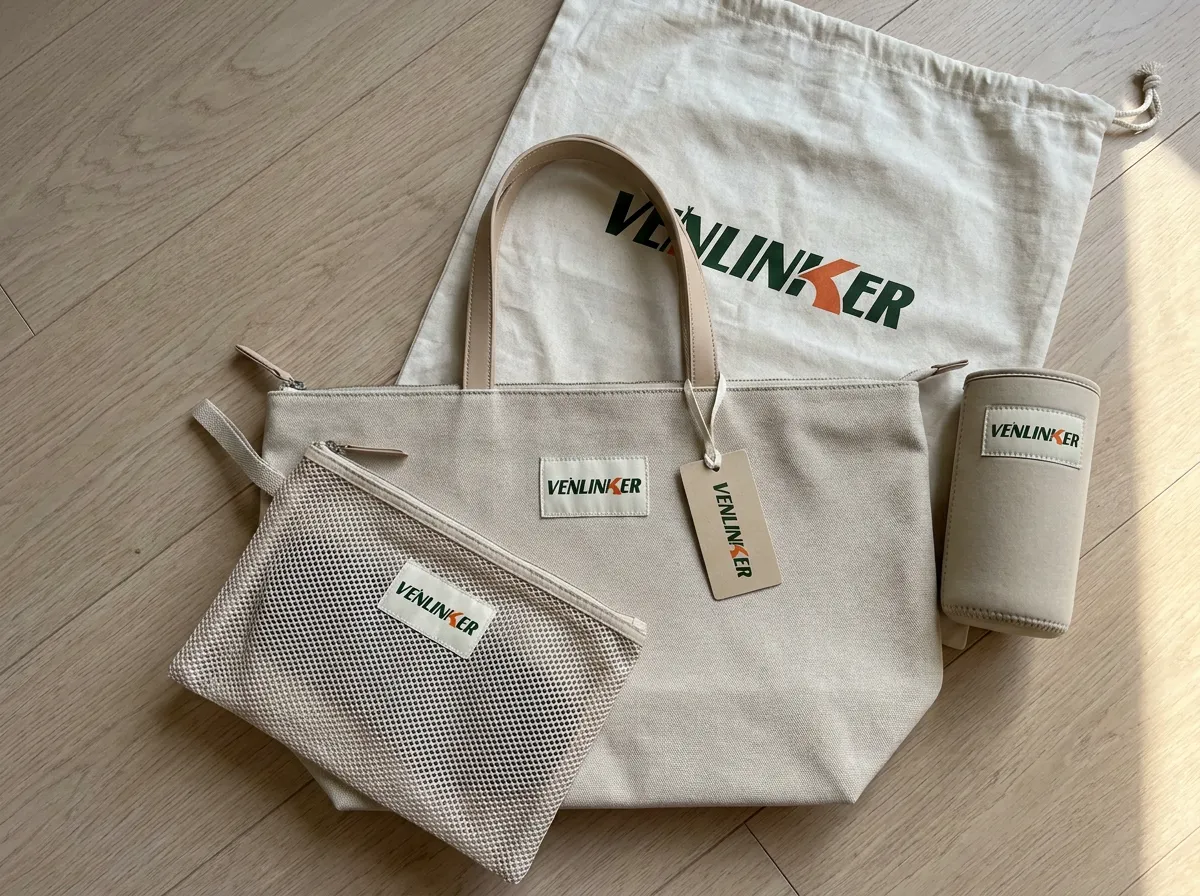
A single tote is a product. A tote, a sock pouch and a bottle sleeve in one fabric and one colour is a range, and it gives the reception shelf three price points instead of one. A three-piece set typically lifts order value by 25–40% against the same pieces sold separately.
Piece
Format
Typical spec
Role in the range
Studio tote
Structured zip-top tote
12–20 L, 14–16 oz canvas or 600D RPET, base board, external sock pocket
The anchor; the reason the member stops at the shelf
Sock pouch
Mesh drawstring or welded zip pouch
15–20 × 10–12 cm mesh, or 2–3 L welded PEVA or TPU
Lowest price point; add-on and welcome gift
Bottle sleeve
Neoprene or insulated fabric sleeve with carry strap
Sized to a 500–750 ml bottle, 3 mm neoprene
Impulse buy; second logo placement
Optional extension
Crossbody sling or mat-strap tote
2–5 L sling, or 18–28 L tote with removable straps
Added on the reorder once the colour has sold
MOQ for a single studio versus a chain
The minimum is 300 pcs per style per colourway, and that number means different things to a single studio and a chain, and it is worth doing the sum before choosing pieces.
A three-piece range in one colour is 900 pieces. For a single studio, 300 totes is a lot of stock to sell through one reception shelf, and the buyer should estimate how many months it takes at the studio’s own sales rate before committing. The usual way to reduce the commitment is to fold the bottle sleeve into the tote as an internal sleeve rather than a separate SKU, which takes the range to two styles and 600 pieces, and to run one colourway only. The sock pouch at 300 pieces also works as a welcome gift for new members, which moves stock without depending on retail sales.
A chain splits the same order across sites. Ten studios taking 300 totes is 30 per location, which most chains sell through in a season. Chains can also afford a second colourway or a second silhouette sooner. The custom bag MOQ guide sets out how styles, sizes and colourways count towards minimums.
Buyer
Sensible first order
Pieces
Why
Single studio
Tote with built-in bottle sleeve plus sock pouch, one colourway
600
Two styles; the pouch doubles as a welcome gift
Studio group, 3–5 sites
Tote, sock pouch and bottle sleeve, one colourway
900
60–100 totes per site; full three-price shelf
Chain, 10+ sites
Tote in two colourways plus sock pouch
900–1,200
30+ totes per site per colour; pouch in one colour
Activewear or creator brand
Tote and sling, one colourway each, plus sock pouch
900
Online shelf; the sling carries the second price point
Sets and packaging
Where the pieces ship as one packed gift set, the minimum is counted per set at 300 sets, which suits a boxed studio welcome kit. The yoga mat bag set and yoga studio set structures apply to Pilates without change, and a cotton dust bag or retail pouch reads better on a boutique shelf than a polybag. Hangtags, barcodes and belly bands are covered under custom packaging and retail prep.
Who orders which shape
Gym, studio and club chains usually buy for reception shelves and instructor kit in one or two brand colours with a tight logo standard. Influencer and creator brands riding the Pilates audience tend to want a smaller number of pieces in a signature colour, launched in a drop. Activewear and fitness brands add a Pilates tote to an apparel range and match it to a season’s colours. Community groups run the same playbook with other sports, and the run club merch bag guide shows how a small club builds a range under the same minimum. Buyers with a shape in mind can send it through the get a quote form for a first costing.
A Pilates tote looks simple, and that is why buyers under-specify it. The tech pack has to state the kit the bag holds, the structure, the pocket map and the finish, because each of those sets cost and each one shows on the shelf.
Worked specification: reformer studio tote
The table below is a worked example of the lines a studio would send for a structured reformer tote. Values are the buyer’s targets for this example; a different kit or price point would move them.
Tech pack line
Worked specification
Target kit
One pair of grip socks, hand towel, 750 ml bottle, phone, keys, cardholder, light jumper; no mat
Capacity and size
Target 15 L; external 38 × 14 × 30 cm (W × D × H), ±1 cm
Shell
16 oz cotton canvas, piece-dyed to studio Pantone; PU-coated canvas base panel 14 × 38 cm
Structure
2 mm PE base board, removable; fused interfacing on front and back panels; 4 metal feet optional
Closure
#5 coil zip across the top, one slider, tonal zip tape and matched puller
Handles
30 mm cotton webbing, 24 cm drop, anchored with an X-box stitch through a reinforcement patch
Sock pocket
External end-panel pocket 12 × 15 cm, mesh-lined, snap closure
Internal pockets
Elastic-bound bottle sleeve for a 750 ml bottle; 18 × 15 cm zip pocket; key clip on 15 cm tape
Lining
210D polyester lining in a tonal shade, printed with a small logo repeat optional
Logo
Tonal embroidery, 8 cm wide, centred 7 cm below the top edge; woven label in the side seam
Hardware finish
Brushed metal puller and feet; no exposed plastic hardware
Care and retail
Care label (spot clean, cold hand wash), hangtag with barcode, cotton dust bag
Quantity
300 pcs, one colourway
Lines buyers forget
Three lines account for many first-sample revisions on Pilates totes. The first is handle drop: under 22 cm the tote will not go over a shoulder with a coat on. The second is the bottle sleeve height, which should be tall enough to hold the bottle upright when the tote is half empty. The third is the base panel: an uncoated canvas base usually shows floor marks within weeks. The bag tech pack guide shows where each line sits in a full drawing set, and the RFQ checklist covers the commercial lines that go with it. Where the buyer has a reference bag rather than a drawing, the custom design and structure process works from the reference and the kit list.
Questions to Ask a Custom Pilates Bag Manufacturer
A short list of questions, answered in writing, separates a supplier that has made studio totes from one that will learn on your order.
What kit was your standard Pilates tote patterned around? Expect a list that includes grip socks and a bottle size. A vague answer means the pattern is a generic tote.
What is the finished capacity in litres and the external size, and to what tolerance? Ask for both, since a tote quoted only in centimetres can be 12 L or 20 L depending on the gusset.
How is the sock pocket built, and can it be mesh-lined or welded? A stitched pocket in coated fabric still leaks at the seams.
Is welding done in-house? Welding sent to a subcontractor adds days and a hand-off in the quality chain.
Which fabrics are in stock in my colour, and what does a lab dip add? Stock colours skip the dip and the working days it adds.
Can the tote, pouch and bottle sleeve share one fabric booking and dye lot? This is what keeps a three-piece range matched on the shelf.
How does MOQ count across a set? Ask whether a boxed set counts per set or per piece, and whether a second size counts as a new style.
What does the sample include and how many revisions? Expect 5–7 working days with one free revision and a swatch set.
What is checked at final inspection? Dimensions, handle drop, logo placement, zip function and colour against the approved sample are the minimum for a retail bag.
Can I see the construction before I commit? A free or low-cost sample of a comparable tote settles fabric and structure faster than any spec sheet.
Buyers who send the kit list, the fabric and the quantity together usually get a first drawing and a costing in one round. The get a quote form takes all three, and questions about a specific build can go to the sample room through contact.
How venlinker Builds Custom Pilates Bags for Studios and Brands
venlinker is Your Trusted Custom Pilates Bag Manufacturer in China, building Pilates totes, sock pouches, bottle sleeves, slings and matched studio sets in a 5,000 m² factory in Huadu District, Guangzhou, that has made women’s sports and studio bags since 2010. The sample room patterns each Pilates bag around the member’s kit list, starting with the socks, the bottle and the handle drop.
Sampling from the kit list
A buyer who sends the kit list, a reference image and a target price gets a sample built in 5–7 working days with one free revision, against a refundable sample fee. The 10+ in-house designers work out the base board, pocket map and handle drop from the kit, and a swatch set ships with the sample so a studio can compare canvas, coated canvas, nylon and RPET in hand. The process is described on the sample development page, and the full yoga and studio bag range shows the pattern families a Pilates tote can start from.
Fabric, colour and welded pouches
Fabric comes through a network of 200+ verified suppliers, covering 12–16 oz canvas, coated canvas, nylon twill, quilted nylon, 600D RPET, neoprene and PU trims. The material sourcing team books a range’s pieces against one dye lot where the fabrics allow, so the tote and the pouch match on the shelf. Welded sock pouches and wet pockets in PEVA or TPU are made on venlinker’s own high-frequency welding equipment, which keeps the smallest piece of a studio range on the same schedule as the tote.
MOQ, lead time and inspection
MOQ starts at 300 pcs per style per colourway. Bulk production takes 25–35 days for 300–1,000 pcs and 30–40 days for 1,000–5,000 pcs; repeats run in 20–30 days. Payment is 30% deposit and 70% before goods leave the factory, on FOB terms by default. Every order passes 100% pre-shipment inspection by venlinker’s own team, with final inspection checking dimensions, handle drop, logo placement and colour against the approved sample. SGS, BV and TUV inspectors are welcome on any order when the buyer commissions and pays for the visit. Production orders include free white-background product photography, which creator and DTC brands can use on a product page from day one. Factory visits run Monday to Saturday, 40 minutes from Baiyun airport with pickup, and live video tours cover buyers who cannot travel.
Studios and brands that want to handle the construction first can request a free sample, and programmes running several colourways a year work through the OEM and ODM workflow. To discuss a specific range, send the kit list and quantities through get a quote or contact the team directly.
What is the difference between a Pilates bag and a yoga bag?
A yoga bag is usually designed around a mat, so the mat sets the geometry. A reformer Pilates bag carries no mat, so it is a smaller structured tote of 12–20 L built around grip socks, a towel and a bottle. Mat Pilates bags sit closer to yoga bags but need a larger roll allowance, since Pilates mats at 8–10 mm roll to roughly 15–19 cm across. The yoga mat bag design guide covers that geometry.
What size should a Pilates tote bag be?
For reformer members, 12–20 L, with 15 L the common studio size and an external size of roughly 36–42 × 12–16 × 28–32 cm. For mat and hybrid members, 18–28 L with external straps that hold a 10–19 cm rolled mat. A handle drop of 22–26 cm lets the tote go over a shoulder with a coat on.
How should a Pilates bag handle grip socks?
With a separate space that keeps damp, floor-used socks away from clean kit. An external 12 × 15 cm mesh-lined pocket suits most reformer classes; a mesh pouch lets socks dry; a welded PEVA or TPU pouch seals them completely for heated or high-intensity classes. A 20–25 mm clip lets a pouch hang from the tote’s D-ring.
What is the MOQ for custom Pilates bags?
At 300 pcs per style per colourway, a tote plus a sock pouch in one colour comes to 600 pieces; a three-piece range is 900. Boxed gift sets count per set at 300 sets. A studio sample is ready in 5–7 working days with one free revision, and a first run of up to 1,000 pieces follows in 25–35 days.
Which fabric is best for a Pilates studio bag?
It depends on the look and how the bag is used. Canvas at 14–16 oz suits boutique shelves and tonal embroidery; a coated base panel stops floor marks. Nylon twill and quilted nylon give the soft, technical look and wipe clean. 600D RPET is the lowest-cost wipe-clean option for chains ordering one colour across many sites.
Can a single studio order custom Pilates bags?
Yes, if the range is kept small. A tote with a built-in bottle sleeve and a sock pouch in one colourway is 600 pieces, and the pouch can double as a new-member gift. A single studio should estimate how long 300 totes will take to sell through its own shelf before adding a second colour or silhouette.
Summary: Specifying a Custom Pilates Bag Programme
Pilates bookings grew 66% on ClassPass in 2025, and the bag on the studio shelf is now a product members judge as an accessory. The buyers who get it right write down the kit first and size the bag around it.
Separate reformer from mat. Reformer members carry grip socks, a towel, a bottle and small items in a 12–20 L structured tote with a zip top; mat members need a tote with external straps or a carrier sized to a thicker roll; hybrid members need removable straps.
Solve the grip socks. An external mesh-lined pocket, a mesh pouch or a welded pouch keeps damp socks away from clean kit, and the sock pouch is the lowest-cost add-on with the highest attach rate on the shelf.
Build a small range that fits the minimum. A tote, a sock pouch and a bottle sleeve in one fabric and one dye lot give three price points and typically lift order value by 25–40%; a single studio can start at 600 pieces by folding the bottle sleeve into the tote.
Buyers with a kit list and a target quantity can send both through get a quote for a first drawing and costing, or start with the Pilates studio tote pattern and a matched wet pouch for the socks.
Building a Pilates Bag Range for Your Studio or Brand?
venlinker makes custom Pilates totes, grip-sock pouches, bottle sleeves and matched studio sets for Pilates studios and chains, activewear brands and creator labels, with samples in 5–7 working days, canvas, nylon and RPET from 200+ verified fabric suppliers, in-house high-frequency welding for sock and wet pouches, 100% pre-shipment inspection and MOQ from 300 pcs per style.