* Simply fill out the form below as best you can. And don’t sweat the details. * Your information will be kept strictly confidential. * Share your needs with us, We’ll contact you in very short time.
Planning a Custom Bag Order?
Send your bag type, quantity and target delivery date. We will review the specification and confirm the next step.
Who this guide is for: run club founders and organisers, running brands and shops that host a weekly club, race and event organisers, coach and creator brands with a running community, and corporate wellness teams who want run club merch that gets carried on runs instead of folded into a drawer.
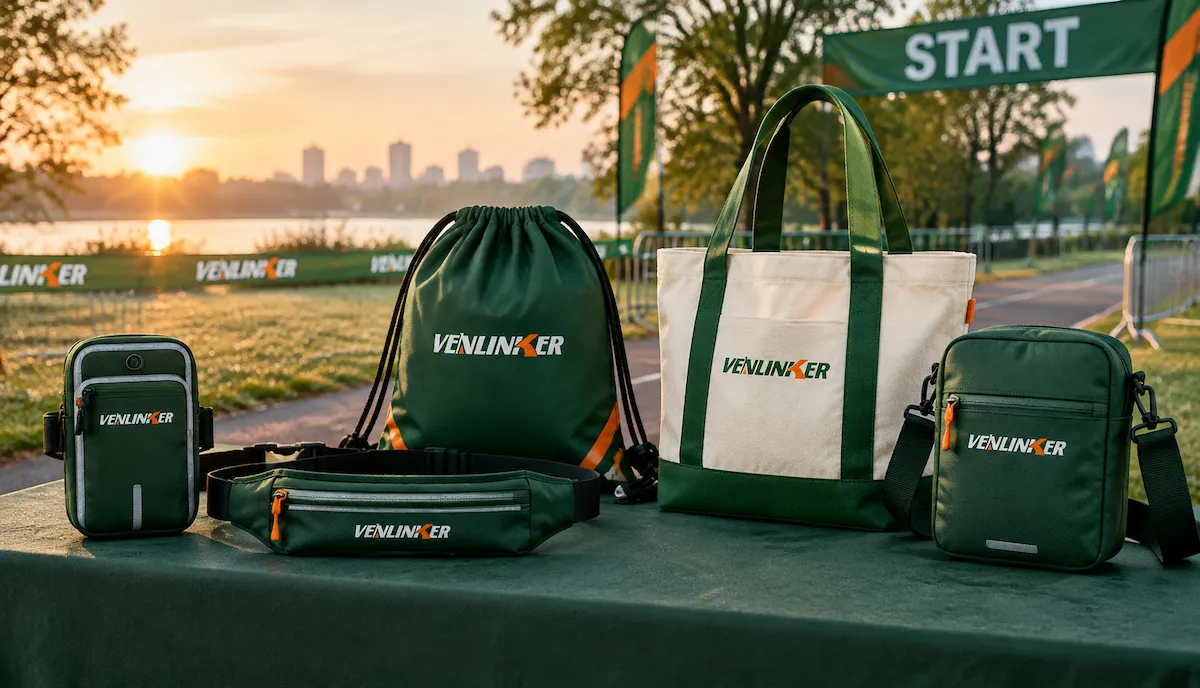
Run club merch used to mean a T-shirt, ordered in five sizes, handed out once and rarely seen again. Clubs now meet weekly, draw a crowd to a Saturday long run and finish at a café, and the merch that works for that routine is the item a member carries every time: the pouch on the belt, the bag at the bag drop, the tote on the walk home. Custom run club bags are simpler to order than apparel, because nobody needs a size, and they put the club’s name in front of other runners each week.
This decision shapes a club’s budget, its sponsor relationships and how the club looks at the start line. For a founder, a shirt order or a bag order is a choice between a one-off giveaway and something members keep using. A running brand that hosts a club is choosing which product carries its name onto the pavement. A race organiser is choosing what every finisher takes home.
This guide covers the growth in club running, why bags beat shirts as running club merchandise, the eight products that make up a run club range, how a small club reaches a 300-piece minimum, reflective detailing, branding that members want to wear, race-day kits, sponsor programmes, timing, packing, and a worked spec for a two-piece kit you can send to a factory. When you have a product and a date in mind, you can request a quote with the spec block filled in.
Why Run Club Merch Is Growing: What the Strava and ClassPass Data Show
The run club boom shows up in the numbers. Strava’s May 2026 community update reported that running club creations rose 3.5× year-on-year through late 2025, that the platform now counts 1 million clubs across all sports, and that club-organised events rose 1.5×. The same source puts Strava’s 2025 Year in Sport at 180 million registered users and 4 billion activities logged in 190+ countries, with running the most-recorded sport.
Run club growth on Strava against a 1.0× prior-year baseline, with studio running classes for contrast
Bars show each figure as a multiple of its prior-year level. The grey bar below the line comes from a different platform and a different measure and is shown only for contrast.
Sources: Strava May 2026 community update and 2025 Year in Sport, reported by Running Lookout; ClassPass 2025 booking data, reported by SGB Online.
Community running, not studio running
The same year gives an honest counterpoint. ClassPass data for 2025 put running at number ten among booked workouts and roughly flat year-on-year, at −0.2%. On that platform, paid treadmill and studio running classes did not grow. The growth sits in free, social, outdoor running organised around a meeting point and a coffee afterwards.
That distinction matters to a merch buyer. A studio sells its members a class. A run club sells nothing at the door, so merch is often one of its few sources of income and its main way of showing up in public. Its members also carry things differently. They leave a bag at the start, run with a phone and a key, and walk to breakfast with a change of top. Each of those moments suggests a product.
What the growth does and does not tell you
The Strava figures describe club creation and events on one platform. They do not tell a club how many members will buy a pouch or what price they will pay, and nobody should build a forecast on them. They do tell a running brand or shop that the channel is real and widening, which is why brands that already sell running bags and light outdoor gear are adding a club programme alongside retail. Where run clubs sit next to Pilates, padel and hybrid racing in wider bag demand is covered in the sports bag trends 2026 roundup.
Why Custom Run Club Bags Beat T-Shirts as Club Merchandise
A club shirt is the default order, and it has three structural problems that a bag does not share.
No sizing, no leftover sizes
A shirt order splits into five or six sizes, often in two fits. The organiser guesses the split, and the guess leaves some sizes sold out and others still in a box a year later. A running pouch, a drawstring bag or a tote comes in one size. The whole order is one SKU per colourway, and every unit fits every member. That also makes reorders simple: the club reorders a quantity, not a size grid.
Carried where other runners see it
A club shirt spends most of its life under a jacket in winter, and many members prefer their own technical tops on a hard session. A belt or pouch sits outside every layer. A drawstring bag hangs on the fence at the bag drop while the group warms up. A tote goes into the café and onto the train. Each of those is a place where a runner from outside the club sees the name, which is the main reason a club orders merch at all.
Used every week
Running merch that has a job gets used weekly. A key pouch goes on every run. A wet pouch holds damp socks after every long run. A shirt gets worn when it happens to be clean. For a sponsor or a host brand, that difference decides how often the logo is seen for the same order value.
Merch item
Sizing
Visible on a run
Typical use pattern
Leftover-stock risk
Relative cost per unit
Club T-shirt
5–6 sizes, often 2 fits
Often covered by layers
Occasional
High; split across sizes
Low
Phone and key pouch
One size
Yes, on the belt or in hand
Every run
Low
Lowest
Running belt
One size or S/M/L bands
Yes, outside all layers
Every run
Low to moderate
Low
Drawstring kit bag
One size
At the start and bag drop
Weekly
Low
Lowest
Post-run tote
One size
Café, commute, market
Weekly and off-run
Low
Moderate
The table is qualitative on purpose. No survey measures how often a club pouch is used against a club shirt, and a factory that quotes one is inventing it. The pattern above is what organisers describe, and it is enough to decide which product leads the order.
Run Club Merch Range Compared: Pouches, Belts, Totes and Race Kit Bags
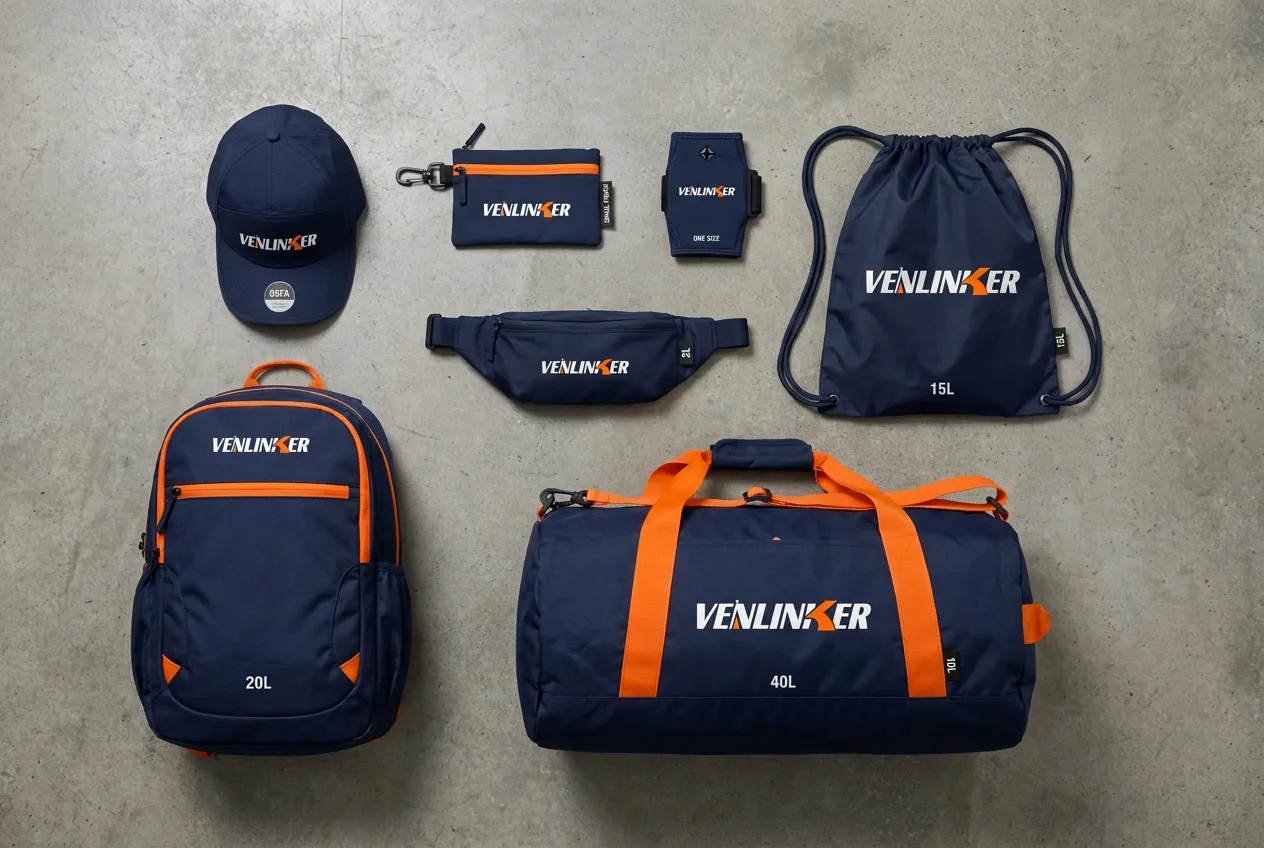
Eight products cover almost every run club merch programme. A club rarely needs more than two of them in a first order. The table sets out what each does, the size it usually comes in, how well it suits a small club against a brand at a 300-piece minimum per style per colourway, and where it sits on cost.
A first order should lead with one product that every member will use. For a weekday evening club in a city, that is usually a running belt or a reflective pouch, because both go on every run. For a weekend club built around a long run and a café, the drawstring kit bag or the tote often works better, because it is the item members hold at the meeting point. The engineering behind belts, including bounce control and elastic width, is covered in the running belt and waist pack guide; a club only needs to decide whether one size will fit its members or whether graded S/M/L bands are worth the extra SKUs.
Where the range extends
Brands and shops that host clubs tend to carry more of the range. A running waist pack with a larger pocket suits trail sections of a club. A hydration waist pack suits a marathon-training group running two hours or more. An athleisure belt bag worn cross-body at the café carries the brand off the run. Each is a separate style with its own 300-piece minimum, which is why most brands add one per season.
Run Club Merch MOQ: How Small Clubs Reach 300 Pieces
Venlinker’s minimum is 300 pieces per style per colourway. That is the number, and a club of 80 regulars needs a plan to reach it. The custom bag MOQ guide explains why the floor sits there: fabric is booked by the roll, logos need setup, and a sewing line needs a run long enough to justify a changeover. A supplier quoting 50 custom pieces is often adding a print to stock bags, which is a different product.
The minimum applies per style and per colourway. A club that wants a pouch in black and in orange needs 600, not 300. A pouch and a drawstring bag in one colour also need 600. This is the point most first-time organisers misread, and it is the first thing to settle.
Five routes to 300 pieces
Route
How it reaches 300
Who it suits
What to watch
One hero product, one colourway
All demand goes into a single SKU
Any club with 100+ active members
Pick the product with the widest use, not the most exciting one
Pool across chapters or partner clubs
Several clubs share one spec and one colourway
City clubs with sister chapters; regional networks
One logo or a shared mark; agree the split before the deposit
Bundle with an event
Race packs or anniversary run absorb part of the order
Clubs that host a race, relay or social run
Event date fixes the timeline; stock left after the event becomes shop stock
Sponsor-funded run
A sponsor buys the order and the club distributes it
Clubs with a local shop, café or brand partner
Co-branding rules and logo sizes agreed in writing
Sell over two or three seasons
Order 300, sell through the club shop over 12–18 months
Clubs with a shop page and somewhere to store stock
Choose a colourway that will not date; one carton takes little space
Pooling without losing identity
Pooling works best when the product and colourway are shared and the identity sits in a small, cheap-to-change element. Chapters of one club can share a single screen-printed front with a woven label that carries each chapter name, because woven labels are ordered in small runs and sewn at the channel or seam. Partner clubs that do not share a name can share a neutral bag with a tonal mark and a heat-transfer club crest applied per batch. The method decision follows from the variant list, so send the split with the brief.
What a club should not expect
A lower MOQ for a first order is not on offer. Venlinker does not split a 300-piece minimum across colourways, and it does not run 100-piece custom batches. The free sample programme exists so that a club can hold a showroom bag and test its members’ reaction before committing; the sample takes the risk out of the order at a fraction of the cost of a small run.
Reflective Run Club Gear for Dark Morning and Evening Runs
Many club runs happen before work or after it. From autumn to early spring in northern-hemisphere cities that means dark streets, and reflective detailing moves from styling to a practical feature. It is also the feature that most often justifies a second product in a club range.
Reflective options on pouches and belts
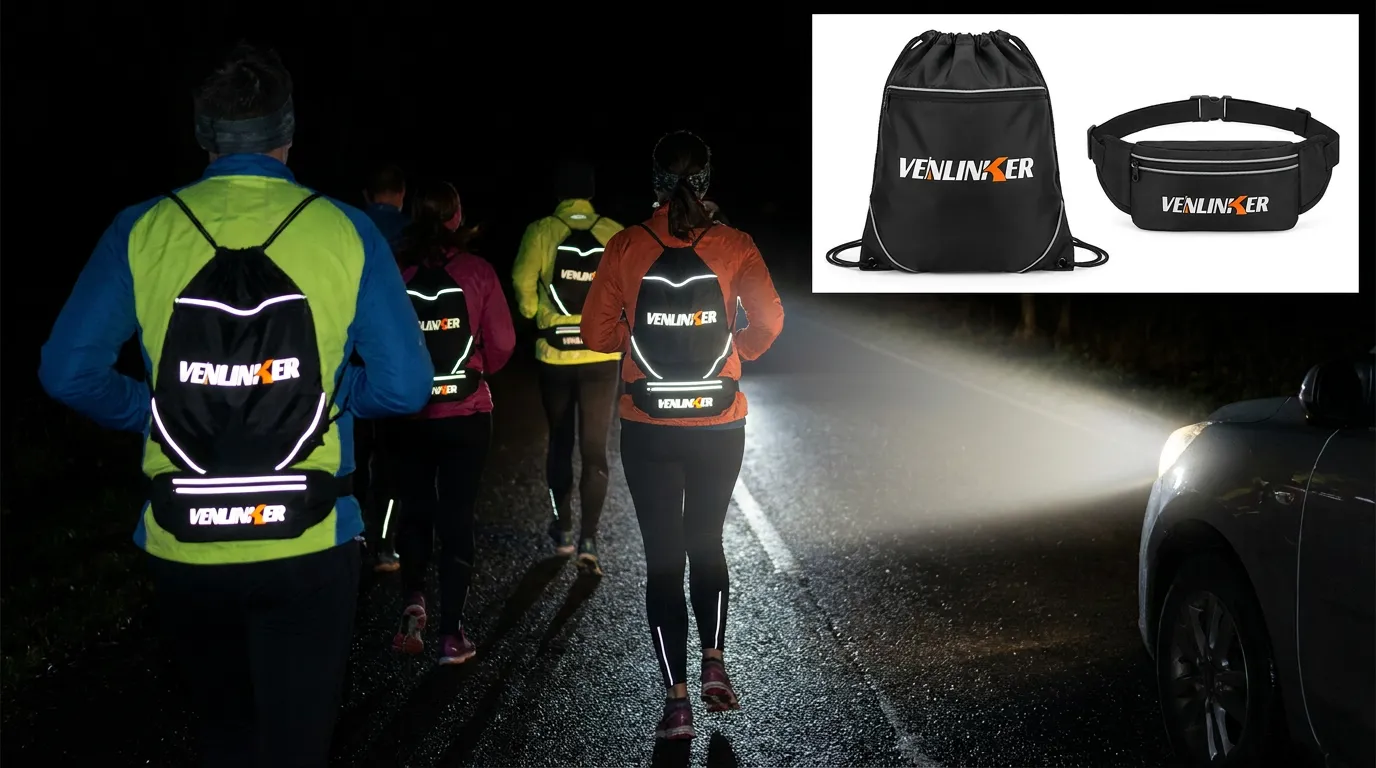
Three builds cover most needs. Reflective trim, a 5–10 mm piping in the pocket seam or a reflective zip puller, is a design detail and priced as one. Reflective print, a transfer film covering roughly 30–50% of the front panel, can carry the club logo inside the reflective area, so the crest itself lights up in a headlight beam. A full reflective panel, reflective-coated fabric across the whole front of a reflective running pouch, gives the most coverage and costs the most. Reflective elastic on a belt adds coverage around the body at moderate extra cost.
Put reflective on both faces of anything worn at the waist, because runners wear pouches front, side and back. Remember that fluorescent colour and reflective material do different jobs: a neon pouch is visible at dusk and invisible under headlights, while grey retroreflective film looks dull by day and bright at night. A winter drop wants both.
Reflective print durability
Reflective transfer film cracks along fold lines faster than woven reflective tape, so on a soft pouch the logo should sit on a flat area away from the zip. A stitched reflective patch lasts longer than film and costs more. The custom graphics and printing team can sample the same logo in film and in a stitched reflective patch so the club can wash both before choosing. The wider set of night-visibility options for belts sits in the belt guide linked above.
Run Club Merch Branding: Logos Members Want to Wear
Members wear what looks like something they would buy. That usually means smaller, quieter branding than an organiser’s first draft. A 25 cm crest across a tote reads as a giveaway. A tonal logo at 5–8 cm on the same tote reads as a product.
Tonal logos, woven labels and small placements
Three choices do most of the work. A tonal logo, printed or debossed in a shade close to the fabric, looks deliberate and survives the café test. A woven label at a seam or on a pull tab carries the club name at 3 × 8 cm or smaller and lasts the life of the bag. A small placement, a 4–6 cm mark on a pocket or a strap end, looks like a brand. Big prints still have a place on drawstring bags for race packs and on event items where visibility matters more than taste. The custom logo and branding page sets minimum legible sizes by method, which matters on a pouch with a 20 cm front.
Logo method
Best placement on club merch
Wear on a run bag
Relative cost
Suits
Tonal screen print
Tote face, drawstring front, pouch face
Good with a thin deposit; cracks at folds if heavy
Lowest at volume
Everyday club identity
Woven label
Seam, pull tab, belt end
Life of the bag
Lowest per unit
Chapter names, understated branding
Rubber or silicone patch
Pouch face, crossbody front
Life of the bag; sweat-proof
Moderate
Brand-hosted clubs, retail items
Embroidery
Tote, crossbody, duffel
Life of the bag; puckers on light fabric
Moderate to high
Anniversary and founder editions
Reflective transfer
Pouch face, belt, drawstring front
Fair; cracks along flex lines over time
Moderate
Winter and night-run drops
Sublimation
All-over on light polyester
Life of the fabric
Moderate
Race editions, bold club patterns
Colour and artwork
Club colours are usually specified as Pantone references, and a shell fabric in a club colour needs a lab dip unless the colour is close to a stock shade. Most clubs are better served by a stock shell in black, navy or grey with the club colour carried in the logo, the zip puller or the cord. The logo method guide covers file formats and wash life by method, and fabric and colour choices are set out on the custom materials and colours page.
Race Kit Bags and Sponsor Co-Branded Run Club Merch
Race and event organisers face a different problem. The order is large, the date is fixed and every runner receives the same item.
Bag drop, finisher and goodie bags
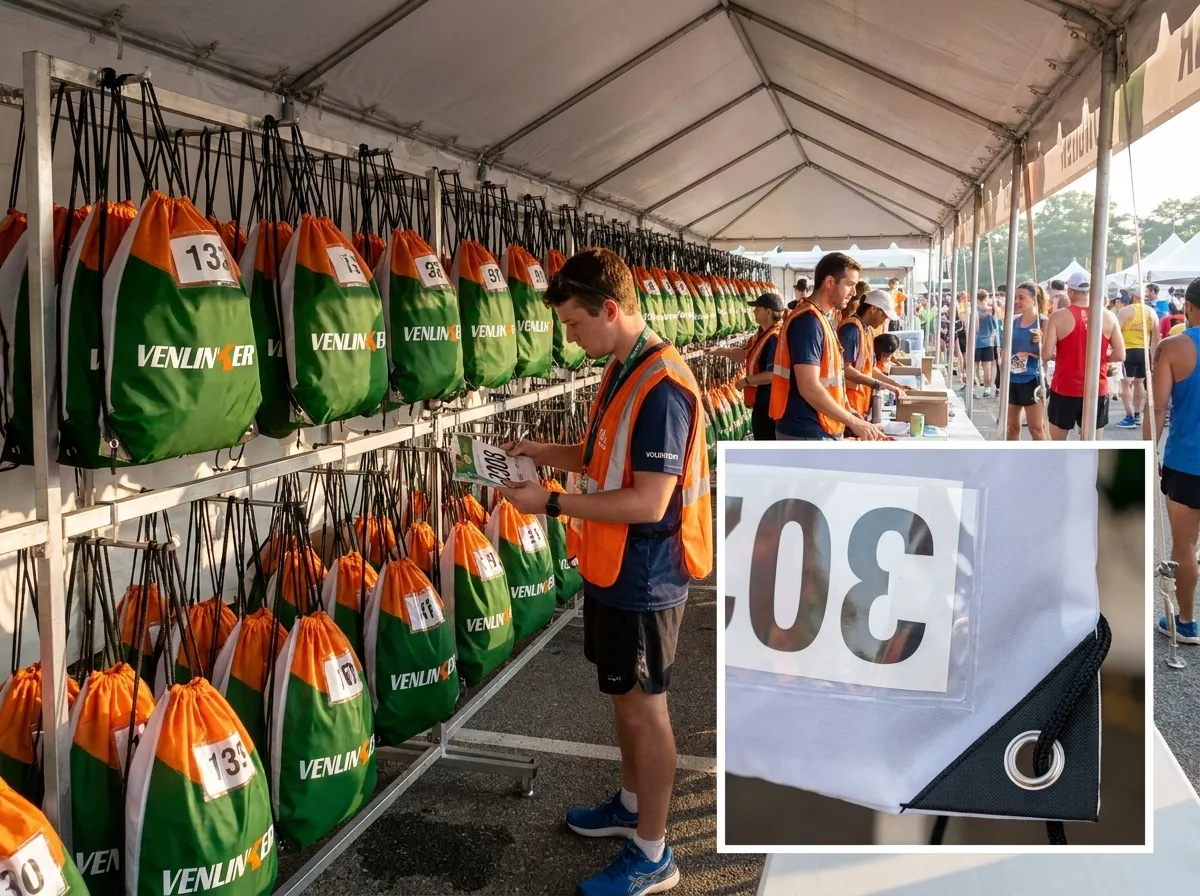
A race needs up to three bag types. The bag-drop bag holds a runner’s warm layers at the start and is collected at the finish. It must be large, easy to label with a bib number and quick to hand over, which points to a 38 × 48 cm drawstring bag or, for a premium event, a duffel. The finisher bag carries a medal, a drink and a snack, and a lighter drawstring or a tote does the job. The goodie or race-pack bag holds the bib, the timing chip and sponsor samples, and it is often the same drawstring bag handed out at registration.
Drawstring bags carry most race kits because they are the lowest-cost carry item that still looks like a bag. Fabric, cord diameter and corner reinforcement decide whether one survives a wet bag drop, and the custom drawstring bags guide sets out each choice and the print areas by size. A drawstring gym bag built with 5–6 mm cord and reinforced corners takes a wet jacket and trainers; a 3–4 mm promotional cord does not. The corporate, event and promotional page covers how event orders are scheduled and packed.
Many clubs fund merch through a partner: a local running shop, a café, a physio clinic or a running brand. The sponsor usually pays for the order and gets a logo on the product. Two rules keep the result wearable. Give the club mark the lead position and put the sponsor second, on a woven label, the back panel or a strap end. And agree logo sizes, colours and placements in writing before artwork goes to the factory, because a sponsor who expects a front-panel logo and receives a label is a harder conversation after bulk than before.
A running brand that hosts a club runs the programme in reverse. The brand mark leads and the club name sits in the small placement. Creator and coach brands with a running following do the same, and the influencer and creator brand page covers how a first drop is sampled and photographed. Where several clubs carry one sponsor, one shell and one sponsor mark across the whole order, with club names on woven labels, keeps every batch at or above the minimum.
When to Order Run Club Merch: Timing a Drop Around the Club Calendar
A club calendar has natural drop points: the start of the dark months, the spring race season, a club anniversary and the week before a home race. Working back from each gives the order date.
Stage
Typical time
What sets it
Brief, artwork and quote
A few days, depending on how complete the brief is
Logo files, product choice, colourway, quantity split
Sample
5–7 working days, plus 1 free revision
Logo method and any lab dip
Bulk, 300–1,000 pcs
25–35 days after sample approval
Fabric availability, logo method
Bulk, 1,000–5,000 pcs
30–40 days
Number of variants and packing format
Bulk, 5,000–20,000 pcs
35–50 days
Event quantities, split deliveries
Repeat order, same spec
20–30 days
Approved sample and artwork on file
Fabric outside the supplier network
Adds 7–14 days
Specialist reflective or knit fabrics
Custom-moulded hardware
Adds 10–15 days
A moulded buckle or puller in club colour
Sea freight
Several weeks depending on route
Confirm with your forwarder
Three drop points and their order dates
A reflective drop for the dark months should be in members’ hands by early autumn, which means ordering in early summer. A spring race-season drop runs into Chinese New Year, which falls on Saturday 6 February 2027; production typically slows two to three weeks before the holiday, so a spring order needs its sample signed and materials confirmed before the slowdown. The Chinese New Year 2027 production planning guide works that calendar backward from a warehouse date. A club anniversary or a home race can be planned around the table above with a few weeks of margin.
Repeat orders shorten everything
Once a club has an approved golden sample, the second order runs in the 20–30 day repeat window without a new sample round. Clubs that expect to reorder should choose a stock colourway and keep the spec unchanged, because a new colour restarts the lab dip. The sample cost and lead time page explains how sample fees are refunded against the production order.
Packing and Fulfilment for Running Community Merchandise
A club usually distributes merch by hand at a run or ships it from a volunteer’s hallway. Packing decisions made at the factory decide how much work that is.
Individual polybags and kit sets
Individual polybags keep each item clean in storage and make hand-outs quick. A printed polybag or a hang tag with the club name turns the item into something that looks bought rather than handed out. For two-piece and three-piece kits, packing the items together at the factory saves a volunteer evening: a pouch folded into a drawstring bag, or a wet pouch and a belt inside a tote, packed as one unit with one label. The accessories and sets range and the private-label gym bag sets page show how set components share one fabric booking. A printed dust bag or retail pouch is an option for founder or anniversary editions.
Cartons, labels and splits
For pooled orders, ask for cartons packed and labelled per chapter or per partner club, with the count on the outside. For events, ask for cartons per distribution point. Clubs and brands that sell merch online should settle barcode placement at sampling. The custom packaging, retail and FBA prep page lists the formats, and the packing inspection page describes how carton counts and labels are checked before goods leave.
How to Brief a Factory for Run Club Merch: Worked Spec and Supplier Questions
A factory can quote accurately only from a complete brief. For run club merch the brief is short, and the block below shows a two-piece kit, a reflective phone pouch and a drawstring kit bag, written the way a sourcing manager or an organiser can send it.
PROGRAMME Run club two-piece kit, winter drop QUANTITY 400 kits (400 pouches + 400 drawstring bags), one colourway, packed as sets SPLIT Chapter A 150, Chapter B 150, Chapter C 100; cartons labelled per chapter PIECE 1: REFLECTIVE PHONE POUCH Size Roughly 20 x 10 x 3 cm, flat back Body 210D ripstop nylon, stock black Reflective Transfer print covering roughly 40% of the front, club crest inside the reflective area Closure No. 3 coil zip, closing toward the body, 40 mm pull with reflective cord Carry Rear belt loop for a 40-50 mm belt, plus a metal key clip on 80 mm cord inside Branding Woven label on the zip end, chapter name, roughly 3 x 1.5 cm PIECE 2: DRAWSTRING KIT BAG Size 38 x 48 cm flat, roughly 14-17 L Body 420D polyester, stock black, lined 190T Cord 5-6 mm polyester cord, reflective tracer Corners Reinforced corner tab with metal grommet Pocket Front zip pocket, roughly 18 x 20 cm Branding Tonal one-colour screen print, 22 x 22 cm max, front panel; sponsor logo woven label at the side seam Bib window Clear window on back panel for a name or bib card, roughly 10 x 7 cm PACKING Pouch inside bag, one printed polybag per kit, hang tag with club name; 50 kits per carton SAMPLE One set; reflective print sampled in film and in a stitched patch for a wash comparison
The block sits inside a fuller tech pack as the bag tech pack guide describes, and the RFQ checklist lists anything else a quote needs. An organiser without a tech pack can send the block above as an email to the Venlinker team and get it turned into a specification.
Ten questions to ask a run club merch supplier
Are you the factory, or do you buy stock bags and add a logo? Ask for a live video tour of the sewing floor.
Is the MOQ per style, per colourway, or per order? The answer decides how many products and colours a club can afford.
Can you pack items as kits and label cartons per chapter? A yes saves a volunteer evening.
Which logo methods do you recommend on this fabric, and at what minimum size? A small pouch limits the options.
Can you sample the reflective logo in two methods? Film and a stitched patch wear differently.
What cord diameter and corner build will the drawstring bag have? Ask for the numbers in writing.
Is the colour a stock shade or a lab dip? A lab dip adds time and a separate minimum.
What does the sample cost, and is the fee refunded on the production order? It should be.
What is checked at final inspection? Zip function, logo position, reflective coverage and carton count at least.
Can the approved sample be kept for repeat orders? That is what makes the second drop faster.
Put the answers next to the spec block and request a quote with both attached.
How Venlinker Makes Custom Run Club Bags and Pouches
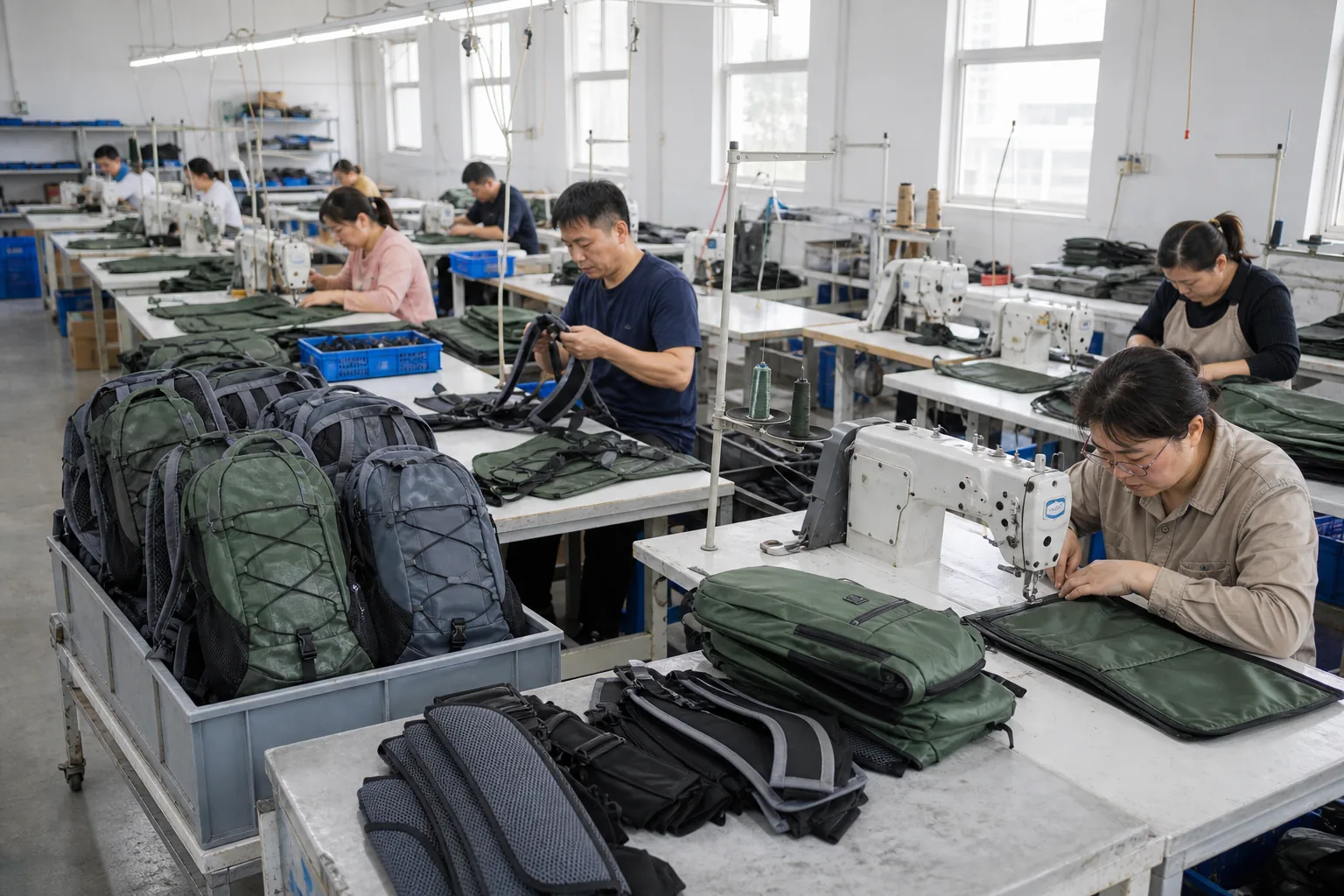
Venlinker is Your Trusted Custom Running Bag Manufacturer in China, building running belts, reflective pouches, drawstring kit bags and post-run totes for run clubs, running brands and event organisers from a 5,000 m² factory in Huadu District, Guangzhou, founded in 2010.
Samples a club can test on a run
The sample room builds a production-grade sample in 5–7 working days with one free revision, and for run club merch that revision usually adjusts the logo size or the reflective coverage after the first night run. The sample fee is refundable against the production order, and the sample development page sets out what the room needs to hold that window. Ten-plus in-house designers turn a club crest and a product idea into a specification, so a founder without a tech pack still gets a manufacturable brief.
Fabric, reflective and trims from one network
Venlinker sources fabric from 200+ verified suppliers, which covers the ripstop nylon, polyester, lycra knit and reflective-coated fabrics a club range uses, and the custom trims and hardware page covers cords, pullers and key clips. In-house high-frequency TPU and PVC welding builds welded wet pouches on site. Brands that want a post-run tote in the same colourway can pair an everyday sport tote or a gym tote with a pouch from one fabric booking.
Production, inspection and terms
Ten-plus production lines produce 50,000+ bags a month, which covers a 300-piece club order and a 20,000-piece race order in the same schedule. Every order passes 100% pre-shipment inspection by the factory’s own team, described on the final inspection page, and third-party inspections by SGS, BV or TUV are welcome on any order, commissioned and paid by the buyer. MOQ starts at 300 pieces per style per colourway, payment is 30% deposit with 70% before goods leave the factory, and FOB is the default. Free white-background product photography is included on production orders, which gives a club shop or a brand’s store its product images. Startup and DTC brands launching a running line and gym, studio and club chains adding a run club work to the same terms. Factory visits run Monday to Saturday, 40 minutes from Baiyun airport with pickup, or by live video tour. You can ask for a quote or talk to the team about a first drop.
One product that every member uses on every run: a running belt, a phone and key pouch or a reflective pouch. Start with one colourway at 300 pieces and add a second product once the first has sold through. A mini crossbody or a tote suits clubs where the café matters as much as the run.
What is the minimum order for custom run club bags?
Venlinker’s MOQ is 300 pieces per style per colourway. Two colours of one pouch are 600 pieces, and so are two products in one colour. Clubs reach the minimum by choosing one hero product, pooling with chapters or partner clubs, bundling with an event or using a sponsor, as the MOQ section above explains.
How long does run club merch take to produce?
A sample takes 5–7 working days with one free revision. Bulk takes 25–35 days for 300–1,000 pieces after sample approval, 30–40 days for 1,000–5,000 and 35–50 days for 5,000–20,000, plus sea freight. Repeat orders on an approved spec take 20–30 days.
Can run club merch be reflective?
Yes. Options run from reflective piping and zip pullers through a reflective logo print to a full reflective front panel. A reflective logo lets the club crest itself light up under headlights. Ask for the logo sampled in film and in a stitched patch before choosing.
Can a sponsor’s logo go on club bags?
Yes, and it works best as a secondary mark: a woven label, a back-panel print or a strap-end patch, with the club logo leading. Agree sizes and positions in writing before artwork goes to the factory.
Can merch be packed as kits for each member?
Yes. Items can be packed together as a set in one polybag with a hang tag, and cartons can be labelled per chapter, partner club or event distribution point. Settle the packing format at sampling so it is priced into the quote.
Summary: Choosing Run Club Merch That Members Use
Club running grew fast on Strava through 2025, with running club creations up 3.5× and club events up 1.5×, while studio running classes on ClassPass stayed roughly flat. The demand is in community running, and the merch that fits it is carried on every run and after it.
Lead with one hero product. A pouch, belt or drawstring kit bag in one colourway at 300 pieces is easier to fill, store and reorder than a shirt in six sizes.
Plan the minimum before the design. MOQ is 300 per style per colourway, so decide how the club reaches it (pooling, an event, a sponsor or a longer sell-through) before choosing a second colour.
Brief the factory with a complete spec and a date. Sample in 5–7 working days, bulk from 25 days, repeat orders in 20–30, with reflective detail and packing settled at sampling.
Send the spec block with your quantity split and drop date to get a quote.
Planning Run Club Merch Your Members Will Carry Every Week?
Venlinker builds custom running belts, reflective pouches, drawstring kit bags and post-run totes for run clubs, running brands and race organisers, with MOQ from 300 pcs per style per colourway, samples in 5–7 working days, fabric and reflective materials from 200+ verified suppliers and 100% pre-shipment inspection.