* Simply fill out the form below as best you can. And don’t sweat the details. * Your information will be kept strictly confidential. * Share your needs with us, We’ll contact you in very short time.
Planning a Custom Bag Order?
Send your bag type, quantity and target delivery date. We will review the specification and confirm the next step.
Waist Pack Bag Guide: Belt Bags, Running Waist Packs, Bounce Control and Belt Geometry
How to specify a waist pack bag: running belt vs athleisure belt bag, bounce control, belt systems, skin-contact fabrics and MOQ from 300 pcs per colour.
Who this guide is for: sourcing managers, DTC founders, activewear brand product managers, race and event organisers and gym-chain merchandise buyers who are adding a belt bag or running waist pack to a range and need to know which of the two products they are actually briefing, how the belt controls bounce, and what the bulk numbers look like.
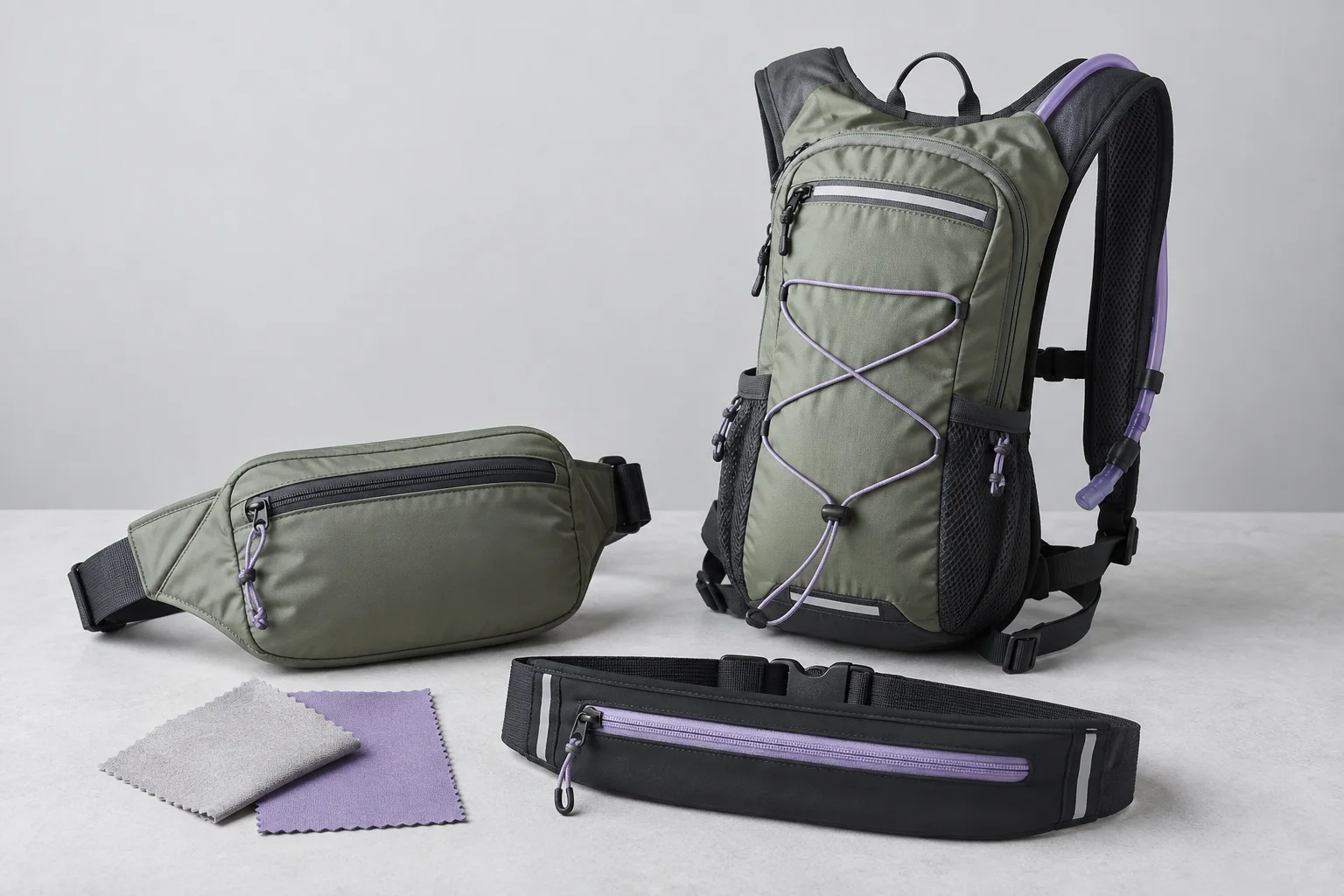
A waist pack bag is two different products sharing one name, and the confusion between them costs brands a sampling round more often than any other category in the light-bag range. One is a technical running belt whose entire job is to hold a mass against the body while that body rises and falls sixteen thousand times an hour. The other is a fashion accessory worn cross-body over a coat, whose job is to hold a silhouette and carry a logo. They use the same word on a purchase order and almost nothing else.
Brief them the same way and the factory delivers a bag that fails at both. A running waist pack built with a 38 mm webbing strap and a side-release buckle looks correct in a photograph and slaps the wearer’s back on every stride. An athleisure belt bag built on a 50 mm elastic band with a silicone grip sits beautifully on a run and reads as sports kit when worn over a wool coat in a shop window. The specification decisions that separate them are made early, in the belt system and the pouch geometry, and they are hard to reverse once tooling and pattern work are done.
This guide sets out the format landscape with capacities and dimensions, explains bounce in plain mechanical terms and names the four levers that control it, compares belt systems for stretch and adjustment range, covers hydration versions, skin-contact fabrics, reflective detailing and athleisure finishing, and closes with bulk ordering, a worked tech-pack spec block and the questions to put to a supplier before you request a quote.
Waist Pack Bag vs Belt Bag: Two Products That Share One Name
The vocabulary problem is genuine. Retail buyers say belt bag, runners say waist pack or running belt, older catalogues say fanny pack or bum bag, and search traffic splits across all of them. The physical products at each end of that vocabulary have opposite priorities.
The technical running belt
A running belt is a restraint system with a pocket attached. Capacity runs from roughly 0.5 L to 1.5 L, the pouch is shallow (30 to 60 mm deep), the belt is elastic and 38 to 70 mm wide, and the whole assembly is designed to be pulled tight enough that the load moves with the body rather than against it. Finished weight is typically 60 to 140 g, because every gram sits on the same waist that is already carrying the load. The buyer’s success criteria are measured on a run: does it bounce, does it chafe, can a hand find the phone pocket without stopping.
Fit range matters more than it does anywhere else in the bag range. A belt tightened to a 68 cm waist and a belt tightened to a 108 cm waist are being asked to hold the same 300 g pouch with the same tension, and a single strap length cannot do both well. That is why running belts are the one product in this category where size bands are common.
The athleisure belt bag
An athleisure belt bag, still catalogued as a fanny pack in some markets, is a small structured bag on a long adjustable strap. Capacity runs from roughly 1.5 L to 4 L, the pouch is deep enough to hold shape (60 to 90 mm), and the strap is 25 to 38 mm webbing on a slider with a moulded side-release buckle worn at the front as a visible design element. Finished weight lands at 180 to 400 g, and nobody minds, because the bag is carried at walking pace. Success is measured in a photograph: the proportions, the hardware finish, how the logo sits on the front panel, whether the strap adjusts long enough to cross the chest over outerwear.
The failure cases run in both directions. A brand that briefs a running belt with fashion language gets a bag with a soft unstructured face, plated hardware that corrodes in sweat and a strap that cannot be pulled tight. A brand that briefs a fashion belt bag with technical language gets a functional pouch on an elastic band that a merchandiser will not put on a mannequin. A third product, the crossbody sports bag, sits between them at 2 to 4 L and is worn over one shoulder rather than at the waist, which removes the bounce problem and replaces it with a sway problem.
The practical fix is a two-line brief. Name the wear position (waist, hip, cross-body over the chest, small of the back) and name the activity the bag must survive (running at pace, walking, a festival, a race). Everything downstream follows from those two lines, and the custom design and structure team can pattern from them without a second guessing round.
Waist Pack and Belt Bag Formats Compared: Capacity, Dimensions and Cost
Six formats cover almost every brief that reaches a light-bag line. The figures below are industry-typical ranges rather than measurements of a single style, and they shift with the pattern.
Race entrants, event organisers buying by the thousand
Lowest
Two entries in that table are worth a second look for a range planner. The race-number belt is the cheapest item a light-bag factory makes and the one most often ordered in five figures at once, because an event buys one per entrant. And the gap between the expandable running waist pack and the hydration waist pack is where most brands over-specify: a flask sleeve adds cost, pattern complexity and roughly 40 to 80 g, and only earns its place on runs long enough to need water carried on the body. The backpack and duffel capacity guide explains how litres are measured and why two bags labelled 2 L can hold different amounts.
What Causes Bounce in a Running Waist Pack and How Much Load a Belt Can Hold
Bounce is the single reason running waist packs get returned, and it is a mechanics problem with a short explanation.
The mechanism in plain terms
During a running stride the torso rises and falls, typically by 60 to 100 mm, and the waist accelerates upward at the start of each rise and downward at the top. If the pouch is clamped to the body, it experiences the same accelerations and stays put. If the belt allows the pouch to move relative to the hips, the pouch behaves like a mass on a slack tether: the body drops away, the pouch keeps travelling, then the belt catches it and it slaps back. The wearer feels that catch as a thump at the small of the back or a swing at the hip.
Two quantities set the severity. The first is the mass being carried. The second is the belt’s ability to keep that mass in contact with the body throughout the stride, which is a question of tension, contact area and how the belt responds when the waist changes circumference on every breath. A rigid webbing strap cannot do the second job well, because a strap tightened enough to hold a load still is tightened enough to restrict breathing, and a strap loosened enough to breathe in is loose enough to let the pouch travel. Elastic solves the contradiction by holding a lower, steadier tension across a changing circumference.
Relative bounce on a running stride against load carried, by belt system
Indexed comparison of the behaviour wear-testers report, not a laboratory measurement. What matters is the shape of the two curves and the point at which they separate, not the absolute values.
The curves separate almost immediately and the gap widens with load. A webbing belt is acceptable up to roughly 150 g, which is a key, a card and a gel. Past 300 g, most wearers describe it as distracting. The wide elastic compression belt stays flat to roughly 400 g and then begins to climb, because past that point the belt’s elastic recovery is no longer strong enough to hold the mass through the downward phase of the stride. Nothing available at any price keeps a dense 800 g load still on a running stride, and a brand that promises otherwise on a product page will read the reviews.
The four design levers that control bounce
Belt elasticity and width. Elastic that stretches roughly 10 to 20% under wearing tension and recovers fully holds a steadier pressure across a breathing waist than webbing does. Width converts that tension into comfort: the same pull spread over 50 mm of skin gives roughly half the pressure of the same pull over 25 mm, so a wide belt can be tightened further before it cuts in. This is why 50 mm is the working standard for loaded running belts and 25 mm is confined to race-number belts that carry nothing.
Contact area and body-conforming curve. A flat rectangular pouch laid against a curved waist touches at two points and tents in the middle. A pouch patterned with a curve on the horizontal axis, shaped panels or a darted back face sits flush and roughly triples the contact area. Contact area is what turns friction into restraint, and a pouch back cut to a curve suited to an 80 to 110 cm waist circumference is a pattern decision that costs nothing in materials and a sampling round to get right.
Load position. The small of the back, over the sacrum, is the position with the least independent movement relative to the body’s centre of mass, which is why serious running belts put the main pocket there and leave the front for a flat card sleeve. The front hip is the easiest position to reach into and the worst for bounce, because the pouch rests on soft tissue that moves on its own. The side hip is the working compromise for a bag that must be opened while moving.
Compression closure. A pouch can be clamped after the belt is fastened. A short pull-tab that draws the loaded pouch flat against the back, or a pair of side compression straps on an expandable model, converts a hanging load into a held one. On expandable running waist packs this single detail does more for bounce than any fabric choice, and it costs a length of webbing, two ladder locks and about 15 g.
The line to hold in a product brief is roughly 1 L of dense load. Past that, no belt system keeps the mass still on a running stride without compression, and past roughly 1.5 L the honest answer is that the customer wants a different product on their shoulders.
Sizing the phone pocket without naming a handset
Handset dimensions change every year, so a tech pack that names a model is out of date before the second production run. Specify a range instead. Current large-format handsets sit roughly 145 to 165 mm tall and 70 to 79 mm wide, and a protective case adds roughly 2 to 4 mm on each axis, bringing carried thickness to roughly 9 to 14 mm. A pocket with a finished internal size of 172 × 88 × 16 mm therefore accepts almost everything on sale, including a cased large-format device, with a little room to get a hand around it.
Three details separate a pocket that works from one that does not. The opening must be at least as wide as the pocket, which means a zip that runs the full width and does not curve in at the ends. The pocket must have a soft lining on the face side, typically a brushed tricot, so the screen is not sitting against a coated fabric that traps grit. And a clear touch-through window is a liability on a running product: the film creases at the fold, the crease clouds, and the panel is the first part of the bag to fail. Where a brand wants one anyway, ask for a 0.3 to 0.5 mm TPU window welded rather than stitched, and expect it to be the item that limits the bag’s life.
Running Belt Systems Compared: Elastic Width, Webbing, Silicone Grip and Knit
The belt is the product. Everything else is a pocket. Six systems cover what a factory can build, and they differ in ways a buyer feels within the first kilometre.
Belt system
Typical width
Stretch behaviour
Adjustment for a 60–110 cm waist
Grip against skin or clothing
Wash behaviour
Relative cost
Flat elastic, 25 mm
25 mm
Roughly 30–50% elongation, quick recovery
One size covers the range with a buckle, but cuts in when loaded
Low; rolls and folds under load
Loses recovery above 40 °C; no tumble dryer
Lowest
Flat elastic, 38 mm
38 mm
Roughly 25–40% elongation
One size with an overlap and buckle, or two size bands
Moderate; acceptable to roughly 300 g
Same; recovery drops after roughly 30 washes in most yarns
Low
Flat elastic, 50 mm
50 mm
Roughly 20–35% elongation, firmer hand
Two size bands give the best fit; one size with a buckle is workable
Good; the working standard for loaded belts
Same; wide elastic holds recovery slightly longer
Low–mid
Webbing with a side-release buckle
25–38 mm
None; adjustment by slider only
One size covers 60–130 cm easily
Low against skin, moderate over clothing
Washes well; the buckle is the wear point
Low
Silicone-gripped elastic
38–50 mm
As the base elastic, plus printed grip on the skin side
As the base elastic
Highest; the grip is what allows lower belt tension
Grip softens with fabric conditioner; specify none on the care label
Mid
Circular-knit tubular belt
60–90 mm
Roughly 40–60% elongation, soft hand
Cut-to-length size bands only; no buckle
Good over a wide area, poor under concentrated load
Pills at the edges; recovers slowly after hot washes
Mid
One size or size bands
This is a commercial decision, not a technical one. A one-size belt with an overlap closure and a buckle covers a 60 to 110 cm waist and gives a retailer a single SKU per colourway. Size bands (typically S at 60 to 75 cm, M at 75 to 92 cm, L at 92 to 110 cm) give a measurably better fit on a continuous elastic loop with no buckle, at the price of tripling the SKU count. At an MOQ of 300 pcs per style per colourway, a three-size, two-colour range is 1,800 pcs before a single unit is sold, which is why most first runs go out one-size and move to bands on the reorder once the sizes that sell are known. The MOQ guide works through how size bands and colourways multiply against a minimum.
Buckles, sliders and the wear points
Where a belt uses hardware, that hardware is the part that gets stressed on every wear. A 38 mm side-release buckle in acetal handles the load on any belt bag in this range; the failure is rarely the buckle body and usually the slider, where webbing that is 1 mm narrow for the slot slips under load. Specify webbing width and slider slot width as a matched pair on the tech pack, and ask for a moulded rather than a stamped slider on anything carrying over 500 g. Custom-moulded hardware in a brand colour or with an engraved logo adds roughly 10 to 15 days to the schedule and is worth planning early with the custom trims and hardware team. The bag hardware guide covers zip sizes, buckle grades and webbing specifications in more depth than this article can.
A hydration waist pack is a running belt that carries between 250 ml and 1 litre of water, which is between 250 g and 1 kg of dense, sloshing load. It is the hardest thing this category asks a belt to do, and the design answers are specific.
Soft flasks in 150, 250 and 500 ml are the standard sizes. A full 500 ml soft flask is roughly 190 to 220 mm tall and 75 to 90 mm across at its widest, and it changes shape as it empties, which is the whole point: a collapsing flask does not slosh. Size the sleeve to the full flask with roughly 5 mm of clearance, put a 30 to 40 mm band of elastic across the top so the flask is retained but can be pulled out and pushed back one-handed, and angle the sleeve so the flask valve sits forward of the wearer’s hip rather than behind it. A sleeve the runner cannot reload while moving will be reported as a broken product.
Rigid bottles and bottle angle
A rigid 500 ml bottle carried behind the back needs a holster tilted roughly 15 to 30 degrees from vertical with the neck angled toward the spine. A vertical holster puts the bottle out of the reach arc of most wearers, and a holster tilted the other way lets the bottle work upward on every stride. Add a retention strap over the shoulder of the bottle, not around its waist, because a rigid bottle escapes upward.
Insulation and the wet pocket
An insulated sleeve, built from 3 to 4 mm closed-cell foam or an aluminised film laminated to 2 mm foam, slows warming on hot runs and adds roughly 40 to 70 g. It is a genuine feature on a trail belt and dead weight on a road belt, so it belongs on the model that needs it rather than across the range.
Any belt carrying water needs somewhere for the wet flask to go without soaking the phone pocket. The construction that works is a lined compartment in TPU film of roughly 0.3 to 0.5 mm with high-frequency welded seams rather than stitched ones, because needle holes leak. Venlinker runs high-frequency TPU and PVC welding in-house, so a welded wet pocket does not go out to a subcontractor and back. The distinction between a welded pocket and a coated fabric that merely resists rain is covered in detail in waterproof versus water-resistant bags, and it applies directly here: a PU-backed shell keeps out drizzle and will not contain a leaking flask.
Fabrics and Linings for Belt Bags Worn Against Skin: Sweat, Salt and Coatings
A belt bag is the harshest wear case in a sports-bag range, and buyers who have only specified duffels tend to underestimate it. Every other bag in the line touches a shoulder through a layer of clothing. A running belt sits directly on skin, under a load, in sweat, for the whole session, and is then either washed or left damp in a kit bag.
What sweat actually does to a belt bag
Sweat is mildly acidic and salty. As it dries, salt crystallises in the fabric surface, in the coating and in the zip chain, where it works as an abrasive on every subsequent flex. Coated fabrics take the worst of it: a PU backing exposed to repeated wet-dry salt cycles picks off at the fold line at the top of the pouch, which is where the belt bag creases every time it is worn. Dye is under the same attack, and colour fastness to perspiration is the test that predicts whether a dark belt will leave a shadow on a pale running top after a summer. Ask for it as part of the fabric testing package described in the bag fabric testing guide, commissioned by the buyer from a lab of choice, and ask for it on the exact roll rather than a generic mill sheet.
Three specification habits reduce the damage. Keep vinyl-backed fabric off the skin side, because it goes tacky against damp skin and traps heat. Put the crease line of the pouch on a seam or a bound edge rather than through the middle of a coated panel. And write a care label the customer will follow: cold hand wash, no fabric conditioner, air dry, no tumble dryer. Conditioner is worth calling out because it coats silicone grip print and destroys the property that stops the bag bouncing.
Fabric options for skin contact
Fabric
Typical weight
Hand against skin
Sweat and salt behaviour
Wash behaviour
Logo methods
Relative cost
210D ripstop nylon, PU-backed
Roughly 80–110 GSM
Light, cool, slightly crisp
Dries fast; PU picks off at hard fold lines over time
Good cold; avoid hot wash
Heat transfer, screen print, small woven label
Low–mid
420D nylon, PU-backed
Roughly 150–200 GSM
Firmer, harder wearing
Better abrasion life at the belt anchor points
Good
Embroidery, heat transfer, rubber patch
Mid
Stretch woven, nylon with 8–12% elastane
Roughly 180–240 GSM
Soft, conforms to the body curve
Elastane degrades faster in salt and heat than the nylon around it
Cold only; recovery drops with hot washes
Heat transfer, tonal print
Mid
Neoprene, 2–3 mm
Roughly 350–500 GSM
Cushioned, warm, high grip
Holds moisture and odour; needs a rinse, not a wash
Slow drying; can delaminate at the edge if not bound
Debossing, rubber patch, screen print on the jersey face
Mid–high
Coated polyester, 300–600D PU-backed
Roughly 160–280 GSM
Dry, structured, cooler than neoprene
Stable; the standard choice for the outer face
Good
Sublimation on light bases, screen print, embroidery
Low
Recycled polyester (RPET), 300–600D
Roughly 160–280 GSM
As coated polyester of the same construction
Same as virgin at equal construction
Good
As coated polyester
Low–mid, narrower stock colour range
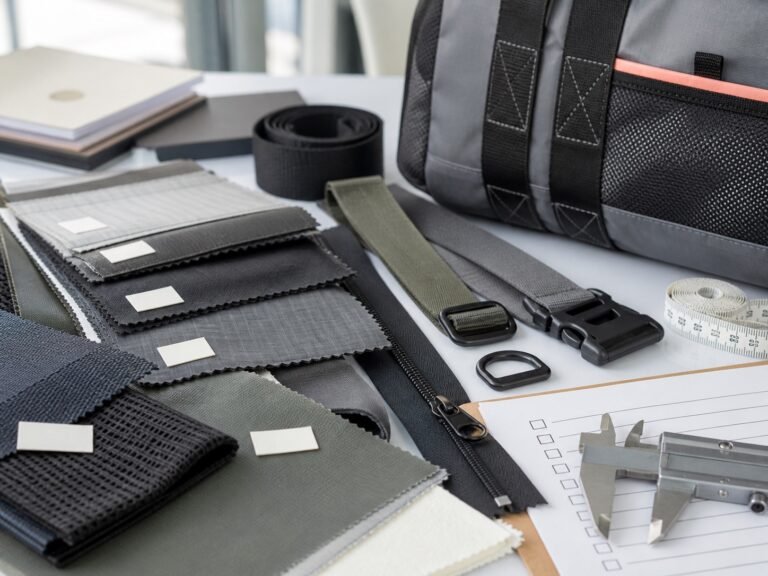
Most belts are built from two or three of these together: a coated polyester or 210D nylon face for structure and print, a stretch woven or brushed tricot on the skin side for comfort, and a light nylon taffeta lining in the pocket. The custom materials and colours page lists what is held in stock by weight and colour, and Venlinker’s material sourcing team quotes the extra 7 to 14 days up front when a brand asks for a fabric outside the supplier network rather than discovering it at cutting.
Reflective and Night-Visibility Detailing on Running Waist Packs
A running belt is worn at roughly the height a car’s dipped headlights illuminate, which makes it a more useful place for a reflector than a shoulder or a cap. It also wraps the body, so a detail applied all the way around is visible from any approach angle without the wearer having to face the light. That combination makes reflective detailing on a reflective running pouch unusually effective for its cost.
The options, and how long each survives
Reflective heat-transfer film is the cheapest and prints in any shape, including a logo, but it cracks along the flex lines after repeated washing and is the first detail to look tired. Reflective piping sewn into a seam survives far longer because it flexes at a bound edge rather than across a panel face. Reflective webbing or elastic, with retroreflective yarn woven into the belt itself, is the most durable option and the only one that gives genuine 360-degree coverage, at a cost premium over plain elastic. Reflective zip pullers and cord are cheap, add visibility at hand height and are easy to replace in a reorder.
Two practical rules. Put reflective detail on both faces of the belt, because a bag worn at the front hip presents a different surface than one worn at the back, and buyers cannot control how the customer wears it. And do not confuse a high-visibility colour with a reflector: fluorescent yellow works in daylight and dusk and does nothing under a headlight, while a grey retroreflective tape is nearly invisible by day and bright at night. A belt intended for winter running wants both. The custom graphics and printing team can sample a reflective logo in film and in a stitched patch so a brand can compare wash durability before committing bulk.
Athleisure Belt Bag Design: Silhouette, Finish and Hardware as Jewellery
The fashion belt bag is a different engineering problem: it must look correct hanging on a rail, correct in a flat-lay photograph and correct worn diagonally across a body over a coat. Bounce is irrelevant. Proportion is everything.
Silhouette and structure
Belt bags that read as fashion tend to sit in a width-to-height ratio of roughly 2.2:1 to 2.6:1, with a depth of 60 to 90 mm and either hard, squared corners or a deliberate crescent. A soft unstructured pouch collapses on the rail and photographs badly, so the front panel usually carries 2 to 3 mm of EVA foam or a light stiffener board so the face stays flat and the logo stays flat with it. The base often gets a second layer or a bound edge, because a belt bag set down on a table is set down on that edge.
Strap geometry decides whether the bag can be worn cross-body. A strap that adjusts between roughly 75 and 150 cm of usable length covers waist wear on a large frame and chest wear over outerwear on a small one. Anything shorter forces a return. Where the buckle is meant to be seen at the front of the chest, it becomes a styling element rather than a fastener, which changes the hardware brief.
Finishes and hardware as jewellery
The finish set that sells in this category is narrower than in technical bags: PU leather at roughly 0.8 to 1.2 mm on a knit backing, coated nylon in matte or lacquered gloss, quilted panels with 3 to 5 mm wadding, and tonal ripstop. Hardware is chosen the way jewellery is chosen. Light gold, gunmetal and matte black plated zip pullers, a moulded side-release buckle in a shell-matched colour or with a raised logo, and a metal-tipped strap end are the details a merchandiser looks at first.
Two cautions worth putting in the brief. Plated finishes on a bag that will be worn against a sweating body during a festival or a workout will show wear at the zip puller before anything else fails, so a brand selling into gyms should specify a coated or anodised finish rather than a bright plate. And tonal branding, a debossed or rubber logo in the same colour as the shell, photographs better than a contrast logo on a small front panel and is usually the cheaper method. The custom logo and branding page sets out minimum legible sizes by method, which matters on a panel this small.
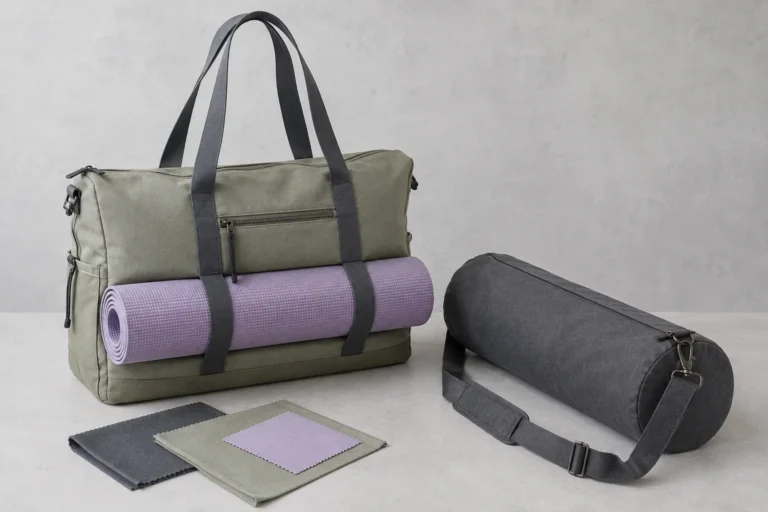
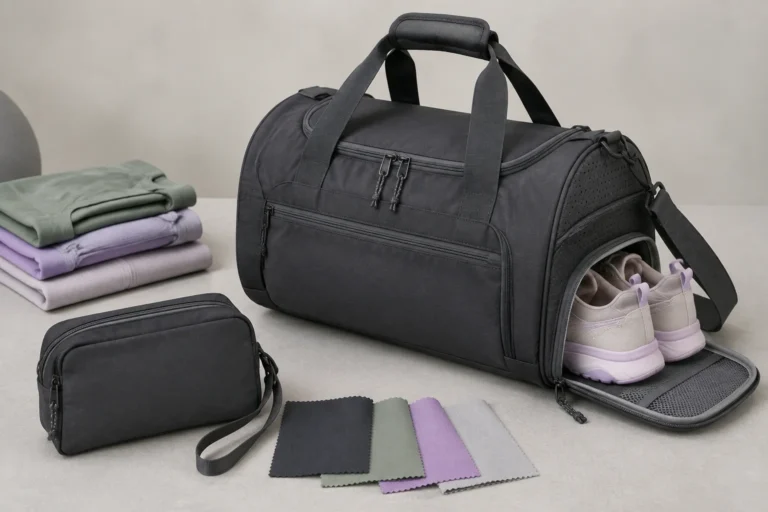
Brands building a family rather than a single style usually pair the belt bag with an active crossbody bag and a mini gym bag in the same fabric and hardware, so one colour development covers three SKUs. Influencer and creator labels in particular tend to start with a belt bag because it is the lowest-cost entry into a branded range, and the influencer and creator brand programme is built around exactly that first order.
Ordering Belt Bags in Bulk for Races, Gyms and Retail
Belt bags are ordered in three quite different patterns, and the schedule pressure is different in each.
Order path
Typical quantity
Colourways
Typical bulk lead time
What actually sets the date
First DTC or retail run
300–1,000 pcs
1–3
25–35 days
Sample rounds and lab dips before bulk starts
Retail assortment
1,000–5,000 pcs
3–6
30–40 days
Colour count; each colourway carries its own 300 pc minimum
Race or event giveaway
5,000–20,000 pcs
1–2
35–50 days
A fixed race date and sea freight, working backward
Gym or studio member kit
300–1,500 pcs
1–2
25–35 days
Logo approval and packaging format
Repeat order, unchanged spec
300–5,000 pcs
As before
20–30 days
Fabric availability in the original dye lot
MOQ starts at 300 pcs per style per colourway. That figure is the one most often misread by a first-time buyer: a four-colour belt bag assortment is 1,200 pcs, not 300, and a three-size range in two colours is 1,800. Planning a launch as one colour at 300 pcs and adding colours on the reorder is the route most startup and DTC brands take, and it keeps the first order small enough to test a design that has never been in a customer’s hands.
Working backward from a race date
Event buyers have the least forgiving schedule in this category, because the race date does not move. Working backward from it: sea freight to Europe or North America typically takes 25 to 40 days port to port, plus customs and inland; bulk production at 5,000 to 20,000 pcs takes 35 to 50 days; a lab dip for a sponsor colour takes 5 to 7 working days; and the sample itself takes 5 to 7 working days with one free revision, usually across two rounds. Add contingency and the order wants placing roughly four to five months ahead of the event. An organiser who arrives eight weeks out is choosing between air freight and a stock colour, and usually both. Corporate and event buyers who run the same event annually solve this by carrying an approved golden sample forward and reordering against it, which drops the schedule to the 20 to 30 day repeat window.
Packaging and retail presentation
A belt bag is small enough that packaging is a meaningful share of its cost and its shelf presence. Options run from a simple polybag with a hang tag, through a printed belly band, to a retail-ready box for a gift programme, and each carries a different carton count and a different labelling requirement. Sellers shipping into fulfilment centres should settle barcode placement and carton limits before the first production run rather than after, and the custom packaging and retail prep page sets out what each format needs. Amazon FBA sellers in particular benefit from settling this at sampling, because a repack after arrival costs more than the packaging did.
How to Specify a Waist Pack Bag in a Tech Pack and What to Ask a Supplier
A belt bag tech pack is short, which tempts buyers to leave things out. The lines below are the ones that change the product if they are missing, written as a worked block a sourcing manager can adapt.
STYLE            VL-RWP-01  Running waist pack, slim, one size
WEAR POSITION    Small of the back, primary; side hip acceptable
ACTIVITY         Running at pace, road and treadmill
FINISHED WEIGHT  Target 95 g, tolerance +/- 10 g

POUCH
  Finished size    255 x 110 x 32 mm, back panel curved on the
                   horizontal axis to suit an 80-110 cm waist
  Main opening     No. 5 water-resistant coil zip, full width,
                   straight run, puller with 60 mm reflective cord
  Phone pocket     Internal 172 x 88 x 16 mm, brushed tricot lining
                   on the face side, no touch-through window
  Second pocket    Flat card and key sleeve, 100 x 70 mm, key clip
                   on 80 mm elastic cord
  Compression      One 20 mm webbing pull tab, left side, ladder
                   lock, draws the loaded pouch flat to the back

BELT
  System           Flat woven elastic, 50 mm, silicone grip printed
                   on the skin side in a 6 mm broken-line pattern
  Elongation       20-35% at wearing tension, full recovery
  Adjustment       One size, overlap closure, 38 mm acetal side-
                   release buckle, usable range 62-108 cm
  Belt attachment  Bar-tacked to the pouch at four points, 2 mm
                   from the fold line, not through it

MATERIALS
  Face             210D ripstop nylon, PU-backed, roughly 95 GSM
  Skin side        Stretch woven, nylon with 10% elastane
  Lining           70D nylon taffeta, light PU
  Reflective       Retroreflective piping in both long seams,
                   plus a printed logo in reflective film, 45 mm

BRANDING
  Front            Tonal heat-transfer logo, 45 x 12 mm
  Belt             Woven label at the buckle end, 30 x 10 mm
  Care label       Cold hand wash, no fabric conditioner, air dry,
                   no tumble dryer

PACKING          Individual polybag with hang tag, 100 pcs per
                 carton, barcode on the polybag
The bag tech pack guide shows how this block sits inside a full BOM, and the RFQ checklist covers what else a quote needs before a factory can price it accurately.
Ten questions to ask a belt bag supplier
What elastic will you use, at what width, and what is its elongation and recovery specification? An answer of “elastic band, adjustable” means the factory has not chosen yet.
Is the back panel patterned flat or curved? A curved back panel is a pattern decision that has to be made before the first sample, not added afterwards.
Where does the belt attach to the pouch, and how is it reinforced? Bar tacks at four points, clear of the fold line, is the answer that survives.
Can you sample the same pouch on two belt systems so we can wear-test them? A sample room that says yes will save a full development round.
What is the silicone grip pattern, and how does it behave after twenty washes? Ask for a washed swatch, not a fresh one.
Is the wet pocket welded or stitched? Stitched needle holes leak; welded seams do not, and welding capability is not universal.
What plating do you offer on zip pullers, and how does it hold up in salt? Coated or anodised finishes outlast bright plate on a sweat-facing product.
What is the lead time if we want a moulded buckle in our colour? Expect roughly 10 to 15 days on top of the schedule.
How many stock colours do you hold in the face fabric and the elastic? Matching a belt colour to a shell colour is often what forces a dye lot and adds days.
What do you inspect on a belt bag at final inspection? The answer should include belt attachment pull, zip cycle, buckle release under load and measured belt length, alongside appearance and measurement.
How Venlinker Manufactures Custom Waist Pack Bags and Running Belts
Venlinker is Your Trusted Custom Belt Bag Manufacturer in China, building running waist packs, hydration belts, race-number belts and athleisure belt bags for activewear labels, event organisers and DTC brands from a 5,000 m² factory in Huadu District, Guangzhou.
Sampling and wear testing
The sample room turns a belt bag around in 5 to 7 working days with one free revision, and belt bags are the style where that second round earns its keep, because the first wear test almost always changes the belt width or the compression detail. Buyers who ask for the same pouch on two belt systems get both in one sampling round rather than two. The sample development page sets out what the room needs from a buyer to hold that window, and a brand that wants to feel the difference between 38 mm and 50 mm elastic before writing a tech pack can request a free sample.
Fabric, elastic and hardware sourcing
Venlinker has been building bags since 2010 and works with 200+ verified fabric suppliers, which matters more on belt bags than on duffels because the range of components is wider: face fabrics from 210D nylon to neoprene, elastic in four widths with and without silicone grip, retroreflective tape and piping, soft flask sleeving and TPU film. In-house high-frequency TPU and PVC welding means welded wet pockets and flask sleeves are built on site rather than subcontracted, which keeps the schedule and the quality record in one place. Where a brand wants a moulded buckle or a plated puller in a house colour, the OEM and ODM workflow covers how tooling fits into the sampling timeline.
Production and inspection
Ten-plus production lines running 50,000+ bags a month give the capacity for a 20,000 pc race order without displacing a 300 pc first run, and 10+ in-house designers turn out 100+ new models a month, so a brand starting from a wear position and an activity rather than a drawing has somewhere to start. Every order passes 100% pre-shipment inspection by the factory’s own team, and for belt bags that check includes belt attachment pull, buckle release under load and measured belt length as well as appearance and measurement. The final inspection page describes the sampling plan and the defect classification used. Third-party inspections from SGS, BV or TUV are welcome on any order, commissioned and paid by the buyer, and factory visits run Monday to Saturday, 40 minutes from Baiyun airport with pickup arranged, or by live video tour where travel is not practical.
MOQ starts at 300 pcs per style per colourway, payment runs 30% deposit with 70% before goods leave the factory, and FOB is the default with other terms on request. That structure suits gym and studio chains ordering a single branded belt for members, activewear and fitness brands testing a running belt alongside an existing range, and distributors and retailers who want the same pouch quoted on two belt systems to cover two price points. A buyer with a spec ready can ask for a quote with the belt section already filled in.
Waist Pack Bag and Belt Bag FAQ
What is the difference between a waist pack and a belt bag?
Physically, the belt. A running waist pack uses a wide elastic belt, typically 38 to 50 mm, pulled tight so the load moves with the body, and holds 0.5 to 1.5 L. A belt bag uses 25 to 38 mm webbing on a slider with a side-release buckle, holds 1.5 to 3 L, and is usually worn cross-body over clothing at walking pace. Commercially they are the same word, which is why a brief should name the wear position and the activity rather than the product type.
How do I stop a running waist pack from bouncing?
Four levers, in order of effect: use wide elastic (50 mm) rather than webbing, pattern the back panel with a curve so it contacts the body across its whole width, position the main pocket at the small of the back, and add a compression pull that flattens the loaded pouch against the body after the belt is fastened. Silicone grip printed on the skin side allows the same restraint at lower belt tension. Beyond roughly 1 L of dense load, no belt keeps still on a running stride.
How much can a running belt carry?
Comfortably, up to roughly 300 to 500 g on a wide elastic compression belt, which covers a handset, keys, gels and a light shell. Between 500 and 800 g is wearable at easy pace and noticeable at speed. Above 800 g the honest answer is a different product: a hydration waist pack with the mass split across two flasks, or a vest that carries the load on the torso rather than the waist.
What size should a phone pocket be in a waist pack?
Specify a range, not a model. An internal pocket of roughly 172 × 88 × 16 mm accepts current large-format handsets in a protective case with room to get a hand in. Make sure the opening runs the full width of the pocket, line the face side with a brushed tricot, and avoid clear touch-through windows on a running product, since the film creases and clouds at the fold before anything else fails.
What fabric is best for a belt bag worn against the skin?
For the face, a PU-backed 210D ripstop nylon or a coated 300 to 600D polyester gives structure, print compatibility and fast drying. For the skin side, a stretch woven with 8 to 12% elastane or a brushed tricot is more comfortable than a coated fabric. Keep vinyl-backed fabric off the skin, and ask for colour fastness to perspiration on the exact roll, commissioned from a lab of your choice, because a belt bag sees more sweat than any other bag in a range. The fabric options are listed by weight and colour on the custom materials and colours page.
What is the minimum order for custom belt bags?
300 pcs per style per colourway. The figure applies per colourway, so a three-colour assortment is 900 pcs and a three-size, two-colour range is 1,800. Bulk lead times run 25 to 35 days at 300 to 1,000 pcs, 30 to 40 days at 1,000 to 5,000, 35 to 50 days at 5,000 to 20,000, and 20 to 30 days on a repeat order against an approved golden sample.
How far ahead should an event order race belts?
Roughly four to five months before the race date for a 5,000 to 20,000 pc order shipped by sea. That covers sampling at 5 to 7 working days with a revision round, a lab dip for a sponsor colour at 5 to 7 working days, bulk at 35 to 50 days, sea freight at 25 to 40 days port to port, and customs and inland delivery. Organisers repeating an annual event against an unchanged golden sample can work to the 20 to 30 day repeat window instead.
Summary: Choosing Between a Running Waist Pack and an Athleisure Belt Bag
The two products behind the phrase waist pack bag are engineered against opposite criteria, and a brief that names only the capacity and the strap will get whichever one the factory guesses at. Naming the wear position and the activity in the first two lines of a brief settles almost everything downstream.
The belt is the product. Wide elastic (50 mm), a curved back panel, the load at the small of the back and a compression pull are what stop a running waist pack bouncing. Webbing with a side-release buckle is the right answer for a fashion belt bag worn cross-body and the wrong one for anything carried at running pace above roughly 150 g.
Capacity has a hard ceiling on a moving body. Up to roughly 1 L of dense load a good elastic compression belt stays still. Past that, no belt system does, and the range should step up to a hydration waist pack or a vest rather than promise something the physics will not deliver.
Skin contact sets the material specification. Sweat, salt and repeated washing make a belt bag the harshest wear case in a sports range. Keep vinyl off the skin, put stretch woven or brushed tricot on the body side, weld rather than stitch a wet pocket, test colour fastness to perspiration on the bulk roll, and write a care label that keeps fabric conditioner away from the silicone grip.
Brands ready to move from a concept to a wear-tested sample can send a brief through the get a quote form, or contact Venlinker to discuss the belt system before the rest of the specification is written. The wider running and light outdoor bag range shows what the same fabric and hardware set looks like across belts, pouches, slings and hydration packs, and a matched set can be quoted alongside private label bag sets or organiser pouches if the range is being built as a family.
Need a Running Waist Pack That Does Not Bounce?
Venlinker builds custom running belts, hydration waist packs, race-number belts and athleisure belt bags for activewear brands, DTC founders and event organisers, with elastic and silicone-grip options sourced from 200+ verified fabric suppliers, samples in 5–7 working days with one free revision, in-house high-frequency welding for TPU wet pockets, 100% pre-shipment inspection and MOQ from 300 pcs per style per colourway.