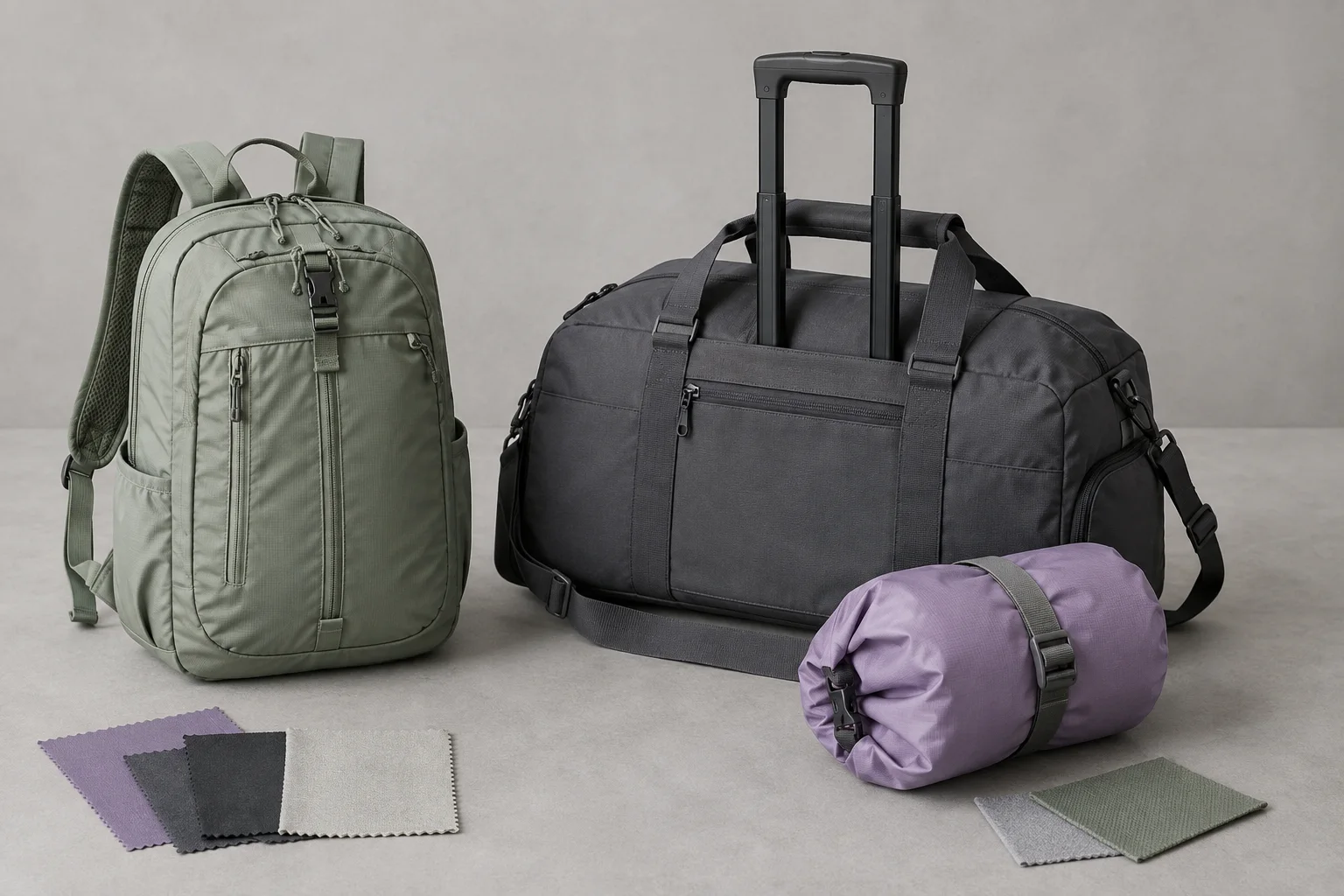
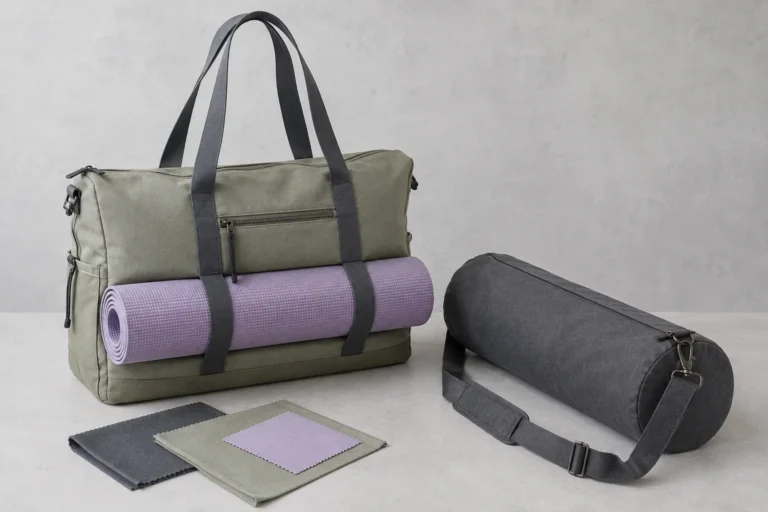
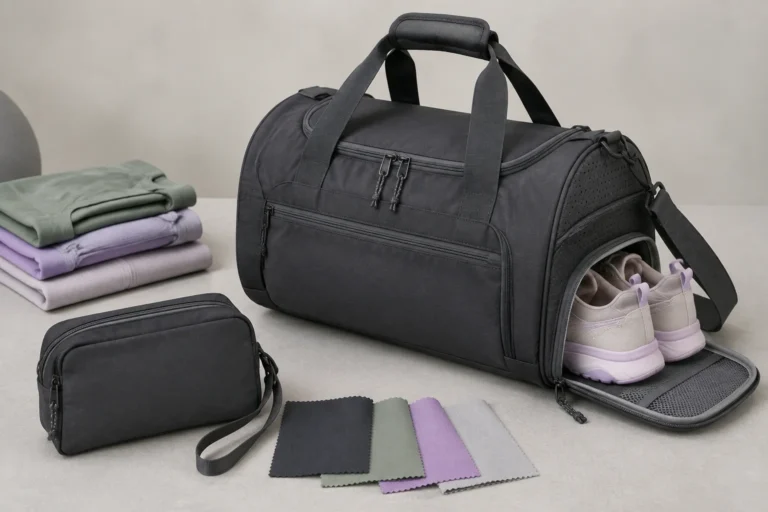
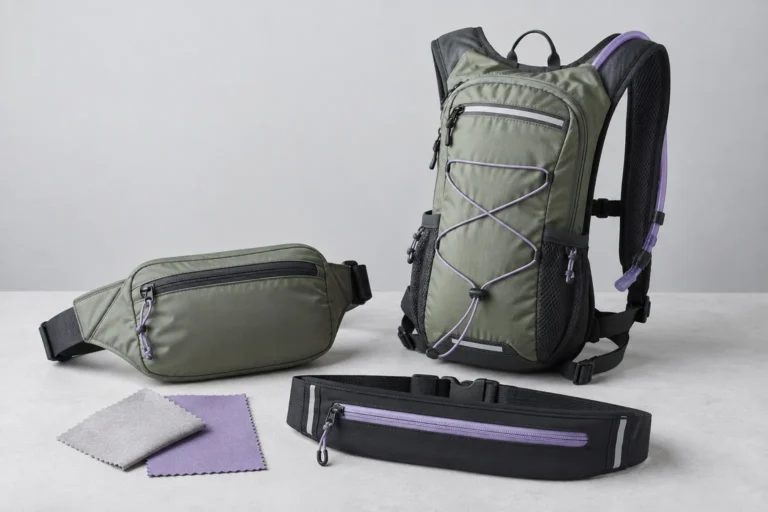
* Simply fill out the form below as best you can. And don’t sweat the details. * Your information will be kept strictly confidential. * Share your needs with us, We’ll contact you in very short time.
Planning a Custom Bag Order?
Send your bag type, quantity and target delivery date. We will review the specification and confirm the next step.
Backpack and Duffel Capacity Guide: How Big Is 20L, 25L, 40L and 60L
sourcing managers, activewear brand product managers, DTC founders, Amazon FBA sellers and gym-chain merchandise buyers who need to put a litre figure and a set of dimensions on a tech pack, and want both numbers to describe the same bag when the sample arrive
Who this guide is for: sourcing managers, activewear brand product managers, DTC founders, Amazon FBA sellers and gym-chain merchandise buyers who need to put a litre figure and a set of dimensions on a tech pack, and want both numbers to describe the same bag when the sample arrives.
A backpack size guide has to answer two questions that buyers ask in opposite directions. The product manager who has decided on “25 L” needs to know how tall, wide and deep that bag will be, so the pattern maker and the packaging team can work from it. The sourcing manager who has been handed a competitor’s bag measuring 47 × 31 × 18 cm needs to know what litre figure to print on the hangtag. Neither conversion is a straight formula, because a litre of bag capacity depends on how the factory measured it, and that method is rarely written down.
The gap matters commercially. A nominal 25 L pack can arrive as anything from 21 L to 29 L of usable space depending on whether the figure came from a box calculation or a fill test, and the same uncertainty runs through duffle bag sizes from 25 L to 60 L. A 10–20% swing in volume changes fabric consumption, finished weight, carton count per pallet and whether the bag passes as carry-on. It also decides whether a customer review says the pack “fits a laptop and gym shoes” or “runs small.”
This guide defines capacity as factories measure it, gives a capacity-to-dimension table for backpacks from 10 L to 35 L and for duffels from 25 L to 60 L, explains how straps, gussets and compartments move usable volume at the same nominal litres, sets out practical carry-on and locker limits, shows how capacity moves fabric, weight and cost tier, and finishes with a tech pack specification and a supplier checklist a buyer can attach to a quote request.
What Is a Litre of Backpack Capacity and How Factories Measure It
One litre is 1,000 cubic centimetres, or a cube 10 cm on each side. A 25 L backpack therefore holds, in principle, 25,000 cm³ of space. The word “in principle” carries the whole problem. A bag is a soft, tapered, padded shape, and there are three common ways to turn it into a litre figure. They give different answers for the same bag.
The geometric estimate: L × W × H ÷ 1,000
The quickest method takes the external height, width and depth in centimetres, multiplies them, and divides by 1,000. A pack measuring 47 × 31 × 18 cm gives 26.2 L. Every factory can do it from a tape measure, every buyer can check it from a product photo with a ruler in the shot, and it is what most quick-quote spreadsheets use.
The estimate treats the bag as a rectangular box. Real bags are not boxes. The top tapers, the corners are radiused, the back panel curves and its foam intrudes, the base is often narrower than the mid-height, and the front pockets are counted at their full depth whether or not they are filled. In most cases the geometric figure overstates the volume a customer can use by roughly 10–20%, and by more on a teardrop daypack or a duffel with rounded ends.
The fill test: 20 mm plastic balls or measured dry fill
The method used by pack makers who publish tested capacities is a fill test. The technician closes every zip except the main compartment, fills that compartment with 20 mm diameter plastic balls until the closure can just be fastened, then pours the balls into a graduated container and reads the volume. The container reading includes the air between the balls, so it reports the space the balls occupied inside the bag, which is what a customer experiences as capacity. Pockets are filled and read separately, and the sum is reported as total capacity.
Some factories substitute a measured dry fill, usually polystyrene beads, rice or dry beans poured from a container marked in litres. The result is close to the ball test and is easier on a sample room that does not stock several thousand plastic balls. A dry fill packs into corners the balls cannot enter, so it typically reads 2–5% higher than a ball test on the same bag. Either way, a filled figure lands roughly 10–20% below the geometric estimate for a conventional backpack and 15–25% below on a duffel with a cylindrical body, where the box calculation counts corners that do not exist.
Which figure a spec sheet should state
A spec sheet should state the measured figure and name the method. “25 L, main compartment, 20 mm ball fill” tells the factory what to reproduce and tells a customer what they are buying. External dimensions belong on the same line as a separate entry, so a buyer can check the box against a carry-on frame or a locker without reverse-engineering the litres. Where a brand has only ever used geometric figures on its existing range, the practical route is to hold the geometric figure for continuity and add a measured figure alongside it, so the two numbers can be reconciled on the next season’s tech pack. The bag tech pack guide shows where each entry sits in the header block.
Backpack Size Guide: Dimensions and What Fits at 10 L to 35 L
The table below sets six nominal capacities against the external dimensions that most packs at that size share, the empty-weight band for a 600D polyester shell with standard padding, what the bag holds in practice, and the Venlinker product page that runs at each size. Dimensions are typical ranges, and a given pattern can sit outside them if it is unusually tall or unusually deep.
Nominal capacity
Typical H × W × D (cm)
Typical empty weight (600D shell)
What it holds
Where it runs
10 L
35–40 × 22–26 × 10–14
150–300 g
A tablet or 11 in laptop, a light jacket, a 500 ml bottle, phone and keys
25 L is the size buyers ask about most, because it is where a laptop sleeve, a gym kit and a commute meet in one bag. A typical 25 L pack stands 45–50 cm tall, which clears a 15 in laptop in a padded sleeve with 3–5 cm to spare, and runs 30–32 cm wide and 16–20 cm deep at the base. In that envelope the main compartment takes a folded set of training clothes and a pair of training shoes up to roughly a women’s size 42 EU laid sole-to-sole, with a bottle in the side pocket. A 15 in laptop, one change of gym clothes and shoes is a fair one-line description for a hangtag.
Move down to 20 L and the shoes become the problem. The same laptop still fits, the clothes still fit, and the training shoes have to go in flat or come out. Move up to 30 L and the pack starts to look oversized on a smaller frame, which is a real concern for a women’s activewear line where the bag is photographed on the body. Most brands in this category land their hero commuter pack at 22–26 L and offer a 15–18 L studio version alongside it.
Typical backpack height (cm) by nominal capacity, 10–35 L
Each bar shows the height range most packs at that nominal capacity fall within. Ranges are industry-typical for conventional top-loading and clamshell packs, not measurements of one pattern.
The chart makes one point visible that the table does not. Height rises by roughly 3–4 cm per 5 L step at the small end and by only 2–3 cm per step above 25 L, because pattern makers add capacity to a larger pack by widening and deepening it rather than by making it taller. A pack much over 55 cm reads as a hiking pack on the body and stops fitting under a seat or in a locker. Depth is where the litres go once height is capped, which is why gusset design is covered in its own section below.
Duffle Bag Sizes: Dimensions and What Fits at 25 L to 60 L
Duffels carry more litres per centimetre of length than backpacks because the body is a near-cylinder or a deep box with no back panel foam and no laptop sleeve eating into the space. The table uses the same columns as the backpack table. Length replaces height because a duffel is carried on its side.
Nominal capacity
Typical L × W × H (cm)
Typical empty weight (600D shell)
What it holds
Where it runs
25 L
42–46 × 24–26 × 24–26
300–500 g
A gym kit with shoes, towel and bottle; the compact end of the studio-to-gym range
Both spellings are correct and both are searched. “Duffel” is the older form, from the Belgian town of Duffel whose thick woolen cloth gave the bag its name, and it is the spelling most US retailers and most bag factories use on line sheets. “Duffle” is common in UK and Australian retail and appears in a large share of search traffic everywhere. A brand should pick one for its product names and use the other in page copy and metadata, so both searches land. On a tech pack the spelling does not matter; the litre figure and the method do.
Where each duffel size sells
The 35 L duffel is the workhorse of this category. It is the size that fits a gym locker, carries shoes without a separate bag and sits on a shoulder without swinging into people on a train. Most first orders at 300 pcs in this category are a 35–40 L duffel in one colourway. The 25 L sits below it as a studio and mini gym bag and is often sold as part of a private label gym bag set with a matching pouch and shoe bag. The 45 L is the crossover into travel, and the 60 L is a team or checked-luggage bag that a women’s activewear line rarely needs unless it serves gym, studio and club chains buying for teams and trainers.
A convertible duffel backpack sits between the two tables. It is patterned as a duffel, so its litres per centimetre follow the duffel table, but it is carried as a backpack, so its length is capped at roughly 50–55 cm to keep it off the back of the knees when worn. That constraint is why most convertibles land at 30–40 L.
How Strap Geometry, Gusset Depth and Compartment Count Change Usable Volume
Two bags with the same nominal litres and the same external dimensions can differ by several litres in what a customer can pack. The difference sits in the pattern, and a buyer can specify it.
The gusset is the side panel that gives a bag its depth. A backpack with a constant 18 cm gusset from base to top holds more than one that starts at 18 cm and tapers to 10 cm at the top, even though both measure 18 cm “deep” on a spec sheet, because depth is usually quoted at the base. The taper looks slimmer in photographs and reads as a commuter bag. It also removes roughly 10–15% of the box volume. A tech pack should state depth at the base and at the top separately, or state that the gusset is constant. The guide to what a gusset is on a bag sets out the panel types behind that line, from a flat side seam to a boxed base.
Duffels have the same issue at the ends. A duffel with flat, square end panels holds close to its box volume. A duffel with round or D-shaped ends loses the corners, which is where the 15–25% gap between geometric and filled figures on duffels comes from. Boxed ends are cheaper to sew and hold more; round ends look softer and carry a small cost premium for the curved seam. The custom design and structure page walks through both end shapes with pattern illustrations.
Back panel, straps and frame
On a backpack, the padded back panel and its foam typically take 1–2 cm off the internal depth across the whole height of the bag, which is 1–2 L on a 25 L pack. An air-channel back with thick raised pads takes more. A laptop sleeve with its own foam takes another litre or so when a laptop is inside it. Shoulder straps and a sternum strap leave internal volume unchanged. A wide harness anchored low on the back panel does pull the base in when loaded, and that changes how the bag stands, which affects the filled measurement if the technician measures the bag on its base.
Compartment count
Every internal divider costs volume twice: once for the fabric and its seam allowance, and again for the space that cannot be used because the divider stops the compartments from borrowing from each other. A single-compartment 25 L pack will swallow a pair of shoes that a three-compartment 25 L pack cannot, because the shoes need a 30 × 20 × 12 cm block of space in one place. A vented shoe compartment at the base of a duffel is the clearest example. It reserves roughly 5–7 L for shoes, and that space is dead when the shoes are on the customer’s feet. A 35 L duffel with a shoe compartment therefore behaves like a 28–30 L bag for clothes, and the hangtag should be written with that in mind.
A wet-dry gym bag shows the same trade-off. Its welded TPU wet pocket keeps a swimsuit away from dry clothes, and it takes 3–5 L out of the main space when the pocket is full. Brands that want the feature without the loss usually add 3–5 L to the nominal capacity of the bag so that the dry compartment still matches the promise on the hangtag. How those compartments are arranged, and how much space a vented shoe end needs to work, is covered in the guide to wet-dry gym bags and shoe compartments.
Carry-On and Gym-Locker Size Limits for Backpacks and Duffels
Two external constraints decide which sizes a brand can sell into which use. Neither is written on a tech pack by default, and both should be.
Most carry-on limits sit around 55 × 40 × 20–23 cm, with some carriers tighter and some looser, and a soft bag can usually be squeezed into a sizing frame if it is packed below its maximum. In practice that means a 35 L backpack at the top of its height range passes when packed normally, a 45 L duffel passes when packed soft and fails when stuffed, and a 60 L duffel does not pass. A brand selling a travel-gym duffel as carry-on should hold the pattern at or below 55 × 35 × 23 cm external and say “fits most carry-on frames” on the hangtag, since the brand cannot control the carrier or the packer. Do not quote a specific carrier’s figures on the product; they change, and the product page will not.
Gym lockers vary more than aircraft bins. A full-height locker typically runs 30–40 cm wide, 45–55 cm deep and 90 cm or more high, and takes any bag in this guide standing upright. A half-height or third-height locker, which most studio chains install, typically offers 30–40 cm wide, 45–55 cm deep and 40–60 cm high. That space takes a 25 L backpack lying flat, a 35 L duffel on its side with the ends compressed, and little else. A brand supplying gym and studio chains should measure the client’s actual lockers before fixing the duffel length, because a 52 cm duffel that will not close in a 50 cm locker will come back in reviews.
Under-seat storage on trains and aircraft is the third limit that comes up on commuter packs. It is typically tighter than carry-on, and a 20–25 L pack under 45 cm tall usually clears it while a 30 L does not. That is one more reason the commuter hero pack in this category stays at 22–26 L.
How Backpack Capacity Affects Fabric Consumption, Weight and Cost
Capacity drives the area of fabric in the pattern, the area drives the weight of the shell, and both feed the price. The relationship is not linear. Surface area grows more slowly than volume, so a bag twice the litres uses roughly 1.5–1.7 times the fabric, and fixed costs such as zippers, straps, hardware and labour do not scale with litres at all. The table gives typical shell fabric areas and weights for a 600D polyester shell, before lining, webbing and hardware, and the cost tier relative to the 25 L backpack in each family.
Bag
Nominal capacity
Typical shell fabric area*
Shell weight at 600D (roughly 250 GSM)
Typical finished weight
Relative cost tier
Backpack
15 L
Roughly 0.6–0.8 m²
150–200 g
250–400 g
Lowest
Backpack
20 L
Roughly 0.8–1.0 m²
200–250 g
350–550 g
Low
Backpack
25 L
Roughly 0.9–1.2 m²
225–300 g
450–700 g
Baseline
Backpack
35 L
Roughly 1.2–1.5 m²
300–375 g
650–1,000 g
Moderate
Duffel
25 L
Roughly 1.0–1.3 m²
250–325 g
300–500 g
Low
Duffel
35 L
Roughly 1.2–1.5 m²
300–375 g
400–650 g
Baseline
Duffel
45 L
Roughly 1.4–1.8 m²
350–450 g
500–800 g
Moderate
Duffel
60 L
Roughly 1.8–2.3 m²
450–575 g
700–1,100 g
Moderate–high
*Cut area including seam allowance, before lining and pockets. Figures are typical for patterns run on Venlinker’s lines and vary with the design.
Weight
Finished weight is what customers feel and what reviews mention. A 25 L backpack in 600D with a padded back, a laptop sleeve and two side pockets lands at 450–700 g. Stripping the laptop sleeve and moving to 420D nylon brings a 20 L pack to 300–400 g, which is the packable backpack range. Stepping a 35 L duffel to 1680D raises the shell alone by roughly 250–300 g and moves the finished bag close to 1 kg. Fabric denier and capacity are the two levers on weight, and they multiply. The bag material guide covers the denier side; this guide covers the litres. For what the denier figure itself describes, and the GSM band each one lands in, see the guide to 600D polyester.
Cost
Fabric is typically 35–50% of the unit cost of a bag in this category, so a 30–40% increase in fabric area from 25 L to 35 L on a backpack adds roughly 10–20% to unit cost, and the rest of the bill of materials stays about the same. Going the other way, a 15 L version of a 25 L pack saves less than a buyer expects, often 10–15%, because the zips, straps, buckles, lining and sewing minutes are nearly the same. The cost factors guide lists the levers side by side, and the guide to zippers, buckles and webbing explains why that fixed hardware line barely moves between a 15 L and a 25 L pack. The practical outcome is that a brand launching a size range should expect the small size to carry the highest margin pressure, and price it as a companion rather than a discount.
Packing and freight
Capacity also sets carton count. A 25 L backpack packs flat at roughly 10–14 per export carton; a 35 L duffel with a stiffened base packs at 8–12; a 60 L team duffel at 4–6. On a container that difference is a freight line the buyer pays, and on a marketplace shipment the carton must stay within the usual 22.7 kg and 63.5 cm limits for fulfilment centres. The custom packaging and retail FBA prep page and the packing and export support page show how the factory nests each size.
How to Specify Backpack Capacity in a Tech Pack
A capacity specification needs five entries. Written together, they let a factory build the bag, let a QC inspector check it, and let a hangtag be printed without a second measurement.
Tech pack line
Entry
Notes
Nominal capacity
25 L
The figure that goes on the hangtag and the product page
Measurement method
20 mm ball fill, main compartment, closure fastened / measured dry fill / geometric
Name one. If the brand’s existing range is on geometric figures, state that and add a measured figure alongside
Main vs total capacity
Main 22 L, total 25 L
Total includes front and side pockets filled and read separately; state both when pockets exceed roughly 2 L
Tolerance
±5% on the measured figure (±10% for a first sample)
Fill tests repeat to within a few percent on the same bag; a wider tolerance on the first prototype allows the pattern to be adjusted at the revision
External dimensions
H × W × D at base, plus depth at top if the gusset tapers
Measured with the bag filled to nominal and standing on its base, on a flat table, in cm to the nearest 0.5 cm
Two supporting lines complete the picture. State the laptop size the sleeve must accept, in inches and in the actual cm of the device, since laptop sizes are nominal too. State the shoe size the shoe compartment must accept, as a length in cm, so the sample room can test with a physical shoe. A tech pack that reads “fits 15 in laptop” and “fits shoes” gets a sample built around whatever laptop and shoe the sample room has to hand.
Nominal, main and total capacity
Brands publish capacity three ways. Some quote the main compartment only. Some quote every pocket summed. Some quote a geometric figure of the whole bag. The three can differ by 5–8 L on the same 30 L pack, and a customer comparing two brands’ 30 L packs may be comparing a 24 L and a 32 L usable space. Stating main and total capacity separately on the tech pack, and choosing which one goes on the hangtag, removes the ambiguity inside the supply chain even if it survives at retail.
Tolerance
A soft bag has no hard volume. The same bag reads differently if the technician fastens the zip tight or leaves it slack, or stands the bag on its base rather than lays it flat. A tolerance of ±5% on the measured figure is realistic for a bag in production against its golden sample. On a first prototype, ±10% leaves room for the pattern to shift at the free revision, after which the tolerance tightens for the golden sample. The sample approval and golden sample page describes how the measured figure is recorded so that bulk production is checked against the same number.
Questions to Ask a Supplier About Bag Capacity and Dimensions
The answers to eight questions tell a buyer whether a factory’s litre figure is measured or guessed. Ask them at the quoting stage and record the answers on the tech pack.
How did you arrive at the litre figure on your quote? Expect a method, either a fill test or a geometric estimate, and expect the factory to say which.
What are the external dimensions of the sample when filled to nominal capacity? Expect three figures in cm, and a fourth for top depth if the gusset tapers.
Is the capacity main compartment only, or all compartments summed? Expect a clear answer and, on a bag with a shoe compartment or wet pocket, a split.
What tolerance do you hold on capacity between the golden sample and bulk? Expect roughly ±5%, and an explanation of how it is checked.
Which laptop and which shoe did you test the sample with? Expect a device size in cm and a shoe length, and ask for the test to be repeated with the sizes on your tech pack if they differ.
How does the bag measure with the back panel and laptop sleeve loaded? Expect the factory to know that a loaded sleeve takes roughly a litre from the main compartment.
If I need the same pattern at 20 L and 30 L, what changes? Expect a pattern maker’s answer about gusset depth and height, and a note on which hardware and straps stay common across the sizes.
What is the carton count per size, and does the largest size stay inside marketplace carton limits? Expect numbers, and a plan for the 60 L if it is in the range.
A buyer running the RFQ checklist can add these to the specification section, and a sourcing team comparing three factories can score the answers in one sheet. A factory whose answer to question one is “we used the dimensions” is quoting a geometric figure, and the buyer should expect the fill test to come in 10–20% lower. A brand that wants the capacity section of a quote answered at this level of detail can send the tech pack for a quote or contact the sample room with the two or three sizes it is considering.
How Venlinker Measures and Confirms Backpack and Duffel Capacity on Samples
Venlinker is Your Trusted Custom Backpack Manufacturer in China, and capacity is one of the first figures the sample room fixes on every new pack and duffel that goes through the Huadu District, Guangzhou factory. The process is built around the same five tech pack lines set out above, so that the litre figure a buyer approves is the litre figure the bulk order is checked against.
Pattern from litres, or litres from a pattern
Buyers arrive at the sample development team from both directions. One brand sends a target of 25 L with a laptop size and a shoe size and asks for a pattern. Another sends a reference bag or a set of external dimensions and asks what to print on the hangtag. In the first case the pattern maker starts from a base H × W × D that lands the geometric figure 10–15% above the target, cuts the prototype, and adjusts at the revision. In the second case the sample room fills the reference bag, reads it, and reports the measured figure alongside the geometric estimate so the brand can decide which to publish. The 10+ in-house designers who develop the 100+ new models a month work from the same method for the factory’s own range, which is why the size families on the gym and training bags and outdoor and travel bags hubs step in consistent increments.
Measuring the prototype
The prototype ships in 5–7 working days with one free revision. Before it leaves, the sample room fills the main compartment with 20 mm plastic balls with the closure fastened, reads the balls into a graduated container, repeats for each pocket over roughly 2 L, and records main and total capacity on the sample record. The external dimensions are taken with the bag filled to nominal and standing on its base on a flat table, at the base and at the top of the gusset. The bag is then loaded with a laptop of the size named on the tech pack and a shoe of the length named, and photographed loaded. That sample record and the loaded photographs go to the buyer with the sample, so the revision, if one is needed, is a numbers conversation and not a guess.
Holding the figure on the golden sample and in bulk
Once the buyer approves the prototype or its revision, the sample becomes the golden sample and its measured capacity, external dimensions and loaded photographs sit in its record. During production, inline production inspection checks cut panel dimensions against the pattern, since a gusset cut 5 mm narrow across a 1,000 pc run takes a litre out of every bag. At final inspection the inspector pulls bags from the lot, measures external dimensions against the golden sample, and fills a sample of them to confirm the litre figure sits inside the tolerance on the tech pack. Every bag then goes through 100% pre-shipment inspection by the factory’s own team. Third-party inspections from SGS, BV or TUV are welcome on any order, commissioned and paid by the buyer, and can include a capacity check if the buyer writes it into the scope.
What that means for a size range
MOQ starts at 300 pcs per style per colourway, and a size range counts as separate styles, which the custom bag MOQ guide explains in full. A startup or DTC brand launching a 20 L and a 25 L version of one pack therefore plans two runs of 300, sharing hardware, webbing and labels across both, which the material sourcing team buys as one lot, with shell fabric drawn from the factory’s 200+ verified fabric suppliers. Amazon FBA sellers who need a hangtag figure that holds across reorders get the same measured litres on every repeat run, because the golden sample record does not change between orders. Activewear and fitness brands that want a capacity claim tested on the exact prototype before the product page is written can request a free sample and ask for the sample record to ship with it, or ask for a quote with the capacity lines of the tech pack already filled in.
Backpack Size Guide FAQ
How big is a 25 L backpack?
A typical 25 L backpack measures roughly 45–50 cm high, 30–32 cm wide and 16–20 cm deep at the base, and weighs 450–700 g empty in 600D polyester with a padded back. It holds a 15 in laptop in a sleeve, one change of gym clothes and a pair of shoes, with a bottle in a side pocket. It fits most carry-on frames and most under-seat spaces and is the most common size for a commuter and gym pack in this category.
How do you measure bag capacity in litres?
Close every zip except the main compartment, fill it with 20 mm plastic balls until the closure just fastens, pour the balls into a graduated container and read the volume. Repeat for each pocket and add the figures for total capacity. A measured dry fill with beads or rice gives a similar result. A geometric estimate, height × width × depth in cm divided by 1,000, is quicker and typically reads 10–20% higher than the fill test because a bag is not a box.
What is the difference between a 20 L and a 25 L backpack?
About 2–4 cm of height and 2–3 cm of depth, and the difference between shoes fitting and not fitting. Both carry a 15 in laptop and a change of clothes. The 25 L takes a pair of training shoes in the main compartment alongside them; the 20 L usually needs the shoes carried flat or left out. Empty weight differs by roughly 100 g, and unit cost by roughly 8–12% at the same fabric and hardware.
Is a 40 L duffel carry-on size?
Usually, when packed soft. A 40 L duffel typically measures 50–55 × 28–30 × 28–30 cm, which sits inside the roughly 55 × 40 × 20–23 cm range that most carry-on limits use once the soft body is compressed to the frame depth. A 45 L is borderline and a 60 L is not carry-on. A brand marketing a duffel as carry-on should hold the pattern at or below 55 × 35 × 23 cm and describe it as fitting most frames, without naming a carrier.
Should a hangtag show main compartment or total capacity?
Choose one and keep it across the range. Main compartment capacity is the more conservative figure and is what a customer experiences as space for clothes and shoes. Total capacity is larger and is what most competitors publish. Whichever the brand picks, the tech pack should carry both figures and name the method, so the factory and the QC inspector check the same number. The OEM/ODM workflow shows where the figure is confirmed at each stage from prototype to bulk.
How much does capacity change the price of a bag?
Fabric is typically 35–50% of unit cost, and fabric area grows more slowly than litres. Moving a backpack from 25 L to 35 L adds roughly 10–20% to unit cost; moving from 25 L to 15 L saves 10–15% because zips, straps, hardware and sewing time stay nearly constant. On a duffel the step from 35 L to 60 L adds roughly 25–35%. Hardware and trim choices on the custom trims and hardware page move price more than 5 L of capacity does.
Can the same pattern be made in several capacities?
Yes, within limits. A pattern maker scales a pack across 20, 25 and 30 L by changing gusset depth and height while keeping the front panel, straps, zips and hardware common, so the three sizes share most of the bill of materials and a single lab dip through custom materials and colours. Beyond a 2:1 ratio in litres the proportions stop working, and a 60 L duffel is a different pattern from a 25 L, not a scaled one.
Summary: Specifying Backpack and Duffel Capacity for Your Bag Line
A litre figure describes a bag only when the method behind it is known. The buyer who writes nominal capacity, method, main versus total, tolerance and external dimensions on the tech pack gets a bag that matches the hangtag, a factory that can check it and a QC record that holds across reorders.
Measure, then state the method. A 20 mm ball fill or measured dry fill of the main compartment gives the usable figure; the geometric L × W × H ÷ 1,000 estimate typically overstates it by 10–20% on backpacks and 15–25% on duffels. Put the measured figure on the spec sheet and the external dimensions beside it.
Use the size tables as the starting envelope. A 25 L backpack runs roughly 45–50 × 30–32 × 16–20 cm and takes a 15 in laptop, a change of gym clothes and shoes; a 35 L duffel runs roughly 48–52 × 27–29 × 27–29 cm and is the standard gym size. Gusset taper, back panel foam, shoe compartments and wet pockets each take litres out of the same envelope, so specify them and adjust nominal capacity to match.
Plan the range against external limits and cost. Keep carry-on bags at or below roughly 55 × 35 × 23 cm, measure the client’s lockers before fixing a duffel length, and expect a 10 L step to move unit cost by roughly 10–20% because fabric area grows more slowly than volume.
Buyers ready to move from a litre figure to a measured prototype can send the tech pack through the get a quote form, or contact Venlinker to discuss the capacity lines before the rest of the specification is written. Brands planning a first run at 300 pcs per size can follow the project communication page for how the sample record, revision and golden sample are shared at each step.
Need a Backpack or Duffel Sampled to a Measured Capacity?
Venlinker builds custom backpacks, gym duffels and travel duffels for DTC brands, activewear labels and Amazon FBA sellers, with every prototype fill-tested and dimensioned in the sample room in 5–7 working days, fabric and trims sourced from 200+ verified suppliers, in-house high-frequency welding for wet pockets, 100% pre-shipment inspection and MOQ from 300 pcs per style.