* Simply fill out the form below as best you can. And don’t sweat the details. * Your information will be kept strictly confidential. * Share your needs with us, We’ll contact you in very short time.
Planning a Custom Bag Order?
Send your bag type, quantity and target delivery date. We will review the specification and confirm the next step.
What Is 600D Polyester? Denier, GSM and Coatings Explained for Bag Buyers
sourcing managers, DTC founders, activewear brand product managers, Amazon FBA sellers and gym-chain merchandise buyers who have seen "600D" on a quote or a tech pack and need to know what the number measures, what it leaves out, and whether it is the right fa
Who this guide is for: sourcing managers, DTC founders, activewear brand product managers, Amazon FBA sellers and gym-chain merchandise buyers who have seen “600D” on a quote or a tech pack and need to know what the number measures, what it leaves out, and whether it is the right fabric for the bag they are about to order.
Almost every quote for a custom sports bag names a fabric by denier, and 600D polyester is the number that appears most often. A buyer asking what is 600D polyester is asking three things at once: what the 600 measures, how it compares with the 300D, 900D and 1680D options on the same price list, and whether the coating and weave behind that number will hold up on a gym duffel that gets dropped on locker-room floors five days a week.
The answer matters because fabric is typically 35–50% of the unit cost of a bag in this category. Move a 40 L duffel from 600D to 1680D and the shell fabric roughly doubles in weight and lands about two cost tiers higher. Move down to 300D and the bag gets cheaper and lighter, but it will scuff through at the base corners within a season of daily use. The denier decision sets weight, hand feel, abrasion life, print behaviour and the price you can hold at retail.
This guide defines denier in plain terms, explains how it relates to GSM and weave, compares the six polyester deniers that appear on most bag spec sheets, sets polyester against nylon at equal denier, decodes PU, PVC and TPU backings and water-column ratings, and finishes with how to read a mill spec sheet and what to ask a supplier before you request a quote.
What Is 600D Polyester and What Does Denier Mean
600D polyester is a woven fabric made from polyester filament yarn that measures 600 denier, usually in both warp and weft, and almost always sold to bag factories with a polyurethane or vinyl backing. It is the standard shell fabric for gym backpacks, duffels, totes and equipment bags across the low-to-mid cost tier.
Denier: the weight of 9,000 metres of yarn
Denier (written D) is a linear density unit for yarn. One denier equals one gram per 9,000 metres of yarn. A 600D yarn therefore weighs 600 g per 9,000 m; a 300D yarn weighs 300 g over the same length, and a 1680D yarn weighs 1,680 g. Because the fibre is the same polyester in each case, a higher denier means a thicker yarn with more material in its cross-section.
Two related units appear on some mill sheets. Tex is grams per 1,000 m (600D is roughly 66.7 tex) and decitex is grams per 10,000 m (roughly 667 dtex). Bag suppliers in China quote in denier. European mills sometimes quote in dtex, and because the conversions are exact a buyer can compare the two sheets without loss.
What denier does not measure
Denier describes the yarn, not the fabric. It says nothing directly about:
Thread count or construction. How many warp ends and weft picks the mill packs into each centimetre is a separate specification. Two 600D fabrics with different pick counts feel and weigh differently.
GSM. Grams per square metre is the weight of the finished, coated fabric. It depends on denier, construction, weave and backing together.
Thickness. A 600D fabric with a heavy PVC backing can be thicker than an uncoated 900D. Thickness is measured in mm on a gauge, not inferred from denier.
Fibre type. 600D nylon and 600D polyester share a yarn weight and little else. Strength, stretch, UV behaviour and cost all differ.
Coating or finish. The D number is the same whether the roll carries a single PU pass, a heavy PVC back or nothing at all.
A sourcing manager who reads “600D” as a complete specification will get a fabric that matches the number and may not match the bag. The rest of this guide covers the lines on a spec sheet that fill the gap.
The denier × denier notation
Mill sheets often write the fabric as 600D × 600D or 600 × 300D. The first figure is the warp yarn (running the length of the roll) and the second is the weft yarn (running across the width). A 600D × 600D fabric uses the same yarn both ways. A 600 × 300D fabric uses a lighter weft, which cuts weight and cost and shows as a finer rib in one direction. Some mills sell a 300D warp with a 600D weft under a plain “600D” label. A buyer who wants the full-weight fabric should ask for both figures in writing.
How Denier Relates to GSM, Weave and Fabric Weight
The question buyers most often ask after “what does 600D mean” is “how heavy is it”. Denier alone cannot answer it. For the plain and oxford weaves used in bags, though, it predicts a typical range.
From yarn weight to fabric weight
GSM rises with denier because a thicker yarn carries more material per metre of length. It also rises with the number of yarns per centimetre and with any backing. In most mills’ spec sheets, an uncoated 600D plain-weave polyester lands roughly in the 190–240 GSM range, and the standard single PU backing adds roughly 20–40 GSM. That is how PU-backed 600D arrives at its usual quoted range of 220–280 GSM. A PVC backing adds roughly 80–150 GSM on the same base cloth, so a PVC-backed 600D can weigh as much as a PU-backed 900D.
Two 600D rolls from different mills can therefore differ by 40–60 GSM while both carrying the same denier label. The lighter roll uses fewer picks per centimetre or a thinner coating. It will cost less per metre and will drape more softly. It will also abrade faster at the base of a duffel, because there is less yarn per square centimetre to wear away before the backing shows.
Weave: plain, oxford, twill and dobby
The weave is how warp and weft interlace, and it changes how a given denier behaves:
Plain weave is the one-over-one-under standard for 600D. Balanced, stable, easy to print, the default for gym bags.
Oxford weave groups two or more warp yarns together, giving a basket texture. “600D oxford” is common on bag quotes and is used almost interchangeably with plain 600D for shell panels.
Twill shows a diagonal line and drapes more softly at the same denier. Less common on 600D, more common on 1200D and 1680D for a luggage look.
Dobby and jacquard add a small repeating pattern (diamonds, checks, a brand’s monogram). These cost more per metre and are usually sampled from 300D–600D yarn.
For a first order the safest specification is 600D × 600D plain or oxford weave, PU-backed, 220–280 GSM. Most stock colours are held in this fabric, so it also avoids a lab dip.
Typical fabric weight (GSM) by polyester denier, PU-backed plain or oxford weave
Ranges are industry-typical, not measurements of a single roll. A PVC backing adds roughly 80–150 GSM on top of these figures.
The chart shows why 600D sits where it does on most price lists. It is the lightest denier that still carries enough yarn to survive daily abrasion on a gym floor, and the heaviest that keeps a 40 L duffel under roughly 800 g finished. Above it, every step up adds weight faster than it adds usable life for a gym or studio bag; below it, the fabric is suited to pouches, drawstrings and linings where the load is light.
300D, 420D, 600D, 900D, 1200D and 1680D Polyester Compared for Bags
Six polyester deniers cover most of what a sports-bag factory stocks. The table below sets them side by side with the figures a buyer needs to place each one. Ranges are typical for PU-backed plain or oxford weaves and vary by mill.
Denier
Typical GSM (PU-backed)
Hand feel
Abrasion behaviour
Shell weight, 40 L duffel*
Cost tier
Best bag types
300D
120–160
Soft, thin, papery when uncoated
Scuffs through at base corners in months of daily use
*Shell weight assumes roughly 1.4 m² of cut fabric for a 40 L duffel body and end panels, before lining, webbing and hardware. Actual figures depend on the pattern.
Where 600D sits in the range
600D is the pivot of the table. Below it, fabrics are chosen for cost and weight and accepted as consumable. Above it, fabrics are chosen for abrasion life and structure and accepted as heavier and more expensive. For a gym, yoga or studio bag that carries clothes, shoes and a water bottle, 600D covers the load and the wear without adding grams the customer will notice on a shoulder.
Most bag factories stock 600D in 10–20 colours in-network, more than any other denier, because it is the fabric that flows through the most orders. That inventory depth is a practical advantage for a first order at 300 pcs: a stock colour avoids a lab dip and the 5–7 working days that a lab dip typically adds.
600D vs 900D polyester
The step from 600D to 900D adds roughly 80–100 GSM and moves the bag up one cost tier. The gain is abrasion life at the base and a firmer panel that holds shape when the bag is half empty. The usual way to buy that gain without paying for it across the whole bag is a 600D body with a 900D base and end panels. Wet-dry gym bags that carry a TPU divider and get set down on wet tiles are the most common case for 900D throughout.
600D vs 1680D
1680D, often called ballistic-style polyester, is a luggage fabric. At 400–480 GSM it roughly doubles the shell weight of 600D and lands about two cost tiers higher. It earns that on a travel-gym duffel that goes through baggage handling, and on team duffels at 60–90 L that get thrown into equipment trucks. For a bag carried between home, office and gym it is more fabric than the use case needs, and the extra grams show up in customer reviews about weight.
Polyester vs Nylon at the Same Denier
Nylon appears on the same spec sheets, usually at 210D, 420D and 840D, and buyers often ask whether a 600D nylon would outperform 600D polyester. At equal denier the two fibres differ in predictable ways.
Fabric is 35–50% of unit cost, so this moves the quote
Is nylon stretchy?
Slightly, and more than polyester, but not in the way spandex or a knit is stretchy. Nylon filament has a higher elongation at break than polyester filament, so a nylon woven gives a little under load and recovers. That give is why nylon straps and belts feel softer and why a nylon pack drapes instead of standing. Polyester elongates less, so a 600D polyester duffel holds its boxy shape when set down half full. Neither fabric stretches enough to change a bag’s dimensions in use, and neither is a substitute for elastic where a stretch pocket is wanted; that is a knit or a Lycra-blend mesh panel sewn into the shell.
The practical rule on a sports-bag line: polyester for duffels, totes, drawstrings, team bags and anything printed; nylon for running belts, packable packs and slings where every 20 g counts. A work-gym backpack sits on the boundary and is sampled in both 840D nylon and 900D polyester depending on the brand’s price point. The bag material guide goes deeper on the twelve fabrics that appear on this category’s spec sheets.
PU, PVC and TPU Coatings on 600D Polyester and Water-Column Ratings
Uncoated 600D polyester is not water-resistant. It sheds a light spray and soaks through in rain. The backing is what gives the fabric its water resistance, and it also sets hand feel, weight, whether the seams can be welded and how the fabric prints. Three backings account for nearly all of the 600D that reaches a bag line.
Backing
Typical thickness
Weight added
Hand feel
Water resistance
Weldable
Typical use on 600D
PU (polyurethane), single pass
Roughly 0.02–0.05 mm
+20–40 GSM
Soft, dry, fabric-like
Rain-resistant; typical water column roughly 500–1,500 mm
No; seams stitched
Default on gym duffels, backpacks, totes
PU, double pass
Roughly 0.05–0.1 mm
+40–70 GSM
Slightly firmer
Higher; roughly 1,500–3,000 mm in most mills’ sheets
A water-column figure (also written as hydrostatic head) states how tall a column of water the coated fabric can hold back before it seeps through, measured in millimetres. A 1,000 mm rating means the fabric resisted the pressure of a one-metre column of water in a lab test. The figure describes the fabric only. Water still enters a bag through stitched seams, zippers and needle holes. A “1,500 mm” 600D duffel is therefore rain-resistant, and a 0.5 mm TPU dry bag with welded seams remains the only construction in this category that should be described as waterproof.
For a gym or studio bag, a single-pass PU backing at roughly 500–1,500 mm covers rain between the car and the door. For an outdoor daypack, a double PU pass or a PU with a durable water-repellent finish on the face side is the usual step up. Where the bag must keep a wet swimsuit away from dry clothes, a higher water column on the shell solves nothing. That job belongs to a TPU-lined wet pocket with taped or welded seams. The four construction levels that separate a coated shell from a genuinely waterproof welded bag are set out in their own guide, and the coating line on a tech pack is easier to write once a buyer knows which level the bag is aiming at. Test reports for water column, colour fastness or abrasion can be commissioned by the buyer from SGS, BV, TUV or a lab of choice, and the factory’s third-party inspection support page explains how that is arranged.
Coating and printing
The backing sits on the reverse of the fabric, so it does not change how the face prints. What changes print behaviour is the fibre and the face finish. Polyester takes sublimation, screen print, heat transfer and embroidery; a calendered or heavily coated face can reject some heat-transfer films. A buyer planning an all-over graphic should name the print method on the tech pack and ask the sample room to test it on the exact roll, which is covered under custom graphics and printing.
Recycled 600D Polyester (RPET) for Bag Programs
RPET is polyester spun from recycled PET, most often post-consumer bottles. At 600D it is woven, coated and finished on the same equipment as virgin polyester, and most mills hold it at the same GSM range of 220–280 with a PU backing. On a sewing line it cuts, sews, prints and wears the same as virgin 600D of equal construction. The differences a buyer should plan for are commercial, not technical.
Cost tier sits slightly above virgin 600D, usually within one tier. Stock colour range is narrower, typically 6–12 colours against 10–20 for virgin, so a brand colour is more likely to need a lab dip. Supply is stable at 300D, 600D and 900D from larger mills, and thinner at other deniers. Lead time is the same as virgin when the roll is in-network, and adds the usual 7–14 days when it has to be brought in from a mill outside the factory’s supplier set.
Venlinker describes recycled fabric by fibre content and source, on the tech pack and on the swatch tag, and does not attach scheme names or claims to it. A buyer who needs documented recycled content for retail labelling should arrange the mill traceability and any testing directly with a lab of choice; the factory supplies roll identification and samples to support that process. The custom materials and colours page lists the recycled options in stock by denier, and startup and DTC brands often run RPET on the reorder once a first run in virgin 600D has validated the design.
How Denier Affects the Weight and Cost of a Gym Duffel, Backpack, Tote and Drawstring Bag
The denier line on a spec sheet changes two things a buyer feels directly: the finished weight of the bag and the fabric share of its cost. Both scale with the area of fabric in the pattern, so the effect is larger on a duffel than on a drawstring.
Rarely specified; 1680D is stiff for a cinch closure
*Cut area including seam allowance, before lining. Figures are typical for patterns run on Venlinker’s lines and vary with the design.
Weight
A 600D shell keeps a 40 L duffel in the 550–800 g band that most customers accept for a daily gym bag. The same pattern in 1680D lands at roughly 900–1,200 g, which reads as “heavy” in reviews for a bag that carries clothes, not luggage. The reverse move to 300D saves roughly 120–170 g on the duffel and roughly 30–50 g on a drawstring. That saving is why 300D is standard on drawstring gym bags at 1,000–20,000 pcs and rare on duffels. Where the 40 L figure itself comes from, and why two bags labelled 40 L can hold different amounts, is covered in the guide to measuring bag capacity in litres.
Cost
Because fabric is typically 35–50% of unit cost, the denier line moves the quote more than any other single choice short of hardware. A step from 600D to 900D adds roughly 10–20% to unit cost on a duffel; a step to 1680D adds roughly 30–45%. A step down to 300D on a drawstring bag takes a smaller percentage off, because cord, grommets and print are a larger share of a low-cost bag. The cost factors guide lists the other levers (hardware, lining, number of pattern pieces, logo method) against the fabric line so a buyer can trade them off in one view. Hardware is the largest of those remaining lines on most gym bags, and the guide to zipper gauges, buckles and webbing shows what each upgrade adds before the fabric is even chosen.
A middle route: mixed-denier construction
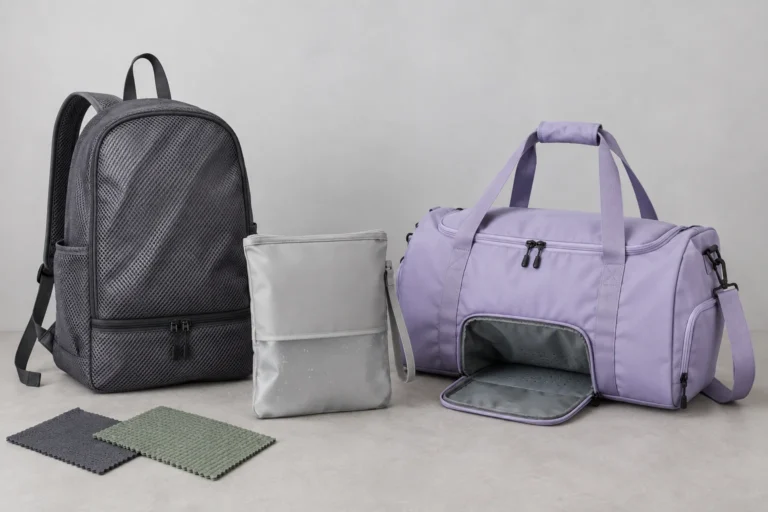
Many gym bags on the market are built from two deniers. A 600D body with a 900D or PVC-backed 600D base gets most of the abrasion gain at the point of contact for a fraction of the cost and weight of a full 900D bag. A 420D or 300D side pocket on a 600D backpack cuts weight where the panel carries no load. Private label gym bag sets often pair a 600D duffel with a 300D shoe bag and pouch, so the set holds one shared colour across three deniers. The custom design and structure page shows how the sample room lays out mixed-denier patterns.
How to Read a 600D Polyester Mill Spec Sheet
A mill spec sheet for 600D polyester runs to eight or ten lines. Each one is a decision the buyer either makes or lets the mill make by default. The table below walks through a typical sheet in the order most mills present it.
Spec sheet line
Typical entry for bag-grade 600D
What to check
Composition
100% polyester (or 100% recycled polyester)
Confirm virgin or RPET; confirm no blend
Denier (warp × weft)
600D × 600D
Ask for both figures; a 300 × 600D is lighter and cheaper
Yarn type
FDY or DTY filament
FDY gives a smoother, brighter face; DTY gives a softer, fuller, more matte hand
Construction (ends × picks)
Stated per inch or per cm
Higher count = heavier, firmer, more abrasion life at the same denier
Weave
Plain or oxford
Plain for printing; oxford for a visible texture
Weight
220–280 GSM, with tolerance
Ask for the tolerance in writing; ±5% is typical
Backing
PU 1× / PU 2× / PVC / TPU
Sets water resistance, weight and whether seams can be welded
Face finish
W/R (water-repellent), calendered, anti-static
W/R on the face plus PU on the back is the standard rain-resistant combination
Width
150 cm cuttable (58–60 in)
Narrower rolls raise fabric usage per bag
Roll length
Roughly 50–100 m per roll in most mills’ sheets
Affects how many dye lots one order draws from
Dye lot / colour
Stock colour code or lab-dip reference
One dye lot per order where possible; state the acceptable colour tolerance
Tests available
Colour fastness, abrasion, water column, tear
Commission from a lab of choice; the mill sheet alone is not a test report
Yarn type: FDY and DTY
Two filament types appear on 600D sheets. Fully drawn yarn (FDY) is smooth and bright; the fabric looks slightly glossy and prints crisply. Draw-textured yarn (DTY) is crimped, which gives a softer and more matte fabric at the same denier. Many 600D oxfords use DTY for a fabric-like hand. Many 600D plains destined for sublimation use FDY. The choice is aesthetic. It changes how two “600D” swatches look side by side, and that difference confuses buyers comparing samples from two factories more often than any abrasion result does.
Width, roll length and dye lot
Coated 600D is usually supplied at 150 cm cuttable width. A pattern nested for 150 cm will waste fabric on a 140 cm roll, so the width belongs on the tech pack. Roll length matters because a 1,000-pc duffel order draws roughly 1,000–1,300 linear metres of shell fabric at 150 cm width once nesting waste is included, which is 10–25 rolls; if those rolls come from more than one dye lot, the bags will show slight shade differences between cartons. A buyer should ask the factory to record the dye lot per roll at incoming inspection and to cut each bag from a single lot.
The bag tech pack guide shows where each of these lines sits in a bag BOM, so the fabric specification the mill supplies and the specification the factory sews from are the same document.
Questions to Ask a Supplier About 600D Fabric
A short list of questions separates a supplier who buys 600D by the number from one who buys it by the specification. Ask them before sampling, and put the answers on the tech pack.
What is the warp × weft denier of the roll you will use for my bag? Expect 600D × 600D unless you have agreed otherwise.
What is the GSM with backing, and what tolerance do you hold at incoming inspection? Expect a figure in the 220–280 range and a tolerance of roughly ±5%.
Which backing, and how many passes? PU single pass is standard; confirm PVC or TPU if you want a wipe-clean base or a welded wet pocket.
Is the fabric in-network or sourced for this order? In-network fabric keeps the sample at 5–7 working days; an out-of-network mill typically adds 7–14 days.
How many stock colours do you hold in this exact fabric, and which are closest to my brand colour? A stock colour avoids a lab dip.
Will the swatch that ships with my sample be cut from the same roll as the bulk fabric? If not, ask for the bulk swatch before the golden sample is signed off.
Do you weigh and measure rolls at incoming inspection, and can I see the record for my order? A supplier that records GSM, width and dye lot per roll can show you why a bag came out as specified.
What happens if bulk fabric arrives lighter than the golden sample? A supplier with a working inspection process rejects the roll; one without it sews the roll and hopes.
Which print and logo methods have you tested on this fabric? Ask for a printed swatch in your method before the first sample.
Can I commission an abrasion, colour-fastness or water-column test on the bulk roll? The factory should be able to send cuttings to the lab you name.
Buyers working through an RFQ checklist can fold these into the fabric section, and a sourcing team comparing three or more factories can score the answers side by side. Answers that come back as “600D, PU, standard” without figures are a sign the supplier is buying by label. What each of those lab tests actually measures, and how to read the figures that come back, is covered in the guide to crocking, abrasion and water-column testing. A sourcing manager who wants the fabric section of a quote written to this level of detail can send the tech pack for a quote or contact the sample room with a swatch request before committing to a full sample.
How Venlinker Sources and Checks 600D Polyester
Venlinker is Your Trusted Custom Gym Bag Manufacturer in China, and 600D polyester is the fabric that runs through more of the 50,000+ bags a month leaving the Huadu District factory than any other. The way the factory buys it, checks it and shows it to buyers is built around the spec-sheet lines covered above.
Sourcing from 200+ verified fabric suppliers
Venlinker holds a network of 200+ verified fabric suppliers, and 600D PU-backed polyester is stocked in depth across it, with 10–20 stock colours available at any time. Fabric moves through the material sourcing team, which records each mill’s warp × weft denier, construction, GSM, backing and width on file so that “600D” on a buyer’s tech pack maps to a specific roll specification instead of a category. Where a brand needs a fabric outside the network (a dobby 600D, a specific RPET colour, a double-PU outdoor grade), sourcing quotes the extra 7–14 days up front instead of discovering it at cutting.
Lab dips and swatches with the sample
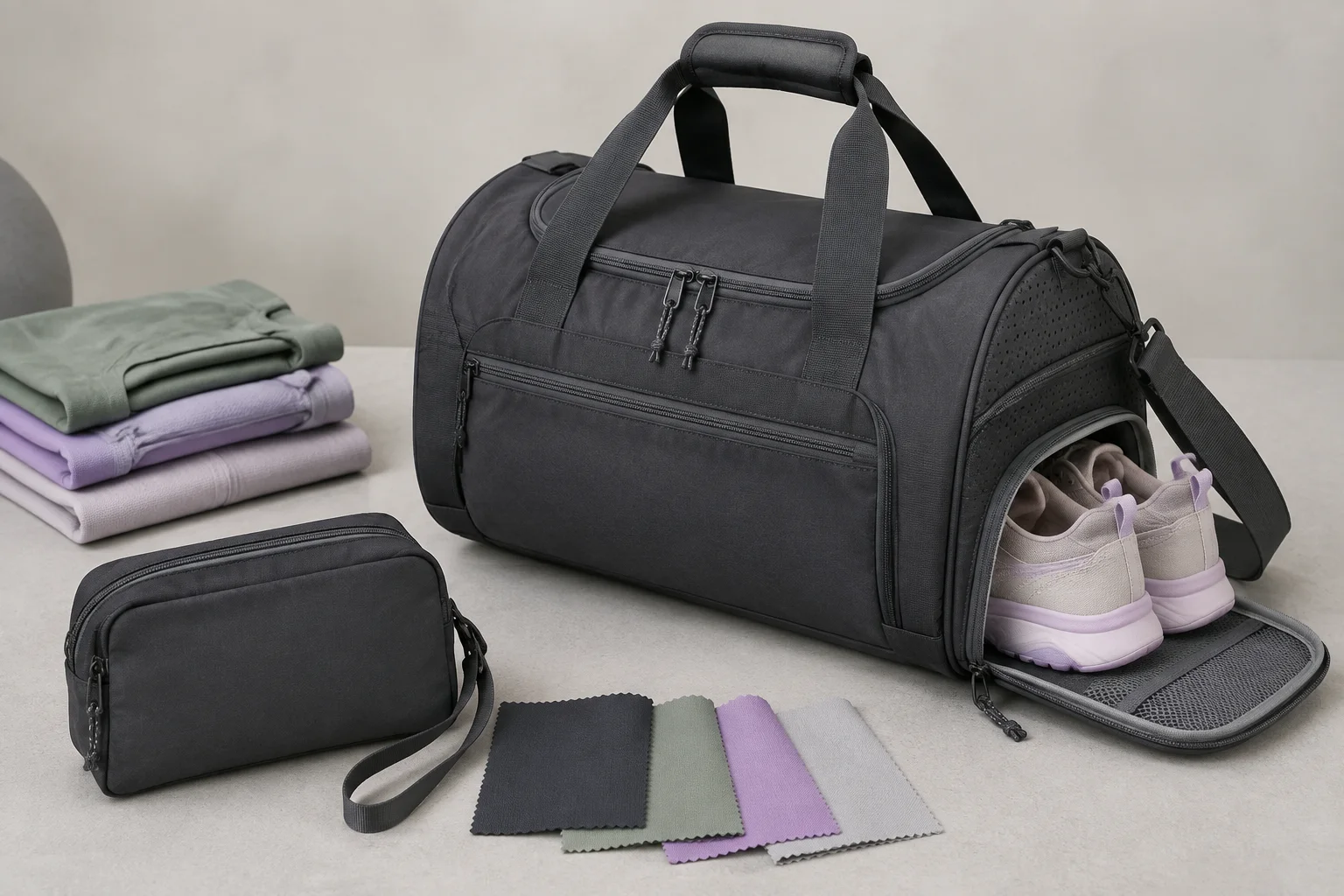
Custom colours are matched by lab dip, typically 5–7 working days from a Pantone reference or a physical colour standard, and approved by the buyer before any bulk fabric is dyed. Every bag sample ships with a swatch set, usually 5–8 fabrics cut to 10 × 10 cm and tagged with denier and GSM, and the buyer can compare the 600D used on the sample against a 900D base option or a 300D pouch fabric in hand. The sample itself takes 5–7 working days with one free revision, and the sample development page describes what the sample room needs from a buyer to hit that window.
Incoming material inspection
Every roll that arrives for a production order passes incoming material inspection before it reaches the cutting table. The inspector weighs a cutting against the GSM recorded on the golden sample, with a working tolerance of roughly ±5%, checks the cuttable width, checks the backing for pinholes and peel, matches the shade against the approved lab dip or stock standard, and records the dye lot per roll. A roll that fails is returned to the mill, and the buyer is informed if the return affects the schedule. The golden sample that the buyer signs off carries the fabric supplier and GSM in its record, so the reference is fixed before bulk is cut.
Welding, inspection and visits
Where the design calls for a PVC-backed 600D base or a TPU wet pocket, seams are welded on Venlinker’s in-house high-frequency machines, and every dry bag or wet-pocket lot gets a fill-and-hold water test at inline inspection. Finished bags pass 100% pre-shipment inspection by the factory’s own team. Third-party inspections from SGS, BV or TUV are welcome on any order, commissioned and paid by the buyer, and factory audits and visits are welcome Monday to Saturday, 40 minutes from Baiyun airport with pickup arranged. MOQ starts at 300 pcs per style per colourway, which suits activewear and fitness brands testing a new fabric on one SKU, Amazon FBA sellers who need a stable 600D spec across reorders, and distributors and retailers who want the same style quoted in two deniers to cover two price points. A buyer can request a free sample to see the 600D swatch set alongside a finished bag, or ask for a quote with the fabric section already filled in.
600D Polyester FAQ
What does 600D mean on a bag?
600D means the shell fabric is woven from 600-denier yarn, where one denier is one gram per 9,000 metres of yarn. The figure describes the yarn, and says nothing about fabric weight or thickness. On a bag it signals a medium-weight polyester, typically 220–280 GSM with a PU backing, that resists everyday abrasion at a low-to-mid cost tier. It is the standard shell fabric for gym duffels, backpacks and totes.
Is 600D polyester waterproof?
No. 600D polyester with a single PU backing is rain-resistant, with a typical water column of roughly 500–1,500 mm, and stitched seams let water through under sustained rain or immersion. A PVC backing raises surface resistance and gives a wipe-clean face. The only construction in this category that should be called waterproof is TPU film or laminate with welded seams, which is how dry bags and wet pockets are built.
Is 600D polyester good for a gym bag?
Yes, for most gym bags it is the right first choice. It survives daily floor and locker contact for a season or more, keeps a 40 L duffel in the 550–800 g range, takes embroidery, screen print, heat transfer and sublimation, and is stocked in more colours than any other denier. Step up to 900D on the base or throughout for wet-dry bags, and to 1680D only when the bag doubles as travel luggage.
What is the difference between 600D and 1680D polyester?
1680D uses a yarn 2.8 times the weight of 600D and lands at roughly 400–480 GSM against 220–280 GSM for 600D. It resists abrasion better, feels stiffer and heavier, and costs about two tiers more. A 40 L duffel in 1680D weighs roughly 900–1,200 g finished, against 550–800 g in 600D. Use 1680D on weekenders and team duffels. Keep 600D for gym, studio and everyday bags.
Is nylon or polyester better for a gym bag?
Polyester, in most cases. At equal denier nylon is stronger and roughly 10–20% lighter, but it costs more, fades faster in sun, absorbs more water and comes in fewer stock colours. For a duffel, tote or drawstring that will be printed and sold at a mid price point, 600D polyester is the better fit. For a running belt or packable pack where every 20 g counts, 210D–420D nylon is the usual choice. Details on both, and on the other fabrics on this category’s spec sheets, are in the bag material guide.
How do I know the 600D on my bulk order matches the sample?
Ask the factory to record fabric supplier, warp × weft denier, GSM and backing on the golden sample, to weigh every roll at incoming inspection against that record with a stated tolerance, and to send you a cutting from the bulk roll before cutting starts. A buyer who wants independent confirmation can commission an abrasion or colour-fastness test on that cutting from a lab of choice. Private label programs that reorder the same style several times a year usually keep a reference swatch on file for this comparison.
Can I print my logo on 600D polyester?
Yes. 600D polyester takes embroidery, screen print, heat transfer, sublimation on white or light bases, rubber and PVC patches, and woven labels. The PU or PVC backing sits on the reverse and does not affect the face print. The logo method guide compares the methods by cost tier, durability and minimum size, and the custom logo and branding page lists what the sample room needs in the artwork file.
Summary: Choosing 600D Polyester for Your Bag Line
600D polyester is the default shell fabric for gym, studio and everyday sports bags because it balances abrasion life, weight, printability and cost better than any other denier in the range. The number on the spec sheet is only the start of the specification, and the buyer who fills in the rest gets the bag they priced.
Denier is yarn weight, not fabric weight. 600D means 600 g per 9,000 m of yarn. GSM (typically 220–280 for PU-backed 600D), construction, weave and backing are separate lines, and two “600D” rolls can differ by 40–60 GSM. Ask for warp × weft denier, GSM with tolerance, backing and width in writing.
Match denier to the bag, not to the highest number. 300D for drawstrings and pouches, 600D for duffels, backpacks and totes, 900D for bases and wet-dry bags, 1680D for weekenders and team duffels. A 600D body with a 900D base is the common route to more life without the weight and cost of a full step up.
The backing sets water resistance and weldability. Single-pass PU is rain-resistant at roughly 500–1,500 mm water column; PVC gives a wipe-clean base and can be welded; TPU with welded seams is the only waterproof construction. Specify the backing on the tech pack, and plan a TPU wet pocket, not a higher water column, where wet gear is involved.
Buyers ready to move from fabric to a sampled bag can send a tech pack through the get a quote form, or contact Venlinker to discuss the fabric section before the rest of the specification is written. Brands planning a first run at 300 pcs can follow the OEM/ODM workflow from swatch to golden sample to bulk, with the 600D specification carried through each step.
Need a 600D Bag Sampled to Your Exact Fabric Spec?
Venlinker builds custom gym duffels, backpacks, totes and drawstring bags for DTC brands, activewear labels and Amazon FBA sellers, with 600D polyester sourced from 200+ verified fabric suppliers, every roll checked at incoming inspection, samples in 5–7 working days with a swatch set, in-house high-frequency welding for TPU and PVC, 100% pre-shipment inspection and MOQ from 300 pcs per style.