Resources › Logo Method Guide

Bag Logo Printing Methods: How to Put a Logo on Bags, Method by Method

Define the required test method, conditioning and pass criteria in the specification. Review the chosen material or logo method on the sample, and request an independent test where the programme requires one. custom logo and branding.
7 logo methods compared·Min logo 2–3 cm·Test to the agreed specification·Artwork: AI / PDF / 300 DPI PNG·Placement ±3 mm in bulk
Logo Method Guide-venlinker

7

Logo methods

2 cm

Smallest embroidered mark

By brief

Test requirements agreed before production

1–6

Screen print colours

By brief

Test requirements agreed before production

5–7 days

Logo sample
The 7 methods

Test to the agreed specification

Define the required test method, conditioning and pass criteria in the specification. Review the chosen material or logo method on the sample, and request an independent test where the programme requires one.

Embroidery

Thread stitched through the panel, 4–5 stitches/mm. Best on 600D–1680D polyester, canvas, neoprene and 420D+ nylon. Up to 12 thread colours; logo 2–15 cm; fine text needs 0.8 mm line weight. Standard on gym duffels and yoga totes.
Test to the agreed specification

Screen print

Ink pushed through one screen per colour onto a flat panel before sewing. 1–6 spot colours, Pantone-matched; area up to 30 × 30 cm; line weight 0.3 mm. Lowest cost per unit at 300–20,000 pcs. Standard on drawstring bags and beach totes.
Test to the agreed specification

Heat transfer

Printed film pressed at 150–170 °C for 10–15 s. Unlimited colours, gradients and photographic marks; best under 15 cm; works on nylon, polyester and PU-coated fabrics. Reflective and metallic films for reflective pouches and running belts.
Test to the agreed specification

Woven label

Damask or satin label woven at 50–100 threads/cm, then sewn on or heat-sealed. Sizes 2 × 5 cm to 5 × 10 cm; up to 8 thread colours; works on every fabric including mesh and TPU. The hang-point and interior brand for private label and accessory sets.
Test to the agreed specification

PU / rubber patch

Moulded PVC, silicone or PU patch 3–8 cm with a raised 1–2 mm logo, sewn or heat-bonded. Colour-matched to Pantone, water-proof, so it is the default on dry bags and wet bags. Mould 7–10 days; usually sensible from 500 pcs.
Test to the agreed specification

Debossing

Heated die pressed into PU, leather-look or TPU up to 8 cm; no ink, one tone. Depth 0.3–0.5 mm. Suits work-gym totes and PU trims on weekenders. Die 5–7 days; not for woven polyester or nylon.
Max 8 cm · 1 tone · Permanent · Mid tier

Metal badge

Zinc-alloy badge 2–4 cm in nickel, gunmetal, gold or matte black, riveted or sewn through a backing plate. One or two enamel colours. Mould 10–15 days; usually from 500 pcs. Used on crossbody bags and travel duffels where a printed logo would look under-priced.
2–4 cm · 1–2 enamel colours · Permanent · Mid–high tier

Order the method: logo service page

Existing showroom samples are free, with courier paid by the buyer. Custom prototypes take 5–7 working days after the specification is confirmed. We quote the prototype fee, courier charge and any sample-fee credit before work starts.
Service page · Sample 5–7 days
Send the logo file and the bag type; we recommend one method and quote its line separately within 24 hours.
By fabric

Embroidery vs Screen Print on Bags: Decision Table by Fabric

The fabric usually decides the method before budget does. Each row gives the first and second choice for that fabric and the method to avoid. Fabric names link to the material guide.
First choice
Test to the agreed specification
Second choice
Screen print (1–6 colours)
Avoid
Deboss
Reason
Woven surface will not hold a deboss
Fabric
Polyester 300D / drawstring
First choice
Screen print
Second choice
Heat transfer
Avoid
Large embroidery
Reason
Light fabric puckers over 8 cm of dense stitching
First choice
Heat transfer (under 15 cm)
Second choice
Screen print
Avoid
Dense embroidery
Reason
Needs tear-away backing; 4–5 stitches/mm distorts under 420D
Fabric
First choice
Embroidery
Second choice
PU patch
Avoid
Deboss
Reason
Coated nylon takes stitching well; no deboss surface
First choice
Embroidery
Second choice
Heat transfer
Avoid
Screen print over 10 cm
Reason
Ink cracks as neoprene stretches
Fabric
First choice
Woven label
Second choice
PU patch on a solid panel
Avoid
Screen print, heat transfer
Reason
No continuous surface for ink or film
First choice
PU patch, welded
Second choice
Heat transfer
Avoid
Embroidery
Reason
Needle holes break the waterproof layer
First choice
Deboss
Second choice
Metal badge
Avoid
Screen print
Reason
Ink does not bond to the PU surface
First choice
Screen print (water-based ink)
Second choice
Embroidery
Avoid
Heat transfer over 15 cm
Reason
Film sits on top of the weave and stiffens the panel
Fabric
First choice
Screen print or embroidery
Second choice
Heat transfer
Avoid
Deboss
Reason
Behaves as polyester of the same denier
Embroidery
600D+, canvas, neoprene
Screen print
Flat panels, 1–6 colours
Heat transfer
Nylon, gradients, under 15 cm
Patch / badge
TPU, PU, premium trims
By quantity

How to Put a Logo on Bags at 300, 1,000, 5,000 and 20,000 pcs: Decision Table by Order Quantity

Tooling costs (screens, tapes, films, moulds) spread across the run, so the sensible method shifts with quantity. The bag MOQ is 300 pcs on every row; the thresholds below are where the method’s tooling stops dominating the logo line.
Order quantity
300–500 pcs
Sensible methods
Embroidery, screen print 1–2 colours, heat transfer, woven label
Usually not sensible
Moulded patch, metal badge, deboss die
Tooling that spreads
Tape, 1–2 screens, film
Typical program
Startup first order; 1 method, 1–2 positions
Order quantity
500–1,000 pcs
Sensible methods
All of the above plus PU patch, deboss on PU trims
Usually not sensible
Metal badge below 1,000 unless brand-critical
Tooling that spreads
Patch mould 7–10 days
Typical program
Creator drop; embroidery + woven label
Order quantity
1,000–5,000 pcs
Sensible methods
All 7 methods; screen print up to 6 colours
Usually not sensible
None
Tooling that spreads
Badge mould 10–15 days
Typical program
Activewear range; 2 methods across 3–8 SKUs
Order quantity
5,000–20,000 pcs
Sensible methods
Screen print 1–2 colours for cost, embroidery for perceived value, custom-moulded hardware with logo
Usually not sensible
Heat transfer on high-abrasion panels
Tooling that spreads
Hardware mould 10–15 days, from 1,000 pcs
Order quantity
Repeat orders, any tier
Sensible methods
Same method; tooling already exists
Usually not sensible
Changing method between runs
Tooling that spreads
None; tapes, screens and moulds stored under your project code
Typical program
Schedule confirmed in the quotation
MOQ, every row
300 pcs
Patch mould
7–10 days
Badge mould
10–15 days
Tooling storage
Under your project code
Tell us the quantity and the fabric; the recommendation comes back with the logo line quoted separately.

See All 7 Methods on One Bag Sample

Existing showroom samples are free, with courier paid by the buyer. Custom prototypes take 5–7 working days after the specification is confirmed. We quote the prototype fee, courier charge and any sample-fee credit before work starts. logo and branding service.
Artwork

Logo Artwork Specs for Bags: File Types, Line Weights, Pantone Codes and Placement

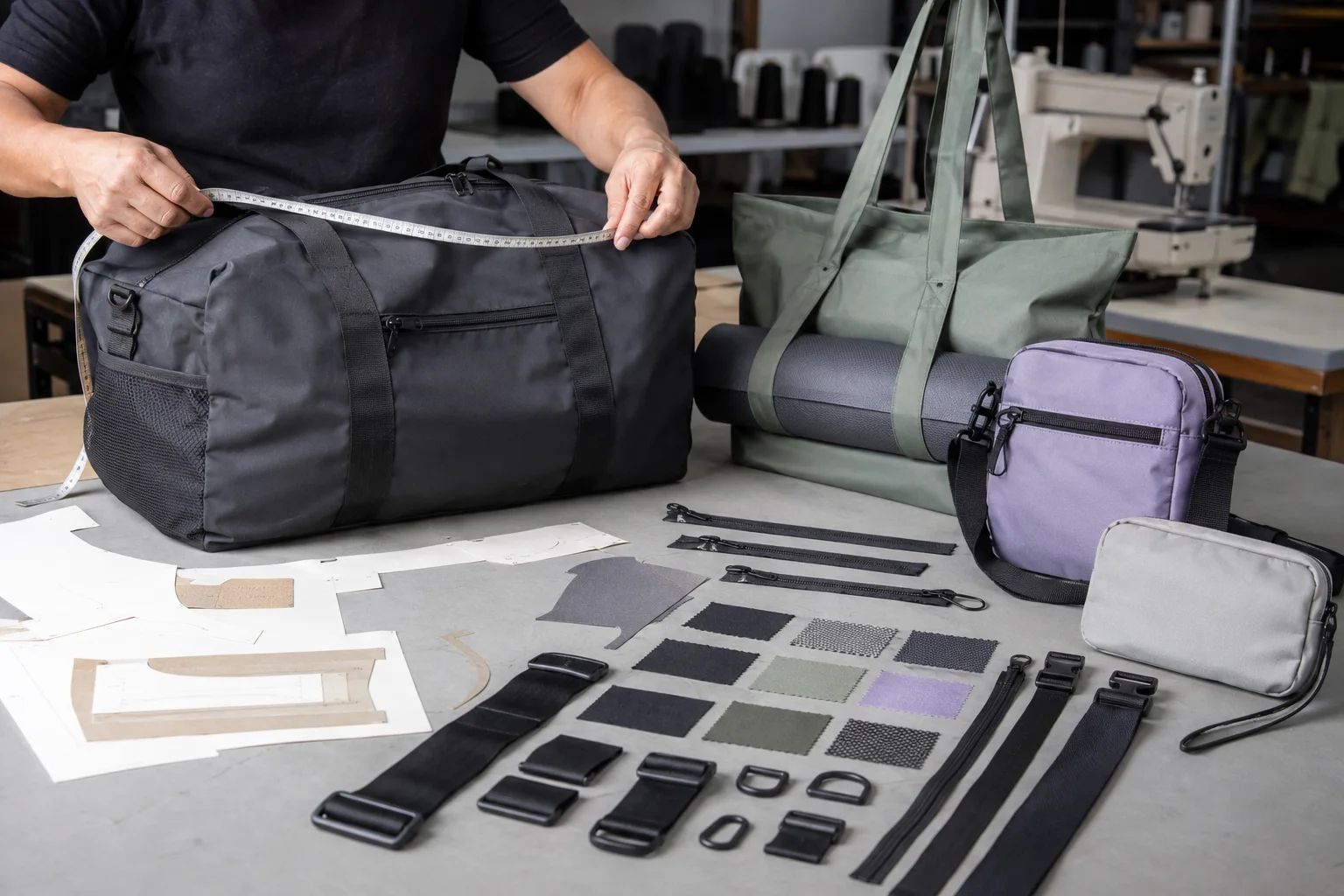
Four artwork rules that decide whether a logo sample is right first time. They apply to every method; the numbers are what our sample room checks on day 0.

File format

Our Guangzhou team coordinates design, cutting, sewing, printing and packing. Specialist logo or sealed-compartment requirements are reviewed during sampling, with the process and inspection criteria confirmed for your bag.
AI / EPS / PDF · PNG 300 DPI, 2,000 px+

Minimum line weight and size

Screen print and transfer hold 0.3 mm lines; embroidery needs 0.8 mm and letters at least 5 mm tall; deboss 1 mm. Whole logo minimum 2 cm for embroidery and print, 3 cm for patches. On Amazon thumbnails a 6 cm main-panel mark is the practical minimum for FBA listings.
Lines 0.3–1 mm · Text 5 mm · Logo 2–6 cm

Colour reference

Pantone Solid Coated for inks and enamel, Pantone TCX or TPG for thread and fabric. Without a code we match to the file on a calibrated screen and confirm on the sample. Thread has a fixed palette of 200+ shades; ink and film are mixed to the code. See materials and colours.
Pantone C / TCX · Lab dip 5–7 days

Placement spec

State each position as cm from a fixed edge: for example 8 cm logo, centred, 6 cm below the top seam of the front panel. Main panel, end pocket, strap and interior label are the usual four. A jig is cut per style and every bag is checked to ±3 mm at inline inspection.
cm from reference edge · ±3 mm
Common problems

Bag Logo Printing Problems: Cracking, Puckering, Colour Drift and How to Prevent Them

Six logo defects that account for most rejections at final inspection, with the cause and the control. The controls are applied on every order in the logo service.
Define the required test method, conditioning and pass criteria in the specification. Review the chosen material or logo method on the sample, and request an independent test where the programme requires one.
Cause: plastisol ink or transfer film on a stretch or coated fabric it does not bond to. Control: method chosen from the fabric table above; 40+ wash test on the approved sample before bulk.
Embroidery puckers the panel
Cause: stitch density too high for the fabric weight. Control: 4–5 stitches/mm with a tear-away backing on anything under 420D; embroidery avoided over 8 cm on 300D drawstring fabric.
Logo colour off from the Pantone
Cause: mixing by eye, or thread palette limits. Control: ink mixed to the Pantone chip; thread matched from the 200+ shade card and approved on the sample photo and physical bag.
Placement wanders 1 cm across the run
Cause: free-hand positioning. Control: laser-marked jig per style; ±3 mm checked on the first 20 pcs and at every inline round. See inline inspection.
Patch corner lifts
Cause: bond temperature or time too low, or patch over 5 cm relying on adhesive alone. Control: 150–170 °C for 10–15 s on a calibrated press; edge stitching on every patch over 5 cm.
Needle holes leak on a dry bag
Cause: embroidery or sewn patch through the TPU layer. Control: welded PU patch or heat transfer only on dry bags and waterproof pouches; fill-and-hold water test on the lot.
Factory

Wet-compartment construction review

Our Guangzhou team coordinates design, cutting, sewing, printing and packing. Specialist logo or sealed-compartment requirements are reviewed during sampling, with the process and inspection criteria confirmed for your bag.

2010

Founded

5,000 m²

Factory floor

500+

Staff

10+

Production lines

50,000+

Bags per month

200+

Fabric suppliers

Get a Logo Method Recommendation and Quote in 24 Hours

Send the logo file, bag type and quantity from 300 pcs. You get one recommended method, the artwork fixes needed, and the logo line priced separately from the bag.
Related guides

More Custom Bag Buyer Guides: RFQ, MOQ, Samples, Materials, Cost, Shipping

The logo method is decided at stage 5 of the buyer journey, before the sample is cut. The guides below cover the other stages with the same verified numbers.

RFQ Checklist for Custom Bags

The 12 fields that let a factory quote in 24 hours: bag type, quantity, dimensions in cm, fabric, colourways, logo file, hardware, packaging, target market, delivery date, incoterm and sample need.
12 points · Quote in 24 h

Custom Bag MOQ Guide

Why the minimum is 300 pieces: cutting lays, 50–100 m fabric rolls and dye lots. How colourways, hardware and print move the number, with 3-colourway math.
MOQ 300 pieces

Sample Cost and Lead Time

Existing showroom samples are free, with courier paid by the buyer. Custom prototypes take 5–7 working days after the specification is confirmed. We quote the prototype fee, courier charge and any sample-fee credit before work starts.
Credit terms agreed in your quote

Bag Material Guide

Polyester 300D–1680D, nylon 210D–840D, ripstop, neoprene 2–4 mm, RPET, TPU/PVC, mesh, canvas 10–16 oz and PU compared by GSM, water resistance, weight and cost tier.
12 fabrics · 3 coatings · 2 linings

OEM, ODM and Private Label

Three routes compared: your tech pack (OEM, sample 7–10 days), our models modified (ODM, sample 5–7 days) and full private label ranges of 3–8 SKUs under one brand standard.
Same 300 pcs MOQ on every route

Custom Bag Cost Factors

Fabric choice, consumption, lining and finishing affect the unit price. Compare quotations against the same approved specification.
Compare costs in your quotation

Factory vs Trading Company

How to tell a bag factory from a trading company in one visit or one video call: floor area in m², line count, in-house sample room, who answers technical questions, audit access Mon–Sat.
Audits welcome Mon–Sat

Packing and Shipping Terms

Send the current requirements for your marketplace and destination, including barcodes, bagging, warnings, carton size and weight. We confirm the packing specification and its cost before production.
FOB default · Written payment terms

Custom Bag FAQ

Custom samples take 5–7 working days after the specification is confirmed. Bulk production and repeat-order schedules are confirmed in your quotation, based on the construction, materials, quantity and production availability.
MOQ · Samples · Payment · Shipping

Bag Tech Pack Guide

What a bag tech pack contains: dimensioned drawing in cm, BOM with denier and GSM, hardware list, logo placement in cm from a reference edge, packing spec. A complete pack keeps an OEM sample at 7–10 days.
sample in 5–7 working days after specification approval with a full pack

All Custom Bag Buyer Guides

The hub: 11 guides indexed by buying stage, a 7-stage buyer journey and a one-table reference of venlinker MOQ, sample, payment and lead time terms.
11 guides · 7 buying stages

Blog: Articles on Sports Bag Sourcing

Longer articles on sports bag sourcing: fabric choices by season, gym bag design trends, FBA carton planning and what to check on a factory visit. Written by the venlinker design and merchandising team.
Sourcing articles · Updated monthly
Bag types

Logo Methods by Bag Category: Gym, Yoga, Running, Swim, Travel and Team Bags

Each category page lists 6–8 sub-types with the logo method that is standard for its fabric, the usual logo size in cm and the placement positions.

Gym & Training Bags

Duffels and backpacks in 600D–900D; embroidery 6–12 cm and PU patch standard.

Yoga & Studio Bags

Mat bags and totes in canvas or neoprene; screen print up to 30 cm, embroidery on neoprene.

Running & Outdoor Bags

Waist packs and belts in 210D–420D nylon; heat transfer and reflective film under 15 cm.

Outdoor & Travel Bags

Weekenders and dry bags; deboss on PU trims, welded PU patch on TPU.

Swim & Wet Gear Bags

Mesh and TPU bags; woven labels on mesh, welded patches on wet bags.

Team & Equipment Bags

Team duffels 60–90 L; embroidery or print up to 30 cm on the main panel.

Work-Gym Lifestyle Bags

Commuter backpacks and crossbody bags; deboss and 2–4 cm metal badge.

Accessories & Sets

Pouches, shoe bags and dust bags; woven labels and 2–5 cm screen print.
Buyer fit

Bag Logo Methods for Startups, Creators, Gym Chains and Corporate Buyers

Four buyer groups ask the logo question most often. Each Who We Serve page shows the method that group usually chooses and the order size behind it.

Startup & DTC Brands

Embroidery on the main panel plus a woven label inside; 300–1,000 pcs, tooling reused on every reorder.

Influencers & Creator Brands

One hero method (embroidery or PU patch) on the duffel and a matching woven label on the pouch; 300–1,000 pcs.

Gym, Studio & Club Chains

Screen print 1–2 colours at 500–5,000 pcs for members; embroidery on staff bags; reorders every 6–12 months.

Corporate, Event & Promotional

1–2 colour screen print on drawstrings and totes at 1,000–20,000 pcs, fixed event date.
FAQ

Test to the agreed specification

Define the required test method, conditioning and pass criteria in the specification. Review the chosen material or logo method on the sample, and request an independent test where the programme requires one. gym duffels.
Our Guangzhou team coordinates design, cutting, sewing, printing and packing. Specialist logo or sealed-compartment requirements are reviewed during sampling, with the process and inspection criteria confirmed for your bag.
2 cm for embroidery and screen print with letters at least 5 mm tall; 3 cm for moulded patches; 2 cm for metal badges. Woven labels start at 2 × 5 cm. For product photos and Amazon thumbnails we advise a 6 cm mark on the main panel.
Screen print 1–6 spot colours; embroidery up to 12 thread colours; heat transfer unlimited including gradients; woven label up to 8; PU patch 4–6; deboss 1 tone; metal badge 1–2 enamel colours. Colour count is quoted per screen or per thread change.
Define the required test method, conditioning and pass criteria in the specification. Review the chosen material or logo method on the sample, and request an independent test where the programme requires one. logo service page.
MOQ stays 300 pieces. Screens, tapes and films are made inside the 5–7 day sample window; patch moulds add 7–10 days and badge moulds 10–15, run in parallel with bulk when released at sampling. See the MOQ guide.
Yes. Main panel, end pocket, strap and interior label are the standard four; each is specified in cm from a reference edge on the tech pack and checked with a jig to ±3 mm. Each position is quoted as its own line.
On the custom logo and branding service page, or directly through the quote form with your logo file attached. A method recommendation and quote come back within 24 hours; a logo sample follows in 5–7 days.
Choose the method with the factory

Get a Bag Logo Quote and a Logo Sample From the Factory

Custom sample fees and any credit against a production order are confirmed in writing before you approve the sample work. Ask us to include these terms in your quotation.
Tel / WhatsApp
+86 133 6639 6425
MOQ
300 pieces
Sample
5–7 working days
Logo Method Guide-venlinker
Have a Bag Project in Mind?
Share the bag type, quantity and target delivery date. We will review the details with you.