* Simply fill out the form below as best you can. And don’t sweat the details. * Your information will be kept strictly confidential. * Share your needs with us, We’ll contact you in very short time.
Planning a Custom Bag Order?
Send your bag type, quantity and target delivery date. We will review the specification and confirm the next step.
Who this guide is for: US brand owners, sourcing managers, Amazon FBA sellers and DTC founders who import sports and gym bags from China, plus distributors and brands in the EU, UK, Canada, Australia and the Middle East who want to know whether the 2026 US changes touch their orders at all.
Tariffs on bags from China changed three times between February and July 2026. A Supreme Court ruling removed one set of duties, a temporary surcharge came and went, and a new Section 301 layer arrived in July. As of late September 2026, a nylon or polyester gym bag made in China and entered under HTS 4202.92.31 carries a combined duty of 55.1% of its customs value, before processing and harbour fees. For a US brand that number sets the landed cost of every gym training bag in the range, the retail price the brand can hold and, for some programmes, the country the bag should be made in.
This guide sets out the duty stack layer by layer, shows how the outer material moves the base rate, and compares China with Vietnam, Cambodia, Bangladesh, Indonesia and India for the same bag. It then covers the de minimis suspension, refunds of the IEEPA duties that were struck down, landed-cost planning for a US programme and the questions to put to a supplier and a broker. It also explains what the US changes mean for buyers importing into other markets: very little. The product side of the 2026 picture, from Pilates totes to hybrid-race bags, is covered in the sports bag trends 2026 roundup.
This is general information, not customs or legal advice. Every rate below is stated as of late September 2026. US rates on Chinese goods have changed several times this year and can change again at short notice. Before you order, have a licensed customs broker confirm the HTS classification of your actual bag and the rates in force for your entry. Venlinker is a bag factory in Guangzhou, so every bag it makes is China-origin, and this guide is written with that in view. Buyers who want a quote built around an HTS line their broker has already confirmed can send the specification for a quote.
What Changed for Tariffs on Bags From China in 2026
Five events explain the duty on a Chinese-made bag as it stands in late September 2026. Two layers ended, one temporary layer came and went, one new layer began, and a round of US–China tariff cuts left bags out.
20 February 2026: Learning Resources v. Trump
On 20 February 2026 the Supreme Court decided Learning Resources, Inc. v. Trump and held that the International Emergency Economic Powers Act (IEEPA) does not authorise tariffs, as summarised in White & Case’s alert on the termination of IEEPA-based tariffs. The same alert records what the ruling left alone: Section 301 and Section 232 tariffs were unaffected. For bag importers that is the part that matters most, because the largest China-specific layer on a bag is a Section 301 duty.
24 February 2026: IEEPA fentanyl and reciprocal tariffs end
The IEEPA “fentanyl” tariff, 10% on goods from China, and the IEEPA “reciprocal” tariffs were terminated at 12:00 a.m. ET on 24 February 2026. Importers who paid those duties before that date may now be owed refunds, covered in the refunds section below.
After the ruling to 24 July 2026: the Section 122 surcharge
A 10% surcharge under Section 122 applied after the ruling and expired on 24 July 2026. As of late September 2026 it is no longer collected, according to Airlift’s China tariff tracker, updated 25 September 2026.
24 July 2026: Section 301 forced-labor duties begin
On 24 July 2026 new Section 301 duties, arising from forced-labor investigations, took effect on imports from 60 economies at 10% or 12.5% depending on the country, under USTR’s July 2026 action. China and Vietnam are covered at 12.5%. Cambodia, Bangladesh, India and Indonesia are among the economies at 10%. The duties are administered under HTSUS 9903.05.20 to 9903.05.84, and the China line is 9903.05.31, as C.H. Robinson’s client advisory on the new forced-labor tariffs sets out.
Late September 2026: US–China tariff-cut lists leave out bags
Around 27–28 September 2026 the two governments released lists of “non-sensitive goods” for tariff cuts. As reported when the lists were published, heading 4202, the heading for bags, is on neither list. As of late September 2026, the September easing does not reduce the duty on a gym duffel, backpack or tote from China.
US duty layers on a China-made HTS 4202.92.31 bag, February to October 2026
Status as of late September 2026. General information only; rates change, and your customs broker confirms the rates for your entry.
Read from top to bottom, the chart is the duty stack. The MFN rate and the List 3 duty run across the whole chart, and the ruling left Section 301 in place. The IEEPA layer came off in February. The Section 122 surcharge ran out in July, and the forced-labor layer went on the same day. What a China-origin bag pays today is the sum of the three bars still running at the right-hand edge.
The US Duty Stack for a Gym Bag From China: HTS 4202.92.31 Layer by Layer
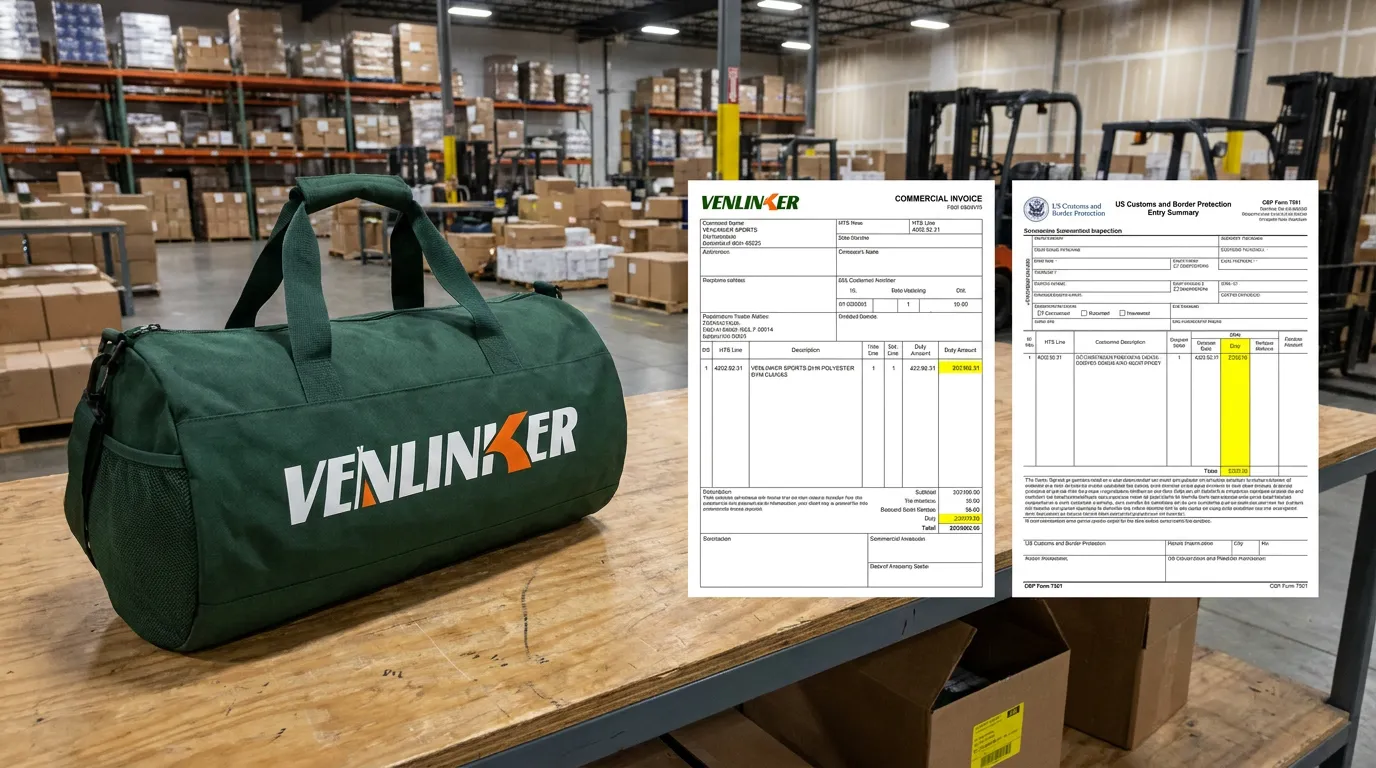
Most custom gym bags, duffels and backpacks with a nylon or polyester outer are entered under HTS 4202.92.31, the line for travel and sports bags and backpacks with an outer surface of man-made textile. Tariff Sentinel’s entry for 4202.92.31 and Gaia Dynamics’ breakdown of chapter 4202 give the MFN rate for that line as 17.6% and confirm that it carries the 25% Section 301 List 3 duty through 9903.88.03. Add the 12.5% forced-labor layer and the stack for a China-origin bag looks like this.
Layer, as of late September 2026
HTS / legal reference
Rate on customs value
Applies to a China-origin 4202.92.31 bag?
MFN (general) duty
HTSUS 4202.92.31
17.6%
Yes
Section 301 China, List 3
9903.88.03
25%
Yes
Section 301 forced-labor duty
9903.05.31 (China line within 9903.05.20–9903.05.84)
12.5%
Yes, from 24 July 2026
Total duty
Sum of the three layers above
55.1%
Yes
Merchandise Processing Fee (MPF)
Fee, not a duty
0.3464%
Yes
Harbor Maintenance Fee (HMF)
Fee on ocean shipments
0.125%
Ocean entries only
IEEPA fentanyl (China 10%) and reciprocal tariffs
IEEPA
None
No; terminated 24 February 2026
Section 122 surcharge
Section 122
None
No; expired 24 July 2026
How the layers add up
The three duty layers are each a percentage of the same customs value, so they add: 17.6% + 25% + 12.5% = 55.1%. The two fees take an ocean entry to just over 55.5%. An import-cost calculator updated 3 September 2026 shows about 55.5% all-in on its own worked example of a bag from China, which is a useful cross-check on the arithmetic. The HMF applies to ocean shipments only.
Put in index terms, a China-origin polyester gym bag with a customs value of 100 pays 55.1 in duty, plus the fees. Nothing in that stack is negotiable at the factory, and a supplier who says otherwise is describing something you should not do.
Customs value, not retail price
US duty is assessed on customs value. For a typical FOB purchase that is the value on the commercial invoice, the price paid to the factory for the bags, not the retail price and not the landed cost. Your broker confirms how value is built for your own entries. The distinction matters in the comparison further down, because a percentage gap on the invoice value is a much smaller share of a retail price.
Section 301 exclusions
According to Airlift’s tracker, 178 Section 301 exclusions remain in effect through 9 November 2026. They are not bag-specific. This guide assumes that no exclusion applies to a heading 4202 bag, and a budget should assume the same. If anyone suggests an exclusion covers your bag, ask your broker to check the exclusion text against your HTS line in writing before it goes anywhere near a costing.
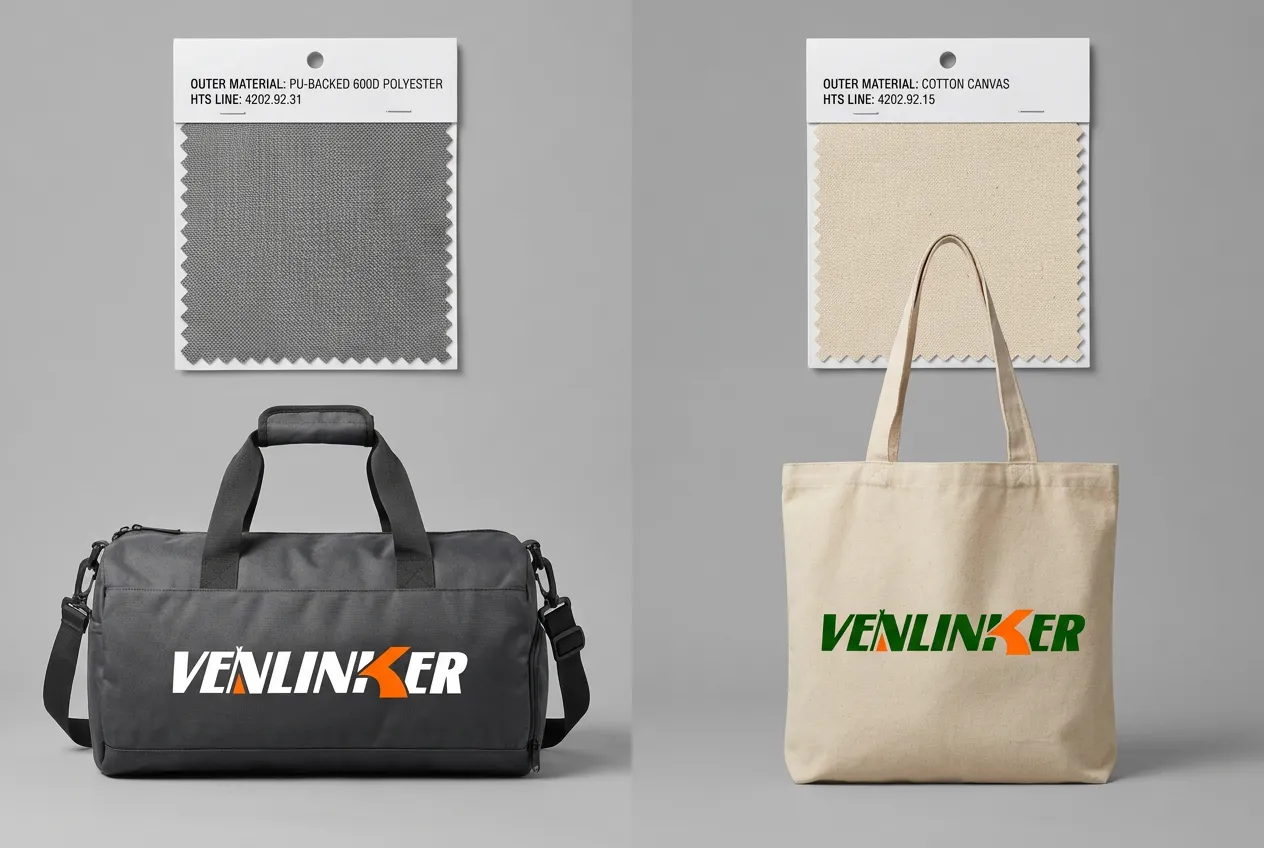
Heading 4202 is split into many lines, and the MFN rate differs from line to line. For travel and sports bags and backpacks, the material on the outer surface is one of the things that decides the line. The two lines this guide’s sources cover show how large the effect can be, as of late September 2026:
4202.92.31, outer surface of man-made textile (nylon, polyester): MFN 17.6%.
4202.92.15, outer surface of cotton: MFN 6.3%.
That is an 11.3-point difference on the MFN layer alone. For a China-origin bag the Section 301 layers are set by origin and line as well. The sources used here confirm List 3 coverage for 4202.92.31; have your broker confirm which layers apply to any other line before you cost it.
A material change is a product change
Moving a bag from polyester to cotton canvas changes the bag. Cotton canvas absorbs water, dries more slowly and cannot be high-frequency welded, so it rules out welded TPU seams on the outer. It suits some products well: a canvas yoga duffel, a studio tote or a lifestyle bag for yoga and studio customers who want a natural hand. It is a poor fit for a swim bag, a wet-dry gym bag or a training duffel that lives on a changing-room floor. The bag material guide compares the fabrics on this category’s spec sheets, and the guide to 600D polyester explains the denier, coating and weight trade-offs on the man-made side.
If a cotton outer is right for the product, it is a legitimate design decision that may also lower the base duty. The custom materials and colours page lists the canvas and polyester options the sample room works with, and a buyer can sample the same pattern in both to compare hand, weight and price before deciding.
What decides the line, and what does not
Classification depends on the actual outer surface of the finished bag. Coatings, laminates, mixed panels and trims can all change the answer, and so can the form of the bag: whether a tote is classified with travel and sports bags or on another 4202 line is a question for your broker. The fabric has to change, and the invoice has to describe the bag as it is made. Changing a label, a description or a declared composition to reach a lower line, without changing the bag, is misdeclaration.
Bag type
Typical outer material
HTS starting point to check with your broker
MFN from this guide’s sources, as of late September 2026
The table is a starting point for the conversation with your broker, and the right-hand column deliberately stays empty where this guide’s sources do not give a rate.
Import Duty on Backpacks and Gym Bags: China vs Vietnam vs Cambodia, Bangladesh, Indonesia and India
The same polyester gym bag, entered under 4202.92.31, pays a different stack depending on where it is made. The MFN rate is the same everywhere. The List 3 duty applies to China only. The forced-labor layer is 12.5% for China and Vietnam and 10% for Cambodia, Bangladesh, Indonesia and India.
Duty layer on HTS 4202.92.31, as of late September 2026
China
Vietnam
Cambodia, Bangladesh, Indonesia or India
MFN (general) duty
17.6%
17.6%
17.6%
Section 301 China List 3
25%
Not applicable
Not applicable
Section 301 forced-labor duty
12.5%
12.5%
10%
Total duty on customs value
55.1%
30.1%
27.6%
Gap against China, in percentage points
–
25.0
27.5
Duty per 100 of customs value
55.1
30.1
27.6
MPF and HMF sit on top of each column; on the China stack they add 0.3464% and 0.125% for an ocean entry, and your broker confirms the fees for each origin. On duty alone, China is the most expensive origin in this table by a wide margin. A China-made bag pays 25 points more than the same bag from Vietnam and 27.5 points more than the same bag from Cambodia, Bangladesh, Indonesia or India.
What the gap means in landed cost
Because duty is charged on customs value, the gap applies to the FOB invoice value of the bag. It does not apply to your retail price. To see the gap as a share of retail, multiply the points by the ratio of customs value to retail price:
duty gap as a share of retail = gap in percentage points × (customs value ÷ retail price)
Plug in your own figures. The lower your FOB value is as a fraction of retail, the smaller the duty gap looks at the till, and the more weight the other lines in total landed cost carry. A brand with a high-margin retail model and a brand selling on thin wholesale margins will reach different answers from the same 25 points.
When a China factory still makes sense for a US programme
Duty is one line in total landed cost. The others do not appear on a tariff schedule, and they can move a programme’s economics as much as a duty layer does. When you compare a China quote with a quote from another origin, put these lines side by side:
MOQ. A factory that runs 300 pcs per style per colourway lets a brand test several colourways without committing to volume it cannot sell. Ask every supplier for its MOQ in writing and cost the unsold stock a higher MOQ would leave you holding.
Sampling speed and revisions. Each extra sampling round pushes back the launch date. Ask how many working days a sample takes, how many revisions are included and how long a revision takes.
Fabric network. A factory with in-network mills can source a specific denier, coating or colour without adding weeks. Ask whether the fabrics on your tech pack are in-network or have to be brought in.
Specialist processes. High-frequency welding for TPU wet pockets and welded seams, heat-transfer logos or moulded hardware may be in-house at one factory and outsourced at another. Outsourcing adds handling, time and a second place for defects to start.
Lead-time reliability. A season missed or a stock-out on a marketplace listing costs revenue that a duty saving has to cover first.
Rework risk. A batch reworked or rejected at inspection costs time, freight and sometimes the season. Ask how each factory inspects before shipment and what happens to failed goods.
None of these has a universal percentage, and this guide does not invent one. Where a China factory still makes sense for a US programme is where these lines, costed honestly, outweigh the duty gap applied to FOB value. That is more likely for small first runs, frequent new styles, technical constructions and fabrics that sit inside an established Chinese fabric network. It is less likely for a large, stable, price-led programme of a simple polyester bag, where a 25-point gap on the invoice value is hard to close, and where a buyer should get quotes from lower-duty origins. The same factory can also be the right answer for a brand’s non-US markets and the wrong answer for its US volume; splitting a programme by market is a legitimate choice.
Country of origin is not a routing choice
Origin is a legal determination that your broker makes from where and how the bag is manufactured. Shipping a finished China-made bag through a third country does not change its origin, and presenting it as anything else is transshipment, which is evasion. The only legitimate way to change the origin line on the stack is to have the bag made somewhere else.
De Minimis in 2026: What the Suspension Means for DTC Parcels and Sample Shipments
Duty-free treatment for low-value parcels, known as de minimis, is suspended for shipments from all countries as of late September 2026. According to White & Case and Airlift’s tracker, the suspension was re-established on 20 February 2026 under a different legal authority after the IEEPA ruling, so the ruling did not bring the exemption back.
What it means for DTC brands
Every parcel of bags entering the US is now a dutiable import, whatever its value. A model that ships individual customer orders direct from a factory or a Chinese warehouse to US consumers pays the full stack on every parcel, plus whatever the carrier charges to clear it. For most startup and DTC brands the practical route is a bulk import into a US warehouse, 3PL or fulfilment centre, with the duty paid once per entry and built into unit cost. The custom packaging and retail and FBA prep page covers labelling, polybags and carton marks for goods that ship straight into a fulfilment network.
What it means for Amazon sellers
Amazon FBA and e-commerce sellers already import in bulk, so the change mostly affects samples, small replenishment parcels and any direct-to-customer side channel. Budget duty on each of those as you would on a container.
What it means for samples
A sample parcel from Guangzhou is a dutiable import too. Before the sample ships, agree who pays the duty and the courier’s clearance charges on it, and state the sample value on the paperwork. Splitting a shipment into several small parcels no longer serves any purpose, and splitting to avoid duty was never legitimate. The sample cost and lead time guide explains how sample fees and courier charges work at the factory end.
IEEPA Tariff Refunds: How US Importers Claim Back Duties Already Paid
Importers can now claim back the IEEPA fentanyl and reciprocal tariffs they paid before 24 February 2026. US Customs and Border Protection (CBP) runs refunds through its CAPE system in phases, with protest and litigation routes alongside, as reported by KVIA and Stacker on 22 September 2026.
Refund route, as reported late September 2026
Entries it covers
Timing
CAPE Phase 1
Unliquidated entries, and recently liquidated entries within 80 days
From 20 April 2026
CAPE Phase 2
Entries flagged for reconciliation
From June 2026
CAPE Phase 3
Court-ordered reliquidation
As ordered
Customs protest
Liquidated entries
Within 180 days of liquidation
Court of International Trade
Litigation
Case by case
As of late September 2026, some refunds remain caught between CBP and the courts, and many claims are still pending. A US importer that paid IEEPA duties on bags should:
Pull the entry list. Ask your broker for every entry that carried IEEPA duty, with the entry date and liquidation status.
Map the deadlines. For each liquidated entry, note the 180-day protest window. Missing it closes that route.
Choose the route per entry. Some entries sit in a CAPE phase; others need a protest or a court route. Your broker or trade counsel decides which.
Keep Section 301 separate. The ruling did not touch Section 301, so List 3 duties already paid are not part of any IEEPA refund.
Do not count on the cash. Until a refund is paid, leave it out of cash-flow planning for the next order.
Do US Section 301 Tariffs on Bags Affect Buyers Outside the US
No. The Section 301 List 3 duty and the forced-labor duty are US measures, applied when goods enter the United States. A brand or distributor importing bags from China into the EU, UK, Canada, Australia or the Middle East pays its own market’s normal import duty, set by that market’s own classification, and is not subject to these US layers. The same goes for the US de minimis suspension and the US–China tariff-cut lists. None of them changes what a buyer in Hamburg, Manchester, Toronto, Sydney or Dubai pays at the border.
This guide does not quote duty rates for those markets. A buyer there should confirm the classification and rate with a local customs broker, the same way a US buyer does. Distributors and retailers outside the US can compare China with other origins on the ordinary factors of price, MOQ, lead time, fabric range and inspection. The US duty stack does not enter their sums.
When a non-US brand sells into the US
A brand based outside the US that sells into the US through its own warehouse or a marketplace is a different case. When bags enter the US, the US stack applies to that entry, and origin is determined as described above. Some brands split sourcing, keeping one factory for non-US markets and running a separate costing, or a second origin, for US volume. Either approach is legitimate. Buyers planning to meet factories in person this autumn can use the Canton Fair autumn 2026 guide for bag buyers to plan the trip and a separate factory visit.
Landed Cost for Custom Bags: Planning a US Programme Under the 2026 Duty Stack
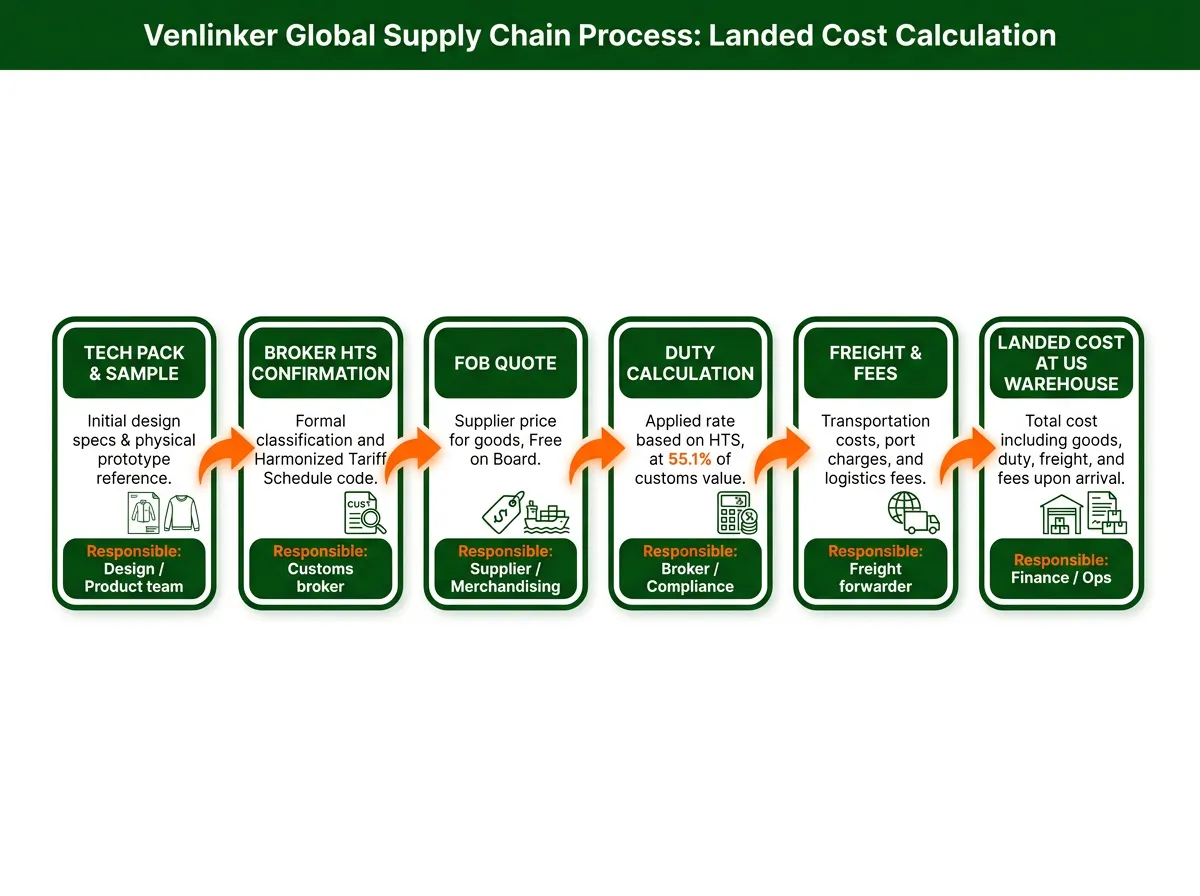
Landed cost is everything a bag costs by the time it sits in your warehouse: the factory price, freight, insurance, duty, fees, brokerage and delivery. Under the 2026 stack, duty is one of the largest variable lines for a China-origin bag, so it belongs in the target cost from the first quote. The Incoterm decides who pays each line. Venlinker quotes FOB by default and arranges CIF or DDP on request; the packing and shipping terms guide explains each term in detail.
Cost line
FOB Guangzhou or Shenzhen (default)
CIF US port (on request)
DDP to your address (on request)
Bags, packing, cartons and export clearance
Factory
Factory
Factory
Ocean or air freight
Buyer
Factory
Factory
Insurance
Buyer
Factory
Factory
US duty: MFN plus Section 301 layers
Buyer
Buyer
Factory, priced into the DDP quote
MPF, and HMF on ocean entries
Buyer
Buyer
Factory, priced into the DDP quote
Customs brokerage
Buyer
Buyer
Arranged by the factory
Delivery from port to warehouse
Buyer
Buyer
Factory
Six steps for a US bag programme
Get the HTS line confirmed at quote stage. Send your broker the tech pack, the outer material of every panel and photos of the sample before you accept a price. A classification settled after production is too late to change the design. The RFQ checklist lists what a factory needs to quote; add a line for the broker-confirmed HTS code.
Build duty into the target cost. Work from the retail or wholesale price back to a target landed cost, then subtract freight, fees and brokerage. What is left has to cover the FOB price plus 55.1% of it for a China-origin 4202.92.31 bag, as of late September 2026. The cost factors guide shows which specification lines move the FOB price.
Engineer the product cost where it genuinely changes. Duty is a percentage of customs value, so a real reduction in FOB price reduces duty in proportion. Fewer pattern pieces, stock hardware and an in-network fabric are the usual routes. The custom design and structure and custom trims and hardware pages show where those savings sit. The invoice must always show the price actually paid.
Choose the Incoterm with the duty in view. DDP puts the duty inside the factory’s price; it does not make the duty smaller. If rates change between quote and entry, a DDP price has to change with them, so agree in writing how a rate change is handled before the order is placed.
Sample under the new rules. Budget duty on sample parcels and agree who pays it. Venlinker’s sample room turns a sample in 5–7 working days with one free revision, as described on the sample development page.
Re-check rates before each shipment. Rates changed three times this year. Ask your broker which date governs your entry and confirm the stack before goods leave the factory. Production timing around the Chinese New Year break affects when goods arrive, and the Chinese New Year 2027 production planning guide works back from a warehouse date.
A buyer who wants to test a landed-cost model against a real FOB price can request a quote on one style and run it through the broker before committing to a range.
Questions to Ask Your Bag Supplier and Customs Broker About Tariffs
A tariff-ready quote needs answers from two people. The supplier knows what the bag is made of, where it is made and what it costs. The broker knows how that bag is classified and what it pays. Ask both sets of questions before sampling is signed off.
Questions for the supplier
Where exactly will the bag be made? Ask for the factory name and address. A trading company may place orders across several factories, and the factory vs trading company guide shows how to tell which you are dealing with.
What is the outer material of every panel, in writing? Your broker classifies from the outer surface, so the composition of the body, base, pockets and trims needs to be on paper.
Will the commercial invoice show the material composition, the HS code my broker confirms and the unit value per style? The invoice is the document duty is calculated from.
Which Incoterms do you quote, and how is a rate change handled under DDP?
What are your MOQ, sample time, revision policy and bulk lead time? These are the landed-cost lines that sit off the tariff schedule.
Which processes are in-house? Welding, printing and assembly done under one roof carry less rework and handling risk than processes sent out.
Questions for the customs broker
Which HTS line applies to this bag as sampled, and why?
Which Section 301 layers apply for my entry date, under which 9903 lines?
What MPF and HMF apply to my entries?
How is customs value built for my purchase terms?
Do I have IEEPA duties to recover, through which route, and by which deadlines?
How will sample parcels and any direct-to-customer shipments clear now that de minimis is suspended?
Is any Section 301 exclusion relevant to this line? Plan on the answer being no unless the broker confirms otherwise in writing.
The compliance documents page lists every document a factory can supply to support the broker’s work.
How Venlinker Supports US Importers Under the 2026 Tariffs
Venlinker is Your Trusted Custom Bag Manufacturer in China, and this guide sets out the duty picture as plainly as we can, including where it works against us. Every Venlinker bag is made in one factory in Huadu District, Guangzhou, so every bag is China-origin and pays the full China stack on entry to the US: 55.1% of customs value on a 4202.92.31 bag, plus fees, as of late September 2026. Venlinker does not give customs or legal advice, and it does not classify goods for its buyers. The HTS line is the broker’s decision.
What the factory does for your broker
Venlinker quotes FOB Guangzhou or Shenzhen by default and arranges CIF or DDP on request. For every shipment it prepares the packing list and commercial invoice for the buyer’s broker: bag description, material composition, the HS code the buyer’s broker has confirmed, unit value, quantity and Incoterm, matched line by line to the cartons. Copies go by email before departure so the broker can prepare the entry. A material list per style and colourway, naming the shell, lining, zips, webbing and trims, gives the broker the outer-surface detail classification depends on. The packing and export support page covers carton marks, documents and the handover under each Incoterm.
What the factory brings to total landed cost
The lines that sit off the tariff schedule are where a China factory has to earn its place in a US programme. Venlinker’s MOQ starts at 300 pcs per style per colourway, samples take 5–7 working days with one free revision, and bulk runs typically take 25–35 days for 300–1,000 pcs. Fabric comes from a network of 200+ verified suppliers through the material sourcing team, so most specifications are quoted without the 7–14 days an out-of-network fabric adds. High-frequency TPU and PVC welding is in-house, and every order passes 100% pre-shipment inspection by the factory’s own team, described on the final inspection page. Third-party inspections by SGS, BV or TUV are welcome on any order, commissioned and paid by the buyer.
For some US programmes those lines will outweigh a 25-point duty gap, and for others they will not. Private label programmes running gym bag sets in several colourways at modest volumes are more likely to sit in the first group; a single high-volume polyester style may sit in the second. For buyers importing into the EU, UK, Canada, Australia or the Middle East, the US layers do not apply at all. A buyer can request a free sample to check construction before running the numbers, get a quote to put a real FOB price into a landed-cost model, or contact the team to discuss Incoterms and documents.
As of late September 2026, a China-made travel or sports bag or backpack with a nylon or polyester outer, entered under HTS 4202.92.31, pays 17.6% MFN duty, 25% Section 301 List 3 duty and 12.5% Section 301 forced-labor duty: 55.1% of customs value. MPF of 0.3464% and, for ocean shipments, HMF of 0.125% apply on top. Rates change, so confirm the line and the rates with a licensed customs broker before ordering.
What is the HTS 4202 duty rate for a backpack or gym bag?
It depends on the line, and heading 4202 has many. As of late September 2026, the MFN rate on 4202.92.31 (outer surface of man-made textile) is 17.6%, and on 4202.92.15 (outer surface of cotton) it is 6.3%. Origin-based layers such as Section 301 sit on top for bags from China. Your broker confirms the line from the bag’s actual outer surface and form.
Did the Supreme Court ruling remove Section 301 tariffs on bags?
No. Learning Resources, Inc. v. Trump on 20 February 2026 held that IEEPA does not authorise tariffs, and the IEEPA fentanyl and reciprocal tariffs ended on 24 February 2026. Section 301 and Section 232 tariffs were unaffected, so the 25% List 3 duty on bags from China still applies, and a new 12.5% forced-labor layer was added on 24 July 2026.
Is de minimis still available for bags from China?
No. As of late September 2026, duty-free treatment for low-value parcels is suspended for shipments from all countries. The suspension was re-established on 20 February 2026 under a different legal authority. DTC parcels and sample shipments are dutiable, so budget duty on them and agree who pays before they ship.
Can I get a refund of IEEPA tariffs I paid on bags?
Possibly. CBP is processing refunds through its CAPE system in phases: Phase 1 from 20 April 2026, Phase 2 from June 2026 and Phase 3 for court-ordered reliquidation. A customs protest within 180 days of liquidation and the Court of International Trade are the other routes. Some refunds remain stuck as of late September 2026, so work through your entries with your broker or trade counsel. Section 301 duties are not refundable under the ruling.
Do Section 301 exclusions cover bags?
This guide assumes not. As of late September 2026, 178 Section 301 exclusions remain in effect through 9 November 2026, and they are not bag-specific. Budget List 3 at 25% on a China-origin 4202 bag unless your broker confirms otherwise in writing.
Do US tariffs apply if I import bags from China into the UK or EU?
No. The Section 301 layers are US measures. A buyer importing into the EU, UK, Canada, Australia or the Middle East pays its own market’s normal import duty and is not subject to them. Confirm your own market’s rate with a local customs broker.
Summary: Tariffs on Bags From China in 2026
The 2026 changes removed the IEEPA duties, brought in and then ended a temporary surcharge, and added a new Section 301 layer, leaving China-origin bags with the highest duty stack of the origins compared here. All of it is general information as of late September 2026, and a licensed customs broker should confirm the classification and rates before you order.
Know the stack for your line. A nylon or polyester gym bag from China under 4202.92.31 pays 17.6% + 25% + 12.5% = 55.1% of customs value, plus 0.3464% MPF and 0.125% HMF on ocean entries. The same bag pays 30.1% from Vietnam and 27.6% from Cambodia, Bangladesh, Indonesia or India. De minimis is suspended, so every parcel is dutiable.
Use only legitimate levers. The legitimate levers are a genuine material change, such as a cotton-canvas outer (6.3% MFN on 4202.92.15), a real reduction in FOB cost, a different place of manufacture and recovery of IEEPA duties already paid. A changed label, a lower declared value or a routing through a third country is evasion.
Compare total landed cost, not the duty rate alone. Duty applies to customs value, not retail. MOQ, sampling speed, fabric network, specialist processes, lead-time reliability and rework risk all sit in landed cost, and buyers importing outside the US are not subject to the US layers at all.
A sourcing team that wants to test a US or non-US programme against real numbers can send a tech pack for a quote or contact Venlinker about Incoterms and shipping documents. Brands starting from a sketch can follow the OEM/ODM workflow from sample to bulk, with the broker’s HTS confirmation built into the quote stage.
Costing a Bag Programme Around the 2026 US Duty Stack?
Venlinker makes custom gym, studio and sports bags for US brand owners, Amazon FBA sellers and distributors worldwide, quoting FOB by default with CIF or DDP on request and preparing packing lists and commercial invoices for your customs broker. Samples take 5–7 working days, MOQ starts at 300 pcs per style, fabric comes from 200+ verified suppliers and every order passes 100% pre-shipment inspection.