* Simply fill out the form below as best you can. And don’t sweat the details. * Your information will be kept strictly confidential. * Share your needs with us, We’ll contact you in very short time.
Planning a Custom Bag Order?
Send your bag type, quantity and target delivery date. We will review the specification and confirm the next step.
PFAS Rules for Bags in 2026: France, EU and California Deadlines for PFAS-Free Water-Repellent Sports Bags
PFAS free bags explained for sports bag buyers: France, EU PFHxA and California AB 1817 dates, limits, TOF testing and fluorine-free DWR specs for 2026.
Who this guide is for: compliance and sourcing managers at sports and activewear brands, product developers choosing coated fabrics for gym, swim and outdoor bags, and distributors selling into France, the EU and California who need to know which PFAS dates apply to a bag, which limits a lab will test against and what to write in the next tech pack.
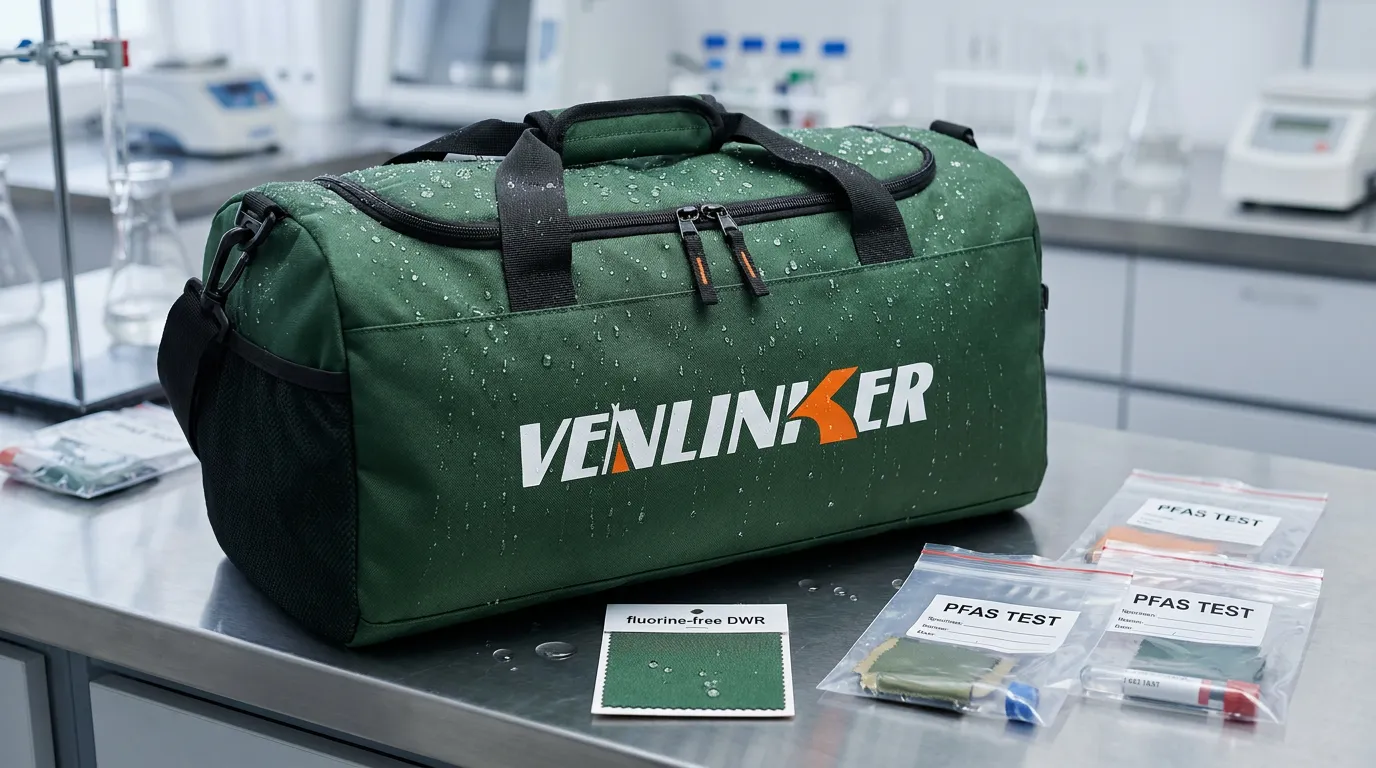
PFAS free bags have moved from a sustainability talking point to a date on the calendar. As of late September 2026, three sets of rules decide what a water-repellent sports bag may contain. California’s textile law names backpacks and handbags and has capped total organic fluorine at 100 ppm since January 2025. France’s ban started on 1 January 2026 for clothing and footwear and reaches textile products generally in 2030. The EU restriction on PFHxA applies from 10 October 2026 to clothing and related accessories and from 10 October 2027 to other consumer textiles. A gym duffel, swim bag or commuter backpack with a durable water-repellent (DWR) finish falls under at least one of them.
The decisions are practical. Which finish goes on the shell. Whether the zip tape, webbing and labels need their own line on the spec. Which lab test to order, on which materials, and who pays. Whether stock already on the water can still be sold. Orders placed this autumn reach Europe after the EU date, so for most bag programmes the open question is how to specify a fluorine-free finish and how to prove it worked.
This guide sets the three deadlines side by side, explains the “is a bag an accessory” question under the EU rule, and covers existing stock, testing, a line-by-line tech pack spec, the trade-offs of fluorine-free DWR and the questions to put to a supplier. It is general information, not legal advice. Whether a specific product falls in scope is a question for your compliance adviser or a testing lab, and every date below should be confirmed with them. Buyers who already have a draft spec can send it for a quote and ask for the finish options on each material.
What Are PFAS and Why Do Sports Bags Contain Them
PFAS, short for per- and polyfluoroalkyl substances, are a large family of man-made chemicals built on carbon–fluorine bonds. Those bonds give a treated surface very low surface energy, so water and oil bead up and roll off instead of soaking in. The same bonds break down very slowly in the environment, hence the nickname “forever chemicals”. In textiles the main use has been water, oil and stain repellency.
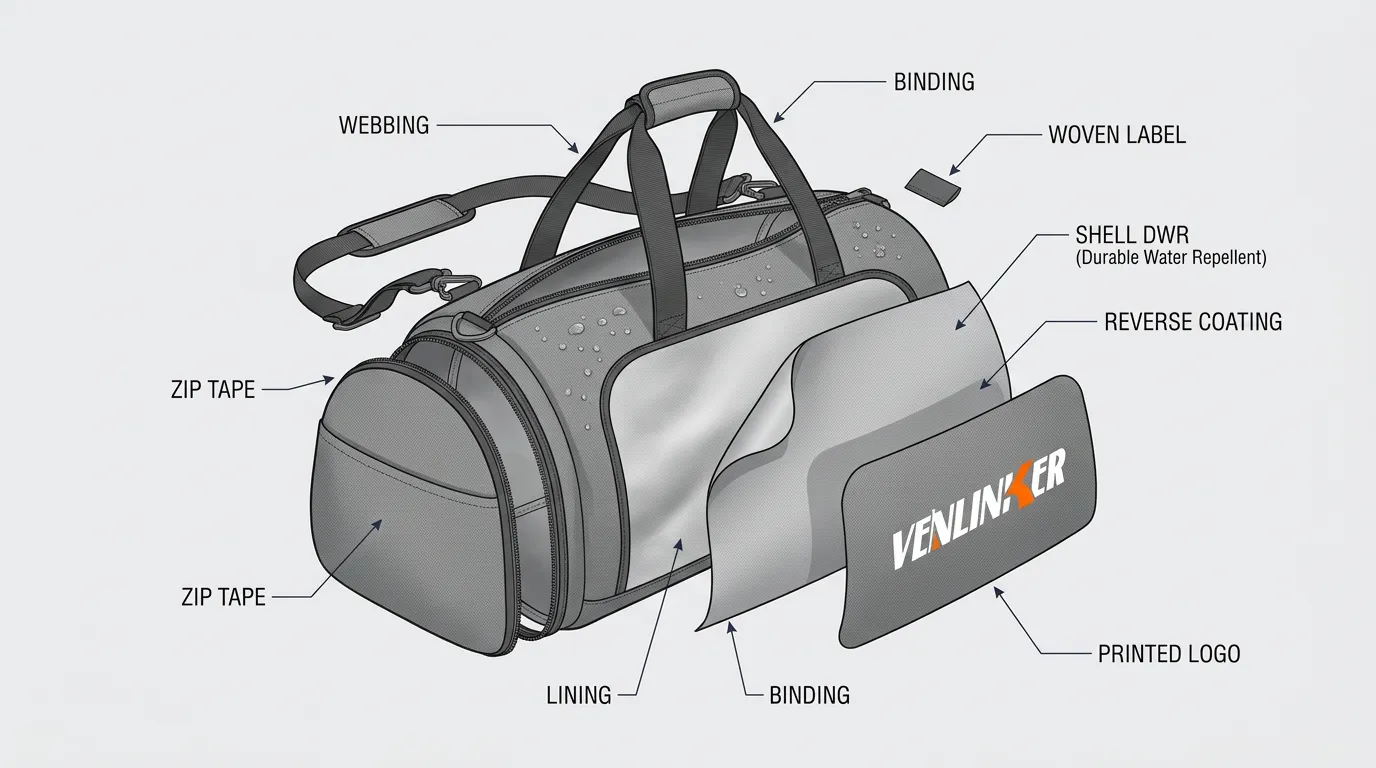
A sports bag picks up PFAS the way a rain jacket does, through the finishes on its fabrics and trims. A bag usually has more separate materials than a garment, and each arrives from a different supplier with its own finishing history.
Where PFAS can sit on a bag
Shell fabric DWR. The water-repellent finish on the face of woven polyester or nylon is usually the main intentional source. It makes rain bead on a gym duffel or daypack and keeps the face from wetting out and darkening.
Coatings and laminates. The PU, PVC or TPU layer on the reverse does the waterproof work on most bags. Some coating formulations can carry fluorinated additives, and a fabric may have been given a fluorinated face finish before it was coated.
Trims. Zip tapes, water-repellent zips, webbing, binding and drawcords are sometimes finished to match the shell, which means a bag can carry PFAS in its trims after the shell has been switched.
Labels, heat-transfer films and print inks. Less common, but some printed labels, transfer films and ink systems can contain fluorinated additives. A lab may still test these small components as separate materials.
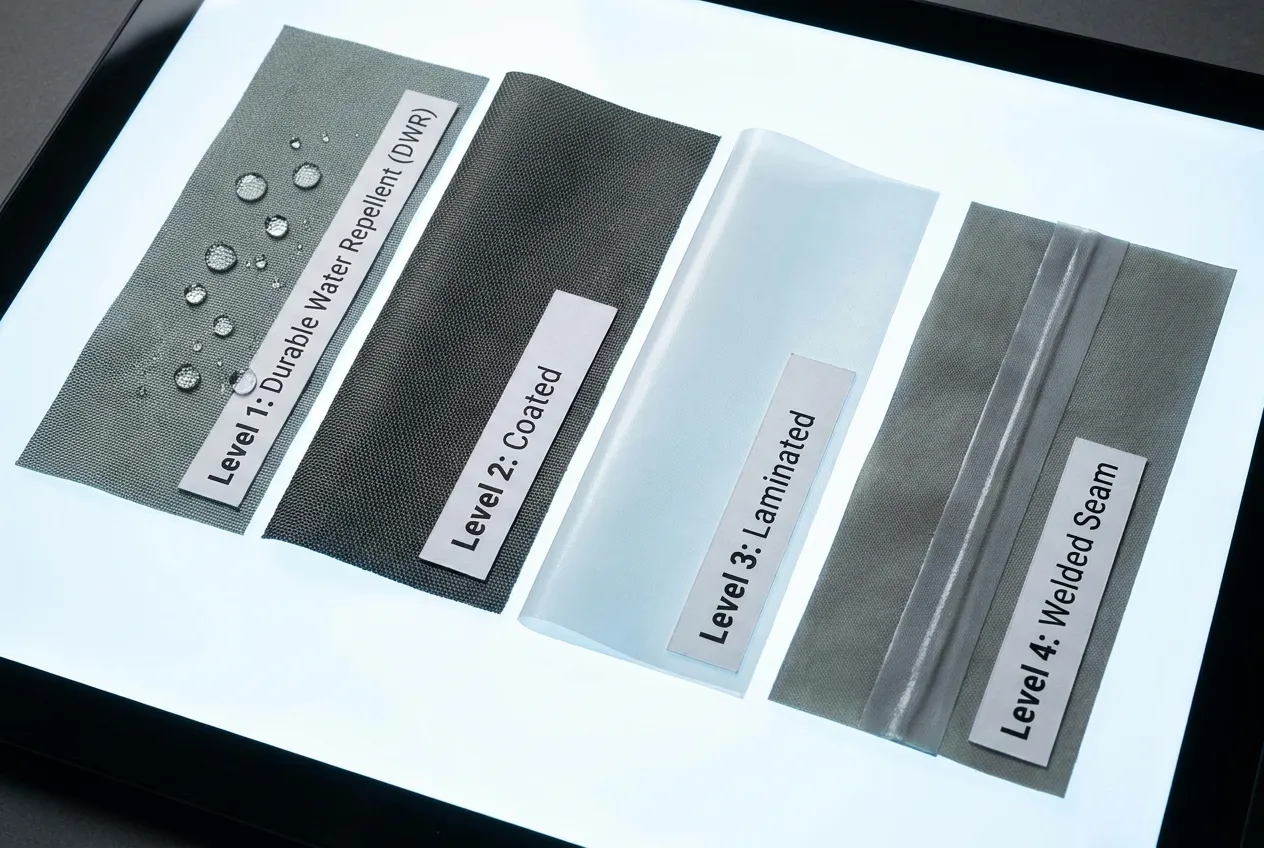
How much work the finish is doing depends on how the bag is built. The four waterproofing construction levels, from a DWR-finished woven through to a welded TPU body, are covered in the companion guide. The short version for PFAS purposes: at the lowest level the finish is the only water barrier, and at the highest level the bag needs no finish at all.
Intentionally added versus trace PFAS
Two different things get called “PFAS in a bag”. Intentionally added PFAS are there for a function: the mill applied a fluorinated DWR because the brand asked for water and oil repellency. Trace PFAS arrive without anyone choosing them. Residue on a shared finishing line, contaminated process water, recycled inputs or a treated component from a sub-supplier can all leave low levels in a fabric that was ordered fluorine-free.
The distinction matters because the rules in this guide set numeric limits, and a lab reports what is present regardless of intent. Switching to a fluorine-free finish removes the main source without guaranteeing a clean result. A sound specification therefore carries two separate lines: “no intentionally added PFAS” as a sourcing instruction to every supplier, and a set of numeric limits as the acceptance criterion for the lab.
PFAS Ban 2026 Deadlines for Bags: France, EU and California Compared
The table below sets out the dates as they stand in late September 2026, ordered by date. The scope column is written for a bag buyer, so it says plainly where bags are named and where they are not. Limits are given in the units each rule uses: parts per billion (ppb) for targeted analysis of named substances and parts per million (ppm) for broader measures such as total organic fluorine. One ppm is 1,000 ppb.
Jurisdiction and rule
Scope as it affects bags
Date
Limit
What the bag buyer must do
California AB 1817, phase 1
Textile articles, which the law says include accessories such as handbags and backpacks; bags are named
1 Jan 2025
100 ppm total organic fluorine (TOF)
Already in force: bags sold in California now should sit below 100 ppm TOF; test current styles if no result is on file
France PFAS ban, phase 1
Consumer clothing textiles, footwear and waterproofing agents for consumer textiles; bags are not named
1 Jan 2026
Decree n° 2025-1376: 25 ppb any single PFAS and 250 ppb sum of PFAS (targeted), 50 ppm including polymers
Check whether anything sold alongside the bag, such as a re-proofing spray or matching garment, is in scope
EU PFHxA restriction, phase 1
Textiles in clothing and related accessories, and footwear, for the general public; bags not named but arguably a related accessory
10 Oct 2026
PFHxA and its salts below 25 ppb; PFHxA-related substances below 1,000 ppb, per homogeneous material
Treat bags imported from this date as in scope; move EU-bound orders to fluorine-free finishes now
California AB 1817, phase 2
Same scope; handbags and backpacks named
1 Jan 2027
50 ppm TOF
Specify and test new orders to 50 ppm; review stock that will still be selling in 2027
EU PFHxA restriction, phase 2
Other textiles not related to clothing; bags are caught here on any reading
10 Oct 2027
Same limits as phase 1
The latest possible date for bags; do not plan to it
California outdoor apparel exemption ends
Outdoor apparel for severe wet conditions, exempt with a “Made with PFAS chemicals” disclosure until 31 Dec 2027; written for apparel
1 Jan 2028
50 ppm TOF
Do not assume the exemption covers bags without advice
France PFAS ban, phase 2
Textile products generally, with listed exceptions; bags fall in scope unless an exception applies
1 Jan 2030
Decree n° 2025-1376 limits as above
Catalogue styles that will still sell in 2030 should be specified fluorine-free now
PFAS deadlines that affect sports bags, 2025–2030 (as of late September 2026)
Each dot marks the date a rule or phase applies. The light band on the EU lane is the year in which a bag’s status depends on whether it is read as a clothing “related accessory”. The dashed line marks late September 2026. General information only; confirm scope with your adviser or lab.
California AB 1817: backpacks and handbags are named
California is the only one of the three that names bags outright. The text of AB 1817 defines textile articles to include accessories such as handbags and backpacks, and the limit is expressed as total organic fluorine: 100 ppm from 1 January 2025, falling to 50 ppm from 1 January 2027, as Certivo’s compliance summary sets out. A buyer should expect a textile duffel or tote to be read the same way and confirm with an adviser before arguing otherwise.
The law carries one exemption that bag buyers sometimes misread. Outdoor apparel for severe wet conditions is exempt until 31 December 2027, provided it carries a “Made with PFAS chemicals” disclosure, and must be below 50 ppm TOF from 1 January 2028. That wording is about apparel. Plan a waterproof backpack sold into California against the 50 ppm limit from 2027, and treat the exemption as out of reach unless an adviser says otherwise.
Washington, Connecticut and New Jersey have their own textile PFAS measures running in parallel. Their dates and scopes differ, so a distributor shipping to those states should check each one separately.
France: clothing and footwear from 2026, textiles generally from 2030
France’s ban took effect on 1 January 2026 for consumer clothing textiles, footwear and waterproofing agents for consumer textiles, and extends to textile products generally, with listed exceptions, from 1 January 2030. Bird & Bird’s analysis of the French textile rules and Collective Studio’s summary of PFAS rules for clothing both describe the phasing. Decree n° 2025-1376 sets the residual limits: 25 ppb for any single PFAS and 250 ppb for the sum of PFAS, both by targeted analysis, and 50 ppm including polymers.
A sports bag is not clothing, so on a literal reading most bags sit in the 2030 phase. Two things still make the 2026 phase relevant to a bag programme. A brand that sells a re-proofing spray or wash-in treatment with its bags in France is selling a consumer waterproofing agent, which appears to fall within the 2026 scope. And a brand that uses one coated fabric across jackets and bags will find it simpler to run one fluorine-free specification than two.
EU PFHxA restriction: Regulation (EU) 2024/2462
The EU measure covers one PFAS group across every member state. Commission Regulation (EU) 2024/2462 adds entry 79 to Annex XVII of the EU chemicals regulation and restricts PFHxA, its salts and PFHxA-related substances. From 10 October 2026 it covers textiles, leather, furs and hides in clothing and related accessories for the general public, and footwear for the general public. From 10 October 2027 it covers other textiles, leather, furs and hides not related to clothing. The limits, as Bureau Veritas summarises them, are below 25 ppb for PFHxA and its salts and below 1,000 ppb for PFHxA-related substances, measured in homogeneous material.
Because the EU rule targets one PFAS group, a fabric could in principle pass it and still fail California’s TOF limit or France’s rules. A buyer selling into all three markets should write one specification that covers all three.
EU PFHxA Restriction for Bags: Is a Bag a “Related Accessory”?
The regulation does not name bags. That leaves a sports bag with two possible readings, and the one a buyer picks moves the EU date by twelve months.
The two readings
Bags as a related accessory. In ordinary retail language a bag is an accessory, and a gym duffel sold in a matching set with leggings and a top is hard to describe as unrelated to clothing. Read this way, a bag is inside the 10 October 2026 phase.
Bags as other textiles. A narrower reading treats “related accessories” as items worn with clothing, and puts a carried textile article such as a backpack or tote in the second group. Read this way, a bag comes in on 10 October 2027.
Either way, bags are in scope by 10 October 2027 at the latest. The research this guide relies on, including the Collective Studio summary, does not settle which reading an enforcement authority will take, and national authorities may not all read it the same way.
The practical answer: build to the stricter date now
Most bag buyers can avoid the argument altogether. Three points lead to the same answer.
First, time. A bag order placed in October 2026 will not reach an EU port before 10 October 2026, so every new order is already on the post-deadline side of the first date. Second, the cost of each mistake is lopsided. Building early means changing a finish line on the next order. Reading the rule too narrowly and being wrong means holding stock that cannot legally be placed on the EU market. Third, the product mix. Many activewear and fitness brands sell bags alongside apparel, and matching sets are among the sports bag trends for 2026. The closer the bag sits to the clothing range, the weaker the narrow reading becomes.
The workable position for a brand or distributor is to treat every bag imported into the EU from 10 October 2026 as in scope, specify fluorine-free finishes on all EU-bound orders now, and hold test results per material. If your adviser later takes the narrower view for a particular product, the only cost is having switched a year early.
PFAS Rules and Existing Stock: What It Means for Bags Shipping in Autumn 2026
The three rules treat existing stock differently, and the difference catches buyers out. The EU looks at the date goods are placed on the market. France looks at the date they were manufactured. California, in the sources this guide relies on, does not describe a sell-through window at all.
EU: the import date counts
Under the EU restriction, articles placed on the market before 10 October 2026 are exempt, and importing counts as placing on the market. A consignment imported on 9 October is on one side of the line and one imported on 12 October is on the other, whatever date the goods left the factory. Distributors holding EU stock imported before the date can sell it through under the transitional rule for the 2026 scope. How the transitional provision works for items that fall only in the 2027 group is a point to confirm with your adviser.
France: the manufacture date counts
France allows products manufactured before 1 January 2026 to be sold for 12 months. Counted from the 1 January 2026 start, that window closes at the end of this year; confirm the exact end date with your adviser. For most bags the French date that matters is 2030. A catalogue style with a five-year life that launches in 2026 will still be on shelves when the second phase starts, so its fabric specification should already be fluorine-free.
California: plan for 50 ppm from 1 January 2027
With no sell-through window described in the sources, the conservative plan is to treat any bag sold in California on or after 1 January 2027 as subject to the 50 ppm TOF limit. Replenishment orders placed now will reach Californian shelves around the turn of the year, so specify and test them to 50 ppm. US-bound orders also carry a separate landed-cost question, covered in the guide to tariffs on bags from China in 2026.
What an order placed this autumn looks like
A new style ordered in early October runs through a sample in 5–7 working days, then bulk production of 25–35 days for 300–1,000 pcs, or 30–40 days for 1,000–5,000 pcs. Sea freight adds several weeks depending on route, so confirm transit with your forwarder. The goods reach Europe after the first EU date and reach California close to the 50 ppm change. If the fluorine-free fabric sits outside the factory’s existing supplier network, sourcing adds roughly 7–14 days. The timing and the scope question point to the same step: specify fluorine-free on this order.
Situation
EU PFHxA restriction
France
California AB 1817
Practical step
Bags imported into the EU before 10 Oct 2026
Exempt as articles placed on the market before the date
Bags generally in the 2030 phase
Not relevant unless also sold in California
Keep customs entry records by lot to show the import date
New order shipping from China in Oct–Dec 2026
Placed on the market after 10 Oct 2026; treat as in scope
Bags generally in the 2030 phase
Arrives close to the 1 Jan 2027 change to 50 ppm TOF
Specify fluorine-free finishes; test to PFHxA limits and 50 ppm TOF
In-scope items manufactured before 1 Jan 2026
Depends on EU import date
12-month sell-through
If sold in California, 100 ppm TOF already applies
Clear stock first; confirm French dates with your adviser
Catalogue style carried into 2030
In scope by 10 Oct 2027 on any reading
In scope from 1 Jan 2030 unless excepted
50 ppm TOF
Write the fluorine-free spec into the golden sample record now
PFAS Testing for Textiles: Targeted Analysis vs Total Organic Fluorine (TOF)
Two kinds of laboratory measurement sit behind the limits above, and they answer different questions. Order the wrong one and you get a clean-looking report that does not answer the regulator’s question.
Targeted analysis
A targeted analysis looks for a named list of individual PFAS and reports a concentration for each one, in ppb. The EU PFHxA limits and France’s 25 ppb single-substance and 250 ppb sum limits are expressed this way. Its strength is identification: the report says which substance is present and at what level. Its blind spot is anything the lab’s list does not include, which can include fluorinated polymers.
Total organic fluorine (TOF)
A TOF test measures the total amount of fluorine bound in organic compounds in the sample and reports it as one figure, in ppm. California’s 100 ppm and 50 ppm limits are expressed this way. It catches polymers and substances that are not on any list, because it measures fluorine rather than named compounds. It cannot say which substance is present, so on its own it does not answer an EU PFHxA question. France’s 50 ppm figure includes polymers; ask the lab which method it uses to report against that limit.
Test approach
What it reports
Where it lines up
What it catches
What it misses
Targeted analysis, PFHxA panel
PFHxA, its salts and related substances, in ppb
EU Regulation 2024/2462 (below 25 ppb and 1,000 ppb)
The substances the EU restriction names
Other PFAS groups and polymers
Targeted analysis, broad PFAS list
Each listed PFAS and a sum, in ppb
France: 25 ppb single, 250 ppb sum
Named substances at low levels
Polymers and anything not on the lab’s list
Total organic fluorine (TOF)
One figure for organically bound fluorine, in ppm
California AB 1817: 100 ppm now, 50 ppm from 1 Jan 2027
Polymers and unlisted PFAS, counted as fluorine
Which substance is present; no PFHxA figure on its own
Supplier declaration
The mill’s statement of finish chemistry and no intentionally added PFAS
Supports the “no intentionally added PFAS” line in the spec
The intended chemistry
Trace contamination; it is not a measurement
Before sampling, ask the lab whether a TOF screen is accepted evidence for each market you sell into or whether a targeted panel is needed as well. One plan worth discussing is a targeted panel plus TOF on the shell and a TOF screen on the trims; the lab should set the final plan.
Homogeneous materials: why a bag is several tests
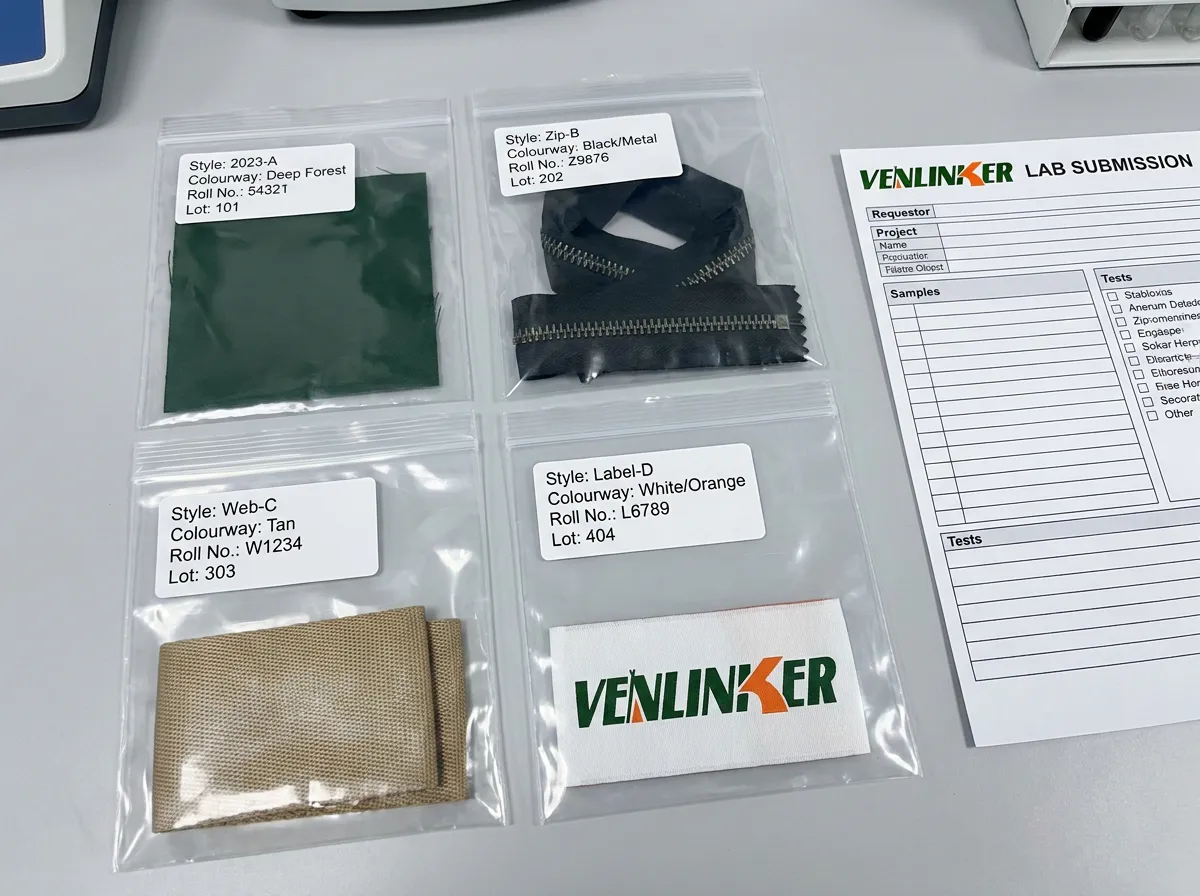
The EU limits are measured in homogeneous material, which in practice means each distinct material in the bag is assessed on its own: shell, lining, zip tape, webbing, label. The result is not averaged across the whole bag. A duffel with a fluorine-free shell and a fluorinated zip tape can therefore fail on the tape alone. Colourways matter too, because each colourway of a finished fabric is usually a separate lot from the mill. Ask the lab how it will treat a coated fabric, where the coating and the base cloth are bonded together, and how many specimens it needs per material and per colourway.
Specimens should come from the bulk roll, since a development swatch only shows what the mill made for sampling.
Who commissions the test
The buyer. The factory in this arrangement does not issue test reports. It cuts specimens from the bulk roll, labels each with roll number and lot, and sends them to the lab the buyer names, or holds the goods for an inspector the buyer books. The companion guide to bag fabric testing and buyer-commissioned labs covers how to write test rows into a tech pack, and the third-party inspection support page describes how goods and specimens are staged for SGS, BV, TUV or a lab of your choice.
How to Specify a PFAS-Free Water-Repellent Finish in a Bag Tech Pack
A tech pack that says “PFAS-free” on the shell and nothing elsewhere leaves the zip tape, webbing, labels and inks to each sub-supplier’s default. The fix is a finish line on every material in the bill of materials, plus one block that sets the limits and the testing plan. The bag tech pack guide covers the rest of the document; the section below covers only chemistry.
A worked spec block
The example is for a PU-coated 600D polyester gym duffel with a welded wet pocket, sold into the EU, France and California. Adapt the materials to your own bill of materials.
FINISH AND CHEMISTRY - Style [code], all colourways
General: No intentionally added PFAS in any component. Every supplier to
  declare finish chemistry in writing; declarations passed to buyer unchanged.
Shell: 600D polyester, PU coated reverse. Face finish: non-fluorinated
  (fluorine-free) DWR. Mill to name the chemistry family (silicone-based,
  hydrocarbon/paraffin-based or dendrimer-based).
Coating: PU. Coating supplier to declare no fluorinated additives.
Lining: 210D polyester. No water-repellent or stain finish.
Wet pocket: TPU, high-frequency welded. No surface finish.
Zip: #5 coil, tape without repellent finish. Water-repellent zip on the
  wet pocket: coating declared fluorine-free.
Webbing and binding: 38 mm polyester. No repellent finish.
Labels: woven main label; printed care label. Supplier to declare no
  fluorinated coatings.
Logo: screen print on shell. Ink system named; supplier to declare no
  fluorinated additives.
Acceptance (per homogeneous material, buyer-commissioned lab):
  TOF below 50 ppm; PFHxA and salts below 25 ppb; PFHxA-related
  substances below 1,000 ppb; any single PFAS below 25 ppb and sum below
  250 ppb (targeted). Lab to confirm method for each market.
Testing: specimens cut from bulk roll per material per colourway, labelled
  with roll number and lot. Rolls held uncut until result if buyer requests;
  hold written into lead time.
Three points on the block. The acceptance line takes the strictest figure from each rule, so one result set serves all three markets. The chemistry-family line gives the sample room something to check against the mill’s data sheet. And the “no repellent finish” lines on lining, webbing and binding are deliberate, because a finish that does no useful work on a component only adds risk.
Component checklist
Use the table as a pass through the bill of materials before the RFQ goes out. Each row is a separate material a lab may test on its own.
Component
Where PFAS can come from
Tech pack line
Document to request
Tested separately?
Shell fabric
DWR finish on the face
Fluorine-free DWR, chemistry family named; no intentionally added PFAS
Mill data sheet and finish declaration per lot
Yes, per colourway
Lining
Repellent or stain finish on some linings
No repellent finish, or fluorine-free if needed
Mill data sheet
Yes
Coating or laminate (PU, PVC, TPU)
Additives in some formulations; a finish applied before coating
Coating supplier to declare no fluorinated additives
Coating declaration
Ask the lab how it treats coated fabric
Zip tape and water-repellent zips
DWR on the tape; coating on water-repellent zips
Tape unfinished or fluorine-free; zip coating declared
Zip supplier declaration
Yes
Webbing, binding and cord
Repellent finish applied to match the shell
No repellent finish
Supplier declaration
Yes
Mesh, foam and padding
Occasional stain or repellent finishes
No repellent finish
Data sheet
If a finish is present
Labels and heat-transfer films
Coatings on printed labels and films
Supplier to declare no fluorinated coatings
Supplier declaration
Ask the lab
Print inks
Additives in some ink systems
Ink system named; declaration requested
Ink supplier declaration
Printed panel as the lab advises
The trims are where specifications most often fall short. The custom trims and hardware page lists the zip, webbing and binding options a factory can source to a finish instruction, and the custom graphics and printing and custom logo and branding pages cover the print and label methods whose inks and films need a declaration. Shell and lining choices, including coated and laminated options, sit under custom materials and colours.
Fluorine-Free DWR vs Fluorinated DWR: Performance Trade-Offs for Sports Bags
Fluorine-free DWR finishes fall into three broad chemistry families. All three repel water. In general none of them repels oil the way a fluorinated finish does, and all need re-treatment sooner. On most sports bags the design can absorb that trade-off.
Finish family
Water repellency
Oil and stain repellency
Re-treatment
What to check on the swatch
Silicone-based
Yes
Generally no
Sooner than a fluorinated finish
Hand feel of the face; ask the mill whether it affects print or seam-tape adhesion
Hydrocarbon / paraffin-based
Yes
Generally no
Sooner than a fluorinated finish
Hand feel and whether the face marks when scratched or folded
Dendrimer-based
Yes
Generally no
Sooner than a fluorinated finish
Ask the mill for its own wash and abrasion data on the finish
Fluorinated DWR (being replaced)
Yes
Yes
Longer between treatments
Limited by the rules in this guide, depending on chemistry and market
Where the trade-off shows on a bag
Oil and grease. Sunscreen, body lotion, gym-floor grime and bike-chain oil will mark a fluorine-free face more readily. That matters most on light-coloured beach totes, studio bags and commuter packs that brush against a bike.
Wear zones. The base, shoulder-contact panels and grab-handle area lose finish first on any bag. With a fluorine-free finish those zones show sooner, as patches that wet out and darken in rain.
Care. Consumers will need to re-proof the bag sooner. A brand that sells a re-proofing product with the bag in France should check that product against the French 2026 scope for consumer waterproofing agents.
How to design around it
Choose colours and prints that hide marks on high-contact panels: darker bases, printed or heathered faces, contrast panels where oil is most likely. Put a wipe-clean coated or laminated face on panels that pick up sunscreen and grime, such as the base of a tote or the lower front of a running waist pack. Write the finish expectations into the product copy and care label in behaviour terms (“beads light rain; re-proof when the face starts to wet out”), which saves customer service from explaining it later.
A water spray at incoming inspection shows whether a fluorine-free finish beads water on the face of the bulk roll. It says nothing about PFAS content, which only a lab test measures.
PFAS-Free Waterproof Bags: Coated and Welded Construction Without a PFAS Finish
The surest way to make a PFAS-free bag perform in the wet is to make the finish matter less. A DWR finish only changes how the fabric face behaves; the coating, seams and closure keep contents dry. The waterproof vs water-resistant bags guide sets out the four construction levels in detail, so this section only maps them to the finish decision.
When the finish is the only barrier
At the lowest construction level, an uncoated woven shell with sewn seams, the DWR is doing all the water work. Switching to fluorine-free changes the product most here, and the bag should be described as splash-resistant in the copy. Studio totes, yoga mat bags and lightweight packable styles often sit at this level.
Coated builds
At the coated levels, a PU- or PVC-coated woven holds back water through the fabric field, with taped seams and a coated zip at the upper end. The fluorine-free DWR keeps the face from wetting out and darkening but is not what keeps the laptop dry. Bags in this group include gym backpacks, work-gym backpacks, outdoor daypacks, waterproof backpacks and active commuter backpacks. For these, the switch to fluorine-free changes appearance in rain far more than it changes protection.
Welded builds that need no finish
At the top level, a high-frequency welded TPU or PVC body with a roll-top or welded closure needs no DWR at all. There is no woven face to wet out. Dry bags, wet bags, waterproof pouches and the welded wet pocket inside wet-dry gym bags all fall here. For a brand building a PFAS-free swim or outdoor range, a welded body removes the largest finish question from the specification; the coating, trims and labels still need their declarations.
Questions to Ask a Bag Supplier About PFAS-Free Materials
Put these to every factory on the shortlist before sampling. The answers show whether a supplier can source a fluorine-free finish on every component and how plainly it states what it can and cannot prove.
Can you source a fluorine-free DWR on this shell fabric, and which chemistry family is it? A good answer names silicone-based, hydrocarbon/paraffin-based or dendrimer-based and identifies the mill.
Is the fabric in your existing supplier network or a new source? A new source usually adds days to the fabric stage; ask how many.
Will you pass on the mill’s data sheet and finish declaration unchanged, with the mill named? Rewritten or unsigned declarations are a warning sign.
What finish is on the zip tape, webbing, binding and labels as standard? A supplier that has not asked its trim vendors will not know.
Can the coating supplier declare no fluorinated additives? This matters most on coated and laminated shells.
Do you hold any PFAS test reports or certificates of your own? A factory that says yes to a certificate on a sports bag is either confusing a mill document with its own or overstating. The test report should come from a lab the buyer commissions.
Will you cut specimens from the bulk roll per material and per colourway, labelled with roll number and lot? This is what makes a lab result traceable to the goods.
Can the rolls be held uncut until the result returns, and how is the hold written into the lead time?
Can the lab or inspector the buyer books have access to the goods and records? Ask about notice needed and working days.
How will the finish be recorded on the golden sample, so a reorder uses the same chemistry? The approved chemistry belongs in the golden sample record.
The RFQ checklist covers the non-chemistry questions. Distributors and retailers placing product into EU or Californian retail should settle questions 3, 6 and 7 before the first sample, since those decide whether a usable test file exists when goods land. You can contact Venlinker with the list before a full tech pack is ready.
How Venlinker Sources Fluorine-Free Finishes and Supports Buyer-Commissioned PFAS Testing
Venlinker is Your Trusted Custom Sports Bag Manufacturer in China, and on PFAS its role is narrow and practical: source the finish your tech pack specifies, pass on what each supplier declares, and stage the goods and specimens for the lab you commission. The factory holds no certifications, issues no test reports and makes no compliance declaration of its own. What it offers is the sourcing, the records and the access a buyer’s lab needs.
Sourcing the finish you specify
Fabric and trims come through the material sourcing team from a network of 200+ verified suppliers. A non-fluorinated DWR can be specified on the shell in the tech pack, with “no repellent finish” on linings, webbing and binding, and the team asks each mill and trim vendor for its finish declaration against that line. Where a fluorine-free fabric sits outside the network, sourcing adds roughly 7–14 days, and the quote says so. MOQ stays at 300 pcs per style per colourway whichever finish is chosen.
Documentation passed to the buyer
Supplier data sheets and finish declarations go to the buyer unchanged, with the mill or vendor named, alongside a bill of materials that lists every component with its supplier. The compliance documents page sets out what the factory can provide and what a buyer commissions. At incoming material inspection each roll is logged with roll number and lot and checked against the approved swatch, including a water spray on coated fabric to confirm the face beads water. That check shows the finish is present; it is not a chemical test.
Construction that does not rely on a finish
High-frequency TPU and PVC welding is done in-house, so a swim or outdoor range can move the water barrier from the finish to the construction. Welded dry bags, wet pockets and pouches across the swim and wet gear range and the outdoor and travel range need no DWR on the welded body.
Samples, specimens and testing
Samples are ready in 5–7 working days with one free revision, which can be used to change a finish or a trim after a lab result on the swatch. For bulk, specimens are cut from the bulk roll per material and per colourway, labelled and couriered to the buyer’s lab at the buyer’s cost, and rolls can be held uncut until the result returns, with the hold written into the lead time. SGS, BV, TUV or a lab of the buyer’s choice is welcome on any order, commissioned and paid by the buyer. Every finished bag also passes Venlinker’s own 100% pre-shipment inspection for measurement, function and appearance. This suits private label programmes that need one test file to cover a reorder, and startup and DTC brands writing their first chemistry spec. Buyers can request a free sample with swatches to send to a lab, or get a quote on a spec with the finish lines filled in.
For a bag buyer it should mean two things: no intentionally added PFAS in any component, and test results per homogeneous material below the limits for each market you sell into. The claim belongs to the brand, and it should rest on the brand’s own lab results rather than on a supplier’s statement alone. Ask your compliance adviser how the claim may be worded where you sell.
Are bags covered by the EU PFHxA restriction from 10 October 2026?
Possibly. The regulation covers clothing and related accessories from 10 October 2026 and other consumer textiles from 10 October 2027, and it does not name bags. A bag may be read as a related accessory and caught in 2026; on any reading it is caught in 2027. Most buyers should treat bags imported from 10 October 2026 as in scope, since new orders will land after that date anyway.
Does California AB 1817 apply to backpacks and gym bags?
The law’s definition of textile articles includes accessories such as handbags and backpacks, so backpacks are named. The limit is 100 ppm total organic fluorine now and 50 ppm from 1 January 2027. Buyers should expect duffels and totes made of textile to be read the same way and confirm with an adviser. The outdoor apparel exemption is written for apparel and should not be assumed to cover bags.
Is a fluorine-free DWR as good as a fluorinated one?
For water, it performs well enough on most sports bags. It generally does not repel oil, so sunscreen, lotion and grease mark the face more readily, and it needs re-treatment sooner. On coated and welded bags the difference in protection is small, because the coating or weld keeps water out. The bag material guide covers the coatings that do that work.
What is a TOF test, and is it enough?
A total organic fluorine test reports all organically bound fluorine in a material as one figure in ppm, which is how California’s limits are written. It catches polymers and unlisted substances but does not identify them, so it does not give a PFHxA figure for the EU or a single-substance figure for France. Ask the lab whether a TOF screen is accepted evidence for each market or whether a targeted panel is needed too.
Can Venlinker provide a PFAS test report or a PFAS-free certificate?
No. Venlinker holds no certifications and issues no test reports. It sources the finish you specify, passes on supplier data sheets and declarations unchanged, and cuts and stages specimens for a lab you commission, such as SGS, BV or TUV. The report comes from that lab and is addressed to you.
Summary: PFAS-Free Bags and the 2026–2027 Deadlines
As of late September 2026, a water-repellent sports bag sold into California already sits under a 100 ppm TOF limit that falls to 50 ppm on 1 January 2027. In the EU it is arguably inside the PFHxA restriction from 10 October 2026 and certainly inside it from 10 October 2027. In France it comes into the textile ban in 2030 unless an exception applies. All of this is general information; confirm scope for each product with your compliance adviser or a testing lab.
Build to the stricter date now. Every new order will reach the EU after 10 October 2026 and California close to 1 January 2027. Treat bags as in scope under the EU rule’s first phase and specify fluorine-free finishes on all EU- and California-bound orders.
Specify every material, not only the shell. Write “no intentionally added PFAS” as a sourcing line, give each component its own finish line, and set the strictest limits as acceptance: TOF below 50 ppm, PFHxA and salts below 25 ppb, related substances below 1,000 ppb, and 25 ppb single and 250 ppb sum by targeted analysis, per homogeneous material.
Let construction carry the water. Fluorine-free DWR repels water but generally not oil and needs re-treatment sooner. Coated and welded builds keep contents dry regardless of the face finish, and a buyer-commissioned lab test on the bulk roll is what proves the result.
Buyers with a draft spec can request a quote with the finish lines marked per material, or contact Venlinker to discuss which components need a declaration before sampling.
Need Water-Repellent Sports Bags Built to a Fluorine-Free Spec?
Venlinker builds custom gym, swim and outdoor bags for activewear brands, distributors and private label programmes, sourcing the non-fluorinated DWR and trims your tech pack specifies from 200+ verified suppliers, with in-house high-frequency TPU and PVC welding, samples in 5–7 working days, 100% pre-shipment inspection and specimens staged for the SGS, BV or TUV test you commission. MOQ from 300 pcs per style.