* Simply fill out the form below as best you can. And don’t sweat the details. * Your information will be kept strictly confidential. * Share your needs with us, We’ll contact you in very short time.
Planning a Custom Bag Order?
Send your bag type, quantity and target delivery date. We will review the specification and confirm the next step.
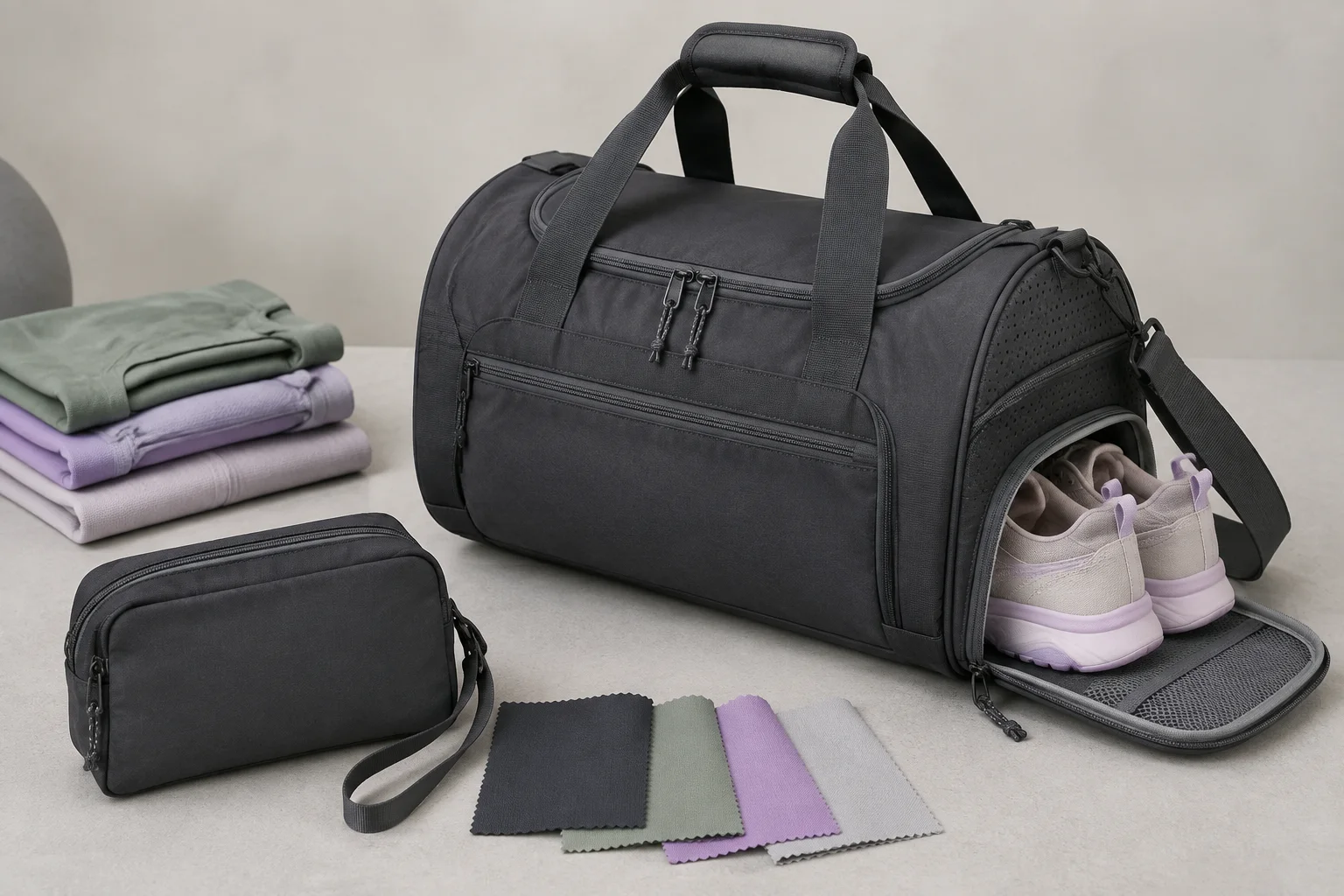
Gym Bags With Shoe Compartments and Wet-Dry Separation: How to Spec Them
How to spec a gym bag with shoe compartment and wet-dry separation: tunnel sizes to EU 46, ventilation compared, welded 0.15-0.3 mm TPU cells, tech pack.
Who this guide is for: activewear brand product managers, sourcing managers, DTC founders, Amazon FBA sellers and gym-chain merchandise buyers who are deciding how many compartments a duffel or backpack needs, where the shoes and the wet kit go, and how each one has to be built.
A gym bag with shoe compartment is the most requested feature on a training-bag brief, and the one most often specified as a single line: “shoe pocket, one end”. That line does not say how long the pocket is, whether it vents, whether it steals space from the main body, or what happens when a damp swimsuit is packed on the other side of the same divider. Those answers decide whether the bag is returned. A duffel shell is a commodity; every factory in Guangzhou can cut 600D polyester. The compartment architecture is the product.
Two features carry almost all of the perceived value in this category: a shoe compartment that actually holds the shoes your customers wear, and wet-dry separation that holds water rather than resisting it for twenty minutes. Both take volume out of the main compartment, add pattern pieces, add seams and add days to the sample round. A buyer who specifies them properly gets a bag that costs a defined amount more and works. A buyer who leaves them to the factory gets whichever tooling the factory already owns.
This guide sets out the six compartment architectures used in gym duffels and backpacks with their typical dimensions and their capacity cost, sizes shoe compartments by shoe size rather than by litres, compares the four ventilation methods and what each does to water resistance, explains why a welded wet-dry gym bag cell is the only construction that holds standing water, and finishes with a worked tech-pack block and the questions to ask a supplier before you request a quote. Capacity measurement itself — what a litre is, how a factory fill-tests it, and the dimensions behind each nominal size — is covered in the backpack and duffel capacity guide, so this guide takes those figures as given and spends its space on what happens inside the bag.
The Three Problems a Gym Bag With Shoe Compartment Has to Solve
A gym bag carries four categories of cargo that dislike each other: clean clothes, worn clothes, footwear and small valuables. A single-compartment duffel puts all four in one bag and lets the customer sort it out. Every compartment added to the pattern is an attempt to solve one of three specific failures.
Wet kit soaking dry clothes
A swimsuit holds roughly 150–300 ml of water after wringing. A towel holds more. Packed loose in a 45 L body, that water reaches everything within an hour and the bag smells by the next morning. The customer notices on the commute home, which is the worst possible moment for a brand’s reviews.
The usual answer is a pocket lined with coated polyester. It buys time and nothing more. Coated fabric resists water arriving from outside; it does not hold water sitting against a stitched seam from the inside. Every needle hole is a capillary, and a sewn seam in bag construction runs at roughly 8–10 stitches per 10 cm. The pocket is not a barrier, it is a delay.
Dirty soles touching everything
An outsole carries grit, gym chalk, street water and whatever was on the changing-room floor. Put it against a clean T-shirt and the shirt is dirty regardless of how the bag is lined. Shoes also carry the bag’s odour load: an enclosed space with a damp insole becomes the smell the customer associates with the brand.
A shoe compartment solves the contact problem and creates a new one. Sealing shoes in a lined box with no airflow concentrates moisture. The compartment has to isolate the soles and still let the air move, which is why ventilation is a specification line rather than a detail.
Finding a phone in a 40 L hole
The third failure has nothing to do with hygiene. A 40–45 L duffel with one opening is a well. Keys, a phone, a padlock and a protein tub sink to the base under a folded towel, and the customer stands at the locker unpacking the bag to find them. Small zipped pockets, a quick-access top pocket and a valuables sleeve are cheap in fabric terms and they are what the customer touches most often.
These three failures explain why compartment design carries the product. Two duffels can share fabric, capacity, hardware and colour and behave completely differently in use, and the difference is where the walls are. Brands building a range around one shell — a duffel, a gym backpack and a gym tote sharing one fabric booking — get most of their differentiation from compartment layout, not from the outside of the bag.
Gym Bag Compartment Architectures Compared: Shoe Tunnels, Wet Cells and Dividers
Six architectures cover almost every gym bag on the market. They differ in where they sit, how much they take out of the main compartment, how they are built and what they cost. The table below sets them side by side. Dimensions are internal clear space, typical for a 40–50 L duffel or a 25–35 L backpack, and vary with the pattern.
Architecture
Typical internal size (cm)
Volume taken from main compartment
Construction
Ventilation method
Bag types that use it
Relative cost
End shoe tunnel
31–34 L × 15–16 W × 13–14 H
6–9 L
Two tunnel walls plus a stiffened divider sewn into one end panel; #8 zip on the outer face; mouth bound in 25 mm webbing and bar-tacked
Mesh panel roughly 10 × 15 cm, or 6–8 eyelets on the outer face
Two rules fall out of the table. The first: shoes cost more volume than water. A shoe compartment reserves 6–11 L and that space is dead when the shoes are on the customer’s feet, whereas a wet cell collapses flat when empty and gives most of its volume back. The second: cost tracks process, not size. The welded cell is the smallest feature on the list by area and the most expensive, because it needs film, a welding jig and a leak check rather than a sewing operation.
Usable main-compartment litres remaining in a 45 L duffel as compartments are added
Figures are typical for a 45 L nominal body and vary with pattern and gusset depth. Each step subtracts the volume the compartment reserves plus the fabric and seam allowance of its walls.
A fully compartmented 45 L duffel packs like a 26–28 L bag. That is a legitimate design as long as the hangtag and the listing copy say so, because a customer who buys 45 litres and can fit two days of clothes will say so in a review. Brands that want the features and the promise usually size the body up: a 50–55 L shell with a shoe tunnel and a wet cell leaves 33–36 L of clothes space, which reads as a genuine weekend bag. The alternative is to make the wet section removable and the divider detachable, so the customer can strip the bag back to a single compartment for travel.
Gym Bag Shoe Compartment Design: Sizing the Tunnel by Shoe Size
A shoe compartment is specified in centimetres of clear space, never in litres. The customer does not care that the pocket holds 8 L; they care whether their shoes go in. A pair of men’s UK 11 / EU 46 trainers placed side by side, one reversed against the other, occupies roughly 34 × 20 × 14 cm. That block, plus the thickness of the tunnel walls and the ease the pattern needs, is the compartment.
Clear space by size range
Size range
Longest outsole
Clear length
Clear width, pair side by side
Clear height
Block volume
EU 36–38 / UK 3–5
23–25 cm
27–28 cm
17–18 cm
11–12 cm
Roughly 5.5 L
EU 39–41 / UK 6–7.5
25–27 cm
29–30 cm
18–19 cm
12–13 cm
Roughly 7 L
EU 42–44 / UK 8–9.5
27–29 cm
31–32 cm
19–20 cm
13 cm
Roughly 8 L
EU 45–46 / UK 10.5–11
29–31 cm
33–34 cm
20 cm
13–14 cm
Roughly 9.5 L
EU 47–48 / UK 12–13
31–33 cm
35–36 cm
21–22 cm
14–15 cm
Roughly 11 L
Clear length is the outsole plus 2.5–3 cm of ease, because a shoe pushed hard against the end of a tunnel loads the seam that holds the tunnel wall to the end panel. Height matters more than most tech packs admit: a running shoe with a stacked midsole and a raised heel counter is typically 1–2 cm taller than a flat court or lifting shoe, and a mid-cut boot needs another 2 cm again. A tunnel cut to 13 cm of height takes trainers and refuses walking boots, which is a decision worth making deliberately if the brand sells to hikers or to a team programme carrying studded boots.
Why a compartment sized for a women’s EU 38 fails half the market
The most common shoe-compartment defect is not a split zip. It is a tunnel cut to 28–29 cm, which takes an EU 38–39 comfortably, an EU 42 with force and an EU 45 not at all. In most Western markets men’s sizes cluster around EU 42–45 and women’s around EU 38–40, so a 29 cm tunnel on a unisex SKU works for a large share of the women’s customer base and almost none of the men’s. The bag is then reviewed as broken by half the people who buy it.
Two routes out. The first is to spec to the largest foot the SKU is sold to: a 33–34 cm clear length covers EU 46, costs roughly 1–2 cm of body length on a duffel and is invisible to the customer with smaller feet. The second is to split the range, which is what most brands with a distinct women’s line do — a 29–30 cm base pocket on the women’s bag, a 33–34 cm end tunnel on the unisex duffel. Either is defensible. Cutting one 29 cm tunnel and calling the bag unisex is not.
Where the shoes go also changes the bag. An end tunnel shares the duffel’s existing end panel and is the cheapest to add, but it makes the bag long and the shoes sit at head height when the bag is carried on a shoulder. A base drawer keeps the load low and the body full height, which most product managers prefer once they have handled both, and it costs a new base pattern. A side pocket on a backpack gives access without opening the main bag, which suits commuters, and it pushes the pack’s width out by 8–10 cm on one side. The custom design and structure page shows the pattern change for each position.
Detail lines that decide whether the tunnel survives
The mouth of a shoe tunnel carries roughly two to three times the load of any other opening on the bag, because shoes are forced in at an angle and pushed against the slider. A #5 coil zip that lasts five years on the main opening splits at the tunnel within months. Specify a #8 coil or moulded zip there even when the body runs #5, bar-tack both ends of the zip, and bind the mouth in 25 mm webbing so the load spreads into the panel rather than into the stitch line. Zip choice, pull style and finish sit on the custom trims, hardware and accessories page, and the guide to zipper gauges, chain types and sliders explains what separates a #5 from a #8 in service.
The tunnel walls take heel abrasion every time a shoe goes in. Keep them at 600D and do not step down to 420D to save weight, for the reasons the guide to 600D polyester and denier sets out on abrasion life. Under the tunnel, a 900–1680D base panel or a moulded insert takes the drop load when the bag is set down on concrete. The lining inside the tunnel should be a wipe-clean coated 210T rather than a plain one, so a customer can wipe grit out instead of shaking the bag over a bin.
Ventilated Shoe Compartment Bag Design: Four Methods Compared
An enclosed shoe compartment with no airflow holds moisture, and moisture is what the customer smells. Four methods are used to vent one, and each trades air for water resistance somewhere on the bag.
6–8 eyelets of 8–12 mm inside diameter, punched and set through shell and lining together, washer on the inside face
Roughly 5–8 cm² total
Small deliberate holes in the shell; water passes both ways, so keep them off the base and off the panel that faces the wearer
Modest airflow, good drainage; the cheapest honest vent
Outer face of an end tunnel, floor of a base drawer
Laser-cut holes
A field of 40–80 holes at 3–5 mm, cut and edge-sealed; needs a coated or laminated face so the cut edges do not fray
Roughly 5–10 cm²
Same exposure as eyelets with no hardware to corrode; the coated fabric between holes keeps its splash resistance
Moderate airflow, the cleanest look
Premium shells, side shoe pockets on backpacks
Mesh panel
100–200 GSM polyester mesh, typically 10 × 15 cm up to 15 × 25 cm, sewn in with bound edges
100–300 cm² of open weave
The panel is not water-resistant at all; rain and splash pass straight through, so it never goes on the base
Best airflow and fastest dry-out
Side or end face of a tunnel, shower caddies and mesh kit bags
Breathable liner
Uncoated 210T or a 2–3 mm spacer mesh replaces the coated tunnel lining
No discrete openings
Shell water resistance is untouched
Slow; moisture migrates into the main body rather than out of the bag, so it works only alongside a real vent
Backing layer, never the only method
Mesh moves the most air by a wide margin and gives up the most protection. Eyelets and laser holes are compromises with a similar open area, and the choice between them is usually aesthetic and commercial rather than functional: eyelets add hardware and a punching operation, laser cutting adds a setup and needs a fabric that seals at the edge. Below 100 GSM, mesh tears where a heel pushes against it, so a promotional bag specified at 70–80 GSM mesh will fail at the vent before it fails anywhere else.
One rule holds across all four. Never put a vent between the shoe compartment and the wet section. A brand that vents a shoe tunnel into a damp swimsuit compartment has built one odour chamber with two doors. Keep the shoes at one end of the bag and the wet cell at the other, vent the shoes outward through the shell, and let the wet cell stay sealed.
Wet Dry Bag Compartment Construction: Coated Polyester vs a Welded TPU Cell
“Wet pocket” on a tech pack covers five constructions that behave nothing alike. The distinction that matters is whether the compartment resists water arriving or holds water sitting. Only one construction does the second.
Construction
Materials
Seams
Holds standing water
Odour behaviour
Typical failure
Relative cost
Coated polyester pocket, sewn
210D–600D PU-coated polyester lining
Stitched, roughly 8–10 needle holes per 10 cm
No; wicks through the seam within 1–3 hours
Moderate; the coating can be wiped
A damp patch on the dry side after one session
Low
Coated polyester, sewn and taped
As above plus 20 mm hot-melt seam tape
Tape applied over the stitch line
Slows it to hours rather than minutes
Moderate
Tape peels at the corners after repeated flexing and washing
Low–moderate
PEVA cell, welded
0.10–0.15 mm PEVA film
High-frequency welded, 8–10 mm seam
Yes at rest
Higher; the film holds smell
Cold cracking along a fold line after a winter of daily folding
Moderate
TPU cell, welded
0.15–0.3 mm TPU film
High-frequency welded, 8–10 mm seam, joined to the shell above the water line
Yes
Lower; wipes clean and dries
The zip, not the cell, is the leak path
High
Removable welded pouch
0.15–0.3 mm TPU, water-resistant #5 zip
Welded on all four sides
Yes
Lowest; it dries outside the bag
The customer leaves it at home
Low–moderate
Why a sewn wet pocket cannot hold water
A stitched seam is a row of holes with thread through them. Under a static head of water, each hole wicks. Coated fabric changes nothing about that, because the coating is a surface on the panel, not a seal at the needle. Seam tape helps for as long as the adhesive holds, and hot-melt tape on a bag that gets stuffed into a locker and pulled out again peels at the corners first. This is why a wet pocket built from coated polyester should be sold as splash resistance, not as containment, and why brands that promise “keeps wet kit separate” on the packaging need the welded version behind the claim.
How a welded TPU cell is built
Welding fuses two layers of thermoplastic film with high-frequency energy so the seam becomes one material. There is no thread, no hole and no adhesive. On a wet-dry gym bag the cell is welded as a closed bag in 0.15–0.3 mm TPU, typically on an 8–10 mm seam, and then joined to the shell only along its top edge and its zip tape, which keeps every point of attachment above the water line. Water inside the cell touches nothing but welded film.
Film thickness is a real choice. At 0.15 mm the cell is light and folds flat inside a slim body, which suits a women’s gym bag or a studio tote. At 0.3 mm it resists puncture from a zip pull or a shoe cleat and survives more fold cycles, which suits swim and team programmes. PEVA is the cost-led alternative at 0.10–0.15 mm; it welds and holds water, and it stiffens and cracks in cold weather sooner than TPU. TPU is also more often out of the factory’s regular supplier network in a specific colour or finish, which typically adds 7–14 days to the material lead time.
The zip is the leak path
A coated or PU-film zip resists splash. It does not seal under submersion, and no zip on a gym bag should be described as waterproof. Three details keep water away from it: route the zip along the top edge so standing water sits 6–10 cm below it, add a 3–4 cm storm flap, and fit a zip garage at the end so the slider does not sit in a gap. Where a brand needs a true seal for a wet compartment, the answer is a welded roll-top closure of the kind used on dry bags rather than a better zip. Where each of those closures sits on the scale from water-resistant to genuinely waterproof is set out in its own guide.
Venlinker welds these in-house
High-frequency TPU and PVC welding runs on Venlinker’s own machines in the Huadu District plant, on the same floor as cutting and sewing. Most bag factories sub-contract this step, which is why a welded wet cell often adds a week to a sample round and why leak problems surface at the customer rather than at the prototype. Keeping it in-house means every wet-cell prototype gets a fill-and-hold water test before it ships, and the same test is repeated on production lots at inline inspection. Each new wet-cell shape needs its own welding jig, and the jig is quoted with the sample rather than discovered later.
How Shoe and Wet Compartments Change the Pattern, Fabric Consumption and Cost
Every compartment is pattern pieces, seams and operations. A buyer comparing two quotes for “a 45 L duffel with a shoe pocket” is often comparing a bag with four extra pieces against one with seven. The table gives typical bands against a plain single-compartment 45 L duffel as the baseline.
Shell fabric is typically 35–50% of a bag’s unit cost, so extra area matters, but on compartment work the labour usually moves the number further than the material does. A shoe tunnel adds around a quarter of a square metre of fabric and six to eight operations; the operations are the larger line. That is also why the welded cell prices high on a small area, and why a removable pouch is the cheapest route to a wet-dry claim in a range: the pouch is built on its own line and hung on the bag with one webbing tab.
Two compounding effects catch buyers out. First, compartments stack: a duffel with a tunnel, a wet cell and an organiser panel is not one feature more expensive than a plain duffel, it is three, and the bands add. Second, each new internal shape can pull in tooling. A moulded base insert under a shoe drawer typically adds 10–15 days for tooling, and a custom welding jig sits in the same category. The cost factors guide lists these alongside fabric, hardware and logo method so a product manager can trade them off in one view instead of one at a time.
Sample time follows the same pattern. A plain duffel samples in 5–7 working days. Each welded feature or new base pattern adds to the front of that window, and out-of-network film or fabric adds 7–14 days on top. A brand that wants two shoe-compartment positions evaluated should ask for both in one sample round rather than sequentially, which costs one prototype fee instead of two rounds of calendar time.
Wet-Dry Separation in Smaller Formats: Pouches, Mesh Bags, Caddies and Studio Kit
Not every wet-dry problem needs a welded cell inside a duffel. In smaller formats the separation moves out of the bag and becomes its own product, which is usually cheaper and often sells better.
A wet pouch at 25–30 × 18–20 cm and 2–4 L holds a swimsuit, a small towel and grip socks. Welded from the same 0.15–0.3 mm TPU as an internal cell, it costs a fraction of the bag it goes into, sells as a standalone SKU in swim and hot-yoga retail, and gives the customer something the internal cell cannot: the ability to take the wet thing out of the bag and hang it up. Brands running a private label set usually bundle one, and a three-piece set lifts order value by roughly 25–40% against the bag alone.
A mesh swim bag solves the opposite problem. Where a wet cell contains water, a 100–200 GSM mesh drawstring at 15–25 L drains and dries it, which is what a swim club needs for fins, a kickboard and a wet towel walking from pool to car. It is the lowest-cost bag in the category and ships at the highest volume. A shower caddy at 3–5 L in the same mesh, with 3–6 elastic-topped bottle slots and a hook rated for a full load, handles the toiletries that would otherwise leak into a duffel. Both are drainage products rather than containment products, and pairing one with a welded cell in the same kit covers the whole wet cycle.
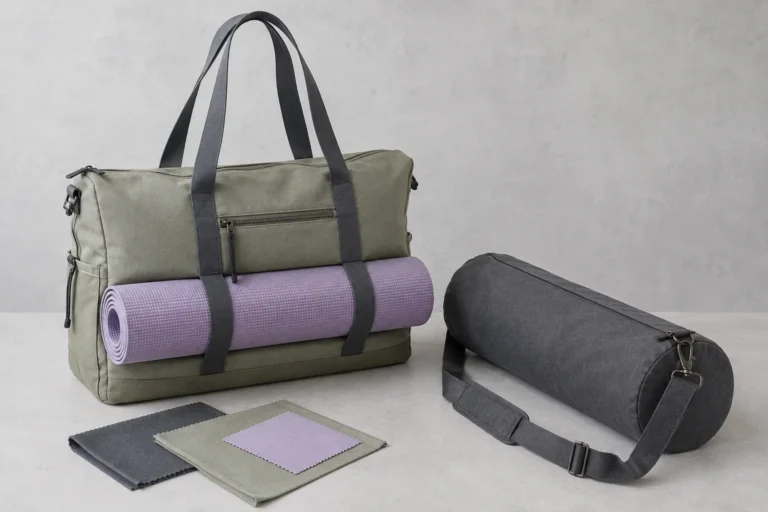
At the dry end of the same cycle sits the laundry bag: 40–50 × 30–35 cm holding 12–20 L, in breathable mesh where the kit needs to dry on the way home or in 210D PU-coated polyester where it needs to stay contained. Gym-chain and hotel wellness programmes usually take the coated version; consumer sets usually take mesh. Studio ranges have their own pattern of use, where a mat, a towel and a change of clothes travel together and the wet item is a sweat towel rather than a swimsuit, which is why yoga duffel bags and studio totes more often carry a removable pouch than a welded cell.
For a brand building a range, the practical sequence is to put the welded cell in the hero bag, the removable pouch in the mid tier, and mesh or coated drawstrings in the accessory set. That gives three price points from one welding capability and one fabric booking. Gym, studio and club chains buying member kits usually take the whole sequence at once, and distributors and retailers tend to want the tiers visibly different on a shelf, which the compartment layout does better than a colour change.
How to Specify a Gym Bag With Shoe Compartment in a Tech Pack
A compartment specification that a factory can build from has seven lines per compartment. Anything less and the sample room fills the gaps with the pattern it already owns. List every compartment, including the main one, and number them so the sample comments can refer to them.
The seven lines are: internal dimensions as clear space in mm, not the flat pattern size; access side and direction, meaning which panel it opens on and which way the zip runs; closure and zip gauge, with bar-tack positions; lining, by fabric, coating and colour; drainage, meaning a grommet or none; ventilation, by method, size and position; and fixed or removable, with the mounting method if removable.
A worked block for the shoe tunnel and the wet cell on a 50 L duffel looks like this:
COMPARTMENT 2 — SHOE TUNNEL
  Position          Right-hand end panel, external access
  Clear internal    340 L × 160 W × 140 H mm  (fits to EU 46 / UK 11)
  Access            Vertical zip on outer end face, opening toward base
  Closure           #8 moulded zip, single slider, bar-tack both ends
  Mouth binding     25 mm webbing, colour to match shell
  Divider           Lined 210T with 1 mm stiffener, fixed, sewn to gusset
  Lining            210T polyester, wipe-clean PU face, black
  Ventilation       Mesh window 100 × 150 mm, 150 GSM, bound edges,
                    outer end face, centred 60 mm above base seam
  Drainage          None
  Reinforcement     900D base panel extending 60 mm up the tunnel wall

COMPARTMENT 4 — WET CELL
  Position          Left-hand end of main body, internal
  Clear internal    360 L × 260 W × 80 D mm  (approx. 6 L)
  Material          0.20 mm TPU film, frosted clear
  Seams             High-frequency welded, 8 mm seam, all four sides
  Attachment        Top edge and zip tape only; no stitching below
                    the 60 mm water line
  Closure           #5 PU-coated zip, top edge, 35 mm storm flap,
                    zip garage at closed end
  Ventilation       None in the cell; 6 × 10 mm eyelets in the shell
                    panel outside it
  Test              Fill to 60 mm and hold 30 minutes, no seepage
Every figure in that block is a decision someone has to make. Left blank, the factory makes it. The bag tech pack guide shows where compartment lines sit relative to the bill of materials and the construction notes, and the RFQ checklist covers what else a quote needs before a supplier can price a multi-compartment bag properly.
Two more lines belong on the drawing rather than in the table. Mark the water line on the wet cell, which is the height below which no stitching is allowed, and mark the vent position relative to the base seam, because a vent set too low drains water into the compartment when the bag is put down on a wet floor. Buyers can send a marked-up drawing with the quote request and get the compartment layout confirmed before the first sample is cut.
Questions to Ask a Custom Gym Bags Manufacturer About Compartments
The answers separate a factory that builds compartments from one that copies them. Ask before sampling and put the answers on the tech pack.
What clear internal length is your standard shoe tunnel, and to which shoe size does it fit? Expect a figure in centimetres and a size, not “fits most trainers”.
Do you weld wet cells in-house or sub-contract the welding? Sub-contracted welding adds days to every sample round and puts the leak check outside the factory’s control.
What film do you use, at what thickness, and what is the weld seam width? Expect 0.15–0.3 mm TPU or 0.10–0.15 mm PEVA and an 8–10 mm seam.
How is the wet cell attached to the shell, and how far above the water line does the lowest stitch sit? If the answer includes stitching through the cell, the pocket will wick.
What zip gauge goes on the shoe compartment mouth, and is it bar-tacked? Expect a step up to #8 and bar-tacks at both ends.
How do you vent the shoe compartment, and what is the open area? Mesh, eyelets or laser holes, with a size and a position.
Do you leak-test the wet cell on the prototype and again in production? Ask what the test is and what gets recorded.
How much main-compartment volume does each compartment take, and is the nominal capacity quoted before or after? This is what drives the hangtag figure.
Which compartments need new tooling or a welding jig, and what does that add to lead time? Moulded inserts typically add 10–15 days.
Can you sample two compartment positions in one round? A factory with its own sample room can; one that outsources patterns usually cannot.
A supplier who answers all ten with figures is quoting a bag. One who answers with adjectives is quoting a photograph. Buyers who want the compartment section of a quote written to this level can contact the sample room with a sketch before committing to a full tech pack.
How Venlinker Builds Shoe Compartments and Welded Wet-Dry Cells
Venlinker is Your Trusted Custom Gym Bag Manufacturer in China, and compartment work is the part of a gym bag that the factory is set up to control end to end: patterns from 10+ in-house designers, high-frequency TPU and PVC welding on its own machines, and fit and leak checks written into the golden sample rather than added later.
The sample room and the fit check
Venlinker’s sample room turns a compartment brief into a prototype in 5–7 working days with one free revision. For a shoe compartment the room asks for the largest shoe size in the brand’s customer base before patterning, cuts the tunnel to that size, and checks the finished sample against a physical shoe reference rather than a drawing. Where a product manager wants to compare an end tunnel against a base drawer, both can be built in the same round. The sample development page lists what the room needs from a buyer to hold the 5–7 day window, and out-of-network film or fabric is quoted with its extra 7–14 days up front instead of appearing at cutting.
Welding on site, tested before it ships
The wet cell is welded in-house on the same floor as cutting and sewing, on 8–10 mm seams in 0.15–0.3 mm TPU or 0.10–0.15 mm PEVA, and attached to the shell above the water line only. Every prototype gets a fill-and-hold test. In production the test repeats at inline inspection, and the tunnel fit check, the zip cycle count and the vent seam pull test are logged alongside it. Finished bags pass 100% pre-shipment inspection by the factory’s own team before cartons are sealed, and the final inspection process covers what is sampled and recorded. Third-party inspections from SGS, BV or TUV are welcome on any order, commissioned and paid by the buyer.
Fabric, film and colour
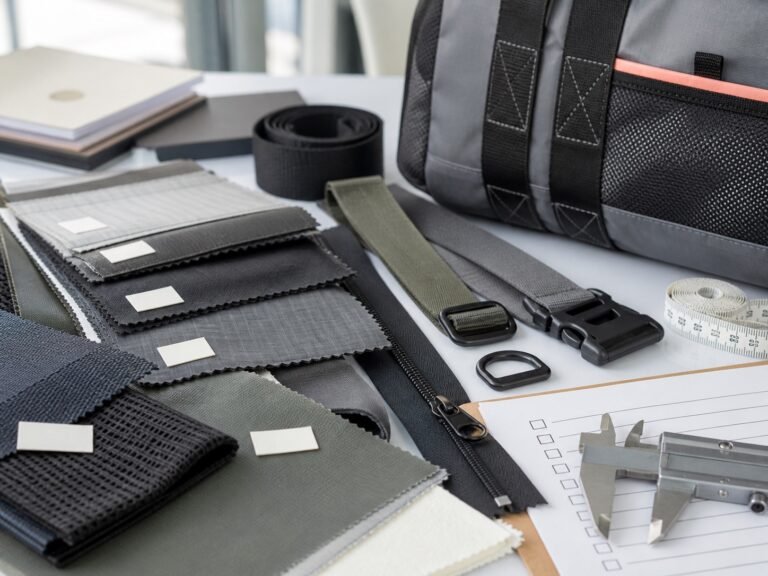
Shell fabric, mesh, lining and film are sourced through a network of 200+ verified fabric suppliers, and the material sourcing team records denier, GSM, coating and width against each roll so a tech pack line maps to a specific specification. Shell, webbing and zip tape are lab-dipped against one reference so a tunnel face and a body panel do not read two shades apart on a retail rail, which is set out on the custom materials and colours page. Logo placement on a shoe compartment gets its own consideration: the tunnel face is the most visible panel on a duffel and the one that takes the most abrasion, so embroidery or a moulded patch usually outlasts a print there. Options are compared on the custom logo and branding page.
Volumes, MOQ and who orders this
MOQ starts at 300 pcs per style per colourway, which suits an activewear or fitness brand testing a shoe-compartment SKU alongside a plain duffel, a private label program building a three-tier range from one welding capability, and an Amazon FBA seller who needs the same compartment spec held across reorders. Production runs across 10+ lines at roughly 5,000 bags per line per month, with bulk lead times of 25–35 days at 300–1,000 pcs and 30–40 days at 1,000–5,000. Retail packing, hangtags and carton marking are handled on site through custom packaging and retail or FBA prep, and factory visits are welcome Monday to Saturday, 40 minutes from Baiyun airport with pickup arranged. A brand that wants to see a welded cell and a vented tunnel in hand first can request a free sample.
Gym Bag Shoe Compartment and Wet-Dry FAQ
How big should a gym bag shoe compartment be?
Size it in clear internal space against the largest shoe your customers wear. A pair of EU 46 / UK 11 trainers side by side needs roughly 34 × 20 × 14 cm, which is about 9.5 L. For a women’s-only range, EU 41 needs roughly 30 × 19 × 13 cm. Add 2.5–3 cm of ease to the outsole length so the shoe does not load the end seam, and add 1–2 cm of height if the range includes running shoes with stacked midsoles.
Does a shoe compartment reduce the capacity of the bag?
Yes, by 6–11 L depending on the architecture, and that space is unusable when the shoes are out of the bag. A 45 L duffel with an end tunnel behaves like a 38 L bag for clothes, and with a wet cell and an organiser panel as well it behaves like 26–28 L. Brands that want the features and the number usually size the shell up by 5–10 L, or make the divider removable so the customer can recover the space.
What is the difference between a wet pocket and a welded wet cell?
A wet pocket is a coated fabric pocket with stitched seams. It resists splash and wicks through the needle holes within one to three hours. A welded cell is TPU or PEVA film fused on an 8–10 mm high-frequency seam with no stitching below the water line, and it holds standing water. Only the second should sit behind a packaging claim about keeping wet kit separate. Both are built on wet-dry gym bags; the choice is a cost and claim decision.
Can a shoe compartment and a wet compartment share a wall?
They should not. A vent between them turns two odour sources into one chamber, and a wet cell against a shoe tunnel keeps the shoes damp. Put the shoes at one end of the bag and the wet section at the other, vent the shoes outward through the shell, and keep the cell sealed. On a backpack the same rule puts shoes in a side or base pocket and the wet cell against the main body.
How do you stop a shoe compartment smelling?
Ventilation plus a wipe-clean lining plus separation from the wet section. A 100–200 GSM mesh window of roughly 10 × 15 cm, or 6–8 eyelets at 8–12 mm, moves enough air to dry an insole between sessions. A coated 210T lining lets a customer wipe grit out instead of leaving it in the weave. Bags that skip both and rely on a sealed compartment come back smelling within weeks, whatever fabric the shell uses.
Which compartment layout should a first order use?
For a first run at 300 pcs, the lowest-risk combination is an end shoe tunnel cut to EU 46, a removable welded pouch instead of a fixed cell, and a small zipped valuables pocket. The tunnel shares the gym duffel pattern, the pouch avoids a welding jig on the bag itself, and both can be upgraded on the reorder once the range has sold. The MOQ guide explains how colourways and set components stack against that first 300 pcs.
How long does a multi-compartment sample take?
A plain duffel samples in 5–7 working days. A shoe tunnel adds 1–2 days, a base drawer 2–3, and a welded wet cell 2–4 while the jig is made. Out-of-network film or fabric adds 7–14 days, and a moulded base insert adds 10–15 for tooling. Asking for two compartment positions in one round costs one prototype fee and saves a full round of calendar time.
Summary: Specifying a Gym Bag With Shoe Compartment and Wet-Dry Separation
Compartment architecture is what a customer experiences and what a buyer usually leaves to the factory. Three decisions carry most of the outcome.
Size the shoe compartment in clear centimetres against the largest foot you sell to. A pair of EU 46 trainers needs roughly 34 × 20 × 14 cm of clear space; a 29 cm tunnel fits EU 38–39 and fails most of the men’s market. Specify length, width and height separately, add 2.5–3 cm of ease, and step the mouth zip up to #8 with bar-tacks at both ends.
Decide whether the wet compartment resists water or holds it, and build accordingly. A stitched coated pocket wicks through the needle holes in one to three hours. A welded 0.15–0.3 mm TPU cell on an 8–10 mm seam, joined to the shell above the water line, is the only construction that holds standing water, and it costs roughly 12–20% more on the bag. A removable welded pouch delivers most of the benefit for roughly 3–6%.
Budget the volume and the days before you commit to the layout. Each compartment takes 1–11 L out of the main body, adds 2–10 operations and pushes the sample round by 0–4 days. A 45 L duffel with a tunnel, a cell, a divider and an organiser packs like 26–28 L, so either size the shell up or write the hangtag honestly.
Product managers with a layout in mind can send the compartment list and a marked-up drawing through the get a quote form and get the volume cost, tooling and sample window back against each feature. Brands still choosing between architectures can contact Venlinker to have two positions prototyped in one round, or follow the OEM and ODM workflow from sketch to golden sample with the compartment spec carried through each step.
Need a Shoe Compartment and a Welded Wet Cell in One Sample?
Venlinker builds custom gym duffels, backpacks and totes for activewear brands, gym and studio chains and Amazon FBA sellers, with shoe tunnels cut to your largest shoe size, wet cells welded in-house on 0.15–0.3 mm TPU and leak-tested on every prototype, fabric from 200+ verified suppliers, samples in 5–7 working days, 100% pre-shipment inspection and MOQ from 300 pcs per style.