Quality Control › Inline Production Inspection

Inline Production Inspection for Bags: Cutting, First-Off and Hourly Patrol

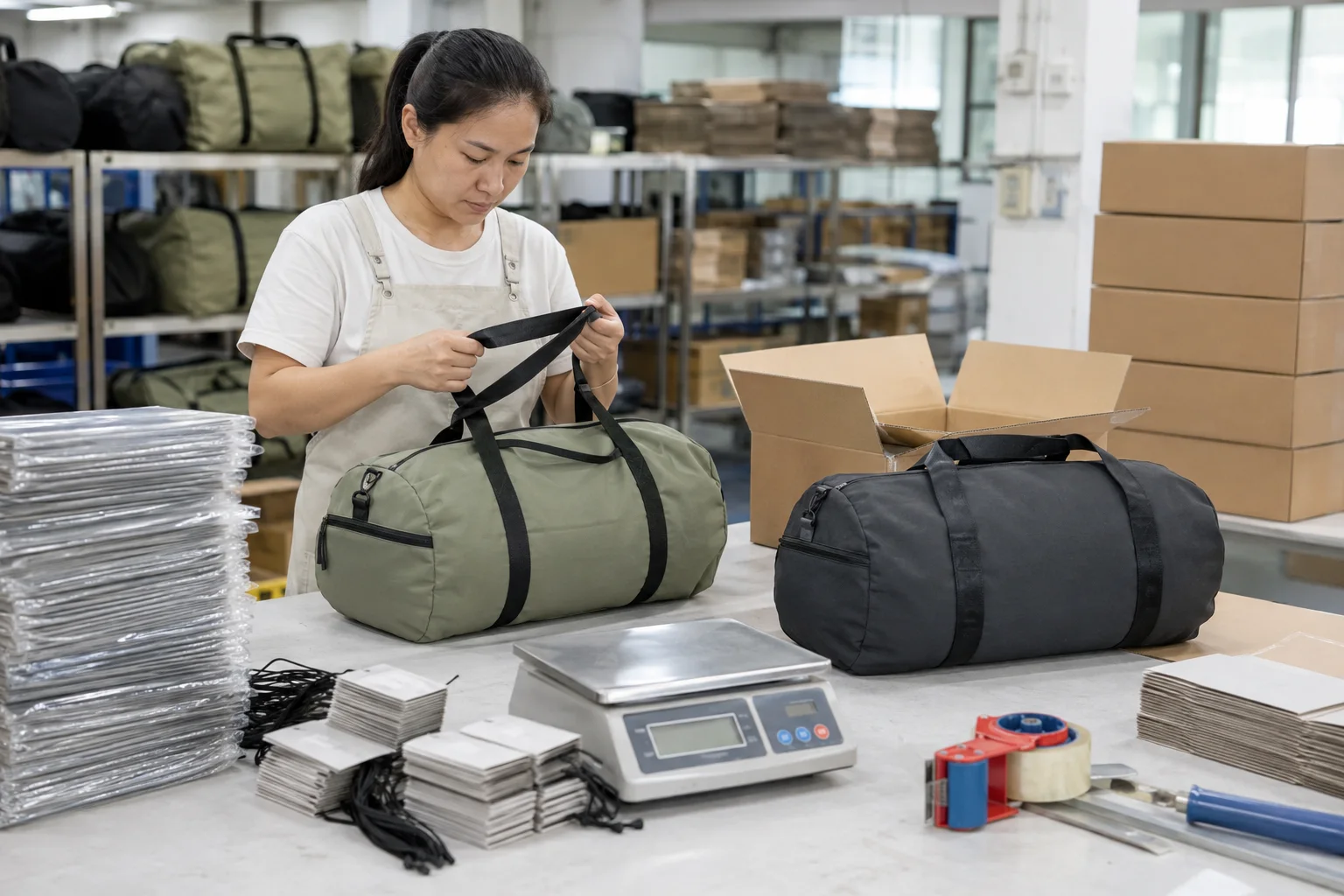
Stage 3 of six, also called DUPRO (during production inspection). Panels are measured to ±0.5 cm at cutting, the first complete bag from each of the 10+ lines is approved against the golden sample before the line runs, and an inline inspector then patrols every station every hour, checking 5–10 bags per line for 8–10 spi, seam allowance, bar-tacks and logo position to ±3 mm. A defect is reworked before the bag moves on; a repeat defect stops the station.
Patrol every hour·5–10 bags per line per hour·First-off approval per line·Panels ±0.5 cm·Logo ±3 mm
Inline Production Inspection-venlinker

1 hour

Patrol interval

5–10

Bags checked per line per hour

10+

Lines patrolled

By brief

Test requirements agreed before production

8–10 spi

Stitch density

±3 mm

Logo position
Inline checkpoints

Inline Inspection for Bags: Checks at Cutting, First-Off and on the Line

Six checkpoints between the cutting table and the last sewing station. Each one is a written procedure with a sample size; together they catch defects when 5 bags are affected, not 5,000. The full run is on the production process page.

Cutting Check

The first 5 panels per marker are measured against the pattern to ±0.5 cm, and grain direction, shade group and print alignment (±3 mm on printed fabric) are confirmed before the marker is cut in full. Bundles are tagged with the roll number so a shade query can be traced back to incoming inspection.
First 5 panels · ±0.5 cm

Logo Panel Check

Every printed, embroidered or patched panel is checked before it reaches the sewing line: registration and position against the jig cut from the golden sample (±3 mm), colour against the lab dip, thread tension, patch bond. A panel that fails is replaced, never sewn and hoped for. See logo & branding.
100% of logo panels

First-Off Approval per Line

The first complete bag from each line is laid beside the golden sample and checked across all 12 form fields: dimensions, spi, seam allowance, bar-tack count, hardware, labels. The line supervisor and inline QC both sign before the line runs; a first-off that fails is corrected and resubmitted within the hour.
1 bag per line per style

Hourly Patrol

The inline inspector walks every station on the line each hour and pulls 5–10 bags at the stage they are at: stitch density with a gauge, seam allowance with a ruler, bar-tacks by count and position, zipper run by hand, strap attachment by pull. Results go on the patrol sheet by station and hour.
Every hour · All stations

Stitch, Seam and Bar-Tack Checks

Topstitch and join seams at 8–10 spi (12–14 on fine lining), seam allowance 8–10 mm, no skipped stitches over 5 mm, thread tension balanced with no loops on the underside. Bar-tacks of 28–42 stitches at every strap, handle and D-ring anchor; a missing bar-tack is a major defect on backpacks and duffels.
8–10 spi · 28–42 stitch bar-tack

Rework Loop

A defective bag is tagged red, logged by station and defect code, returned to the operator who made it and reworked before the next bundle. Two of the same defect from one station in an hour stop that station for a machine or method check. The patrol sheet totals feed the end-of-day defect rate, which we hold under 3% inline.
Same-station rework · Stop at 2 repeats
We confirm the production schedule after reviewing the specification, material availability and target quantity. Allow separate time for sample approval and freight. production process.
Checklist

During Production Inspection Checklist for Bags: Stitch, Seam, Bar-Tack, Logo, Hardware

The patrol sheet by check point. Frequencies are per line; tolerances are the defaults for a 600D–1680D sports bag and are replaced by the figures on the golden sample form when the tech pack is tighter.
Check point
Panel dimensions
Spec
Pattern ±0.5 cm
Tool
Tape, pattern template
Frequency
First 5 panels per marker, then 5 per 100 panels
Fail action
Marker re-cut; bundle held
Check point
Shade group per bundle
Spec
One roll group per bag
Tool
Bundle tag vs roll tag
Frequency
Every bundle
Fail action
Bundle re-sorted
Check point
Print or logo registration
Spec
Jig from golden sample, ±3 mm
Tool
Jig, ruler
Frequency
100% of logo panels
Fail action
Panel replaced
Check point
Stitch density
Spec
8–10 spi (12–14 on lining)
Tool
Stitch gauge
Frequency
5–10 bags per line per hour
Fail action
Machine reset; bags since last pass re-checked
Check point
Seam allowance
Spec
8–10 mm
Tool
Ruler
Frequency
5–10 bags per line per hour
Fail action
Operator guide reset
Check point
Skipped or broken stitches
Spec
None over 5 mm
Tool
Visual, 30 cm
Frequency
5–10 bags per line per hour
Fail action
Re-sew, needle change logged
Check point
Bar-tacks
Spec
All positions on diagram, 28–42 stitches
Tool
Diagram, count
Frequency
5–10 bags per line per hour
Fail action
Add bar-tack; station stopped at 2 repeats
Check point
Zipper run and slider
Spec
Runs end to end by hand, no tape caught
Tool
Hand test
Frequency
5–10 bags per line per hour
Fail action
Re-sew zipper seam
Check point
Strap and handle attachment
Spec
Holds a 5 s hand pull; webbing not twisted
Tool
Hand pull
Frequency
5–10 bags per line per hour
Fail action
Re-anchor with bar-tack
Check point
Hardware fitted
Spec
Matches golden sample hardware card
Tool
Card
Frequency
First-off, then hourly
Fail action
Wrong part removed, batch checked
Check point
Labels and care label
Spec
Position in cm from form, correct content
Tool
Ruler, form
Frequency
First-off, then hourly
Fail action
Label re-sewn
Check point
Thread ends and trimming
Spec
No tails over 1 cm
Tool
Visual
Frequency
Last station, hourly
Fail action
Re-trim
Patrol interval
1 hour
Bags per pull
5–10 per line
Inline defect target
Under 3%
Station stop rule
2 repeats in 1 hour
Daily workflow

DUPRO Inspection Workflow on a Bag Sewing Line: Hour by Hour

One day on one line, from the first bundle to the end-of-day report. Each of the 10+ lines follows the same clock; the inline QC lead compiles all patrol sheets into one daily report that the buyer can receive on request.
07:30

Bundles issued and first-off built

Cut bundles, checked for shade group and panel size, are issued to the line. The first complete bag is sewn under the line supervisor and taken to the inspection table.
08:30

First-off approved against the golden sample

All 12 fields checked and signed by inline QC and the supervisor. Any correction is made and a second first-off submitted before the line is released; typical release within 1 hour.
Every hour

Patrol round

5–10 bags pulled per line at whatever stage each station is at; spi, seam allowance, bar-tacks, zipper run, strap pull, logo position and hardware checked and written on the patrol sheet by station.
On a defect

Red tag and rework

The bag is tagged, logged by defect code, returned to the operator and reworked before the next bundle. Bags sewn at that station since the last pass are re-checked; two repeats stop the station for a mechanic or method reset.
Midday

Logo panel and hardware batch check

New logo panels and hardware batches arriving at the line are checked against the jig and the hardware card before issue, so a wrong batch never reaches the operators.
17:30

End-of-line count and daily report

Finished bags counted, defect rate by station calculated (target under 3%), and the report filed under the project code. Finished bags move to the holding area for final inspection.
First-off release
Within 1 hour
Patrol
Every hour
Daily report
By station and defect code
Buyer photo update
On request, same day

Photo Updates From the Line at Cutting, First-Off and Packing

Every order gets photo updates at the three points that matter and a live video walk-through of the line on request. Project managers reply within 1 working day; see project communication.
Defect codes

Inline Inspection Defect Codes for Bags: Cause, Rework and Prevention

The codes used on the patrol sheet. Recording by code, station and hour is what turns an inspection into a control: the same code twice from one station in one hour stops the station.
Code
S1
Defect
Skipped stitches over 5 mm
Usual station
Join seams
Typical cause
Blunt or wrong needle, thread tension
Rework
Re-sew the seam
Prevention
Needle change log every 8 h; tension set per fabric
Code
S2
Defect
Stitch density under 8 spi
Usual station
Topstitch
Typical cause
Stitch length knob moved
Rework
Re-sew
Prevention
Machine tagged with the spi for the style
Code
S3
Defect
Seam allowance under 8 mm
Usual station
Join seams
Typical cause
Guide moved
Rework
Re-sew where fabric allows; replace panel if not
Prevention
Guide fixed and checked at first-off
Code
B1
Defect
Missing bar-tack
Usual station
Strap and handle anchors
Typical cause
Station skipped
Rework
Add bar-tack
Prevention
Bar-tack diagram at the station; hourly count
Code
Z1
Defect
Zipper tape caught or wavy
Usual station
Zipper set
Typical cause
Feed mismatch
Rework
Unpick and re-set
Prevention
Zipper foot and speed set per zipper size
Code
L1
Defect
Logo off position over 3 mm
Usual station
Logo panel
Typical cause
Jig not used
Rework
Panel replaced
Prevention
Jig from golden sample; 100% panel check
Code
L2
Defect
Logo colour off lab dip
Usual station
Print or embroidery room
Typical cause
Wrong thread or ink lot
Rework
Panel replaced
Prevention
Thread and ink lots locked on the form
Code
H1
Defect
Wrong or damaged hardware
Usual station
Hardware set
Typical cause
Batch mix-up
Rework
Part replaced
Prevention
Hardware card at the station; batch check at issue
Code
A1
Defect
Oil mark or stain
Usual station
Any
Typical cause
Machine oil, handling
Rework
Cleaned or panel replaced
Prevention
Oil-free lubricant schedule; clean covers
Code
A2
Defect
Thread tails over 1 cm
Usual station
Trimming
Typical cause
Rushed trimming
Rework
Re-trim
Prevention
Trim before the bag leaves the line
Codes
10
Logged by
Station + hour
Stop rule
2 same codes in 1 hour
Report
Daily, under project code
Common problems

Inline Inspection Problems in Bag Factories and How the Patrol Prevents Them

Six failures that show up when a factory relies on end-of-line inspection alone, and the inline control that removes each one.
3,000 bags sewn before anyone measures one
Cause: no first-off gate. Control: the first complete bag from every line is approved against the golden sample on all 12 fields before the line runs; typical release within 1 hour.
Stitch density drifts from 10 to 6 spi mid-run
Cause: stitch length knob moved during a thread change. Control: spi gauge on 5–10 bags per line per hour; a reading under 8 resets the machine and re-checks every bag since the last pass.
Strap tears out at the bar-tack point
Cause: bar-tack station skipped under line pressure. Control: bar-tack diagram at the station, count on every patrol pull, and a 5 s hand pull on straps of duffels and team bags.
Logo sits 8 mm off centre on a third of the lot
Cause: operator placed by eye after the jig was moved. Control: 100% of logo panels checked against the jig to ±3 mm before sewing, so an off-position panel never becomes an off-position bag.
Rework pile discovered on the last day
Cause: defects collected, not returned. Control: red-tagged bags go back to the operator who made them before the next bundle; the rework loop closes within the hour, not at the end of the run.
Buyer learns of a problem at the final report
Cause: no daily record. Control: patrol sheets by station and defect code, a daily rate (target under 3%) and photo updates at cutting, first-off and packing through project communication.
Factory

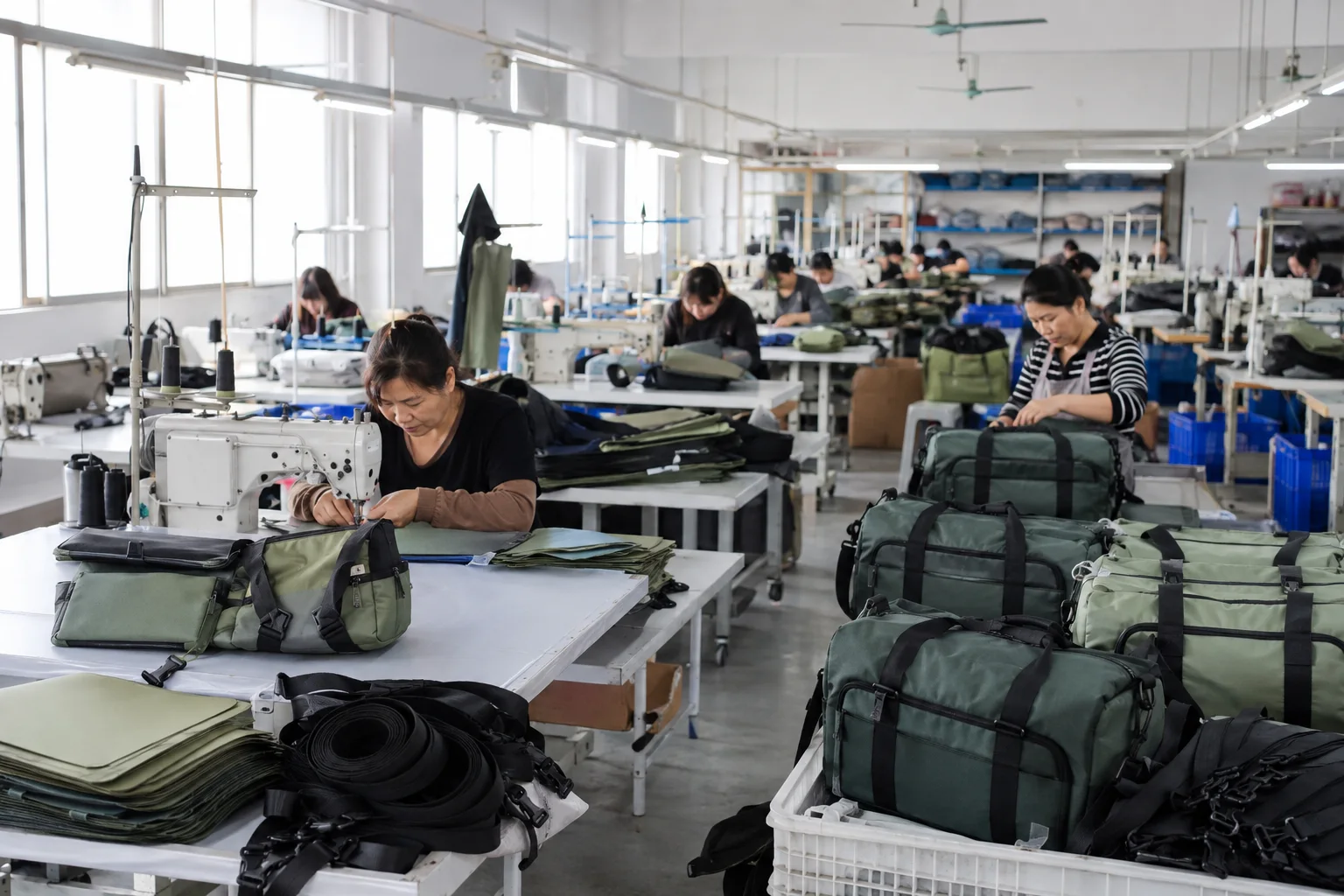
Inline Bag Inspection on 10+ Lines in Guangzhou: 5,000 m², 500+ Staff

Each of the 10+ sewing lines in our own Huadu District factory has an inspection table at its head and an inline inspector on the patrol clock; about 5,000 bags per line per month pass through first-off, hourly patrol and rework on the same floor. Factory tours and audits Mon–Sat.

2010

Founded

5,000 m²

Factory floor

500+

Staff

10+

Production lines

50,000+

Bags per month

200+

Fabric suppliers

Get a Bag Quote With the Inline Inspection Plan

Send bag type and quantity from 300 pcs. The quote comes back within 24 hours with the inspection plan, tolerances and lead time; a sample follows in 5–7 working days.
Related QC stages

Bag Quality Control Stages Before and After Inline Inspection

Inline inspection is stage 3 of six. It works only because incoming inspection and the golden sample come before it and final and packing inspection come after; each stage below has its own page.

Incoming Material Inspection

Stage 1. Every fabric roll checked for GSM (±5%), colour against the approved lab dip, shade lot, denier and coating; zippers cycled 1,000+ times, buckles load-tested, webbing and lining sampled per roll before a single panel is cut.
Before cutting · 100% of rolls

Sample Approval & Golden Sample

Stage 2. The signed-off pre-production bag that fixes dimensions (±1 cm), logo position (±3 mm), colour, hardware and stitch density (8–10 spi) for every later check. Sealed, tagged and stored for the life of the program.
5–7 day sample · 1 free revision

Final Inspection & AQL

Agree the sampling standard, inspection level, defect classes and acceptance criteria before production. AQL sampling is separate from our 100% pre-shipment inspection; the plan must match the order and the buyer’s requirements.
Agreed inspection criteria

Packing Inspection

Stage 5. Polybag, hangtag, labels, carton count and carton weight against the packing list (±0.5 kg), carton drop test, FNSKU scan, seal and strap check, then loading photos before the container door closes.
Follow the current destination-specific packing brief

Third-Party Inspection Support

Stage 6. SGS, BV, TUV or QIMA inspections and factory audits welcome on any order, commissioned and paid by the buyer. Inspector access Mon–Sat, samples pulled, documents and a room provided; typical booking lead time 3–5 days.
Buyer-commissioned · Mon–Sat access

Bag Quality Control Overview

The hub page: all 6 inspection stages on one table with sample sizes, tolerances and sign-off owners, plus a defect list sorted by AQL class. 100% pre-shipment inspection on every order.
6 stages · 1 factory

Factory Capabilities Hub

Our Guangzhou team coordinates design, cutting, sewing, printing and packing. Specialist logo or sealed-compartment requirements are reviewed during sampling, with the process and inspection criteria confirmed for your bag.
Founded 2010 · 50,000+ bags/month
Bag types

Inline Inspection for Gym, Yoga, Running, Swim and Travel Bags by Category

The patrol sheet is the same on every category; the check points that get the most attention change with the bag.

Gym & Training Bags

Duffels and backpacks: strap bar-tacks, #8–#10 zipper set, base stiffener alignment.

Yoga & Studio Bags

Mat bags and totes: strap length ±1 cm, print registration ±3 mm on canvas and RPET.

Running & Outdoor Bags

Waist packs and belts: elastic tension, 20–25 mm buckle set, reflective tape stitch line.

Outdoor & Travel Bags

Weekenders and dry bags: TPU weld line width 8–10 mm, roll-top stiffener, weld peel spot check.

Swim & Wet Gear Bags

Mesh and wet bags: mesh seam binding, TPU lining weld, drain grommet position.

Team & Equipment Bags

Team duffels and ball bags: 50 mm webbing route, 1680D seam density, end pocket alignment.

Work-Gym Lifestyle Bags

Commuter backpacks: laptop sleeve seam, back padding stitch line, top handle bar-tacks.

Accessories & Sets

Pouches and sets: 3-piece colour and label match, drawcord channel, set count per bundle.
Buyer fit

Inline Production Inspection for Private Label, Retailers, Activewear Brands and FBA Sellers

Who asks for the daily patrol report and what each buyer type usually adds to the inline plan.

Private Label Programs

Daily defect-rate report by SKU across 5–20 styles; first-off photos sent per line and per colourway.

Distributors & Retailers

DUPRO by SGS, BV, TUV or QIMA booked by the buyer at 20–40% completion; our patrol sheets handed to the inspector.

Activewear & Fitness Brands

Tech-pack spi and seam figures on the patrol sheet; logo jig approved on the PP sample.

Amazon FBA & E-commerce Sellers

Label and care-label position checked hourly so 100% of units scan and read correctly at packing.
FAQ

Inline Production Inspection for Bags: Frequently Asked Questions

DUPRO is during-production inspection: checks made while bags are being cut and sewn, on 5–10 bags per line every hour, so a defect is fixed at the station that caused it. Final inspection checks finished bags at 100% plus an AQL sample. Both run on every order.
The first complete bag from each line at 100% of the 12 form fields, then 5–10 bags per line per hour across all stations for the length of the run. On a 1,000 pcs order on two lines over 8 days that is roughly 600–1,200 patrol checks before final inspection starts.
8–10 stitches per inch on shell seams and topstitch, 12–14 on fine lining, bar-tacks of 28–42 stitches at every load point. The figure for each seam is written on the golden sample form and checked with a gauge on every patrol.
The bag is red-tagged, logged by code and station, and returned to the operator for rework before the next bundle; bags sewn at that station since the last pass are re-checked. Two of the same code from one station within an hour stop the station for a mechanic or method reset.
Yes. SGS, BV, TUV or QIMA DUPRO visits are welcome Mon–Sat, commissioned and paid by the buyer, usually booked 3–5 days ahead at 20–40% completion. The inspector receives the golden sample, the form and our patrol sheets on arrival.
Yes. Daily reports by station and defect code, photos at cutting, first-off and packing, and a live video walk-through of the line on request are part of project communication on every order from 300 pcs.
We confirm the production schedule after reviewing the specification, material availability and target quantity. Allow separate time for sample approval and freight. It removes days by catching a defect when 5 bags are affected instead of a full rework after final inspection. See the production process. production process.
Inspection on the line, not after it

Get a Bag Quote With Inline Inspection on Every Line

Send bag type, quantity from 300 pcs and any tolerance. The quote comes back within 24 hours with the inline plan, patrol frequency and lead time; a PP sample follows in 5–7 working days.
Tel / WhatsApp
+86 133 6639 6425
MOQ
300 pieces
Sample
5–7 working days
Inline Production Inspection-venlinker
Have a Bag Project in Mind?
Share the bag type, quantity and target delivery date. We will review the details with you.