Factory › Material Sourcing

Bag Fabric Sourcing: 200+ Verified Suppliers Behind Every Order

Fabric choice, consumption, lining and finishing affect the unit price. Compare quotations against the same approved specification.
200+ verified suppliers·Roll width 150 cm standard·MOQ 50–100 m per fabric·Lab dip 5–7 days·Out-of-network +7–14 days
Material Sourcing & Supplier Network-venlinker

200+

Verified fabric suppliers

150 cm

Standard roll width

50–100 m

MOQ per fabric per colour

Compare costs in your quotation

Fabric share of unit cost

5–7 days

Lab dip turnaround

+7–14 days

Out-of-network fabric
Supplier network

Bag Material Supplier in China: What the 200+ Verified Suppliers Cover

The network is split into six buying categories, each with two or more qualified suppliers so a single mill outage never stops a line. Every category below links to the page that explains the specification behind it.

Shell Fabrics

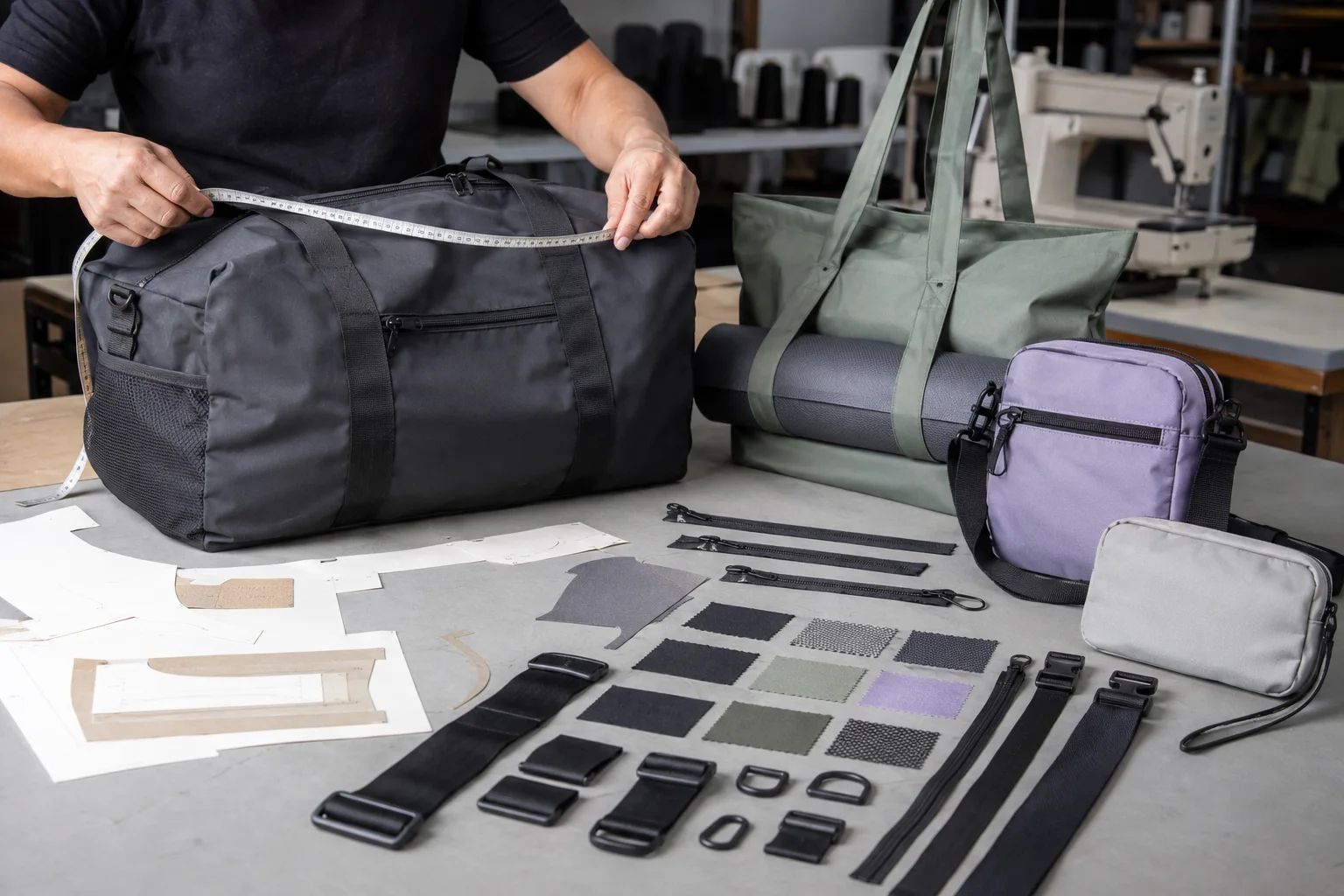
210D–1680D polyester and nylon, cotton canvas 10–16 oz, RPET from post-consumer bottles, neoprene 2–4 mm and ripstop 40D–70D. Roughly 60 base qualities are held as live swatch cards, and every one has a named mill, a GSM figure and a roll width on file. See the bag material guide.
60+ live swatch cards · 4–8 suppliers each

Coatings and Laminates

PU coating 0.1–0.5 mm, PVC backing, and TPU laminate 0.15–0.5 mm for welded work. Water column ratings run 800–3,000 mm depending on the coat weight, which is what separates a shower-resistant gym duffel from a sealed dry bag.
Water column 800–3,000 mm

Linings, Mesh and Interlinings

70D–210D polyester lining, 190T–210T taffeta, polyester mesh at 80–150 gsm for mesh swim bags, plus non-woven interlining 30–80 gsm. Lining is quoted separately from the shell because it moves 3–8% of unit cost on its own.
Lining 70D–210D · Mesh 80–150 gsm

Zippers and Sliders

Nylon coil, vislon and metal zippers in #3, #5, #8 and #10, with auto-lock, double-pull and reverse-coil water-resistant tape. Branded chains such as YKK and SBS are sourced on request; every lot is cycle-tested before cutting at incoming inspection.
#3–#10 · 1,000+ cycle test

Webbing, Cord and Elastic

PP and nylon webbing 20–50 mm wide and 1.2–2.0 mm thick, drawcord 3–6 mm, elastic 15–40 mm and reflective tape 10–25 mm for reflective pouches. Webbing is bought dyed to the shell Pantone rather than matched from stock.
Webbing 20–50 mm · Dyed to Pantone

Foam, Boards and Hardware

Custom tooling needs a separate quote and schedule.
EVA 3–10 mm · Custom mould +10–15 days
Send a fabric name, a GSM figure or just a reference bag: the sourcing desk replies with swatch options within 24 hours.
Qualification

How a Fabric Enters the Approved Supplier List: 6 Qualification Steps

A mill does not become a supplier because it quotes low. Six steps, run by the sourcing desk with the sample room and the QC team, decide whether a fabric is added, and every approved fabric is reviewed again after 12 months.
Step 1

Spec sheet and sample roll

The mill sends a 5–10 m sample roll with a written spec: composition, denier, GSM, roll width, coating type and coat weight, and the minimum order per colour. A fabric with no written spec is not tested.
Step 2

Bench check against the spec

GSM is weighed to ±5% of the claim, width measured across three points, denier and weave confirmed under a loupe, coating thickness checked and water column tested where the mill claims one. A fabric that misses its own spec is rejected here.
Step 3

Test build in the sample room

One full bag is cut and sewn from the roll, not a swatch, so needle damage, fray at 8–10 mm seam allowance, weld behaviour and how the fabric takes 8–10 spi stitching are all seen before any buyer sees the fabric.
Step 4

Wear and colour checks

Rub, wash and light exposure spot checks on the built bag: colour transfer to a white cloth, seam slippage under a strap pull, and coating adhesion after flexing. Results are written on the swatch card next to the mill name.
Step 5

Commercial terms fixed

Minimum order per colour (usually 50–100 m), dye-lot minimum, roll width, stock colours held, price band and delivery window (5–10 days in-network) are agreed in writing so a quote never rests on a verbal price.
Step 6

Trial order and 12-month review

The fabric runs on one real production order under incoming inspection before it is listed. Delivery accuracy, shade consistency across lots and reject rate are reviewed every 12 months; a supplier that fails twice leaves the list.
Qualification
6 steps
GSM tolerance
±5% of claim
Test build
1 full bag, not a swatch
Review
Every 12 months

Get Fabric Swatches With Your Bag Sample

Existing showroom samples are free, with courier paid by the buyer. Custom prototypes take 5–7 working days after the specification is confirmed. We quote the prototype fee, courier charge and any sample-fee credit before work starts.
Buying specs

Fabric Sourcing for Bags: Roll Width, MOQ per Roll, Dye Lot and Lead Time

What the sourcing desk actually buys, by fabric family. Widths and minimums are the ones written on the supplier agreements; the lead time column assumes the fabric is already in the network and the colour is a stock shade.
Fabric family
600D polyester, PU-coated
Typical weight
250–320 gsm
Roll width
150 cm
MOQ per colour
50–100 m
Dye lot minimum
300–500 m
In-network delivery
5–7 days
Fabric family
900D–1680D polyester
Typical weight
380–520 gsm
Roll width
150 cm
MOQ per colour
50–100 m
Dye lot minimum
300–500 m
In-network delivery
5–10 days
Fabric family
210D–420D nylon
Typical weight
90–170 gsm
Roll width
150 cm
MOQ per colour
50–100 m
Dye lot minimum
500 m
In-network delivery
7–10 days
Fabric family
Cotton canvas 10–16 oz
Typical weight
340–540 gsm
Roll width
150 cm
MOQ per colour
100 m
Dye lot minimum
500 m
In-network delivery
7–10 days
Fabric family
RPET recycled polyester
Typical weight
200–320 gsm
Roll width
150 cm
MOQ per colour
100 m
Dye lot minimum
500 m
In-network delivery
10–15 days
Fabric family
Neoprene 2–4 mm
Typical weight
400–800 gsm
Roll width
135–150 cm
MOQ per colour
50 m
Dye lot minimum
300 m
In-network delivery
7–12 days
Fabric family
Polyester mesh
Typical weight
80–150 gsm
Roll width
150 cm
MOQ per colour
50 m
Dye lot minimum
300 m
In-network delivery
5–7 days
Fabric family
TPU laminate for welding
Typical weight
0.15–0.5 mm
Roll width
135–150 cm
MOQ per colour
50 m
Dye lot minimum
300 m
In-network delivery
7–12 days
Fabric family
Lining 70D–210D
Typical weight
50–110 gsm
Roll width
150 cm
MOQ per colour
100 m
Dye lot minimum
500 m
In-network delivery
5–7 days
Standard roll width
150 cm
MOQ per fabric
50–100 m
Fabric cost share
Compare costs in your quotation
Lab dip
5–7 days
Network or outside it

In-Network and Out-of-Network Bag Fabric: What the +7–14 Days Buys

Every quote states which of the four routes below your fabric takes, because the route sets both the lead time and the risk. Nothing is hidden inside a single number.

In-network, stock colour

One of the 60+ live swatch qualities in a shade the mill already holds. We confirm the production schedule after reviewing the specification, material availability and target quantity. Allow separate time for sample approval and freight. This is the default route in a first quote.

In-network, dyed to Pantone

Same qualified mill, your colour. A lab dip is submitted and approved in 5–7 days and runs in parallel with pattern work, so it usually costs 0 extra days. Dye lots start at 300–500 m; see materials and colours.

Out-of-network fabric

A quality no qualified mill holds. It is swatched, bench-checked and test-sewn before bulk, which is where the +7–14 days goes. Flagged in the quote on day one, never discovered after the deposit; timing sits in sample cost and lead time.

Buyer-nominated mill or supplier

You name the mill and hold the price; we buy against your nomination or receive your free-issued rolls. We still run the full incoming inspection, and any defect is documented and referred back to your supplier before cutting.
Not sure which route your fabric takes? Send the reference and the sourcing desk answers within 24 hours.
Material Sourcing & Supplier Network-venlinker
Hardware buying

Bag Hardware Sourcing: Zippers, Buckles, Webbing and Custom Moulds

Hardware is 8–15% of unit cost but causes a large share of returns, so it is bought to a written grade rather than to a picture. Six buying rules apply on every order.

Zipper Grade Is Named, Not Implied

The bill of materials names chain type, size (#3–#10), slider type and tape finish. A #8 auto-lock coil on a 40 L duffel and a #5 on a toiletry pouch are different purchases; every lot is cycled 1,000+ times before cutting starts.
#3–#10 · Lot cycle-tested

Buckles Bought by Load, Not Look

POM and zinc-alloy side-release buckles in 20, 25, 32, 38 and 50 mm, chosen against the strap load the bag carries. Team and equipment bags at 60–90 L take 38–50 mm; running belts take 20–25 mm.
20–50 mm · Load-matched

Webbing Dyed With the Shell

Webbing, cord and binding are dyed in the same Pantone submission as the shell so the trims do not read half a shade off in daylight. Thickness 1.2–2.0 mm; a thin webbing is the usual reason a strap curls after two months.
1.2–2.0 mm · Same lab dip

Two Sources per Critical Part

Zippers, buckles and sliders each have at least two qualified suppliers. We confirm the production schedule after reviewing the specification, material availability and target quantity. Allow separate time for sample approval and freight. production run.
2+ suppliers per part

Custom Moulds Ordered on Deposit Day

A branded slider, buckle or moulded patch needs a mould: drawing on day 1, tooling 10–15 days, run in parallel with fabric and pattern work so it does not extend the ship date. Mould files stay under your project code.
Mould +10–15 days

Packaging Bought as a Material

Polybags, hangtags, retail boxes, tissue and cartons are sourced and inspected like any other component. Printed retail boxes take 7–10 days in parallel; see packaging and FBA prep.
Printed boxes 7–10 days
Common problems

Bag Fabric Sourcing Problems and How the Sourcing Desk Prevents Them

Six failures that start at the fabric purchase rather than on the sewing line, and the control that removes each one before cutting.
Second production run feels thinner than the first
Cause: the mill substituted a lighter quality at the same price. Control: GSM is weighed on every incoming roll to ±5% of the swatch card figure, and the roll tag is recorded against the lot at incoming inspection.
Two cartons of the same style are different shades
Cause: the order was cut from two dye lots. Control: dye lots start at 300–500 m so a 300–1,000 pcs run normally fits one lot; where two are unavoidable, bags are cut lot by lot and cartons are marked so a split never lands inside one retail delivery.
Fabric arrives 3 weeks late and moves the ship date
The quotation and order documents confirm the payment schedule, inspection arrangements and shipment-release requirements. Review these terms before approving the order.
Colour approved on screen, wrong on the bag
Cause: approval from a photo or a PDF. Control: a physical lab dip in 5–7 days on the real fabric, approved against a Pantone chip under the same light, then held as the reference for every roll. See materials and colours.
Coating peels or cracks after a season of use
Cause: coat weight bought down to hit a target price. Control: coat weight and water column (800–3,000 mm) are written on the swatch card and on the bill of materials, and a full test bag is built and flexed before a coated fabric is ever listed as approved.
Buyer’s nominated mill ships a defective roll
Cause: nominated material treated as outside the factory’s control. Control: nominated and free-issued rolls go through the same incoming inspection; a defect is photographed, quantified in metres and referred to your supplier before cutting, not after 800 bags are sewn.
Factory

Bag Fabric Sourcing From a Guangzhou Factory: 5,000 m², 200+ Suppliers

The sourcing desk, the fabric store and the sample room sit on the same 5,000 m² floor in Huadu District, and most of the 200+ suppliers are within 90 minutes of it. That is why a swatch request answered on Monday can be a sewn test bag by Friday. Tours Mon–Sat.

2010

Founded

5,000 m²

Factory floor

500+

Staff

10+

Production lines

50,000+

Bags per month

200+

Fabric suppliers

Send Your Fabric Spec and Get a Sourcing Answer in 24 Hours

Give a fabric name, a GSM figure, a reference bag or a nominated mill. You get the route, the roll width, the minimum per colour and the lead-time effect in one reply, before any deposit.
More factory pages

More Bag Factory Pages: Capabilities, Samples, Production, Export, Documents

Material sourcing is one of seven factory pages. The others cover what happens before a fabric is bought and after the first roll is cut.

Manufacturing Capabilities

Cutting, 10+ sewing lines, high-frequency TPU/PVC welding, embroidery and print, and packing on one 5,000 m² floor. a total factory capacity of 50,000+ bags per month, 50,000+ a month in total, 500+ staff.
10+ lines · 50,000+ bags/month

Sample Development

Existing showroom samples are free, with courier paid by the buyer. Custom prototypes take 5–7 working days after the specification is confirmed. We quote the prototype fee, courier charge and any sample-fee credit before work starts.
Sample 5–7 days · 1 free revision

Production Process

We confirm the production schedule after reviewing the specification, material availability and target quantity. Allow separate time for sample approval and freight.
Schedule confirmed in the quotation

Packing & Export Support

Send the current requirements for your marketplace and destination, including barcodes, bagging, warnings, carton size and weight. We confirm the packing specification and its cost before production.
FOB default · Sea 25–45 days, air 5–10

Project Communication

One project manager per order, replies within 24 hours, a weekly photo and video production report, WhatsApp, WeChat or email, NDA on request and fixed sign-off points at sample, pre-production and final inspection.
1 project manager · 24-hour reply

Compliance Documents

What the factory provides with every shipment (supplier material data sheets, our 100% final inspection report, packing list, commercial invoice, CO on request, photos and video) and how buyer-commissioned testing and audits fit in.
6 standard documents · Audits Mon–Sat

Factory Overview

The hub page: all seven factory pages, a factory-at-a-glance table (founded 2010, 5,000 m², 10+ lines, 500+ staff), an order-flow timeline and the factory-visit page for Mon–Sat tours.
7 pages · 1 factory

Quality Control

Six inspection points from incoming fabric rolls to the sealed carton: incoming material, golden sample, inline, final AQL, packing and third-party support. 100% pre-shipment inspection on every order.
6 inspection points · 100% final
Bag types

Bag Fabric Sourcing by Category: Gym, Yoga, Running, Travel, Swim, Team

Every category draws on the same 200+ supplier network, but the base fabric list is different. Category pages give 6–8 sub-types with the fabric and weight each one normally uses.

Gym & Training Bags

600D–900D PU-coated polyester, #8 coil zippers and 38–50 mm webbing for duffels and backpacks.

Yoga & Studio Bags

Cotton canvas 10–16 oz, RPET and 2–4 mm neoprene for mat bags and studio totes.

Running & Outdoor Bags

210D–420D ripstop nylon, 15–40 mm elastic and 10–25 mm reflective tape.

Outdoor & Travel Bags

1680D polyester for weekenders and 0.15–0.5 mm TPU laminate for welded dry bags.

Swim & Wet Gear Bags

Polyester mesh 80–150 gsm, TPU lining and PVC tarpaulin for wet and beach bags.

Team & Equipment Bags

900D–1680D shells, 50 mm webbing and moulded EVA end panels for team gear.

Work-Gym Lifestyle Bags

Recycled 600D, PU-look fabrics and 5–8 mm foam for laptop sleeves in commuter bags.

Accessories & Sets

Lightweight 210D, non-woven and cotton drill for pouches, shoe bags and dust bags.
Buyer fit

Bag Material Sourcing for Startups, Private Label, Activewear Brands and Retailers

What the four buyer types that use the sourcing desk most often ask it to do.

Startup & DTC Brands

Swatch pack of 6–10 in-network qualities with the sample, so a first 300 pcs run avoids the +7–14 day out-of-network route.

Activewear & Fitness Brands

One fabric standard applied across 3–8 SKUs, with a single lab dip per colour reused on every style in the range.

Private Label Programs

Dye lots of 500 m and up booked ahead for 5,000–20,000 pcs programs so repeat runs hold shade across a year.

Distributors & Retailers

Nominated mills and free-issued fabric accepted, with incoming inspection reports issued per roll and per lot.
FAQ

Bag Fabric Sourcing FAQ: Suppliers, MOQ, Dye Lots and Lead Time

We source it. 200+ verified suppliers cover shell fabric, lining, coating, zippers, webbing, foam and hardware, and the quote names the mill quality behind the price. You can also nominate your own mill or free-issue rolls, in which case we buy against your nomination and still run full incoming inspection.
Most mills sell from 50–100 m per colour, and a dye-to-order lot starts at 300–500 m. A 300 pcs run of a 40 L duffel uses roughly 1.3–1.8 m per bag on a 150 cm roll, which is why 300 pieces is the site-wide MOQ.
A main bag and matching pouches can share fabric, colours and labels. Ask for the individual-item prices and the complete-set price before deciding what to include in your launch. cost factors.
Speciality materials may need additional sourcing time; availability is confirmed before sampling.
The approved lab dip is kept as the reference and every later roll is compared to it, not to the previous delivery. Repeat-order timing is confirmed against the approved sample, any specification changes and current material and production availability. See custom materials and colours. custom materials and colours.
Existing showroom samples are free, with courier paid by the buyer. Custom prototypes take 5–7 working days after the specification is confirmed. We quote the prototype fee, courier charge and any sample-fee credit before work starts.
RPET from post-consumer bottles is in the network at 200–320 gsm and is quoted like any other quality; recycled nylon and organic cotton canvas are sourced on request. Venlinker holds no material certificates of its own, so where a buyer needs recycled-content proof we ask the mill for its declaration and any testing is commissioned by the buyer. See compliance documents.
Start with the fabric

Get a Bag Quote With the Fabric Named and Sourced

Send the bag type, a target quantity from 300 pcs and any fabric reference or nominated mill. Within 24 hours you get the sourcing route, roll width, minimum per colour and the lead-time effect; swatches follow with the 5–7 day sample.
Tel / WhatsApp
+86 133 6639 6425
MOQ
300 pieces
Sample
5–7 working days
Material Sourcing & Supplier Network-venlinker
Have a Bag Project in Mind?
Share the bag type, quantity and target delivery date. We will review the details with you.