* Simply fill out the form below as best you can. And don’t sweat the details. * Your information will be kept strictly confidential. * Share your needs with us, We’ll contact you in very short time.
Planning a Custom Bag Order?
Send your bag type, quantity and target delivery date. We will review the specification and confirm the next step.
Who this guide is for: activewear and training brand product managers, owners and merchandise buyers at hybrid-fitness and functional gyms that coach athletes for these races, coach and creator brands building a kit line, and event organisers who need a race-day gym bag their community will actually carry.
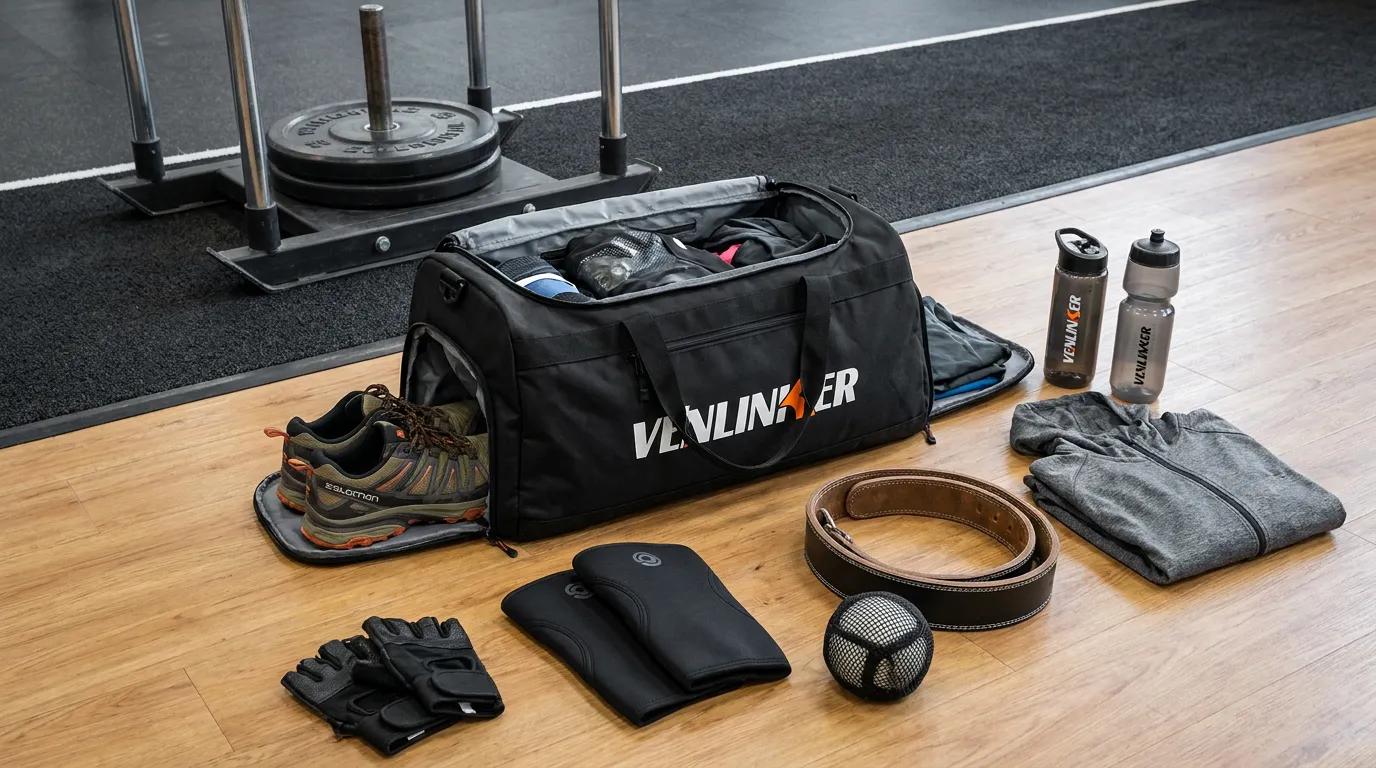
Ask anyone who races HYROX what goes in their HYROX bag and the answer is longer than a normal gym list: two pairs of shoes or at least a change, gloves, knee sleeves, a lifting belt or wraps, chalk, gels, two bottles, a warm-up layer and a full change of clothes for the trip home. The athlete leaves the venue carrying the same kit soaked in sweat, dusted with chalk and grey from the sled track, often straight onto a train or a flight. A standard 40 L duffel with one zip and one end pocket was never designed for that day.
That gap is a product brief. Hybrid fitness racing has moved from a niche event to a mass-participation sport, and the gyms that coach racers, the activewear brands that dress them and the creators who train them all want a bag that fits the race day. The decisions that shape it are specific: how many clean, dirty and wet zones the bag needs, which format suits the athlete who flies to a race weekend against the one who walks from the station, where the base and strap anchors take their abuse, and how a gym can put its own name on 300 bags without buying ten colourways it cannot sell.
This guide sets out the race-day packing list with sizes and zones, the clean-dirty-wet split, four bag formats compared, the durability points that fail first, travel constraints, branding and wholesale for gyms and creator brands, a worked tech-pack block and the questions to put to a supplier before you request a quote. Compartment construction in depth is covered in the guide to shoe compartments and welded wet-dry cells, so this article applies it to race day instead of repeating it.
Hybrid Fitness Racing and Why It Needs Its Own Race-Day Gym Bag
A hybrid fitness race combines endurance running with functional strength work in one timed event. In the HYROX format, athletes run 8 × 1 km, and each kilometre is followed by one functional workout station, according to the race description on Wikipedia. The stations include sled work, and at a mass-participation event the whole field shares the same warm-up areas, bag drops and changing space.
A note on names before going further. HYROX is a registered trademark of its owner. This guide uses the word only to describe the athletes and races the bags are carried to. venlinker has no affiliation with the race series, does not make official or licensed products, and the product category described here is the hybrid fitness race bag or race-day gym bag. A brand or gym ordering one should brand it with its own marks, which the branding section below covers.
How big the hybrid fitness market has become
The participation figures explain why brands and gyms are asking for this bag. As of late September 2026, the race organiser reports more than 1.5 million participants in the 2025/26 season across 200+ days of racing, and a target of more than 2 million athletes for 2026/27, with 107 race weekends planned on six continents in 30+ countries, as reported by endurance.biz on 20 July 2026. For comparison, the Wikipedia entry records about 175,000 competitors across 65 races in the 2023 season.
Hybrid fitness racing participation by season: HYROX athletes, 2023 to the 2026/27 target
Participants per season. The 2026/27 bar is the organiser’s stated target, not a result, and is drawn with a dashed outline.
Sources: 2023 figure from Wikipedia, “Hyrox”; 2025/26 figure and 2026/27 target from endurance.biz, 20 July 2026. HYROX is a registered trademark of its owner and is used here descriptively.
Two things follow for a bag buyer. First, the athlete base is large enough that gyms now run race-prep classes and send teams to events, so a gym has a real reason to order a bag in its own name. Second, a calendar of more than a hundred race weekends means a race is happening somewhere almost every week, which turns the race-day bag into an all-year product with no single selling season.
What makes race day different from a gym session
A normal gym visit is one pair of shoes, one set of clothes and a water bottle, with a shower at the end. Race day is closer to a travel day with a hard workout in the middle. Athletes arrive early, warm up in one layer, race in another, change in a crowded venue and then travel home. They carry equipment a gym-goer leaves in a locker, and they bring back kit far dirtier than a session produces: wet with sweat, coated in chalk and carrying fine dust from the sled lane. A race-day gym bag has to hold that load in separate zones and survive being dropped on a hard venue floor, which sets it apart from a general gym duffel.
What Goes in a HYROX Bag: The Race-Day Packing Checklist
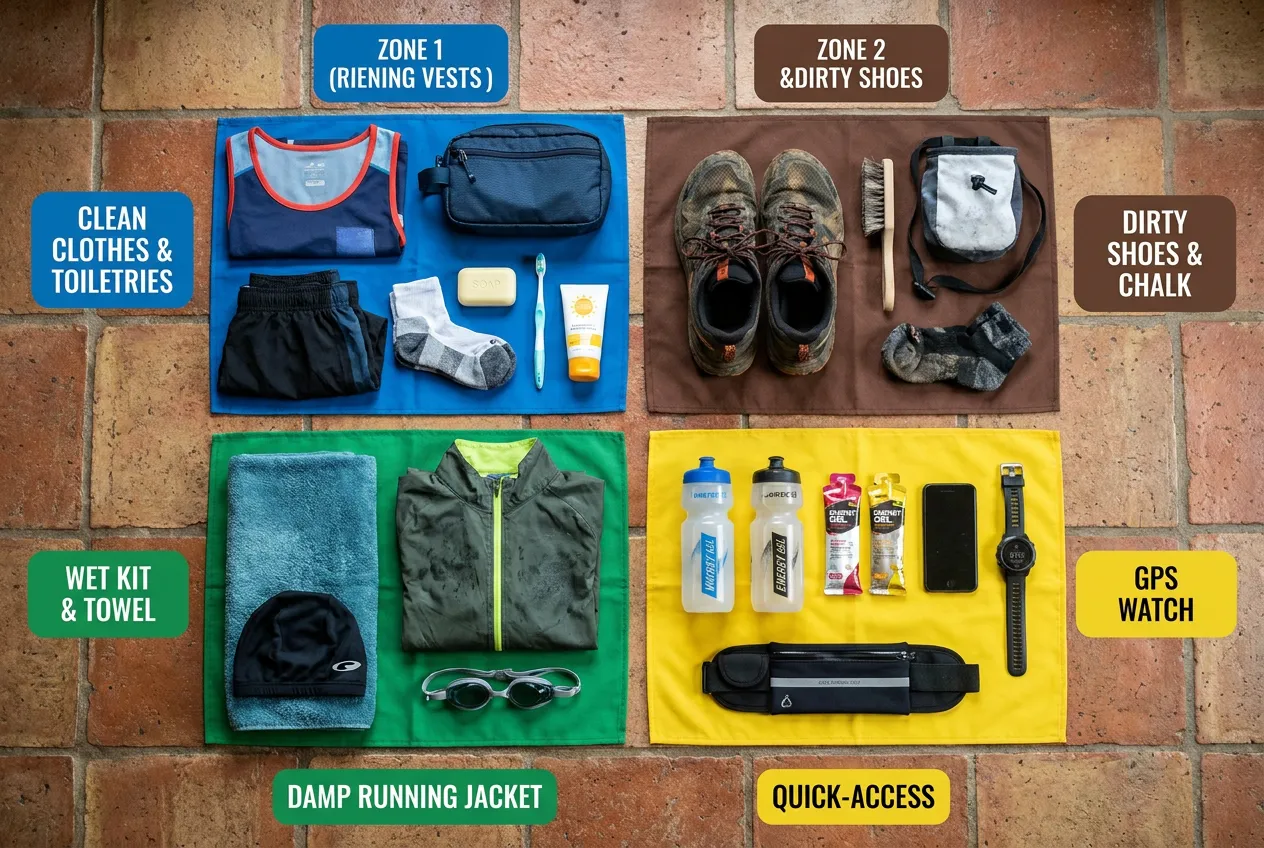
The fastest way to design a hybrid fitness bag is to lay out what an athlete packs and give each item a place. The table below uses typical sizes for each item and assigns a zone: clean (never touches dirty kit), dirty (shoes, grit, chalk), wet (sweat-soaked or rinsed kit) and quick-access (what the athlete reaches for in the warm-up area without opening the main body). Sizes are industry-typical ranges and vary by brand and athlete.
Item
Typical size
Where it should go in the bag
Zone
Race shoes (1 pair)
Roughly 30–34 × 20 × 12–14 cm as a pair, heel to toe
Ventilated end shoe tunnel or base shoe drawer
Dirty
Second pair or travel shoes / slides
Roughly 28–33 × 18 × 8–13 cm
Second shoe bag inside the main body, or a shared tunnel on a larger bag
Dirty
Training gloves
Roughly 20–24 × 10–12 cm flat, pair
Chalk-proof front pocket
Dirty (dry)
Knee sleeves
Roughly 15–20 cm long each, 10–12 cm diameter rolled
Chalk-proof pocket before the race, wet cell after
Dirty, then wet
Lifting belt or wrist wraps
Belt 10–12 cm wide, coils to roughly 20–25 cm diameter; wraps roll to 6–8 cm
Flat rear or base panel sleeve, or the main body in a separate pouch
Dirty (dry)
Chalk ball or block
Roughly 7–9 cm
Sealed chalk pocket with a storm flap, or a small zipped pouch
Dirty
Gels and bars
4–8 sachets, roughly 12 × 6 cm each
Top or front quick-access pocket
Quick-access
Two bottles
500–750 ml, roughly 7–8 cm diameter and 20–25 cm tall
External side sleeves
Quick-access
Warm-up layer
Hoodie or jacket folds to roughly 30 × 25 × 8 cm
Main body, top layer
Clean
Post-race change and towel
Clothes roughly 30 × 25 × 10 cm; towel rolls to 25 × 12 cm
Three observations shape the bag. The dirty zone is bigger than on any everyday gym bag: two pairs of shoes, gloves, sleeves, a belt and chalk together take roughly 10–14 L, which is why a 25 L gym backpack struggles to be a full race bag on its own. The wet zone appears only after the race, so it should collapse when empty and give its volume back on the way there. And the quick-access items (bottles, gels, phone) need to live outside the main zip, because athletes in a warm-up area are standing, crowded and short on time.
Brands also ask what size the bag should be. A single-pair race bag with a wet cell packs comfortably at 30–35 L; a two-pair bag with a belt and full change needs 40–45 L. The capacity section of the backpack and duffel capacity guide explains how nominal litres convert into dimensions and why two bags labelled 40 L can hold different amounts.
Clean, Dirty and Wet Zones in a Hybrid Fitness Bag
A race-day bag works when the athlete can pack it once in the morning and never let dirty kit touch clean kit, even after a tired, rushed change in a busy venue. That takes three separated zones and one extra pocket that everyday gym bags rarely have.
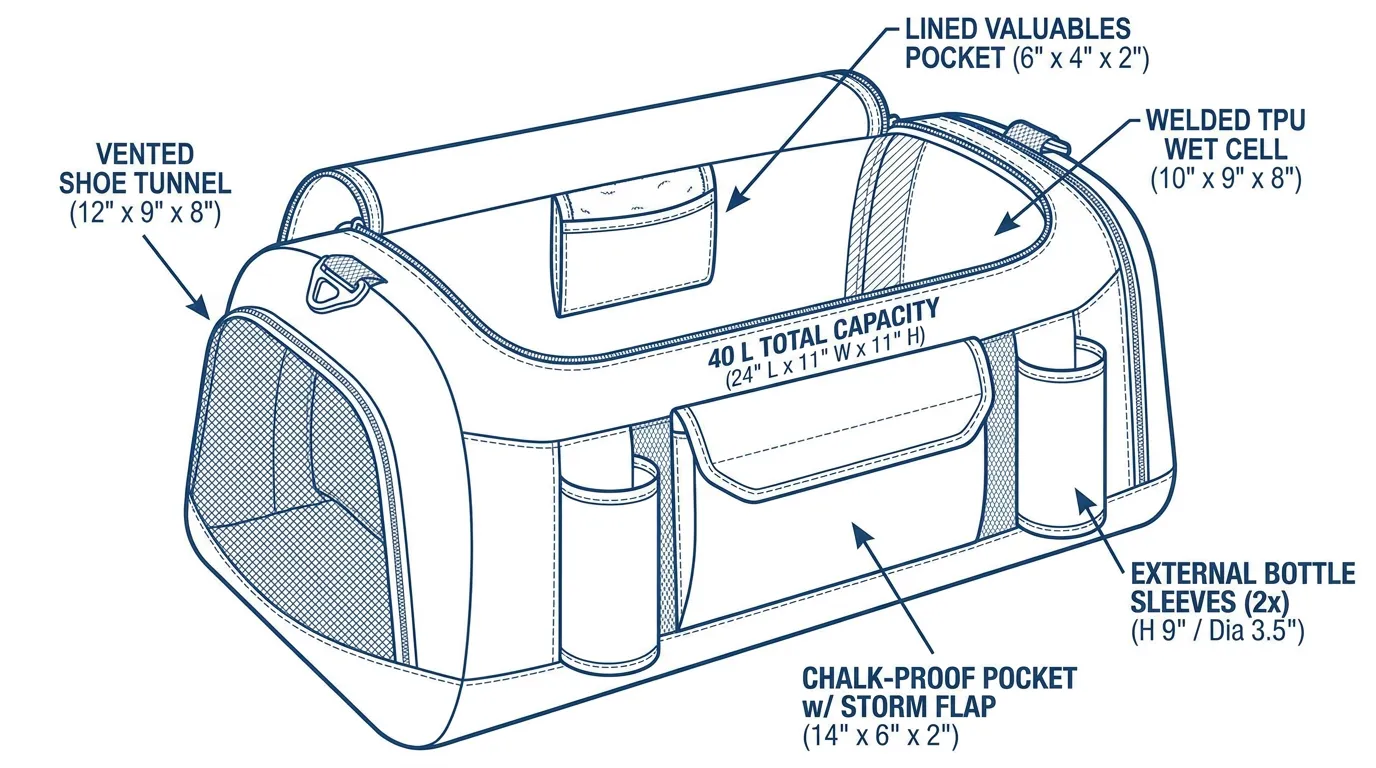
The ventilated shoe tunnel
Shoes are the biggest dirty item and the smelliest. An end tunnel on a duffel or a base drawer on a backpack keeps them physically apart from the main body, with a mesh panel or eyelets venting the tunnel outward through the shell. For a race bag the tunnel should be sized to the largest foot the SKU is sold to, typically 33–34 cm of clear length for a unisex line and 29–30 cm on a women’s-specific bag. Where the brief asks for two pairs, a tunnel that takes one pair plus a separate shoe bag in the main body is usually cheaper and more flexible than a double-height tunnel. How to size, vent and reinforce a tunnel is set out in full on the shoe compartment gym bags page.
The welded or coated wet cell
Post-race kit is heavier with sweat than most gym kit, and it may sit in the bag for hours on a journey home. A coated polyester pocket with stitched seams resists splash for a short time; a high-frequency welded TPU cell holds standing moisture because it has no needle holes. For a race-day bag the welded cell is the right default when the brand promises to keep wet kit separate. A removable welded wet pouch is the lower-cost route and has one advantage on race day: the athlete can lift the soaked kit out at home without emptying the bag. The four construction levels, and why the zip is the real leak path, are covered in the wet-dry separation guide, and the product families are on the wet-dry gym bags page.
The chalk-proof pocket
Chalk is the item most bag briefs forget. Magnesium carbonate is a fine powder that works through coil zips, lodges in untreated lining weave and marks dark fabric on contact. Once it reaches the main compartment, every clean item carries a white trace. A chalk-proof pocket is a small, separately lined compartment on the front or side of the bag, with four features: a coated wipe-clean lining (a coated 210D polyester or a thin TPU-laminated lining), bound or taped internal seams so powder cannot collect in raw edges, a water-resistant or coated #5 zip, and a 2–3 cm storm flap over the zip. Gloves and a chalk ball go in together before the race. The same pocket takes damp gloves afterwards.
Keeping the zones apart
Two layout rules carry over from general wet-dry design and matter more on race day. Put the shoe tunnel and the wet cell at opposite ends of the bag, so a vent from the shoes never opens into damp kit. And keep the chalk pocket on the outer shell, not on the divider between clean and dirty, so a failed zip spills powder onto the outside of the bag instead of into the clothes. The custom design and structure page shows how a sample room lays out multi-zone patterns before cutting.
Race Day Gym Bag Formats Compared: Duffel, Backpack, Convertible and Tote Set
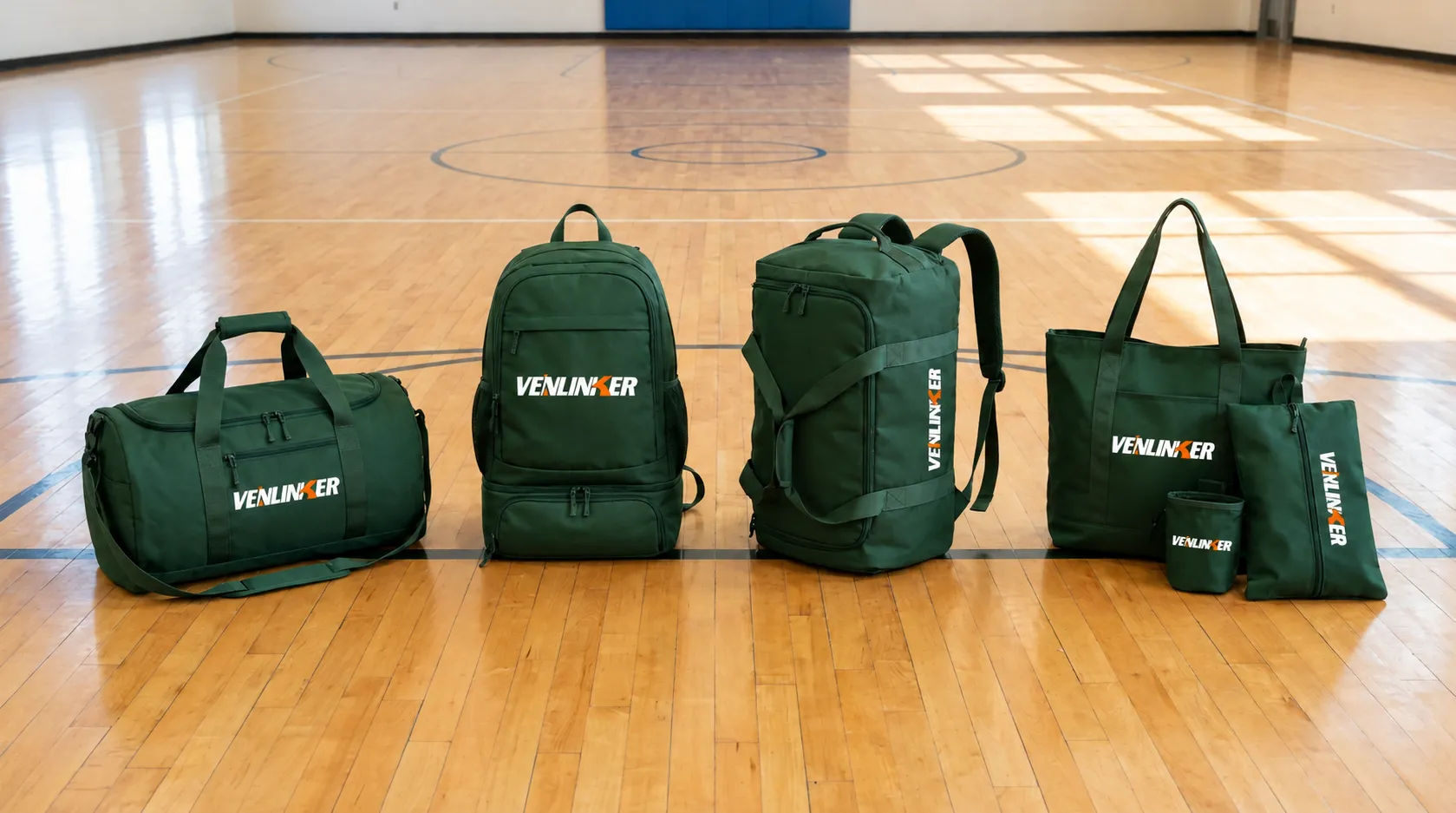
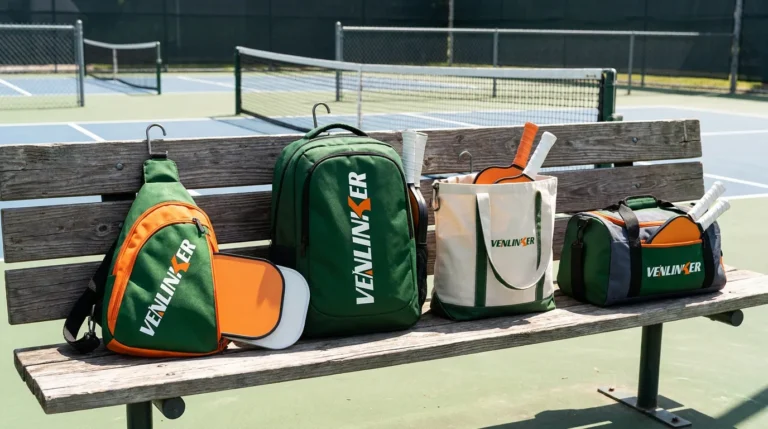
Four formats cover almost every request for a race-day gym bag. Each suits a different athlete journey, and many gyms and brands end up offering two of them.
Athletes who travel to races by air or rail; activewear brands’ hero SKU
Moderate–high
Tote plus pouch set
20–30 L tote with 2–3 pouches
Shoulder handles; pouches carried inside
Separate shoe bag, wet pouch and chalk or accessory pouch; zones travel as pouches
Studios and gyms with a women’s-focused community; gift and finisher kits
Low–moderate
Duffel: the default team bag
The 30–45 L duffel is the easiest race-day bag to build and brand. The end panels give a natural home to the shoe tunnel and the wet cell, the long front panel carries a large logo, and the format tolerates a heavy load in the hand. Its weakness is carry distance. A packed 40 L duffel on one shoulder is tiring over a long walk from the station to the venue, which matters for athletes who travel to races.
Backpack: the commuter race bag
A 25–35 L race backpack with a base shoe drawer suits athletes who ride or walk to the venue and to the gym during the week. The athlete searching for a hyrox backpack usually wants one bag for training days that can stretch to race day. At 25 L the dirty zone crowds out the change of clothes, so race-ready backpacks sit at 30–35 L and move the wet kit into a removable pouch. The closest standing family for a weekday-to-race backpack is the work-gym backpack, which already carries a laptop sleeve and a shoe pocket.
Convertible duffel-backpack: the travelling racer
For athletes who fly or take the train to a race weekend, the convertible is the strongest fit. It packs like a duffel, with full-length access and end compartments, then carries on the back through stations and airports. The cost is added hardware and pattern pieces: stowable straps need a garage pocket, reinforced anchors on the back panel and a second set of buckles, which moves the bag up roughly one cost tier against a plain duffel of the same size.
Tote plus pouch set: zones you can lift out
A 20–30 L tote with a shoe bag, a welded wet pouch and a small accessory pouch puts the clean-dirty-wet split into separate pieces. It suits studios and gyms with a large women’s membership, finisher or welcome kits, and brands that want a lower entry price. The set also raises order value: a three-piece set typically lifts order value by 25–40% over the tote alone. Gym tote bags and private label gym bag sets show the standing constructions.
Hybrid Fitness Race Bag Durability: Base Abrasion, Strap Anchors and Zip Gauge
Race day concentrates wear into a few hours. The bag is dropped on hard floors, dragged along a bag-drop row, packed to the limit and lifted by one strap while the athlete is exhausted. Five points fail first, and each has a specification that fixes it.
Stress point
What happens on race day
Typical specification
Deeper guide
Base panel
Dropped on hard venue floors and dragged across bag-drop areas; picks up dust and damp
900D–1680D polyester or PVC-backed 600D base wrap rising 4–6 cm up the sides; optional base feet
Powder works into the coil and stiffens the slider
Coated or water-resistant #5, storm flap, bound internal seams
Wet-dry guide
Base abrasion
The base is the panel that ends a race bag’s life. A 600D shell resists daily gym-floor contact for a season or more, but hard venue floors and the dust around a sled lane wear it faster. The usual answer is a mixed-denier build: 600D body, heavier base. A PVC-backed base also wipes clean, which suits a surface that sits in damp and dust. The trade-offs between 600D, 900D and 1680D on weight and cost are laid out in the 600D polyester guide, and the custom materials and colours page lists which base fabrics are held in stock colours.
Strap anchors and zip gauge
A race bag packed with two pairs of shoes, a belt and a wet cell is heavier than an everyday gym bag, and the load arrives at the anchors in jerks. Strap anchors should land on a reinforced end panel or base wrap, never on a single layer of shell fabric. On zips, the rule is to match gauge to the compartment: #8 on the main opening and shoe tunnel, #5 on front and chalk pockets, #3 inside. The bag hardware guide explains what separates each gauge in service and how bar-tack counts and reinforcement patches are written on a tech pack. Zip pullers, buckles and branded hardware are specified on the custom trims, hardware and accessories page.
Lining and cleaning
Chalk and sled dust make the lining a durability line as well as a comfort one. A coated 210D polyester lining in a mid or dark tone wipes clean and hides residue better than a pale uncoated lining. Athletes wash race bags more often than office bags, so the brief should say whether the bag must survive a gentle machine wash or only a wipe-down; welded cells and PVC bases generally prefer a wipe-down.
Race Day Travel: Gym Bags for Overhead Lockers, Train Racks and Event Venues
Many athletes travel to a race weekend by air or rail, and that adds three constraints a local gym bag never meets.
Overhead lockers and carry-on frames
A soft race bag intended to fly as cabin baggage should keep its external dimensions inside the common carry-on envelope. A pattern held at or below roughly 55 × 35 × 23 cm external keeps a 40 L duffel inside most carry-on frames when it is packed normally, and the hangtag should say “fits most carry-on frames” rather than naming a carrier. The capacity guide covers the arithmetic between external size and litres and why an overstuffed 45 L bag fails a sizing frame it passes when packed soft. For athletes who check a bag and carry a second one, the travel gym duffels family covers heavier, luggage-grade builds.
Train racks and station walks
Luggage racks and overhead shelves on trains reward a bag that compresses. Side compression straps, a soft base and backpack straps for the station walk all help. A convertible that stows its backpack straps behind a zip garage keeps loose webbing out of rack gaps and door seals.
Bag drops and warm-up areas
At the venue, bags sit in rows. An athlete needs to find their bag fast, and a gym team needs to find all of its bags. Three details help: a name tape or ID window on an end panel, a reflective or high-contrast logo that reads across a crowded floor, and a top grab handle wide enough to lift the bag out of a pile with one hand. The ID window also solves the “twenty identical team bags” problem that gyms run into as soon as they order in one colourway.
Custom Branding and Wholesale Programmes for Gyms, Coaches and Creator Brands
The buyers ordering race-day gym bags fall into four groups, and each brands differently. None of them should use the race series’ name or logo on the bag. The bag carries the buyer’s own marks: the gym’s name, the brand’s logo, the coach’s or creator’s mark, or the local event’s own identity.
Buyer
Typical branding
Common method
Order shape
Hybrid-fitness and functional gyms
Gym logo front panel, “race team” wording, athlete name on an ID patch
Embroidery or rubber patch; hook-and-loop name patch added locally
One style, one or two colourways, 300 pcs per colourway
Activewear and training brands
Full brand system, custom colourways, printed lining
Rubber patch, screen print, custom zip pullers
Two to four styles as a range, several colourways
Coach and creator brands
Creator mark, signature colourway, limited drops
Embroidery or woven label, custom colour lab dip
One hero style at 300 pcs, repeated as drops
Event organisers and local race series
Their own event mark, year, volunteer or finisher wording
Screen print or heat transfer
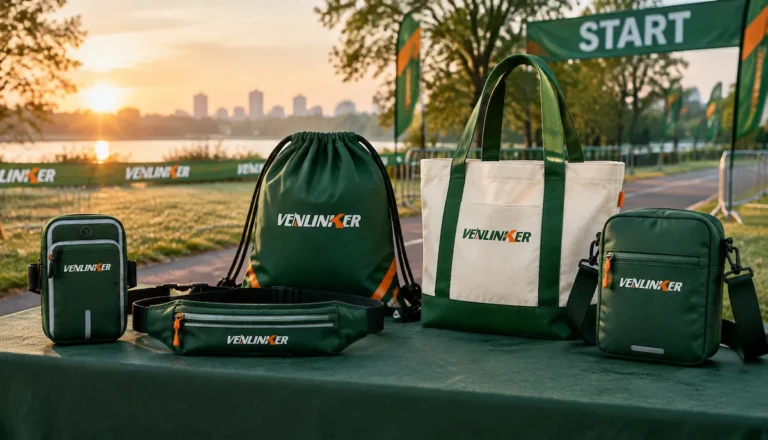
Tote or drawstring sets for volume, duffel for staff
Gyms that train racers
A functional gym running race-prep classes usually wants one bag its members recognise and its team carries to events. The practical order is one style, one colourway, 300 pieces, with the gym logo embroidered or patched on the front and a hook-and-loop ID panel on the end so each athlete can add a name patch after delivery. That keeps the factory order to a single SKU while every bag at the event is personal. The gym, studio and club chains page covers how gym merchandise programmes are usually structured.
Activewear and training brands
Brands selling to hybrid athletes tend to build a small range: a duffel or convertible as the hero, a backpack for daily training and a pouch set as the entry price point. Colourways matter here more than on team bags, because race-day photos travel on social media and the bag appears in them. The activewear and fitness brands page explains how venlinker scopes a first range, and the logo method guide compares embroidery, rubber patches, screen print and heat transfer by cost tier and wear.
Coaches, creators and event organisers
Coach and creator brands often run one hero bag in a signature colour as a limited drop, then repeat it. Influencer and creator brands at 300 pieces usually choose a stock fabric colour plus a lab-dipped accent (zip tape, webbing or lining) to get a signature look without dyeing the whole shell. Local event organisers more often need volume at a low cost tier, and a printed tote or drawstring set suits volunteer and finisher kits; the corporate, event and promotional page covers that order type. The custom logo and branding page lists the artwork files the sample room needs for each method.
MOQ and lead times for race-season orders
venlinker’s MOQ is 300 pieces per style per colourway. Each additional colourway is its own 300-piece run, so a gym that wants black and white bags orders 600 pieces. Bulk lead times depend on the order tier, and they start after sample approval and deposit.
Order size
Typical bulk lead time
Planning note for race season
Sample
5–7 working days, plus 1 free revision
Allow a second round if the brief adds a welded cell or a new shoe-tunnel size
300–1,000 pcs
25–35 days
A single gym or creator drop; plan back from the team’s target race weekend
1,000–5,000 pcs
30–40 days
Brand range launch or a multi-gym programme
5,000–20,000 pcs
35–50 days
Wholesale or retail range across several markets
Repeat order
20–30 days
Same spec, same golden sample; the usual rhythm for creator drops
Out-of-network fabric
Adds 7–14 days
Special base fabric or a custom-dyed shell
Custom-moulded hardware
Adds 10–15 days
Branded zip pullers or buckles
Freight time comes on top of these figures and depends on route and mode; confirm it with your forwarder. The custom bag MOQ guide explains how MOQ works across colourways and sizes.
Multi-gym programmes
Gym groups and affiliate networks can pool orders. Several gyms that agree on one style and one colourway reach 300 pieces together even when each needs only 30–60 bags. The shared bag carries a common design, and each gym’s identity goes on a patch or ID panel added after delivery. A programme coordinator should confirm in writing how the supplier treats logo variants within a single colourway run before promising each gym its own embroidered logo, because that choice changes the quote. Buyers planning a programme like this can contact Venlinker with the list of gyms and quantities before fixing the design.
How to Specify a Race-Day Gym Bag in a Tech Pack
A race-day brief that says “gym duffel with shoe pocket and wet pocket” will come back as whatever the factory already tools. Writing the zones, the durability points and the branding into the tech pack gets a sample that works on the first round. The block below is a worked example for a 40 L convertible duffel-backpack aimed at travelling racers. Every figure is a starting point for a sample, not a tested result.
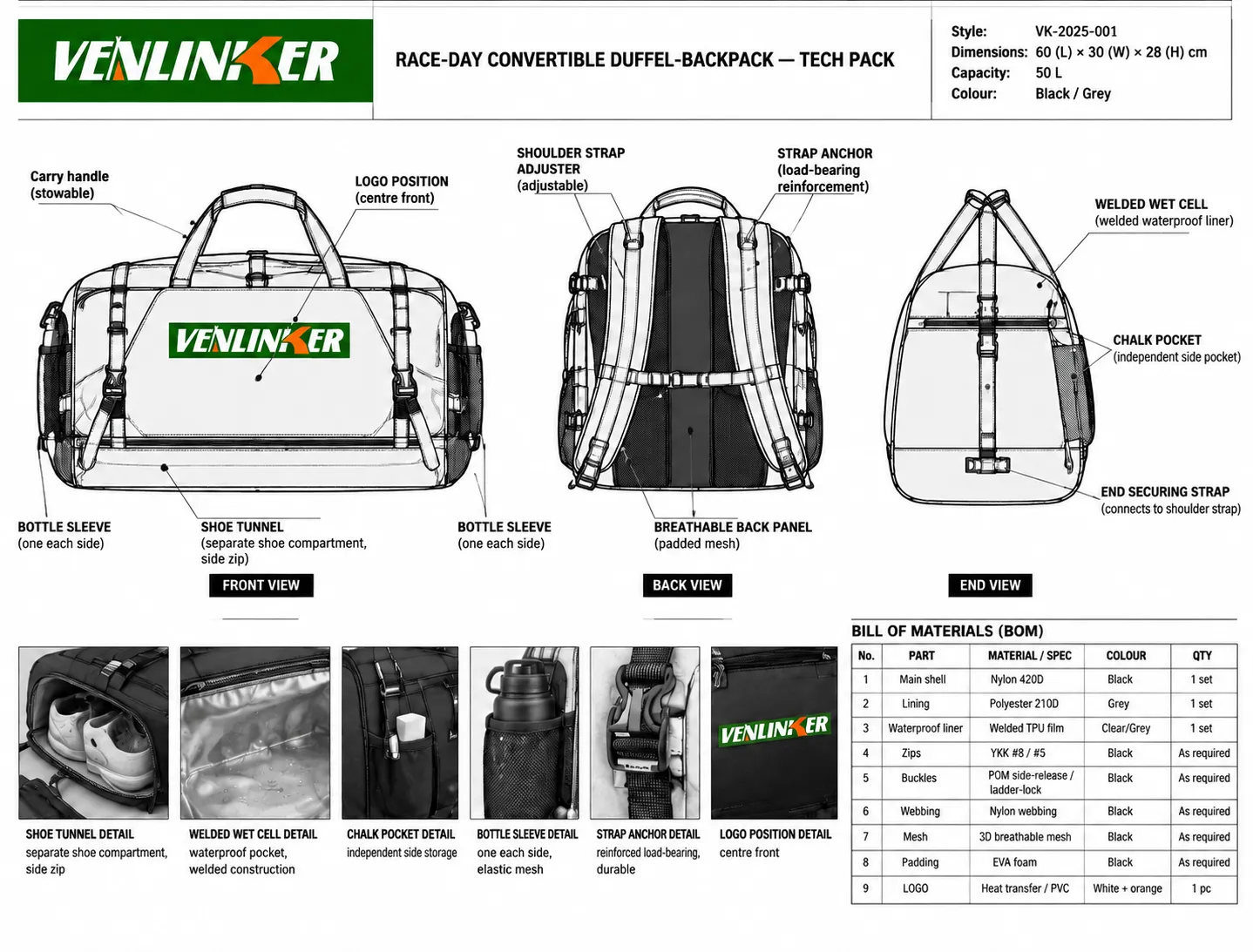
STYLE: Race-day convertible duffel-backpack, 40 L nominal EXTERNAL SIZE: 54 x 33 x 23 cm (L x H x D), tolerance +/-1 cm TARGET: fits most carry-on frames when packed normally SHELL: 600D polyester, PU-backed, 220-280 GSM, stock colour BASE: PVC-backed 600D or 900D polyester wrap, 5 cm up sides and ends LINING: coated 210D polyester, dark tone, wipe-clean ZONE 1 - SHOE TUNNEL (dirty): one end, clear 33 x 20 x 14 cm #8 coil zip on outer face, zip ends bar-tacked mouth bound in 25 mm webbing mesh vent 10 x 15 cm on outer end panel, vents outward only ZONE 2 - WET CELL (wet): opposite end, 30 x 25 x 8 cm 0.2 mm TPU, high-frequency welded, 8-10 mm seams joined to shell above water line only water-resistant #5 zip on top edge, 3 cm storm flap fill-and-hold water test on prototype and at inline inspection ZONE 3 - CHALK POCKET (dirty, dry): front, 22 x 16 cm coated lining, bound internal seams water-resistant #5 zip, 2-3 cm storm flap ZONE 4 - MAIN BODY (clean): #8 coil two-way zip, zip garages both ends QUICK ACCESS: 2 external elastic mesh bottle sleeves, fit 7-8 cm diameter lined valuables pocket 20 x 12 cm on top panel, #3 zip gel pocket 18 x 12 cm inside front flap CARRY: 2 grab handles, 38 mm webbing, wrapped grip detachable shoulder strap, 38 mm, acetal hardware, shoulder pad backpack straps stow in rear zip garage all anchors: reinforcement patch + box-and-cross stitch TRAVEL: side compression straps x 2, ID window on non-tunnel end BRANDING: buyer logo, embroidery 10 x 6 cm front panel woven label inside main body; reflective logo on end panel hook-and-loop ID panel 10 x 5 cm for name patches COLOURWAYS: 2 x 300 pcs (MOQ 300 per style per colourway) PACKING: individual polybag with hangtag; carton under 22.7 kg QC: 100% pre-shipment inspection; wet cell leak check per lot
The five lines that do the most work
If a brief can hold only five lines, keep these: the clear shoe-tunnel dimensions, the wet-cell construction (welded or stitched), the base fabric, the zip gauge on each compartment, and the external size limit. They decide whether the bag holds a race day and whether it flies. The bag tech pack guide shows where each line sits in the bill of materials, and the RFQ checklist covers the commercial details a quote needs alongside the spec.
Questions to Ask a Supplier About Hybrid Fitness Race Bags
These questions separate a factory that has built multi-zone sports bags from one that will learn on your order. Ask them before the first sample, and put the answers on the tech pack.
Is the wet compartment welded or stitched, and who does the welding? An in-house high-frequency welding line keeps the sample round short and lets the factory leak-test the prototype itself.
How do you test the wet cell? Expect a fill-and-hold water test on the prototype and on production lots at inline inspection.
What clear length and height will the shoe tunnel have? Ask for centimetres, not litres, and confirm it takes the largest shoe size you sell.
How is the chalk pocket lined and sealed? Look for a coated lining, bound internal seams and a storm flap over the zip.
Which base fabric do you recommend, and is it in stock in my colour? A stock colour avoids a lab dip; an out-of-network base fabric adds 7–14 days.
What zip gauge goes on each compartment? Expect #8 on the main opening and shoe tunnel, #5 on outer pockets.
How are strap anchors built? Ask for the stitch pattern and whether a reinforcement patch sits behind the shell.
What is the MOQ per colourway, and how are logo variants treated within one run? This decides whether a multi-gym programme is one order or several.
What is the bulk lead time for my quantity, and when does the clock start? Plan back from the race weekend your team is targeting.
Can I commission an abrasion or colour-fastness test on the bulk fabric? The factory should send cuttings to the lab you name, and the third-party inspection support page explains how venlinker arranges it.
A supplier that answers with figures is building to your specification. A supplier that answers “standard” to most of these is building to its own. A buyer comparing three or more factories can send this list with a quote request and score the answers side by side.
How venlinker Builds Race-Day Gym Bags for Hybrid Fitness Brands and Gyms
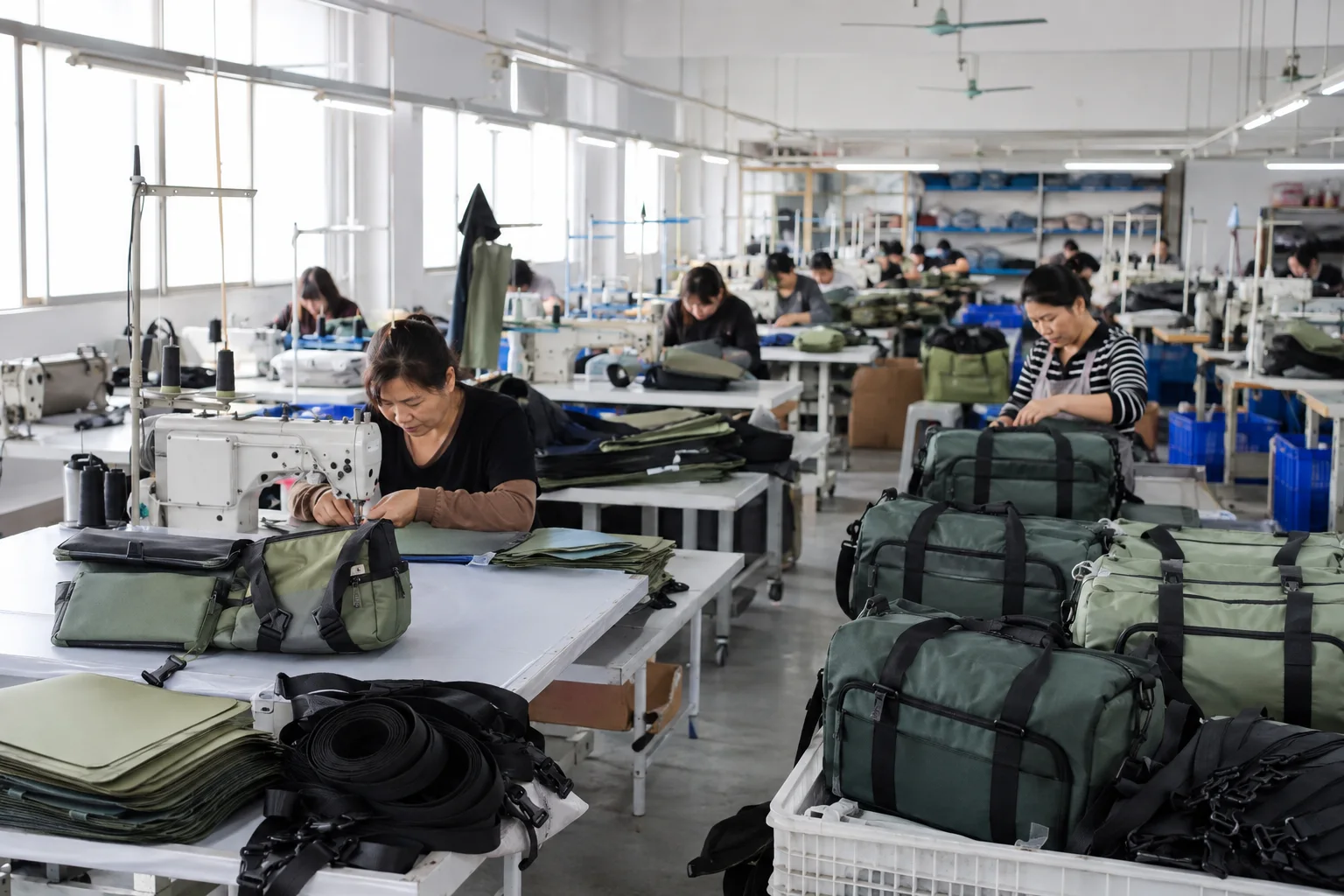
venlinker is Your Trusted Custom Gym Bag Manufacturer in China, and a race-day gym bag uses the full set of capabilities the Huadu District factory runs every day: multi-compartment pattern work, mixed-denier fabric builds, in-house welding for wet cells and inspection tuned to bags that must hold water.
Sample room and first-round fit
venlinker’s 10+ in-house designers and sample room turn a race-day brief into a prototype in 5–7 working days, with one free revision. For a new layout the sample room checks the shoe tunnel with real shoes at the largest size in the brief, packs the full checklist from this guide into the prototype, and reports the usable main-body volume once the zones are built. The sample development page explains what the team needs from a buyer to hit that window, and brands that want a finished bag in hand before writing a full spec can request a free sample from the standing gym bag range.
Fabric and welding in-house
Shell, base and lining fabrics come through the material sourcing team from a network of 200+ verified fabric suppliers, so a 600D body with a PVC-backed or 900D base is usually built from in-network stock colours. High-frequency TPU and PVC welding runs on venlinker’s own machines on the same floor as cutting and sewing, which means the wet cell is welded, leak-tested and fitted without leaving the building. Every roll is checked at incoming material inspection for GSM, width, backing and shade before cutting.
Inspection, capacity and visits
Wet cells get a fill-and-hold water test at inline production inspection, and every finished bag passes 100% pre-shipment inspection by venlinker’s own team. An SGS, BV or TUV inspection can be added to any order, booked and paid for by the buyer. With 10+ production lines, 500+ staff and a capacity of 50,000+ bags a month, the factory handles a single gym’s 300-piece run and a brand’s multi-colourway range on the same schedule logic. MOQ starts at 300 pieces per style per colourway, payment is 30% deposit and 70% before goods leave the factory, FOB is the default with CIF or DDP on request, and production orders include free white-background product photography for the brand’s listings. Factory visits run Monday to Saturday, 40 minutes from Baiyun airport with pickup, and live video tours are available for buyers who cannot travel. Gyms and brands can get a quote on a race-day gym bag by sending the checklist, the format and the quantity per colourway.
HYROX Bag FAQ: Race-Day Gym Bag Questions From Brands and Gyms
What should be in a HYROX bag on race day?
Most athletes pack race shoes and a second pair or slides, gloves, knee sleeves, a lifting belt or wraps, chalk, gels, two bottles, a warm-up layer, a post-race change, a towel, toiletries and valuables. That load splits into clean, dirty, wet and quick-access zones. A race-day gym bag should give each zone its own compartment, with the shoes and the wet kit at opposite ends and the bottles in external sleeves.
What size bag do you need for a hybrid fitness race?
A single-pair bag with a wet cell packs comfortably at 30–35 L. Two pairs of shoes, a belt and a full change need 40–45 L. For athletes who fly to races, a 40 L duffel or convertible held at roughly 55 × 35 × 23 cm external fits most carry-on frames when packed normally. The capacity guide explains the conversion between litres and dimensions.
Can a gym or brand sell custom bags as HYROX bags?
No. HYROX is a registered trademark of its owner, and a gym or brand should not describe its bag as a HYROX bag, as official or licensed, or put the race series’ logo on it. venlinker makes hybrid fitness race bags and race-day gym bags carrying the buyer’s own marks. Describing the use (“built for hybrid fitness race day”) is the safe route in listing copy; take your own legal advice on wording.
How do you keep chalk out of clean kit?
Give chalk its own pocket on the outer shell, lined with a coated wipe-clean fabric, with bound internal seams, a coated or water-resistant #5 zip and a 2–3 cm storm flap. Keep that pocket away from the divider between the clean and dirty zones. A dark lining tone hides residue better than a pale one.
Is a backpack or a duffel better for race day?
It depends on how the athlete travels. A 30–45 L duffel is the easiest team bag to build and brand. A 25–35 L backpack suits athletes who walk or cycle to the gym and the venue. A convertible duffel-backpack suits those who travel to races by air or rail. Many gyms order a duffel for the team and offer a backpack for daily training.
What is the minimum order for a custom race-day gym bag?
venlinker’s MOQ is 300 pieces per style per colourway. Samples take 5–7 working days with one free revision, and bulk runs 25–35 days for 300–1,000 pieces. Groups of gyms can pool one style and colourway to reach the MOQ, then add each gym’s name on a patch. The custom bag MOQ guide covers the detail.
Summary: Designing a Race-Day Gym Bag for Hybrid Fitness Racing
Hybrid fitness racing now draws more than 1.5 million participants a season, with a target of 2 million+ for 2026/27, and the athletes, gyms and brands around it need a bag built for a day unlike an ordinary gym visit. The race-day gym bag earns its place through zoning, durability at the base and anchors, and a size that travels.
Design from the packing list. Two pairs of shoes, gloves, sleeves, a belt, chalk, bottles and a change of clothes split into clean, dirty, wet and quick-access zones. Give each a compartment: a vented shoe tunnel, a welded wet cell, a chalk-proof pocket and external bottle sleeves, with shoes and wet kit at opposite ends.
Match format to the athlete’s journey. A 30–45 L duffel for team bags, a 25–35 L backpack for commuters, a 35–45 L convertible for athletes who fly or take the train, and a tote plus pouch set for entry price points and finisher kits. Reinforce the base, the strap anchors and the zips on every format.
Brand with your own marks and order in colourways. Use the gym, brand, creator or event identity, never the race series’ name or logo. Plan 300 pieces per style per colourway, pool orders across gyms where it helps, and plan back from the target race weekend using the bulk lead-time tiers.
Gyms and brands ready to sample can request a quote with the packing list and preferred format, or contact venlinker to talk through zones and colourways before the spec is written. The OEM/ODM workflow sets out each step from brief to golden sample to bulk.
Ready to Build a Race-Day Gym Bag for Your Athletes?
Venlinker builds hybrid fitness race bags for activewear brands, functional gyms and creator brands, with vented shoe tunnels and in-house welded wet cells, fabric from 200+ verified suppliers, samples in 5–7 working days, 100% pre-shipment inspection and MOQ from 300 pcs per style per colourway.