* Simply fill out the form below as best you can. And don’t sweat the details. * Your information will be kept strictly confidential. * Share your needs with us, We’ll contact you in very short time.
Planning a Custom Bag Order?
Send your bag type, quantity and target delivery date. We will review the specification and confirm the next step.
Who this guide is for: brand owners, sourcing managers, Amazon sellers and activewear product managers who need custom bags on the shelf or in a fulfilment centre for spring 2027 and are writing purchase orders this autumn.
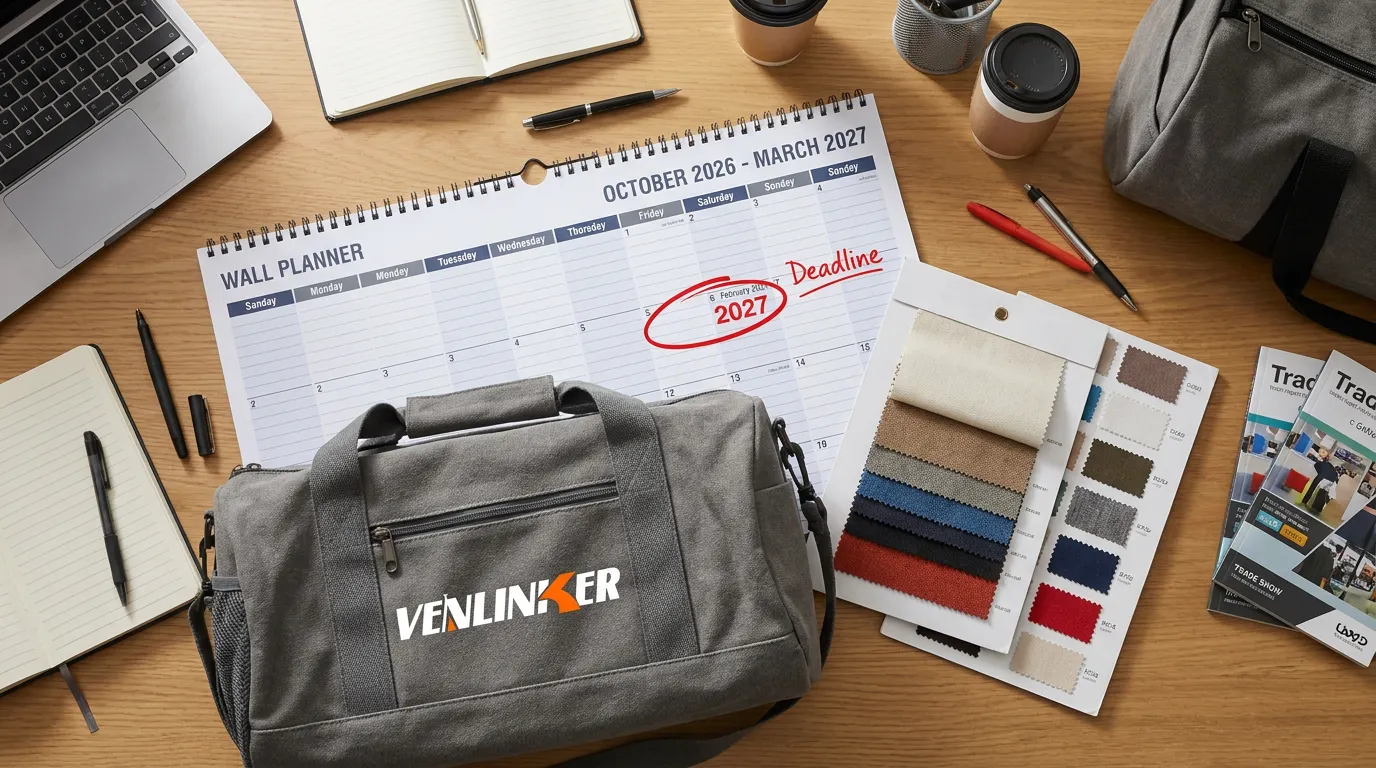
The Chinese New Year 2027 factory closure is the scheduling event that shapes a custom bag buyer’s whole winter. The holiday itself falls on Saturday 6 February 2027, but the disruption to production starts weeks earlier and lasts weeks longer. A purchase order that would comfortably ship in six weeks in April can miss its vessel in January because a fabric mill shut its gates a week before the sewing lines did.
The decisions that protect a spring 2027 launch are made in October and November 2026: when to sample, when to confirm fabric and trims, when to pay the deposit, and whether to split the order so part of it ships before the holiday. Buyers who plan these dates backward from the warehouse date keep their launch. Buyers who plan forward often end up choosing between air freight and a late launch.
This guide sets out the 2027 dates that are known and the one that is not, the five milestones to plan backward through, worked calendars for 800, 3,000 and 10,000 pcs built from Venlinker’s verified lead-time tiers, and the parts of an order that stall first. Every calendar date below is illustrative arithmetic, not a promise. If you already have a spec, send it for a quote and ask for a dated schedule against your warehouse date.
Chinese New Year 2027 Factory Closure: The Dates Bag Buyers Need
Three dates frame the 2027 planning window. Two are fixed by the lunar calendar; the third, the official mainland holiday schedule, had not been published at the time of writing.
Date or item
Status (as of late September 2026)
What it means for a bag order
Saturday 6 February 2027: Chinese New Year
Fixed
The anchor date for every other deadline in this guide
Saturday 20 February 2027: Lantern Festival (15th day of the first lunar month)
Fixed
Many factories are back at reduced staffing around or after this date
Mainland 2027 public-holiday schedule
Not yet published as of mid-September 2026
Official days off are still unknown
Pre-holiday production slowdown
Typically two to three weeks before the holiday
Plan as if output falls from roughly mid-to-late January 2027
Sources: Chinese New Year date, the unpublished schedule and the two-to-three-week slowdown are from Drip Capital’s Chinese New Year 2027 planning guide; the Lantern Festival date is counted from 6 February 2027 as day one. Days of the week are calculated from those dates.
Why the official schedule matters, and why you cannot wait for it
The State Council’s schedule decides the statutory days off. Factories then set their own closing and reopening dates, which are usually wider than the statutory window. As of mid-September 2026 that schedule had not been released, so no supplier could give a final closing date in September. Confirm each vendor’s actual window in writing once it is out.
Waiting for the official schedule before placing an order is a mistake, though. The critical dates for a pre-holiday shipment (sample approval, fabric confirmation, deposit) fall in October and November, well before the published schedule is likely to change anything. Plan on the fixed dates now and adjust by a few days once the official calendar appears.
How Venlinker handles the unknown dates
Venlinker does not publish its own closing and reopening dates before the official schedule is released. Once it is out, the exact dates are confirmed to each buyer in writing, together with the last date the production schedule can accept an order for pre-holiday completion. Buyers planning now can contact the team to be put on that list.
Why the China Factory Shutdown in 2027 Lasts Longer Than the Public Holiday
The statutory holiday is a short window. The effective disruption to a bag order is much longer, because it starts upstream and ends only when the whole supply chain is back at normal pace. Three things stretch it.
The pre-holiday slowdown
Production typically slows two to three weeks before the holiday, per the Drip Capital guide. Counting back from Saturday 6 February 2027, three weeks is Saturday 16 January and two weeks is Saturday 23 January. Workers with long journeys home often leave early, and lines can lose operators day by day. A factory that runs full shifts in the first week of January may be running thinned lines by the third week. Any order still on a sewing line at that point finishes slowly, or not at all, before the break.
Material suppliers close earlier than assembly
A bag factory is the last link in a chain of fabric mills, dyehouses, coating plants, webbing weavers, zip makers, buckle moulders, printers and carton makers. Each sets its own holiday, and upstream suppliers often wind down before the assembly factory does, because their own customers’ final orders for the year have already been placed. A sewing line can be staffed and ready while the roll of custom-dyed fabric it needs sits unfinished at a dyehouse that has already emptied its vats. This is why material confirmation is usually the first deadline a buyer misses, often weeks before the sewing would have started.
The post-holiday ramp-up
After the holiday, lines restart gradually. Some workers return later than planned, some do not return, and new staff need training before they run a line at normal pace. Upstream suppliers restart on their own schedules too, so a factory with operators back at their machines may still be waiting for fabric. Orders held over from before the holiday usually take the first weeks of capacity. The practical result is that a line may run at reduced output for a period after reopening, and that a buyer placing a fresh order in mid-February should not expect the same lead time as in October.
Put together, a bag order is exposed to the holiday from the moment its materials need to be ordered until the point the supply chain is back to full pace. In the worked calendars below, that exposure runs from the first material orders in early to late November until the restart after the holiday: well over two months, for a holiday far shorter than that.
When to Order Before Chinese New Year: Five Milestones Worked Backward From Your Warehouse Date
The reliable way to plan a pre-holiday order is to start at the date the goods must be in your warehouse and walk backward. The research-backed sequence has five milestones: last order acceptance, material confirmation, production completion, inspection window and final cargo hand-off (Drip Capital). Each one has an owner and a condition that must be true by that date.
The example below plans a 3,000-piece order of one style in fabric available through the factory’s supplier network, using the long end of Venlinker’s verified 30–40 day tier. The dates are illustrative. The planning assumption, which you should replace with your supplier’s confirmed window, is that production slows from roughly mid-to-late January, so the goods should leave before Saturday 16 January 2027.
Milestone (read bottom to top as time runs)
What must be true
Input used
Illustrative date
Warehouse need date
Goods received and checked in at your warehouse or fulfilment centre
Set by you; sea freight adds several weeks depending on route; confirm with your forwarder
Your date
5. Final cargo hand-off
Cartons collected from the factory or delivered to the forwarder under FOB
Planning assumption: before a slowdown from roughly mid-to-late January
Friday 15 January 2027
4. Inspection window
Final inspection passed, 70% balance paid, any buyer-commissioned third-party inspection complete
A seven-day buffer chosen for this example, not a factory figure
Friday 8 to Friday 15 January 2027
3. Production completion
All pieces sewn, finished and packed
Bulk tier 1,000–5,000 pcs: 30–40 days; long end used
Friday 8 January 2027
2. Material confirmation
Fabric, colour, trims, hardware and packaging artwork approved in writing
Must be done by the PO date for the tier lead time to hold
Friday 27 November 2026
1. Last order acceptance
PO issued, 30% deposit paid, golden sample approved
8 January minus 40 days is Sunday 29 November, moved back to the previous working day
Friday 27 November 2026
Two points in the table carry the whole plan. First, material confirmation sits on the same day as the PO only because the fabric is in network; if it is not, the PO and the material sign-off move 7–14 days earlier. Second, the supplier’s own last order-acceptance date may be earlier than your arithmetic. If it is, the supplier’s date wins. Ask for it in writing as soon as the official schedule is published.
The chart shows the same logic for three order sizes, with and without an out-of-network fabric, against the months from October 2026 to March 2027.
Chinese New Year 2027 backward-planning timeline for custom bag orders (illustrative)
Each bar ends with production complete on Friday 8 January 2027 and cargo hand-off on Friday 15 January 2027. Bar lengths use the long end of Venlinker’s verified bulk tiers (35, 40 and 50 days) plus 14 days where the fabric is out of network. Sundays are moved back to the previous Friday. All dates are illustrative.
Read the chart from right to left. The grey band is the three weeks before the holiday, where the plan assumes output may already be falling. Everything to the left of it has to be finished, inspected and paid for before the band starts. The further left a bar begins, the earlier the buyer has to commit, and a 10,000-piece order in a custom fabric needs its PO in the first week of November.
CNY 2027 Production Deadlines for 800, 3,000 and 10,000 Custom Bags
The worked calendars below apply the same backward method to three typical order sizes. The inputs are Venlinker’s verified bulk lead times (25–35 days for 300–1,000 pcs, 30–40 days for 1,000–5,000 pcs, 35–50 days for 5,000–20,000 pcs) and the verified 7–14 day extension for fabric sourced outside the supplier network. Each calendar counts the long end of the range back from production completion on Friday 8 January 2027, which leaves the seven-day inspection and hand-off buffer before Friday 15 January.
Order (one style)
Verified bulk tier
Fabric
Days counted back
Latest sensible PO + 30% deposit (illustrative)
Production window (illustrative)
800 pcs
25–35 days
In network
35
Friday 4 December 2026
4 Dec 2026 to 8 Jan 2027
800 pcs
25–35 days
Out of network (+7–14)
49
Friday 20 November 2026
20 Nov 2026 to 8 Jan 2027
3,000 pcs
30–40 days
In network
40
Friday 27 November 2026 (arithmetic gives Sunday 29 November)
27 Nov 2026 to 8 Jan 2027
3,000 pcs
30–40 days
Out of network (+7–14)
54
Friday 13 November 2026 (arithmetic gives Sunday 15 November)
13 Nov 2026 to 8 Jan 2027
10,000 pcs
35–50 days
In network
50
Thursday 19 November 2026
19 Nov 2026 to 8 Jan 2027
10,000 pcs
35–50 days
Out of network (+7–14)
64
Thursday 5 November 2026
5 Nov 2026 to 8 Jan 2027
All dates are arithmetic from the verified tiers, rounded back to a working day where the count lands on a Sunday, and assume the golden sample is approved on or before the PO date. Use them as a planning guide; your supplier’s confirmed schedule replaces them.
Why plan on the long end of each tier
The short end of each range would give ten to fifteen more days. It holds when fabric is in stock, the line is free and nothing needs a second look. In November and December, lines fill with every other buyer’s pre-holiday orders, and a single fabric re-dye or a trim that arrives late uses up the difference. Planning on the long end keeps the hand-off date safe if one thing slips. If everything runs to the short end, the goods finish early and the buyer has more room for inspection and booking freight.
Adding custom-moulded hardware
Custom-moulded hardware, such as a branded zip puller or a moulded logo buckle, adds a verified 10–15 days. If the mould sits on the critical path together with an out-of-network fabric, count both. For the 3,000-piece order that is 40 + 14 + 15 = 69 days back from 8 January, which is Saturday 31 October 2026, or Friday 30 October as a working day. Ask the supplier whether the mould and the fabric can run in parallel; if they can, only the longer of the two sits on the critical path. The custom trims and hardware page lists which upgrades need a mould and which use stock parts.
What the three calendars mean for spring ranges
The 800-piece calendar suits a first run of one or two styles for a startup or DTC brand: a gym duffel bag or a gym tote bag in stock fabric can still take a PO in early December. The 3,000-piece calendar is typical of a spring studio range, such as yoga tote bags or Pilates studio totes in two or three colourways. The 10,000-piece calendar belongs to larger programmes, whose PO has to be signed by mid-November. MOQ is set per style per colourway, so a 3,000-piece order split across five colourways still has to meet the minimum in each; the custom bag MOQ guide explains how that works.
What Gets Stuck First Before Chinese New Year: Fabric, Trims, Moulds and Packaging
Buyers tend to watch the sewing line. The items that delay a pre-holiday order are more often the ones made by someone else before the line starts. The table ranks them by how early they need to be locked.
Item
Why it stalls before the holiday
Timing impact
How to lock it before the holiday
Fabric outside the supplier network
Mill and dyehouse set their own holiday, often earlier than assembly
Verified: +7–14 days on bulk lead time
Choose an in-network fabric where the spec allows, or confirm the out-of-network fabric first
Custom colours and lab dips
A lab dip must be approved before bulk dyeing starts; dyehouses fill their last pre-holiday slots early
A full lab-dip round before bulk fabric can be ordered; ask for the dyehouse timing
Approve the lab dip with the sample, not after it
Custom-moulded hardware
A new mould must be cut and first shots approved
Verified: +10–15 days
Use stock pullers and buckles for the pre-holiday tranche; add the moulded part to a later run
Printed webbing, labels and tapes
Made by outside weavers and printers with their own cut-off dates
Varies by supplier; not covered by the bulk tier if artwork changes late
Freeze artwork at sample approval and order trims with the fabric
Printed retail packaging and inserts
Printers and carton makers close for the holiday too
Can hold finished bags in the factory after sewing is done
Approve packaging artwork with the PO; keep a plain polybag fallback agreed in writing
Outsourced logo processes
Any logo step sent out adds a hand-off and another closing date
Depends on the method and the subcontractor
Ask which logo methods run in-house; choose one for the pre-holiday tranche
Fabric and colour
Fabric is typically 35–50% of the unit cost of a bag, and it is also the item with the longest upstream chain. A buyer who wants a brand colour in 600D polyester with a PU back needs the lab dip approved, the greige fabric dyed and coated, and the roll delivered and inspected before cutting starts. When the fabric comes from within the factory’s own network of mills, the verified bulk tiers already include it. When it does not, the verified 7–14 days is added, and in the pre-holiday months the long end is the one to plan on. The custom materials and colours page covers stock colours against lab dips, and the material sourcing page explains how the supplier network works. Every roll is then checked at incoming material inspection before cutting, so a roll that arrives late also arrives with less time to fix a fault.
Hardware moulds
A custom-moulded puller or buckle looks small on a tech pack and adds a verified 10–15 days to the schedule. For a spring launch, a common compromise is to run the pre-holiday tranche on stock hardware in a matching colour and introduce the moulded part on the first post-holiday run, once the mould has been cut and approved without time pressure.
Printed packaging
Retail boxes, printed polybags, hang tags and insert cards come from printers who close for the holiday like everyone else. A finished bag that cannot be packed cannot ship. Approve packaging artwork at the same time as the PO and agree a fallback in writing, such as a plain polybag with a barcode label, so a late print run does not strand finished goods. The custom packaging and FBA prep page lists the packaging options that can be fixed at PO stage.
Logo methods
The same logic applies to the logo. Embroidery, screen print, heat transfer and woven labels each depend on thread, ink, film or label stock arriving before the holiday, and any method sent to a subcontractor adds that workshop’s closing date to your plan. The custom logo and branding page shows which methods suit which fabrics; for the pre-holiday tranche, pick one the factory runs in-house and approve the strike-off with the sample.
Bag Sample Timing for Spring 2027 Orders
The bulk tiers above all assume the golden sample is approved by the PO date. Sampling therefore has to happen in October and November 2026 so bulk production can run through December and early January.
At Venlinker a production-grade sample takes 5–7 working days and includes one free revision. If the revision round takes as long as the first, two rounds at the long end add up to 14 working days in the sample room, close to three calendar weeks before courier transit and your own review time. For the 10,000-piece order in a custom fabric, where the illustrative PO date is Thursday 5 November 2026, that means the first sample request should go in during October. For the 800-piece order in stock fabric, a sample started in mid-November still leaves time before a PO on Friday 4 December.
How to make the sample round count
Send a complete brief. Dimensions in cm, fabric, colourway, logo method and position, hardware and packaging. The sample development page lists what the sample room needs, and the RFQ checklist gives the fields for the quote that goes with it.
Approve colour with the sample. If the brand colour needs a lab dip, ask for it alongside the first sample so bulk fabric can be ordered the day the sample is approved.
Spend the free revision on construction points. A colour change after sample approval can restart the fabric chain.
Record the approval. The approved sample becomes the golden sample the bulk order is inspected against.
The sample cost and lead time guide explains sample fees, refunds and courier timing in more detail. Buyers ready to start can request a free sample of their spec; the sample fee is refunded on the production order.
Deposit, Balance and QC Inspection Timing in the January 2027 Rush
Money and inspection both sit near the end of the pre-holiday timeline, where there is least room to absorb a delay.
When the 30% deposit and 70% balance fall due
Venlinker’s terms are a 30% deposit with the PO and the 70% balance before the goods leave the factory, with FOB as the default Incoterm (CIF and DDP on request). Around the holiday that creates two payment dates under different pressure.
The deposit falls on the PO date, which in the worked calendars lands between early November and early December 2026. For a buyer whose financial year or budget cycle closes at year-end, that can mean committing next year’s stock budget in this year’s accounts; agree internally when the deposit can be released before the order is at risk.
The balance falls inside the inspection window, between production completion and hand-off, which the examples place between Friday 8 and Friday 15 January 2027. International transfers take time to clear, and your own finance team may be working reduced hours around the year-end. If the balance has not landed when the forwarder’s truck arrives, the cartons stay in the factory. Two habits reduce that risk: schedule the balance payment on the first working day after the final inspection report is received, and send remittance proof the same day.
Booking final inspection and third-party inspection in January
Every Venlinker order passes 100% pre-shipment inspection by the factory’s own team, and the final inspection and AQL page explains how the result is reported. Many buyers also commission an independent inspection. Buyers who want an independent check before the holiday can book SGS, BV or TUV on any order; the buyer commissions and pays for it.
January is a crowded month for inspection agencies, because a large share of pre-holiday orders finish in the same few weeks. Book the inspection on the day you place the PO, and give the agency the golden-sample reference and the target hand-off date. The third-party inspection support page explains how the factory prepares cartons, samples and a workspace for the inspector. If an inspection finds a problem that needs rework, the seven-day buffer in the worked calendars is what absorbs it, which is why it should not be spent on a late deposit or a late fabric.
Lunar New Year 2027 Manufacturing Restart, Split Shipments and Repeat Orders
Not every order can finish before the slowdown, and not every order needs to. Splitting an order and timing the repeat run keep stock moving across the holiday.
What a realistic restart looks like
Factories reopen on dates confirmed to each buyer once the official schedule is known. Many are back at reduced staffing around or after the Lantern Festival on Saturday 20 February 2027. The first days after reopening usually go to restarting machines, receiving materials from suppliers who are restarting too, and finishing orders held over from before the holiday. Output then climbs as returning staff settle back onto their lines and new operators are trained. Plan a fresh post-holiday order on reduced output for the first weeks, and ask the supplier for a dated completion before committing a launch date to it.
Splitting an order into two tranches
A split order ships a first tranche before the holiday and a second after it. It is the usual answer when the full quantity cannot finish before mid-January, or when the buyer wants early stock to test sell-through before committing to the rest.
Approach
What ships before the holiday
When the deposit is paid
Main risk
Suits
Single order, finished before the slowdown
Everything
At the pre-holiday PO date
The whole launch depends on one tight schedule
Buyers who can confirm the spec by November
Split order: first tranche before, second after
Launch quantity for the first weeks of sales
Tranche 1 at its PO date; tranche 2 when it is placed
Tranche 2 finishes during the post-holiday ramp-up
Amazon and DTC launches that want early stock
Whole order after the holiday
Nothing
At the post-holiday PO date
Reduced output in the first weeks after reopening
Programmes with a late-spring or summer date
As an illustration, a buyer with a 3,000-piece spring plan could place 800 pcs as tranche 1 with a PO on Friday 4 December 2026 (the 800-piece calendar above) and hold 2,200 pcs for tranche 2. Each tranche must still meet the MOQ of 300 pcs per style per colourway.
Timing the repeat run
A repeat order of an approved style runs in a verified 20–30 days, shorter than a first order because the golden sample, patterns and material specs are already fixed. Whether tranche 2 counts as a repeat is the supplier’s call, so ask. Illustratively, if the line were back at full pace by Saturday 20 February 2027 and the order were placed that day, a 20–30 day repeat run would complete between Friday 12 March and Monday 22 March 2027. Priced as a new 2,200-piece order in the 30–40 day tier instead, the same start would complete between Monday 22 March and Thursday 1 April 2027. Neither date accounts for the reduced output described above, so treat both as the earliest case. The production process page shows which steps a repeat run skips.
Materials for tranche 2 can be ordered with tranche 1, so the fabric is already in the factory when the line restarts. That removes the upstream suppliers’ restart from the critical path, which is often the difference between a mid-March and a late-March finish.
Spring 2027 Bag Orders for Amazon, DTC and Retail Launches
Spring bag demand leans on a familiar set of products: gym duffels and totes for training, yoga and Pilates bags for studios, running belts for the start of the outdoor season, beach totes and swim and wet gear bags for early summer, travel organisers for spring and early-summer trips and accessory sets that raise order value. Most of them need to be in stock before the season starts, so the warehouse date sits well ahead of the launch date.
Amazon sellers
For Amazon FBA and ecommerce sellers, the warehouse need date is the date stock must be received and available for sale, and inbound check-in adds its own time on top of sea freight. Start the backward count at the listing date. Agree FBA prep with the PO: carton weights under 22.7 kg and no side over 63.5 cm, carton labels and unit barcodes applied at the factory. A carton that has to be repacked on arrival loses days the spring launch does not have. The packing and export support page covers carton marking and labelling, and the packing and shipping terms guide explains FOB, CIF and DDP.
Free white-background product photography on production orders can also be shot before the goods leave the factory, which lets a seller build the listing while the cartons are at sea.
DTC and activewear brands
Activewear and fitness brands often launch bags alongside a spring apparel drop, so the bag PO has to match the apparel calendar. A private-label gym bag set with a duffel, shoe bag and pouch in one colourway is one order line for the buyer but three bills of materials for the factory; lock all three fabrics and trims at the same time. For category choices ahead of 2027, the sports bag trends 2026 hub summarises where demand has moved, and the Pilates bag guide covers one of the studio categories buyers ask about most for spring.
Distributors and retail buyers
Distributors and retailers buying for spring catalogues usually need several styles to land together, so the slowest style sets the date for the whole shipment. Plan the calendar on the style with the longest chain, typically the one with a custom fabric or a moulded part, and let the stock-fabric styles finish early.
Landed cost and duty
Freight and duty sit on top of FOB, and a spring order placed in autumn is generally assessed at the duty rates in force when it enters. US importers face several duty layers on bags from China; the 2026 guide to tariffs on bags from China sets them out. Confirm the rates with your customs broker before the PO date.
Questions to Ask a Bag Supplier Before Chinese New Year 2027
Send these questions in one email and ask for the answers in writing. The replies become the dated plan.
What is your last order-acceptance date for completion before the holiday, and when will you confirm your closing and reopening dates in writing?
Is my fabric within your supplier network? If not, how many extra days does it add, and when is the fabric supplier’s own cut-off?
Do any of my trims need a lab dip, a mould or outside printing, and what is the latest approval date for each?
Which bulk lead-time tier does my order fall in, and does it start from the deposit, the sample approval or both?
When will production complete, and when can final inspection be held? Can a buyer-commissioned SGS, BV or TUV inspection be booked for that week?
When exactly is the 70% balance due, and what happens to the cartons if it lands a day late?
If part of the order cannot finish before the slowdown, can it split into two tranches, and would the second count as a repeat run?
Can materials for the post-holiday tranche be bought and held before the holiday?
How will you show me progress if I cannot visit: photos, video or a live walk-through of the line?
The RFQ checklist turns most of these into standard fields, and the OEM/ODM workflow shows where each approval sits between brief and bulk. Buyers who met suppliers at the autumn fair can use the same list; the Canton Fair autumn 2026 guide covers the booth follow-up that comes before it. When the answers are in, request a quote with a dated schedule against your warehouse date.
How Venlinker Plans Custom Bag Orders Around Chinese New Year 2027
Venlinker is Your Trusted Custom Bag Manufacturer in China, and its production planning for the 2027 holiday starts from each buyer’s warehouse date and works backward through the same five milestones set out above.
Capacity and schedule
The 5,000 m² factory in Huadu District, Guangzhou, runs 10+ production lines with 500+ staff and makes 50,000+ bags a month, only in women’s sports, fitness, studio, swim and active-lifestyle categories. Once the PO, deposit and approved sample are in, the order goes onto the line schedule and the buyer receives a written plan showing the production completion date, the inspection window and the hand-off date. Closing and reopening dates are confirmed to each buyer in writing once the official 2027 schedule is published. Venlinker does not quote them before then.
Materials and sampling
Fabric comes from 200+ verified fabric suppliers. Choosing a fabric within that network keeps the order on the standard bulk tiers; a fabric from outside it adds 7–14 days, and custom-moulded hardware adds 10–15 days. The sample room, with 10+ in-house designers developing 100+ new models a month, turns production-grade samples in 5–7 working days with one free revision. High-frequency TPU and PVC welding is done in-house, so welded wet pockets on wet-dry gym bags and wet bags do not wait on an outside workshop’s holiday.
Terms that shape the calendar
MOQ from 300 pcs per style per colourway
Bulk lead time 25–35 days (300–1,000 pcs), 30–40 days (1,000–5,000 pcs), 35–50 days (5,000–20,000 pcs); repeat orders 20–30 days
30% deposit with the PO, 70% before goods leave the factory
FOB by default, CIF or DDP on request
100% pre-shipment inspection by the factory’s own team; third-party inspections by SGS, BV or TUV welcome, commissioned and paid by the buyer
Free white-background product photography on production orders
Factory visits Monday to Saturday, and live video tours for buyers who cannot travel
Chinese New Year 2027 falls on Saturday 6 February 2027, and the Lantern Festival follows on Saturday 20 February 2027. As of mid-September 2026 the mainland 2027 public-holiday schedule had not been published, so factories could not yet confirm their exact closing and reopening dates (Drip Capital).
When do Chinese factories close for Chinese New Year 2027?
Each factory sets its own dates, usually around the official holiday, and confirms them once the State Council schedule is out. Production typically slows two to three weeks before the holiday, so plan as if output falls from roughly mid-to-late January 2027. Venlinker confirms its dates to each buyer in writing once the official schedule is published.
When should I order bags to ship before Chinese New Year 2027?
Work backward from your warehouse date. In the illustrative calendars in this guide, which aim for cargo hand-off by Friday 15 January 2027, the latest sensible PO and deposit date is Friday 4 December 2026 for 800 pcs in stock fabric, Friday 27 November for 3,000 pcs and Thursday 19 November for 10,000 pcs. An out-of-network fabric moves each date 14 days earlier.
Can I still get a sample approved before the holiday?
Yes, if sampling starts in October or November 2026. A Venlinker sample takes 5–7 working days with one free revision, and the golden sample must be approved by the PO date for the bulk lead time to hold. Larger orders and custom fabrics need the earliest start.
What happens if my order is not finished before the slowdown?
It finishes after the holiday, during the period when lines are ramping back up. The alternative is to split the order: ship a first tranche before mid-January and run the rest after reopening, with materials bought and held in advance. A repeat run of an approved style takes 20–30 days once the line is back at pace.
How long does shipping take after the goods leave the factory?
Sea freight adds several weeks depending on the route and the destination port. Confirm transit times and vessel cut-offs with your forwarder when you place the PO, because vessel space in the weeks before the holiday can be tight.
Summary: Chinese New Year 2027 Production Planning for Bags
Chinese New Year falls on Saturday 6 February 2027, but the planning deadlines for a spring bag order fall in October and November 2026. The effective shutdown is longer than the holiday because production slows weeks before it, upstream suppliers close earlier than sewing lines, and output ramps up slowly after reopening.
Plan backward through five milestones. Start at the warehouse date and work back through cargo hand-off, inspection, production completion, material confirmation and last order acceptance. If production slows from roughly mid-to-late January, a 3,000-piece order in in-network fabric needs its PO and deposit by about Friday 27 November 2026 in the illustrative calendar.
Lock the slow items first. Out-of-network fabric adds 7–14 days and custom-moulded hardware 10–15 days. Lab dips, printed trims and printed packaging depend on suppliers with their own holiday. Approve them with the sample, and sample in October and November.
Use split orders, repeat runs and early bookings. Ship a launch tranche before the slowdown, hold materials for the rest, book inspection when you place the PO, and schedule the 70% balance so it clears inside the inspection window.
Need Spring 2027 Bag Stock Shipped Before Chinese New Year?
Venlinker plans pre-holiday orders for Amazon sellers, DTC brands and activewear labels backward from your warehouse date: samples in 5–7 working days, fabric from 200+ verified suppliers, MOQ from 300 pcs per style and 100% pre-shipment inspection. Send your spec and target date for a dated schedule.