* Simply fill out the form below as best you can. And don’t sweat the details. * Your information will be kept strictly confidential. * Share your needs with us, We’ll contact you in very short time.
Planning a Custom Bag Order?
Send your bag type, quantity and target delivery date. We will review the specification and confirm the next step.
Who this guide is for: studio-chain merchandise buyers, yoga and wellness DTC founders, activewear brand product managers, private label programme managers and distributors developing a mat carrier or a studio retail range, who need the dimensions, strap geometry and fabric specification settled before the first sample is cut.
Every other bag in a sports range starts with what the brand wants to sell. A mat carrier starts with something the customer already owns. The yoga mat bag size that works is the one that fits the mat in the customer’s hallway, and that mat may be 4 mm or 15 mm thick, 61 cm or 68 cm wide, 173 cm or 183 cm long, dense rubber at close to 3 kg or foam at under 1 kg. Get the internal diameter wrong by 2 cm and the bag either will not close or hangs slack on the shoulder, and no amount of fabric quality or branding recovers it.
That is why mat carriers generate more returns per thousand units than duffels or totes in most wellness ranges, and why the specification work sits mostly in geometry rather than in materials. A buyer who writes “fits standard yoga mat” on a tech pack has written nothing. A buyer who writes “internal diameter 15 cm, internal sleeve length 70 cm, patterned to a 173 × 61 cm mat at 6 mm rolled to 13–15 cm” has written a bag that fits roughly nine out of ten mats sold at studio retail.
This guide covers the mat size landscape and what each mat rolls down to, the arithmetic that converts mat thickness into rolled diameter so a buyer can size a barrel or a sleeve without guessing, the six carrier formats and what each one costs and suits, strap and sling geometry for a 155–185 cm wearer, fabrics for studio retail, how to handle a sweat-soaked hot yoga mat, branding for studios and wellness retail, and how to build a range as a set rather than a single SKU. It ends with the tech pack lines and the supplier questions to settle before you request a quote.
Why Mat Geometry Drives the Whole Yoga Mat Bag Design
In a gym duffel, the brand sets the volume. Forty litres is a decision, not a constraint, and the buyer can move it to 35 L or 45 L to hit a price point. In a mat carrier, the mat sets three of the four principal dimensions and the brand controls only the fourth. Length comes from the mat’s width. Diameter comes from the mat’s length and thickness together. Fabric weight, pocket layout and strap system are the parts the brand actually chooses.
This inversion has practical consequences that reach into merchandising. A studio chain selling one mat model at reception can pattern the carrier to that exact mat and hold the tolerance tight, which makes the bag look and feel expensive because it is snug. A DTC brand selling a carrier on a marketplace to customers with unknown mats has to build in ease, because a bag that fits only a 4 mm mat will collect one-star reviews from every customer who owns a 6 mm one. The two briefs produce different bags from the same drawing.
Three dimensions the mat dictates
Internal sleeve length is the mat’s width plus 5–12 cm of ease. A 61 cm mat wants 66–72 cm inside. A 66–68 cm wide mat wants 71–76 cm. Mat length has nothing to do with it, which surprises buyers who assume a 183 cm “long” mat needs a longer bag.
Internal diameter comes from mat length and thickness. A longer mat at the same thickness adds material to the roll, and thickness adds it much faster. This is the number that decides whether the zip closes.
Load path comes from mat weight. A 0.9 kg foam mat and a 2.7 kg natural rubber mat put very different forces through the same strap anchor, and a carrier designed around the light one tears at the seam when the heavy one goes in.
The one dimension the brand controls
Ease, and how the brand spends it. A close-fitting carrier at 13 cm internal diameter looks tailored on a shelf and holds a 4–6 mm mat with nothing else. Open it to 17 cm and the same bag swallows a 6 mm mat plus a towel and a change of clothes, at the cost of a slightly slack silhouette when the mat alone is inside. Neither is wrong. What fails is a bag sized by copying a competitor’s flat measurement without knowing which mat it was patterned to. The yoga mat bags category page lists the internal diameters held as standard patterns, which is the fastest way to see where a target mat lands before any drawing work starts.
Yoga Mat Sizes and Dimensions: Standard, Long, Extra-Wide, Travel and Thick
Mats sold through studios and wellness retail cluster into six recognisable formats. The table below gives each one with the rolled diameter it produces and the internal bag dimensions that fit it. Rolled diameters assume a mat rolled by hand without compression straps, which is how a customer rolls it in a class; a tightly compressed roll runs 1–3 cm smaller.
Mat format
Unrolled size (L × W)
Thickness
Typical mat weight
Rolled diameter
Internal bag diameter
Internal sleeve length
Travel or foldable
173 × 61 cm
1–1.5 mm
Roughly 0.7–1.0 kg
5–8 cm
8–11 cm
66–70 cm
Standard
173 × 61 cm
4–6 mm
Roughly 0.9–1.6 kg
10–15 cm
13–17 cm
66–72 cm
Dense rubber studio mat
180–183 × 66 cm
4–5 mm
Roughly 2.0–3.0 kg
11–14 cm
14–17 cm
71–76 cm
Long
183 × 61 cm
4–6 mm
Roughly 1.0–1.8 kg
11–15 cm
13–17 cm
66–72 cm
Extra-wide
173–183 × 66–68 cm
4–6 mm
Roughly 1.2–2.0 kg
11–15 cm
13–17 cm
71–76 cm
Thick fitness or pilates
183 × 61 cm
8–10 mm
Roughly 0.9–1.4 kg
15–19 cm
18–22 cm
66–72 cm
Extra-thick foam
183 × 61 cm
12–15 mm
Roughly 1.0–1.6 kg
18–23 cm
21–26 cm
66–72 cm
Figures are industry-typical across the mats a studio buyer is likely to encounter, not measurements of a named product.
What the table shows a buyer
Two patterns matter more than the individual rows. First, mat length barely moves the rolled diameter. Going from 173 cm to 183 cm at 6 mm adds roughly 0.3 cm to the roll, which disappears inside normal ease. A carrier patterned for a standard mat handles a long mat without any change to the barrel; only the sleeve length matters, and that follows the width. Second, thickness dominates everything. The step from 6 mm to 15 mm nearly doubles the rolled diameter, which is why a single carrier cannot serve a yoga range and a pilates or floor-fitness range at the same time.
Where the volume sits in a studio retail range
Standard 4–6 mm mats at 173 × 61 cm still account for most of what walks into a class. A carrier built around a 13–15 cm rolled mat with 2–3 cm of ease covers that group. The 66–68 cm wide mats have grown into a visible minority and need their own sleeve length, not a wider barrel, which makes them cheap to accommodate as a second size in the same pattern family. Thick 8–15 mm mats sit with fitness and pilates ranges, not with yoga, and they usually travel in a tote or a duffel because a 20 cm roll gets awkward on a shoulder. Pilates studio totes exist as a separate sub-type for that reason.
Two sizes, not one, in most ranges
A range that offers one carrier size sized for a 6 mm mat will fit the majority and disappoint the customers at both ends. Most studio retail programmes run a regular and a wide or deep option once volumes justify it, since MOQ starts at 300 pcs per style per colourway and two sizes in one fabric is often a smaller commitment than two colours in one size. Buyers weighing that trade-off will find the arithmetic set out in the custom bag MOQ guide.
How to Calculate Rolled Mat Diameter and Internal Bag Size
The rolled diameter of a mat is not a mystery and does not need a physical sample to estimate. A rolled mat is a spiral, and the area of its circular end face equals the area of the mat seen edge-on: length multiplied by thickness. From there the diameter follows.
The arithmetic
Take the mat length L and thickness t, both in centimetres. The cross-sectional area of the rolled end is L × t. A circle of that area has a diameter of roughly 1.13 × the square root of (L × t).
For a 173 cm mat at 6 mm (0.6 cm), L × t is 103.8 cm², and the tight-rolled diameter is roughly 11.5 cm. Hand-rolled, with air between the layers and a soft foam that does not compress against itself, the same mat measures 13–15 cm across, which is 15–25% above the theoretical figure. That gap is consistent enough to design against: calculate the tight roll, add 20%, then add 2–3 cm of ease for the bag.
Run the same sum at 15 mm on a 183 cm mat and the tight roll is roughly 18.7 cm, the hand roll 20–23 cm, and the internal bag diameter 21–26 cm. At 1.5 mm on a travel mat the tight roll is roughly 5.8 cm and the hand roll 6–8 cm. The chart below plots the whole curve.
Rolled mat diameter against mat thickness, 173–183 cm long × 61 cm wide mat
Lower line: tight-rolled minimum from the spiral area calculation. Upper line: typical hand-rolled diameter as a customer rolls a mat after class. Add 2–3 cm to the upper line for internal bag diameter.
Turning diameter into a pattern
Once the internal diameter is fixed, the panel width follows. A barrel-shaped mat bag is a rectangle wrapped into a tube with a circular end, so the flat panel width is the internal diameter multiplied by 3.14, plus seam allowance. A 15 cm internal diameter needs a 47 cm panel plus allowance. A 22 cm diameter for a thick mat needs 69 cm plus allowance, which crosses a threshold on fabric nesting and can push the cut plan onto a wider roll. Buyers who want the pattern arithmetic carried through into a full drawing set will find it under custom design and structure.
Where ease should and should not go
Ease belongs in the diameter, not in the length. A carrier that is 6 cm too long looks slack and lets the mat slide out of a drawstring end; a carrier that is 2 cm too narrow is unusable. For a studio’s own-mat programme, 2 cm over the hand-rolled diameter gives a snug fit. For a retail or marketplace bag with unknown mats, 3–4 cm of ease plus a bellows or gusseted zip is the safer specification, and it also leaves room for a towel wrapped around the mat, which is how a large share of customers carry one anyway.
Yoga Mat Carrier Formats Compared: Bag, Sleeve, Sling, Tote, Duffel and Backpack
Six formats cover almost every mat carrier sold at studio retail. They differ in how much kit they hold beyond the mat, how the mat is retained, and what they cost to make. The table sets them side by side.
Format
Mat fit
Kit capacity beyond the mat
Closure
Typical dimensions
Suits
Relative cost
Full-zip mat bag
Fully enclosed; 13–17 cm internal diameter
Small: end pocket 15 × 20 cm, phone and keys
Full-length #5 coil zip, 2 sliders
66–72 × 14–18 cm diameter
Studio retail, commuters, mats kept clean
Low–mid
Open-end sleeve
Enclosed body, ends open or drawstring
Minimal; sometimes one slip pocket
Drawstring top with cord lock, or open both ends
66–76 × 13–17 cm diameter
Wet mats, fast in-and-out, lowest price tier
Lowest
Sling strap only
Mat held by two adjustable loops
None
Slide buckles or elastic loops
150–190 cm total webbing
Add-on and gift-with-purchase, mats 10–17 cm
Lowest
Mat tote with external straps
Mat carried outside the body in a cradle or side sleeve
18–28 L: clothes, towel, bottle, laptop
Open top, magnetic snap or #5 zip top
42–48 × 14–18 × 34–40 cm
Studio-to-office, the highest-selling retail format
Mid
Duffel with mat pocket
Mat strapped under the base or along one side
30–45 L: full change of clothes and shoes
Top #5–#8 zip, 2 sliders
48–56 × 24–28 × 26–30 cm
Teacher bags, hot yoga, travel to retreats
Mid–high
Backpack with mat mounts
Mat in a base, side or vertical front cradle
18–25 L plus laptop sleeve
Top zip or roll top, front organiser
42–48 × 28–32 × 14–18 cm
Cycling and walking commuters, students
Mid–high
Choosing between them by shopper, not by feature
The formats are not a ladder from cheap to good. They serve different journeys. A sleeve or a full-zip carrier suits a customer who arrives dressed and leaves in ten minutes. A yoga tote bag with an external mat cradle suits the customer who goes to a class from work, and it sells at a higher price because it replaces a handbag as well as carrying a mat. A yoga duffel suits teachers, hot yoga and weekend retreats, where a change of clothes and a wet towel travel with the mat. A yoga backpack suits anyone arriving by bicycle, because a cross-body sling swings when a rider stands on the pedals.
The sling as a price-entry and gift piece
A yoga mat sling is two webbing loops on an adjustable strap, weighing 50–100 g and using no shell fabric at all. It is the lowest-cost item a wellness brand can put its woven label on, which makes it useful as a gift with purchase, a class-pass reward or an entry price point on a shelf next to mats. Elastic loops of 30–40 mm fit 10–17 cm rolled mats without adjustment; fixed webbing loops on slide buckles fit a wider span but need the customer to set them once.
Where the mat rides on a tote, duffel or backpack
External mat carriage has three common geometries, and each behaves differently on a body. A base cradle under a tote or backpack keeps the mat low and the load centred, and is the most comfortable for a heavy rubber mat, but the mat picks up dirt from the ground when the bag is set down. A side sleeve keeps the mat off the floor and out of the way of the back panel, at the cost of a lopsided load. A vertical front mount on a backpack looks distinctive and keeps the mat clean, but pulls the centre of gravity forward and only works with mats under roughly 1.5 kg. Two 25 mm webbing straps with side-release buckles fit 10–17 cm rolled mats in any of the three positions and are the standard fitting on wellness retail totes.
Yoga Mat Bag Strap and Sling Geometry for a 155–185 cm Wearer
Strap geometry is where cheap mat carriers fail first, and it is the part of the specification most often left to the factory. A mat carried cross-body sits diagonally across the back with the roll running from hip to opposite shoulder, and the strap has to reach around a torso that varies by 30 cm of height and by two clothing seasons.
For a wearer between roughly 155 cm and 185 cm, the strap needs a usable shoulder run of 100–140 cm, which means 150–190 cm of total webbing once the anchor tails and the buckle return are counted. Set the shortest position for a 155 cm wearer over a t-shirt and the longest for a 185 cm wearer over a winter coat. A strap that adjusts only between 110 and 130 cm will be wrong for both ends of that range, and the complaints come back as “the bag hangs too low” from shorter customers.
Drop length for a cross-body carry, measured from the shoulder crest to the top of the bag body, typically lands at 55–70 cm. Shorter than that and the mat sits high on the back and knocks the head of a taller wearer; longer and it swings at the hip and catches on door handles.
Webbing width and hardware
Webbing at 38–50 mm spreads a mat’s weight across the shoulder well enough that most carriers need no pad. Below 25 mm the webbing bites, and this is the single most common cause of a returned sling. Cotton or cotton-blend webbing at 38 mm suits a canvas studio range and feels softer against bare skin than polyester in a hot studio. Polyester or recycled polyester webbing at 38–50 mm carries more load with less stretch and is the choice where a mat is over 2 kg.
Hardware follows the webbing width. Acetal slide buckles keep weight down and cost at the lowest tier. Metal sliders and ladder locks add a considerable feel of quality on a retail shelf and suit a canvas range, at a modest cost step and roughly 10–15 additional days if a shape has to be moulded rather than taken from stock. The options and their lead times sit on the custom trims, hardware and accessories page, and the guide to buckles, webbing and hardware finishes compares acetal against metal on weight, feel and cost.
Shoulder pads: length and placement
A pad is worth adding once the carried mat exceeds roughly 1.5 kg or the webbing drops below 38 mm. Useful pads are 20–30 cm long, 5–8 mm of EVA or moulded foam, and sliding rather than fixed, because the point where the strap crosses the shoulder moves by 10 cm or more between a 155 cm and a 185 cm wearer. A pad stitched in a fixed position at the strap’s midpoint sits correctly on exactly one body size. Adding a light non-slip element on the underside, such as a silicone print or a brushed backing, stops the strap creeping off the shoulder of a technical top, which is a frequent complaint in hot yoga where everything is slippery.
How mat weight loads the anchor
A mat between roughly 0.8 and 3 kg does not sound heavy, but it hangs from two points and swings. The anchor patch under each strap end takes a repeated shock load every time the wearer takes a step or the bag slides off a shoulder. On a canvas carrier the standard construction is a reinforcement patch of the shell fabric or a webbing X-box behind the anchor, bar-tacked through both layers. On a lighter polyester shell, a woven interlining behind the patch stops the stitch line from working through the fabric over a season. Where a mat is likely to be over 2 kg, the anchor moves off the body panel onto a webbing run that passes under the base of the bag, so the load goes into the webbing rather than into the seam.
Fabrics for Yoga Mat Bags and Studio Retail Ranges
Studio retail is one of the few corners of the sports-bag market where cotton canvas outsells synthetics, because the shelf sits next to candles, blocks and tea, not next to trainers. That said, a hot yoga studio and a wellness gift range want different cloth. The table compares the fabrics that appear on most yoga carrier quotes.
Fabric
Typical weight
Hand
Print behaviour
Wash behaviour
Relative cost
Where it fits
Cotton canvas, 10–12 oz
Roughly 340–410 GSM
Soft, dry, drapes; softens with use
Takes screen print and embroidery well; sublimation not possible
Machine washable cold; shrinks 2–4% on first wash; creases
Excellent for large screen prints and heavy embroidery
Washable but slow to dry; holds shape
Mid
Structured studio totes, retail totes with a base board
300–600D polyester, PU-backed
Roughly 150–280 GSM
Dry, light, technical
Screen, transfer, sublimation on white or light bases
Wipes clean; dries in minutes; no shrinkage
Lowest–low
Sport builds, mat sleeves, duffels, back panels
300–600D RPET
Roughly 150–280 GSM
Same as virgin polyester of equal construction
Same as virgin polyester
Same as virgin polyester
Low (usually one tier above virgin)
Sustainability-positioned studio ranges and reorders
Neoprene, 2–4 mm
Roughly 400–700 GSM
Soft, thick, stretchy, cushioned
Sublimation and heat transfer; embroidery pulls the foam
Hand wash; slow drying; can retain odour
Mid–high
Sleeve-style carriers, protective mat bags, retail statement pieces
PU (polyurethane-faced)
Roughly 350–600 GSM
Smooth, leather-effect, wipe-clean
Debossing, foil and heat transfer; no sublimation
Wipe clean; can crack at fold lines over years
Mid–high
Trim panels, base panels, logo patches, higher-price retail carriers
Canvas weight and what it changes
A 10–12 oz canvas mat bag drapes around the roll and feels soft in the hand. A 14–16 oz canvas holds its own shape, which suits a tote that has to stand open on a shelf and a bag with a 1.5–2 mm base board. The step up adds roughly 130 GSM and a cost tier, and it also lengthens drying time, which is a real consideration for a bag that lives in a car boot with a damp mat. Most studio ranges land on 10–12 oz for mat carriers and 14–16 oz for the structured totes in the same family.
Where synthetics win
Polyester and recycled polyester earn their place on any carrier that meets sweat. They shed water instead of absorbing it, dry within minutes, do not shrink and do not grow mildew in a bag left in a car overnight. For hot yoga programmes and for teacher bags carried five days a week, a 300D RPET shell with a canvas-look finish keeps the studio aesthetic and the technical behaviour together. The full comparison across the twelve fabrics used in this category, including linings and webbing, sits in the bag material guide, and the stock colours held in each are listed on the custom materials and colours page. On the polyester side, the guide to denier, GSM and coatings explains what separates a 300D sleeve fabric from a 600D duffel shell.
Neoprene: a specific tool, not a default
Neoprene at 2–4 mm makes a cushioned sleeve that protects a mat and feels distinctive on a shelf. It also holds moisture, resists embroidery because the needle compresses the foam, and costs a tier or two above canvas. It works as a limited retail piece or a protective carrier for an expensive rubber mat. It does not work as the base fabric for a whole range, because the pouches, totes and shoe bags that go with the carrier cannot be made from it economically.
Wet Mats, Hot Yoga and Studio Hygiene in a Mat Carrier
A mat that comes out of a heated class is wet, and it goes into the carrier immediately because nobody stands in reception waiting for it to dry. This one fact should shape the specification of any carrier sold to a hot yoga studio, and it is the detail most wellness ranges skip.
What a wet mat does to a bag
A hand-rolled wet mat carries a surprising amount of moisture between its layers. Inside a cotton canvas carrier it transfers into the fabric, and the bag stays damp for a day or more. Repeat that four times a week through a summer and the canvas develops odour and, in a car boot, visible mildew at the seams. The customer blames the bag rather than the mat.
Three constructions that handle it
A wipeable liner. A PU-coated or PEVA lining bonded to the inside of the carrier stops the moisture reaching the shell and lets the customer wipe the inside dry. It adds a modest cost and roughly 40–80 GSM.
Ventilation. Open ends on a sleeve, mesh end panels, or a row of metal eyelets along the barrel let air move through the roll. This is the lowest-cost answer and works well on a sleeve-format carrier.
A separate welded wet pocket or pouch. For a tote or duffel, the sweat problem extends beyond the mat to a towel and studio clothing. A welded pocket keeps that away from a laptop and a change of clothes.
Welded pockets and separate wet pouches
Welded construction is what separates a pocket that holds water from one that leaks at the needle holes. High-frequency welding on TPU or PEVA film produces a joined seam with no stitching, and it is the only construction in this category worth describing as watertight. A slim 3–4 L welded pouch at 0.15 mm PEVA weighs very little and can be sold inside the carrier or separately on the shelf. The wet pouches and wet bags sub-types cover both routes, and the guide to waterproof versus water-resistant construction explains what a water-column figure does and does not promise once a seam is stitched rather than welded.
Cleaning instructions belong on the care label
Studios recommend wiping mats with a mild solution after class, and some of that reaches the bag. A carrier sold into wellness retail should carry a care label written for the fabric actually used: cold machine wash and line dry for cotton canvas, wipe clean for PU and coated polyester, hand wash for neoprene. Getting this on the label is a small line in the tech pack that prevents a large share of avoidable returns.
Branding Private Label Yoga Bags for Studios and Wellness Retail
Wellness retail reads branding differently from gym retail. A large printed logo across a mat bag panel sells in a chain gym and sits badly on a studio shelf, where the buying signal is restraint. The method matters as much as the artwork.
Method by fabric and by shelf
Embroidery on canvas is the default for studio ranges. A 6–12 cm mark in a single thread colour on 12 oz canvas reads as considered and survives the life of the bag. Stitch counts rise fast with size and with fill, so a line-art mark costs far less than a solid block.
Screen print covers larger areas on canvas and polyester at the lowest cost per piece, and suits a studio’s name, a class-series graphic or an event bag. Print sits on the surface and softens over wash cycles, which many wellness ranges accept as part of the look.
Woven labels stitched into a side seam or a strap anchor give a garment-like signal at very low cost, and are the usual way to brand a sling where there is no panel to print.
Tonal logos — a mark in the same colour as the shell, or a debossed PU patch — carry a brand without shouting. They photograph well and suit the price point studios sell at.
Rubber and PU patches add dimension and a hardware-like feel, and hold up better than print on a bag that gets dropped on studio floors.
The comparison of these by durability, minimum size and cost tier is in the logo method guide, and the artwork formats each method needs are listed under custom logo and branding. Where a range calls for an all-over pattern rather than a placed logo, custom graphics and printing covers sublimation and repeat-print options and the fabrics each one needs.
Matched sets lift order value
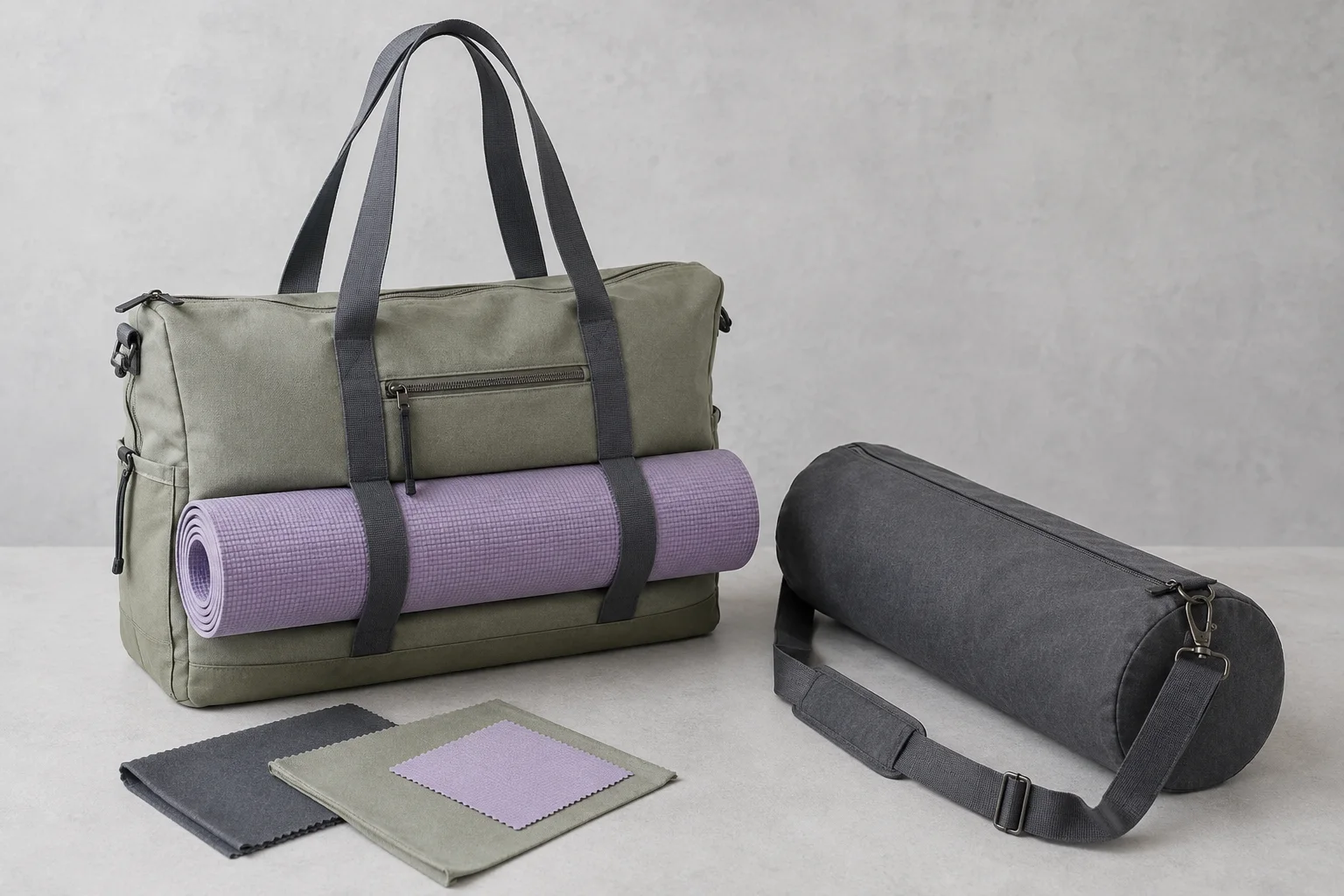
A carrier, a tote and a pouch in one shell fabric, one webbing colour, one zip tape and one label design read as a range instead of three separate items, and a three-piece set typically lifts order value by 25–40% against the same pieces sold individually. The colour matching is the work: shell, webbing, zip tape and label are four different substrates that each need to hit the same reference, which is done by lab dip before bulk is dyed. Ranges built this way are the standard structure on yoga mat bag sets and yoga studio sets.
Retail presentation
A bag that sits on a studio’s reception shelf needs a hangtag, a barcode and packaging that survives the trip. For wellness ranges, a cotton dust bag or a printed belly band costs little and reads better than a polybag, and it doubles as a shoe or laundry bag for the customer. Where the range also sells through a marketplace, carton dimensions and labelling follow the fulfilment centre’s rules, with the usual carton limits of 22.7 kg and 63.5 cm on the longest side. Both routes are covered on the custom packaging and retail prep page, and Amazon FBA and ecommerce sellers usually specify both from the same drawing set.
Building a Studio Retail Range Instead of a Single Yoga Bag SKU
A studio chain that buys one mat bag has bought a product. A studio chain that buys a carrier, a tote, a pouch and a sling in one fabric and one colour has bought a shelf. The second costs less per piece to develop than four unrelated items and sells at a higher basket value, because a customer who buys the carrier comes back for the pouch.
Tier
Piece
Format
Typical spec
Role in the range
Entry
Sling strap
Webbing only
150–190 cm webbing, 38 mm, woven label
Gift with purchase, class-pass reward, impulse buy at reception
Entry
Zip pouch
Flat pouch
15–20 × 10–12 cm, shared shell fabric
Add-on; the piece that gets bought second
Core
Mat carrier
Full-zip bag or sleeve
66–72 cm × 14–18 cm diameter, end pocket
The anchor SKU and the reason the customer visits the shelf
Core
Studio tote
Tote with mat cradle
18–28 L, external mat straps, internal bottle sleeve
The highest-value piece; replaces a handbag as well
Extension
Wet pouch
Welded PEVA or TPU
3–4 L, 0.15 mm, welded seams
Hot yoga and swim crossover; low cost, high attach rate
Extension
Teacher duffel
Duffel with mat straps
30–45 L, shoe pocket, mat straps under the base
Staff uniform kit and retreat programmes
Sequencing a range across two orders
Few brands launch six pieces at once, and they should not. A workable sequence is to sample the carrier and the tote together in one fabric booking, launch those two, then add the pouch and the sling on the reorder once the colour has proved itself at retail. Because MOQ starts at 300 pcs per style per colourway, a two-piece launch in two colours is a 1,200-piece commitment, which is within reach for a single studio group. Repeat orders on an approved style typically run 20–30 days against 25–35 for a first production run at that quantity.
Sharing a fabric booking across pieces
The commercial reason to build a range in one fabric is that the pieces draw from a single dye lot, which keeps the colours matched on the shelf and reduces the risk that the pouch reads slightly warmer than the carrier. It also concentrates the fabric purchase, which matters because fabric is typically 35–50% of unit cost in this category. Sets built this way are the standard structure on private label gym bag sets, and the same approach carries over to everyday sport totes where a wellness brand extends beyond the studio.
Who buys which shape
Gym, studio and club chains buy for reception shelves and for staff kit, usually in one or two brand colours with a tight logo standard. Startup and DTC brands buy a smaller number of styles in more colours, because their shelf is a product page. Distributors and retailers want the same carrier quoted in two fabrics to cover two price points on the same fixture. The shape of the range should follow the shape of the shelf it is going on.
How to Specify a Yoga Mat Bag in a Tech Pack and What to Ask a Supplier
The difference between a mat carrier that fits and one that does not usually sits in five or six lines of a tech pack. The table lists what to state and why each line matters.
Length × width × thickness in cm and mm, and the material if known
The whole pattern derives from this; “standard mat” is not a specification
Internal diameter
The finished internal figure, plus tolerance
Decides whether the zip closes on a hand-rolled mat
Internal sleeve length
Mat width plus stated ease
Follows mat width, not mat length; a common source of confusion
Panel width
Internal diameter × 3.14 plus seam allowance
Lets the factory check nesting against roll width before quoting
Shell fabric
Fibre, weight in oz or GSM, backing, and stock colour or Pantone
Sets hand, drying behaviour and cost tier
Strap
Total webbing length, shoulder run range, webbing width, buckle type
Decides fit across a 155–185 cm wearer range
Anchor construction
Patch, X-box or under-base webbing run
Sets whether the bag survives a 2–3 kg mat
Closure
Zip size, slider count, cord and lock, or magnetic snap
#5 coil with two sliders is the common standard on carriers
Pockets
Size and position of each, in cm
An end pocket that does not take a phone gets specified out later
Lining and wet handling
Unlined, 190T lining, PU-coated or welded pocket
The hot yoga decision, made once
Logo
Method, size in cm, placement from a seam, colour reference
Method and size drive both cost and the look on a shelf
Care label and packaging
Wash instruction, hangtag, barcode, polybag or dust bag
Reduces returns and lets the bag go straight onto a shelf
The bag tech pack guide shows where each of these lines sits in a full drawing set and bill of materials, and the RFQ checklist covers the commercial lines that sit alongside them.
Questions to ask a custom yoga bag manufacturer
Which mat was your standard carrier pattern built around? Expect a length, width and thickness, not “standard”. If the answer is vague, the pattern was copied.
What internal diameter and sleeve length will my bag finish at, and to what tolerance? Ask for the internal figures rather than the flat external ones, which are what most catalogues quote.
Will you fit-test the sample with my actual mat? The reliable answer is that the buyer ships one mat to the sample room, or names a mat the factory already holds.
What is the adjustable shoulder run of the strap, from shortest to longest? Look for 100–140 cm; anything narrower will not fit a 155–185 cm customer range.
How is the strap anchored, and what mat weight was that anchor designed for? A bar-tacked patch is standard; over 2 kg the load should go into webbing under the base.
Is the shell fabric in stock in the colours I want? A stock colour avoids a lab dip and the working days it adds.
Can the wet pocket be welded rather than stitched, and is the welding done in-house? Welding sent to a subcontractor adds days and a hand-off in the quality chain.
What is the MOQ per style and per colourway, and does a second size count as a new style? A regular and a wide carrier in one fabric may be cheaper to launch than one carrier in two colours.
Which pieces can share a fabric booking and a dye lot? This is what keeps a four-piece range colour-matched on a shelf.
What does the sample include, and how many revisions? Expect a working window of 5–7 working days with one free revision, plus a swatch set.
A buyer who has these answers in writing can put a carrier into production without a second sampling round. Sending the mat specification and the target price point together at the enquiry stage is usually enough to get a first drawing back; the get a quote form takes both, and the sample room can be reached directly through contact for questions about a specific mat.
How Venlinker Develops Custom Yoga Mat Bags and Studio Retail Ranges
Venlinker is Your Trusted Custom Yoga Bag Manufacturer in China, and mat carriers, studio totes, slings and matched wellness sets run through the same Huadu District factory in Guangzhou that has been building women’s sports and studio bags since 2010. The way the sample room handles mat geometry is built around the problem this guide describes: the customer’s mat, not the brand’s brief, sets the pattern.
Patterns held to real mat dimensions
The yoga and studio bag range is patterned around the mat formats in the table above rather than around a generic barrel. Carrier patterns are held at internal diameters from 13 to 17 cm for standard and long mats and from 18 to 26 cm for thick fitness and pilates mats, and sleeve lengths at 66–72 cm and 71–76 cm cover the 61 cm and 66–68 cm mat widths. A buyer who ships one mat to the sample room, or names its length, width and thickness, gets a carrier patterned to that mat instead of one adjusted from a catalogue shape. Where a brand wants a new shape entirely, the 10+ in-house designers work from the mat dimensions up, and the process is described on the sample development page.
Fabric, colour and welding
Fabric comes through a network of 200+ verified suppliers, which covers 10–16 oz cotton canvas, recycled cotton, 300–600D polyester and RPET, neoprene and PU-faced materials, with stock colours held in the fabrics that move most. Custom colours are matched by lab dip before bulk dyeing, and where a range shares a colour across a carrier, a tote, a pouch and webbing, the pieces are booked against one dye lot so the shelf matches. The material sourcing team records fibre, weight, backing and width per roll so that a specification written on a tech pack maps to an actual fabric. Welded wet pockets and PEVA pouches are made on Venlinker’s own high-frequency welding equipment rather than subcontracted, which keeps the wet-kit piece of a studio range inside the same schedule as the rest.
Sampling, MOQ and inspection
Samples run 5–7 working days with one free revision, against a refundable sample fee, and ship with a swatch set so a buyer can compare a 12 oz canvas against a 300D RPET in hand before committing. MOQ starts at 300 pcs per style per colourway, which lets a studio group launch a two-piece range without a large first commitment. Bulk runs 25–35 days at 300–1,000 pcs and 30–40 days at 1,000–5,000, with repeat orders at 20–30 days. Every order passes 100% pre-shipment inspection by the factory’s own team, with final inspection covering dimensions, strap length, stitch quality and logo placement against the approved sample. Third-party inspections from SGS, BV or TUV are welcome on any order, commissioned and paid by the buyer, and factory visits run Monday to Saturday, 40 minutes from Baiyun airport with pickup arranged, with live video tours for buyers who cannot travel.
Brands that want to see the construction before committing to a drawing set can request a free sample, and activewear and fitness brands adding a mat carrier to an existing range usually start there. Private label programmes running several colourways a year work from the OEM and ODM workflow instead, with the mat specification carried through from first drawing to golden sample to bulk.
Yoga Mat Bag Size and Design FAQ
What size should a yoga mat bag be?
For a standard 173 × 61 cm mat at 4–6 mm, an internal diameter of 13–17 cm and an internal sleeve length of 66–72 cm fits nearly all of them, including a towel wrapped around the roll. For a 66–68 cm wide mat, keep the diameter and lengthen the sleeve to 71–76 cm. For a thick 8–15 mm fitness or pilates mat, the diameter moves to 18–26 cm. Always quote internal dimensions on a tech pack, since external flat measurements vary with fabric thickness and seam construction.
How do I work out the rolled diameter of a yoga mat?
Multiply the mat length by its thickness in centimetres, then take 1.13 times the square root of that figure for a tight roll. A 173 cm mat at 0.6 cm gives roughly 11.5 cm. A hand-rolled mat measures 15–25% larger, so plan for 13–15 cm, then add 2–3 cm of ease for the bag. Mat thickness moves this figure far more than mat length does, which is why a long mat needs the same barrel as a standard one.
Does a longer yoga mat need a longer bag?
No, and this trips up most first-time buyers. Bag length follows the mat’s width, because the mat rolls along its length and the roll’s height equals the mat’s width. A 183 cm long mat and a 173 cm mat both roll to roughly 61 cm tall if they are the same width, so both fit a 66–72 cm sleeve. What a longer mat does add is a fraction of a centimetre to the rolled diameter. An extra-wide 66–68 cm mat is the one that genuinely needs a longer bag.
What is the difference between a yoga mat bag, a sleeve and a sling?
A full-zip mat bag encloses the mat completely and usually carries a small end pocket, which suits commuters and mats that need protecting. A sleeve is open at one or both ends with a drawstring top, costs less, and lets a wet mat breathe. A sling is webbing and two loops with no body at all, weighing 50–100 g, and works as a gift-with-purchase or an entry price point. Studios that sell all three usually price them across three tiers on one shelf.
What fabric is best for a hot yoga mat bag?
A coated polyester or RPET shell with a wipeable or PU-coated liner, or a canvas carrier with open ends and eyelet ventilation. Uncoated cotton canvas alone absorbs the moisture from a wet mat and stays damp, which produces odour and, in a car boot over a summer, mildew at the seams. Where a towel and studio clothing travel with the mat, add a welded wet pouch rather than relying on the shell fabric to manage the water.
Can one yoga mat bag fit every mat on the market?
Not honestly. A carrier at 17 cm internal diameter covers everything from a travel mat to a 6 mm standard mat with room for a towel, but it will not take a 12–15 mm foam mat, and it looks slack around a 1.5 mm travel mat. Ranges that claim universal fit usually mean 4–6 mm mats. Two sizes, or a carrier plus a tote with external adjustable mat straps that fit 10–17 cm rolls, covers a retail customer base honestly.
What is the minimum order for a custom yoga mat bag?
MOQ starts at 300 pcs per style per colourway. A second size counts as a separate style where the pattern changes, so a regular and a wide carrier is a 600-piece commitment in one colour. Sampling takes 5–7 working days with one free revision, and bulk runs 25–35 days at 300–1,000 pcs. The trade-offs between styles, sizes and colours at low volumes are set out in the custom bag MOQ guide.
Summary: Specifying a Yoga Mat Bag That Fits
A mat carrier is a geometry problem before it is a design problem. The brands that get it right settle the mat first, write the internal dimensions on the tech pack, and spend their design effort on the strap, the fabric and the shelf presentation, which are the parts they actually control.
Let the mat set three dimensions and spend your ease deliberately. Sleeve length follows mat width plus 5–12 cm. Internal diameter follows mat length and thickness, which for a hand-rolled 173 × 61 cm mat at 6 mm means 13–15 cm rolled and 15–18 cm inside the bag. Mat length barely moves the diameter; thickness dominates it, so a yoga carrier and a pilates carrier cannot be one product.
Design the strap for the range of bodies, not the average one. A 100–140 cm adjustable shoulder run, 38–50 mm webbing, a sliding 20–30 cm pad above roughly 1.5 kg of mat, and an anchor built for the mat weight prevent the two complaints that drive mat-carrier returns.
Build a range, not a SKU. A carrier, a tote, a pouch and a sling in one fabric and one dye lot typically lift order value by 25–40% over the same pieces sold separately, cost less to develop together, and give a studio shelf three price points instead of one.
Buyers with a mat specification and a target price point can send both through the get a quote form and get a first drawing back, or talk to the sample room about a specific mat before the range is fixed. Studio groups planning a full shelf usually start with the yoga mat bag and studio set structure and add pieces on the reorder, with the mat dimensions carried through every one.
Need a Mat Carrier Patterned to Your Exact Mat?
Venlinker builds custom yoga mat bags, slings, studio totes, duffels and matched wellness sets for studio chains, wellness DTC brands and activewear labels, with patterns held to real mat dimensions from 13 to 26 cm internal diameter, canvas and RPET from 200+ verified fabric suppliers, samples in 5–7 working days with a swatch set, in-house high-frequency welding for wet pockets, 100% pre-shipment inspection and MOQ from 300 pcs per style.