* Simply fill out the form below as best you can. And don’t sweat the details. * Your information will be kept strictly confidential. * Share your needs with us, We’ll contact you in very short time.
Planning a Custom Bag Order?
Send your bag type, quantity and target delivery date. We will review the specification and confirm the next step.
Padel Bags: Racket Sizes, Thermal Compartments and the Specs That Separate a Good Paletero From a Sports Bag
Padel bag guide for brands and clubs: FIP racket sizes to compartment, thermal linings, paletero formats, materials and MOQ from 300 pcs per colourway.
Who this guide is for: padel brands building a carry range, racket brands adding a bag to sit beside the racket, club and court operators planning a pro-shop or merchandise line, distributors supplying clubs in Europe and the Middle East, and activewear brands adding a padel bag to a sports collection, who need to know how the racket sets the pattern, what a thermal compartment is worth, and what to put on the tech pack.
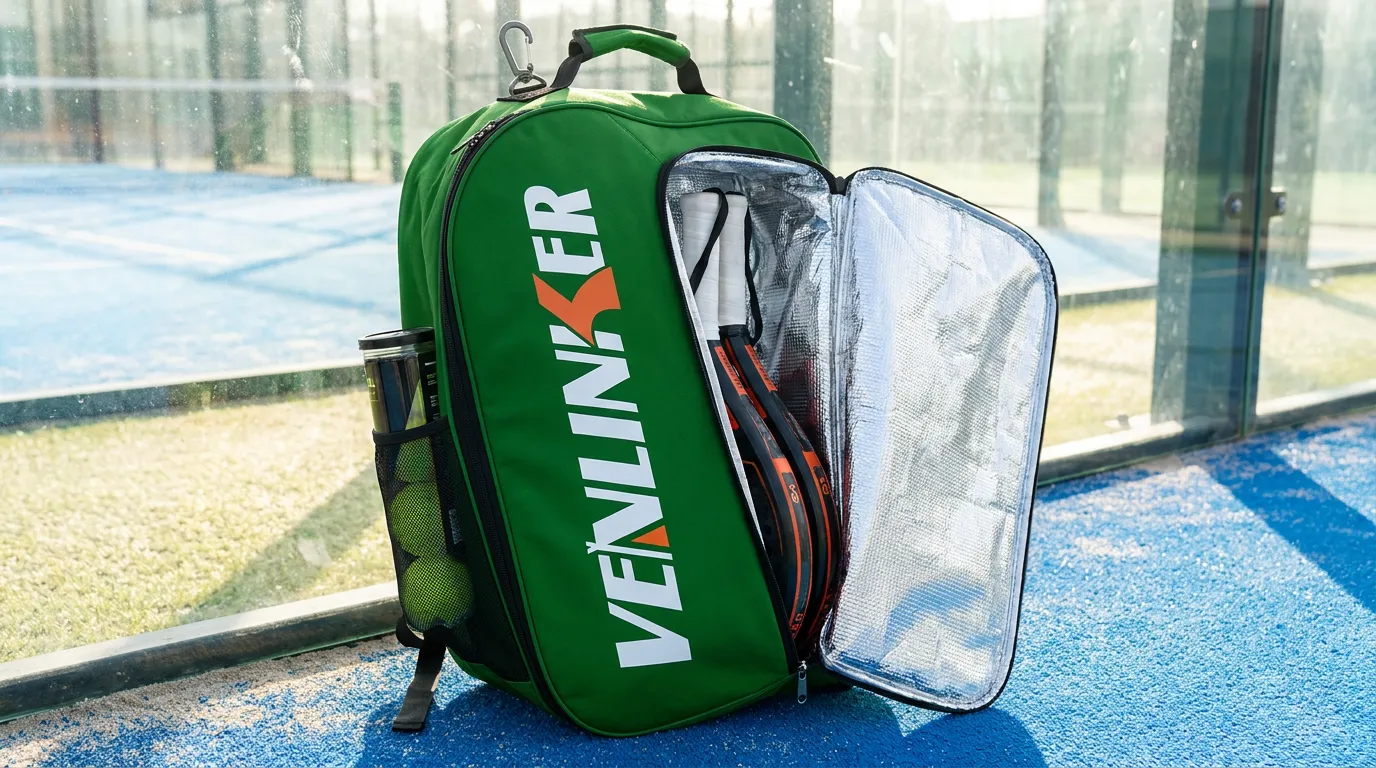
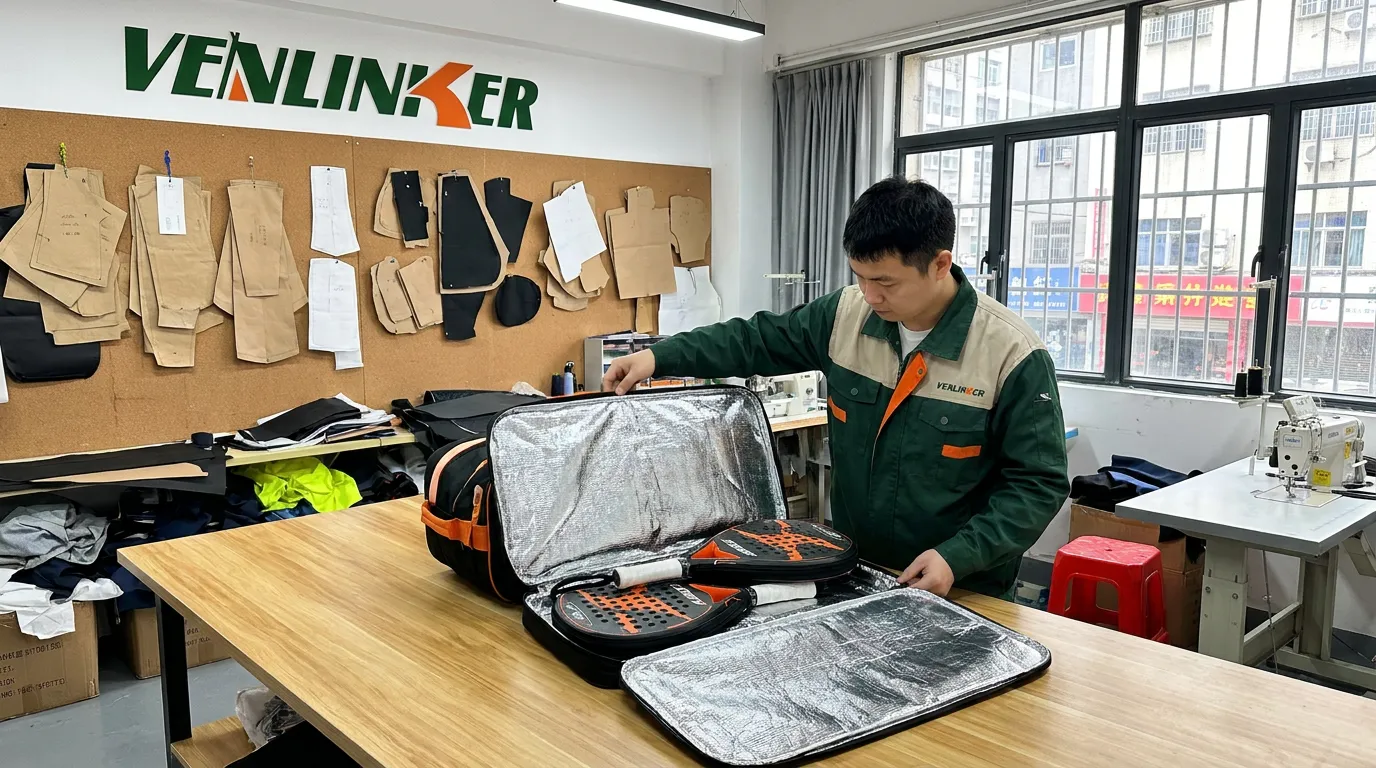
A padel bag looks like a small duffel from across a car park. Open it and the differences show. The racket compartment is short and wide, lined in silver foil over foam, and cut to a racket that the rules cap at 45.5 cm long and 38 mm thick. The shoes sit in their own section because most players change into court shoes at the club. A tube of balls rides in a side sleeve, and a hook on the top handle lets the player hang the bag on the court fence. A custom padel bag that gets those details right sells in a club shop. One that is a gym duffel with a racket pocket sewn on tends to sit on the shelf.
The market behind the category is building quickly. The Playtomic Global Padel Report 2026 counts 19.4 million players worldwide, 58,300 courts and nearly 20,000 clubs, and projects 91,000 courts by 2028. The same report finds that nine in ten leading clubs offer off-court services. For a padel brand, a racket brand or a club, that points to a retail shelf and a merchandise line, and a bag is usually the first product on both.
This guide explains the paletero format and why it exists, sets the FIP racket rules against compartment sizes, compares padel with tennis and pickleball bag geometry, works through two-racket and three-racket compartment sizing, explains what a thermal compartment does and does not do, compares the five padel bag formats, and covers shoes, wet kit, ball pockets, fence hooks, materials, branding, club merchandise and ordering for Europe and the Middle East. It ends with a worked tech pack block and the questions to put to a supplier before you request a quote for custom racket bags.
What Is a Padel Bag: The Paletero and the FIP Racket Rules Behind It
A padel bag is a sports bag patterned around one or more padel rackets, with a dedicated racket compartment (often thermally lined), a separate section for court shoes and room for a change of kit, balls, a bottle and valuables. In Spanish a padel racket is usually called a pala, and the bag that carries palas is a paletero. Buyers in Spain, Latin America and much of Europe use paletero for the traditional two-to-three racket bag. Buyers in the Middle East and English-speaking markets more often say padel racket bag. A supplier should recognise both terms on a brief.
Why the paletero format exists
The paletero is shaped by three facts about the sport. The racket is short and wide, so a bag that holds two or three of them comes out compact and deep rather than long. Players carry a spare racket as a matter of course, because a racket can crack against the glass walls or the frame of a partner’s racket, so the compartment is sized for two at minimum. And padel is a club sport played on booked courts, which means the player arrives, changes shoes, plays and leaves: the bag has to hold outdoor shoes and court shoes at different times, and a sweaty shirt on the way home.
The traditional answer is a rectangular or racket-profile duffel of roughly 40–60 L. A racket compartment runs down each long face, the central section carries clothing, and the shoe section sits at one end or in the base. Most paleteros carry both a shoulder strap and a pair of backpack straps that tuck into a rear pocket. The rounded ends that many paleteros show follow the curve of the racket head, which saves fabric and makes the bag read as padel from a distance.
The FIP racket rules in centimetres
The dimensions a factory needs come from the FIP Rules of Padel, applicable from 1 January 2026:
Length: 45.5 cm maximum, head and handle together.
Width: 26 cm maximum.
Thickness: 38 mm maximum, with a 2.5% tolerance on thickness, which puts the ceiling at roughly 39 mm.
Wrist cord: a non-elastic cord of up to 35 cm is mandatory.
Every compartment in this guide is sized from those four lines. Pattern to the maximum and every legal racket fits. Pattern to one sample racket from a single brand and the bag fails on the first customer who owns a thicker model. The wrist cord matters more than it seems: 35 cm of cord hanging from the handle is the single most common thing to jam in a racket compartment zip, and a good pattern gives it somewhere to go.
Padel Bag vs Tennis Bag vs Pickleball Bag: Racket Geometry Compared
Some clubs run more than one racket sport, and a buyer ordering for a multi-sport club or a team and sports equipment bag range will be asked whether one bag can serve all three. The geometry says it cannot, at least not well. The table sets the three side by side.
Sport
What sets the size
Typical compartment length
Depth per racket or paddle
Typical capacity, retail bag
Usual format
Thermal lining
Padel
FIP maximum 45.5 cm long, 26 cm wide, 38 mm thick; wrist cord mandatory
50–55 cm pattern length
Roughly 4–5 cm with cover and ease
2–3 rackets
Paletero, backpack, compact tournament bag
Common on paleteros
Tennis
The longest frame of the three, with a thin beam
72–76 cm
Roughly 3–4 cm
3 (retail), 6 (club), 9–12 (tour)
Long rectangular racket bag, backpack
Common from 6 rackets upward
Pickleball
USA Pickleball: length up to 43.18 cm, length plus width up to 60.96 cm, no thickness limit; cores usually 14 mm or 16 mm
42–46 cm
Roughly 2–3 cm
2–4 paddles
Sling, backpack, small duffel
Optional; less common
The pickleball rule figures come from the 2026 paddle dimension summary; compartment and depth figures are typical pattern ranges.
What the table means for a multi-sport range
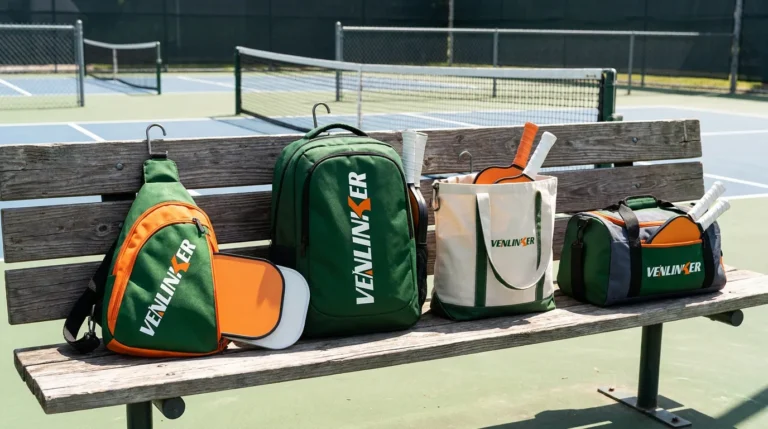
A padel compartment is roughly 20 cm shorter than a tennis compartment and roughly twice as deep per racket as a pickleball compartment. A tennis bag carrying padel rackets leaves them loose in a long tube, and a pickleball sling will not close over a padel racket at all. A padel paletero can take two pickleball paddles, with slack, which is why some clubs sell the paletero to both groups. For a club shop the practical range is a padel paletero plus a pickleball sling or backpack, and a tennis bag only if the club has tennis courts. The paddle-specific details, including the elongated-paddle problem and fence-hook placement on slings, are in the companion pickleball bag guide.
Padel Racket Bag Compartment Sizing: From Racket Dimensions to Pattern
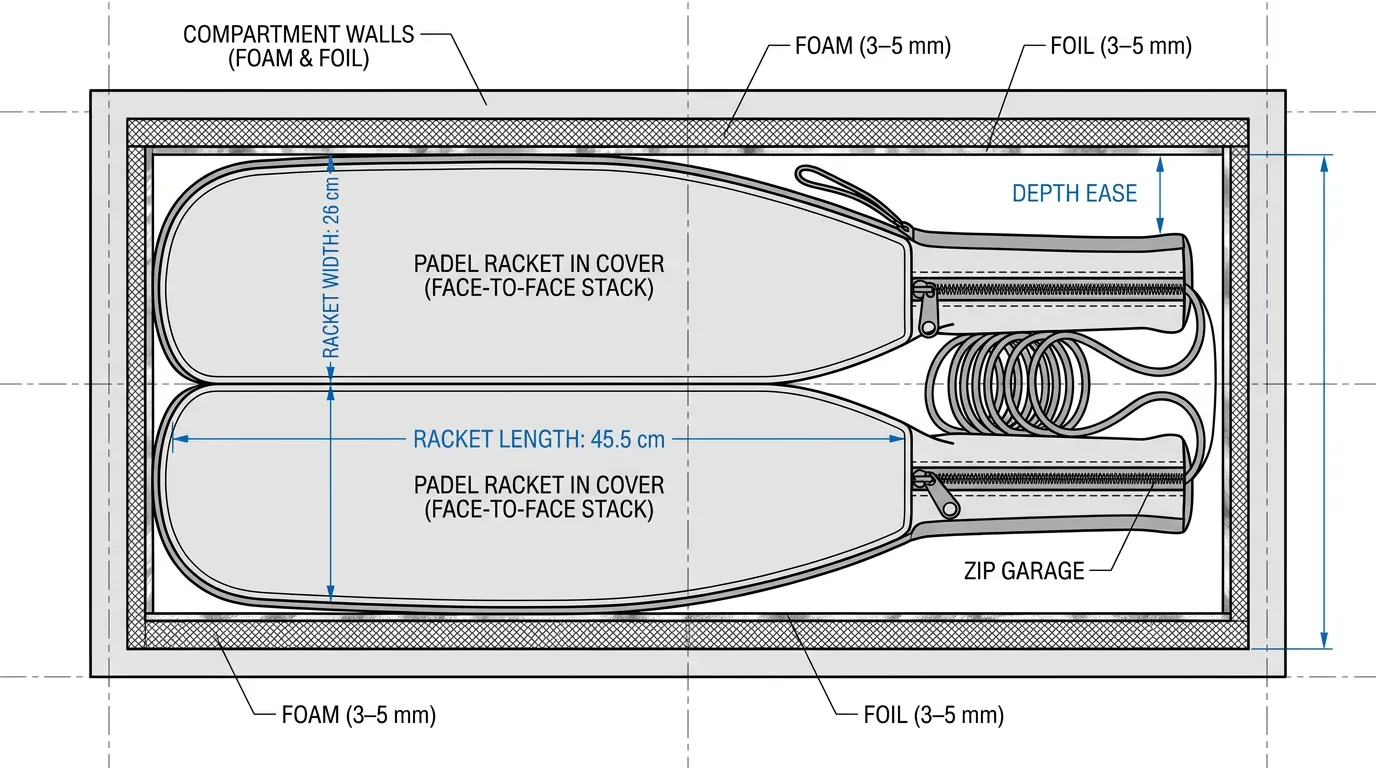
A padel racket bag is patterned to the racket in three dimensions. Litres come afterwards, as a check. The method is the same for any compartment: take the rule maximum, add the thickness of whatever the player keeps on the racket, add closing ease so the zip runs without strain, then add the wall build (foam and lining) to reach the finished size.
What goes on a racket in real use
A player’s racket is rarely the bare frame the rules describe. Most carry it in a thin protective cover, which adds roughly 0.5–1 cm to the stack. Overgrips build up the handle, protector tape adds a ridge to the frame, and the wrist cord sits coiled against the handle. Two rackets in covers therefore stack at roughly 9–10 cm, well above the 7.6–7.8 cm of two bare frames at the rule limit. A compartment patterned to bare frames closes over a sample and fails in a club car park.
Worked example: one, two and three rackets
The table uses the FIP maximums, a cover allowance and 3–5 mm foam on each face of the compartment.
Compartment
Bare stack at rule maximum
Depth ease (covers, grips, zip)
Clear internal size, L × W × D
Finished size with 3–5 mm foam each side
Approx. clear volume
1 racket (sleeve or cover)
3.8–3.9 cm
1–1.5 cm
47–48 × 27–28 × 5–5.5 cm
Roughly 48–49 × 28–29 × 5.5–6.5 cm
Roughly 6–7.5 L
2 rackets
7.6–7.8 cm
2.5–4 cm
48–50 × 28–29 × 10–12 cm
Roughly 49–51 × 29–30 × 11–13 cm
Roughly 13–17 L
3 rackets
11.4–11.7 cm
3–4 cm
48–50 × 28–29 × 14.5–16 cm
Roughly 49–51 × 29–30 × 15–17 cm
Roughly 19–23 L
The clear length carries 2.5–4.5 cm over the 45.5 cm racket so the handle does not load the end seam, and so the coiled wrist cord has room at the handle end. The clear width carries 2–3 cm over 26 cm. Once seam allowance and a curved head profile are added, the cut pattern length usually lands at 50–55 cm.
Three pattern details decide whether a compartment survives a season. First, put the handles at the end where the zip stops. A zip that ends at the handle end lets the cord hang clear of the teeth, and a small fabric garage over the zip end keeps it there. Second, run the zip around three sides of the compartment (a clamshell opening) so the racket drops in flat and is not threaded in from one end; a #8–#10 coil zip with two sliders is typical on the racket compartment. Third, make the compartment deep enough that the zip closes with no pressure on the stack. If a sample needs a hand pressing on the rackets to close the zip, the depth is short, and the zip will split at the ends within months.
For a three-racket paletero, the most common layout splits the load: two rackets in one side compartment and one racket with a valuables pocket on the other. That keeps both faces of the bag close in thickness, so the bag stands straight when set down against a court fence. The custom design and structure page shows how the sample room patterns side compartments on a duffel body.
Padel Bag With Thermal Compartment: How It Is Built and What It Does
The silver lining inside a racket compartment is the feature buyers ask about most and understand least. A padel bag with thermal compartment is worth specifying for most markets, provided the buyer knows what it buys.
Why players want the racket kept out of heat and cold
A typical padel racket is built from a foam core (EVA or a similar foam) between two faces of carbon fibre, fibreglass or a blend, bonded with resin. The foam core is the part most sensitive to temperature. Heat softens it, and cold stiffens it, so the same racket can feel livelier on a hot afternoon and harder and duller on a cold morning. Resin systems also soften at high temperatures, and a racket left in a closed car in strong sun sits at temperatures well above anything it meets on court. The usual advice to players is to keep rackets out of hot cars and away from direct sun, and to avoid moving a racket straight from freezing conditions into hard play. Balls are pressurised and bounce differently at temperature extremes too, which is one reason players like the ball tube kept in the bag body rather than on an outside strap.
That is why a player crossing a Gulf car park in summer, or arriving at a northern European club in winter, looks for the silver lining before the logo.
How a thermal compartment is built
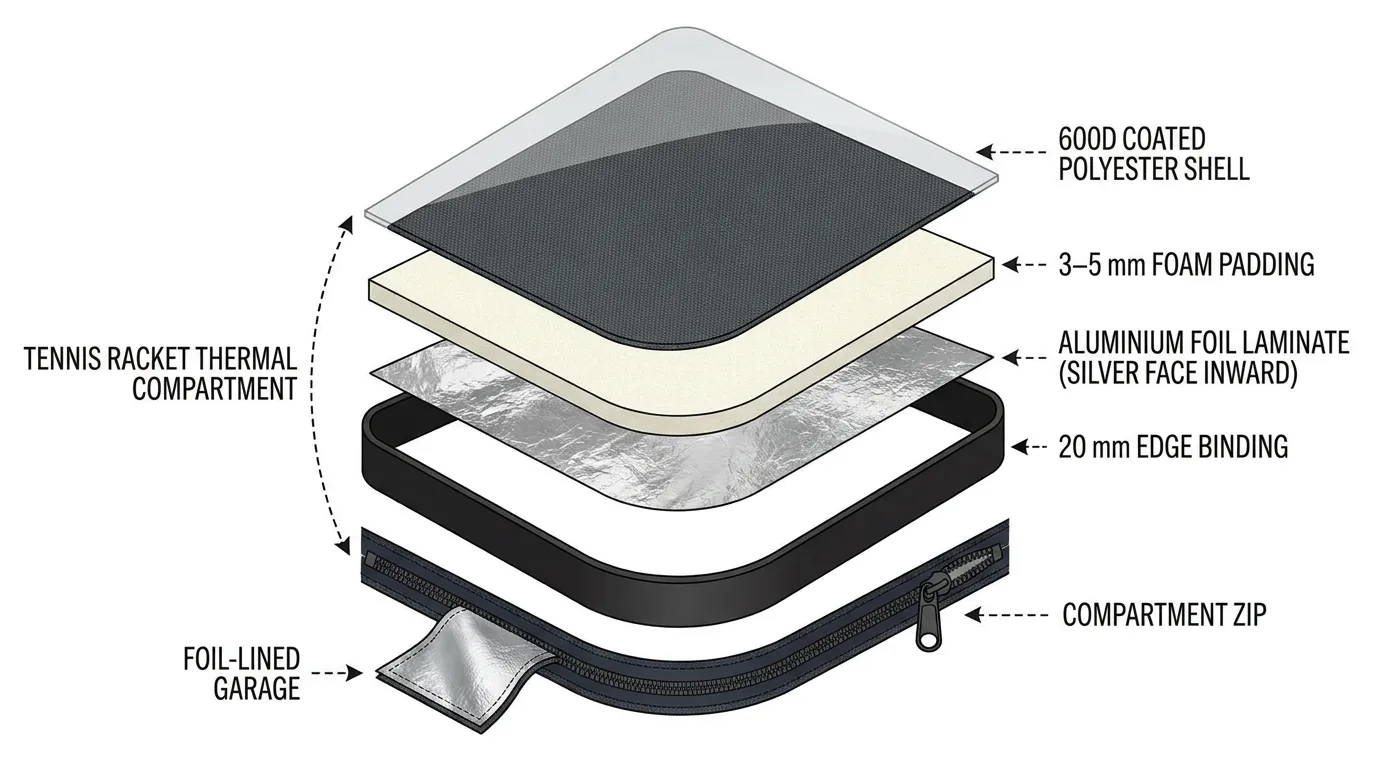
A thermal compartment is a bag-within-a-bag. The typical build, from outside in, is:
Shell fabric, usually 600D PU-coated polyester.
Foam, roughly 3–5 mm of closed-cell polyethylene or similar foam, which slows heat conduction and adds light padding against knocks.
Foil laminate, a thin aluminium or metallised film bonded to a scrim, with the silver face turned into the compartment.
The foam and foil are cut as their own panel, the edges bound with roughly 20 mm tape, and the panel is anchored into the compartment seams. It should never be glued flat to the shell. A glued foil laminate peels at the fold within a few months of summer heat, the condition the lining exists for. The racket compartment zip is a gap in the insulation, so a flap or a foil-lined zip garage along the zip line is worth specifying on a bag sold into hot markets.
What it does: the foil reflects radiant heat and the foam slows conducted heat, so the racket warms more slowly than it would in an unlined compartment. It flattens peaks. A racket carried from an air-conditioned car across a hot car park, or left in a boot for the length of a lunch, stays nearer its starting temperature. The foam also gives the racket some protection from knocks, which many players value as much as the insulation.
What it does not do: it does not cool anything. It is not a cooler, it has no cold source, and left for hours in a closed car the compartment will move towards the temperature of the car. It also does not dry anything. Foil is close to vapour-tight, so a sweaty racket zipped into a thermal pocket stays damp, and the pocket can smell over a season. A hang-tag line telling the player to air the compartment after play costs almost nothing.
On the product page, describe the lining as what it is (a foil-and-foam thermal lining that slows heat transfer and adds padding) and avoid temperature claims. Figures such as “keeps rackets X degrees cooler” depend on the car, the sun and the hours, and a brand has no way to stand behind them. For bags where the goal is water resistance rather than temperature, the coating and welding levels are set out in the guide to waterproof and water-resistant bag construction; a thermal compartment is a separate specification and does not make a bag waterproof.
Padel Bag Types Compared: Paletero, Padel Backpack, Racket Cover, Tote and Tournament Bag
A padel range usually draws on five formats. Most brands start with one or two and add the rest once sell-through shows which customers the shop actually serves.
Format
Racket capacity
Typical volume
Compartment layout
Who buys it
Relative cost
Build base
Paletero
2–3 (some 4)
Roughly 40–60 L
Racket compartment on each long face, thermal on one or both; central kit section; shoe section at the end or base
For a club or a brand’s first order, the paletero is usually the right hero product. It is the bag customers recognise as padel, it carries the most branding area, and its price point supports a margin in a pro shop. The backpack comes second, often in the same colourway, for players who ride or walk to the club. The racket cover is the add-on: low cost, high logo visibility, and easy to bundle. The tote works for clubs with a strong social membership, and the compact tournament bag belongs in a range once the club or brand has a competitive team to supply.
A padel backpack deserves one caution. A racket against the back panel keeps the load close to the spine, but the compartment then sits between the player and the main section, so the back panel needs 8–10 mm of padding to stop the racket edge pressing through. A racket in a front shell pocket avoids that and makes the backpack deeper. Both work; the sample room should build whichever the brand’s customers prefer on the shoulder, and the sample development process allows one free revision to change it.
Padel Bag Shoe Compartments, Wet Kit, Ball Tube Pockets and Fence Hooks
Four details separate a paletero from a sports bag with a racket pocket sewn on: the shoe section, somewhere for wet kit, a ball tube pocket and a fence hook.
Shoe compartment
Padel players change into court shoes at the club, so the bag carries a pair of shoes on every trip, clean or dirty. The shoe section should be sized to the largest foot the SKU is sold to. A pair of EU 45–46 shoes placed side by side needs roughly 33–34 × 20 × 13–14 cm of clear space; a women’s line can drop to roughly 29–30 cm of clear length. Court shoes are usually lower than running shoes, which helps the height. The section needs air: a 100–200 GSM mesh vent panel on an outer face, or a row of eyelets, stops the pocket from holding odour. The full sizing table by shoe size and the options for end tunnels, base drawers and side pockets are covered in the guide to shoe compartments and wet-dry gym bags, and the same patterns appear on venlinker’s shoe-compartment gym bags.
Some buyers leave the shoe section out of a compact bag and sell a separate drawstring or zipped team shoe bag alongside it. That keeps the tournament bag slim and adds a low-cost item to the set.
Wet kit
A shirt after a match on an indoor court comes off wet. On a paletero the wet kit usually goes into a PU-coated or TPU-lined zip pocket in the central section, or into a separate welded wet pouch that the player drops in the main compartment. A sewn and coated pocket slows moisture but will not hold standing water; a welded TPU cell will. For most padel bags a coated pocket plus a pouch in the set is enough.
Ball tube pockets
Padel balls are sold in pressurised tubes, and players carry one or two. An elastic side sleeve or a zipped pocket on the end panel holds a tube upright. Pattern it to the actual tube the club or brand sells, with roughly 1–1.5 cm of ease on the diameter, and send a physical tube with the sample brief. A tube pocket placed inside the thermal compartment keeps the balls out of the sun as well as the rackets, at the cost of some compartment depth.
Fence and wall hooks
Padel courts are enclosed by glass walls and mesh fencing, and players hang bags on the fence between games to keep them off wet or dusty ground. A hook on the top handle or a dedicated webbing loop does this job. Hook options run from a stock plastic or metal hook to a custom-moulded hook in the brand colour; stock hardware keeps the standard lead time, and custom-moulded hardware adds 10–15 days. The hook should be anchored through a reinforcement patch with a box or X bar-tack, because a loaded paletero hanging from one point puts the full bag weight on a few centimetres of stitching. Hook, zip and pull options are listed on the custom trims, hardware and accessories page.
Padel Bag Materials and Finishes: Coated Polyester, PU, Textures and Colour-Blocking
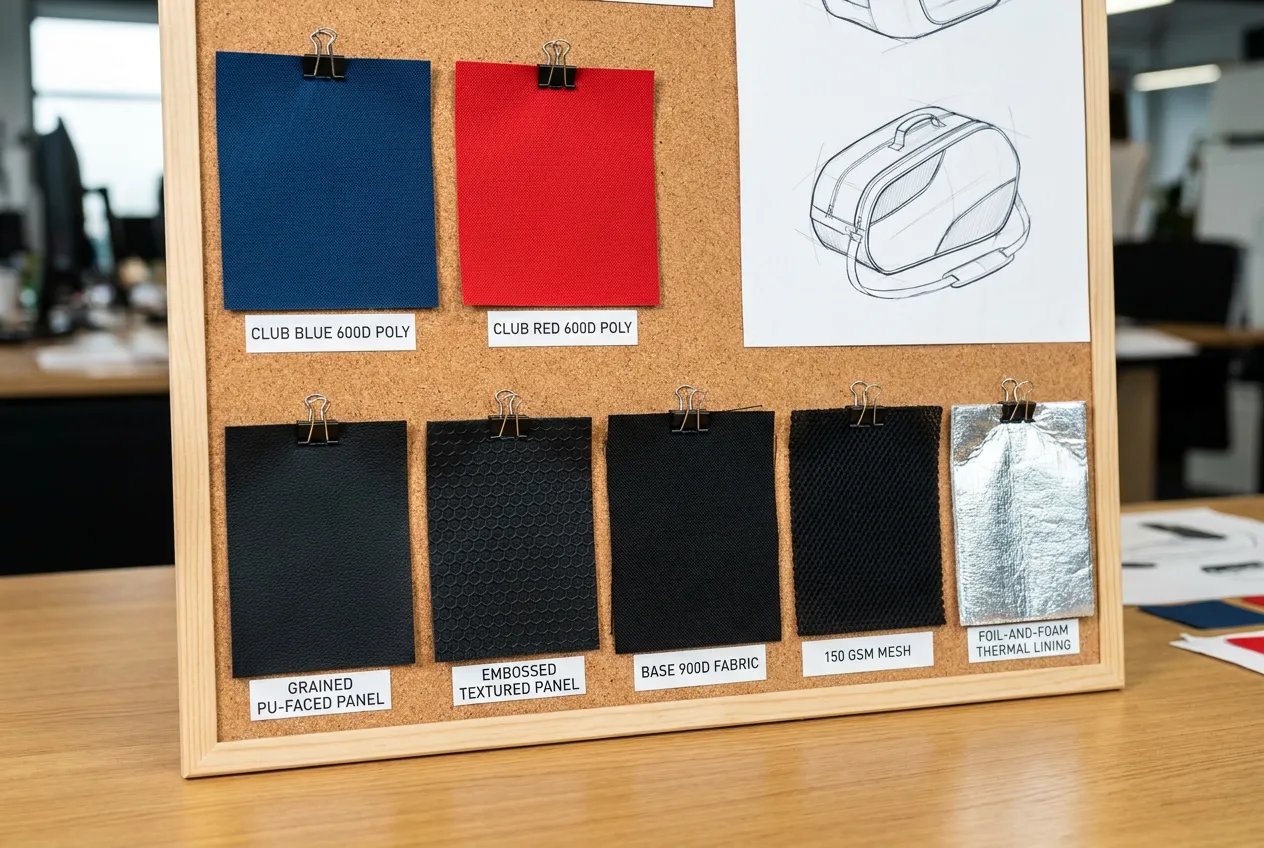
Padel bags sit closer to fashion than most team bags. Clubs and brands want them to look good on a court-side bench and in social photos, so finish carries as much weight as abrasion life. The table covers the materials that show up most often on padel spec sheets.
Material or finish
Typical spec
Where it goes
Look and hand
Relative cost
What to watch
Polyester, PU-coated
600D, roughly 220–280 GSM
Body panels on volume SKUs
Matte, dry, holds shape
Low
Takes screen print and embroidery cleanly
Polyester, heavier base
900D or PVC-backed 600D
Base and lower corners
Firmer, wipe-clean
Low to moderate
Worth it on bags set down on court surfaces
Nylon
840D
Shell on upper-tier SKUs
Softer hand, slight sheen
Moderate to high
Stronger per gram; fewer stock colours
PU-faced fabric
Smooth or grained coated face
Front panels, end caps, strap tabs, trims
Leather-like, slight gloss
Moderate
Gloss shows scuffs; stiffens in cold
Textured finish
Embossed PU, dobby or printed texture on polyester
Front and side panels
Tactile pattern, reads as technical
Moderate
Confirm the texture on the bulk roll, not only the swatch
Many padel bags are two or three colours: a dark body, a contrast front panel and a coloured zip or binding. Colour-blocking costs little in fabric, because each colour is a separate panel already in the pattern, but it adds cutting and sewing steps and every custom colour needs its own dye lot. Staying inside stock colours keeps the sample fast; a custom Pantone match needs a lab dip before bulk fabric is dyed. The colour combination is the colourway for MOQ purposes, so a navy-and-lime bag and a black-and-lime bag are two colourways of 300 pcs each. Fabric families, stock colours and custom matching are covered on the custom materials and colours page, and fabric is sourced through Venlinker’s material sourcing network of 200+ verified suppliers.
Fabric is typically 35–50% of unit cost in this category, so the table above moves the quote. A 600D body with a 900D base and one PU-faced front panel is the usual middle route: most of the look for a small step in cost.
Custom Padel Bags for Clubs and Brands: Branding and Padel Club Merchandise
A padel bag is carried to the same courts by the same people several times a week, which makes it one of the most visible products a club or brand can sell.
Branding methods on a padel bag
The front panel of a paletero is the main logo area, usually flat enough for a panel of roughly 15 × 10 cm or more. Embroidery suits club crests and brand marks on the front panel; a moulded rubber or silicone patch reads as technical and survives court-side wear; screen print suits large single-colour graphics on the compartment face; heat transfer handles gradients and small multi-colour artwork. A woven label in the central compartment carries the brand inside. The foil lining takes no branding at all. For bilingual clubs in the Gulf, Arabic and Latin script can sit side by side in embroidery or print when the artwork arrives as vector files, and small text (roughly under 5 mm high) loses definition in embroidery. Artwork requirements for the sample room are on the custom logo and branding page, and the logo method guide compares methods by cost tier and durability.
Padel club merchandise: the off-court opportunity
The Playtomic finding that nine in ten leading clubs offer off-court services is the commercial case for a club bag. A club with a café, a pro shop and coaching already has a till and a shelf. A branded bag gives members something to carry that advertises the club at every other venue they play, and it gives coaches a product to recommend.
Padel courts worldwide: today vs projected for 2028
Court count from the Playtomic Global Padel Report 2026 and the report’s projection for 2028. The difference of 32,700 courts is a rise of roughly 56%.
More courts means more clubs opening shops, and a club that opens in 2027 needs its bag range ordered months before the doors open. Gym, studio and club chains running several sites usually standardise on one bag design across all of them, with the site name as a secondary embroidery line.
Building a club set
The commercial pattern that works in club shops is a set: a paletero, a matching racket cover and a shoe bag or wet pouch in the same colourway. A three-piece set typically lifts order value by 25–40% over the hero bag alone, and it gives the shop three price points on one shelf. A coaching programme may add ball bags for the academy. Brands running a set under their own label can base it on venlinker’s private label gym bag sets, swapping the gym duffel for a paletero. Retail-ready hangtags, barcodes and polybags are set up under custom packaging and retail prep, so the set arrives shelf-ready.
Padel Bag Wholesale Ordering for Europe and the Middle East: MOQ, Lead Times and FOB
Most padel bag wholesale orders into Europe and the Middle East follow the same shape: a hero paletero, one or two supporting formats, two or three colourways, and a date the goods must reach a club, a warehouse or a retail floor.
MOQ and colourways
Venlinker’s minimum is 300 pcs per style per colourway. A club ordering a paletero in one colourway and a racket cover in the same colourway places two styles of 300 pcs each. A distributor ordering the paletero in three colourways commits to 900 pcs of that style. The custom bag MOQ guide explains how styles, colourways and sizes interact, and how a first order can be split to test demand before scaling. Distributors and retailers supplying several clubs often run one base design with a club-specific front panel, which keeps the fabric colourway fixed and moves only the logo.
Lead times by order size
After the golden sample is signed, venlinker’s bulk lead times run by tier:
300–1,000 pcs: 25–35 days
1,000–5,000 pcs: 30–40 days
5,000–20,000 pcs: 35–50 days
Repeat orders of an approved style: 20–30 days
Fabric from outside the supplier network adds 7–14 days, and a custom-moulded fence hook or zip pull adds 10–15 days. The sample itself takes 5–7 working days with one free revision. Sea freight to Europe or the Gulf adds several weeks depending on route, and the buyer’s forwarder should confirm the transit time for the specific port pair.
Planning around Chinese New Year
Chinese New Year 2027 falls on Saturday 6 February 2027, and production typically slows two to three weeks before the holiday. An order meant for spring 2027 club shelves should have its golden sample signed and materials confirmed well before that window. Work backward from the date the bags must be in the warehouse through freight, inspection, bulk production, material confirmation and sample sign-off. Venlinker confirms its exact holiday closing and reopening dates to each buyer in writing.
Terms and delivery
Payment is 30% deposit with the order and 70% before goods leave the factory. FOB is the default term, with CIF or DDP quoted on request for buyers who want the factory to arrange freight. Buyers importing into the EU, the UK or Gulf states pay their own market’s duty on arrival, and should confirm the tariff classification and rate with a customs broker before ordering. Carton marking, pallet plans and export documents are set out under packing and shipping terms. A buyer who wants a landed-cost view before committing can contact Venlinker with the destination port and quantities.
How to Specify a Custom Padel Bag in a Tech Pack and What to Ask a Supplier
A tech pack for a padel bag should let three factories quote the same product. The lines that matter most are the racket compartment dimensions, the thermal build and the hardware; a brief that says “padel bag, 2 rackets, thermal” leaves every one of those to the factory.
Worked spec block: three-racket thermal paletero
Line
Specification
Style
Three-racket paletero, thermal, club colourway
Overall size
Roughly 56–58 × 32–34 × 30–34 cm (L × H × D), roughly 45–55 L
Racket compartment A
Two rackets; clear 49 × 29 × 11 cm; clamshell #8 coil zip, two sliders, garage at handle end
Racket compartment B
One racket plus valuables pocket; clear 49 × 29 × 6 cm; #8 coil zip, two sliders
Thermal build
Both racket compartments: 4 mm foam plus aluminium foil laminate, sewn as a bound panel with 20 mm tape, anchored in compartment seams; no adhesive to shell
Central section
Clothing compartment with coated wet-kit zip pocket; 210D light-grey lining
Shoe section
End-access, clear 34 × 20 × 14 cm (to EU 46); 150 GSM mesh vent panel
Ball pocket
Elastic end sleeve sized to buyer’s tube plus 1–1.5 cm ease
Padded top handles; detachable 38 mm shoulder strap; stowable 60–70 mm padded backpack straps
Hardware
Stock metal fence hook on top handle, reinforcement patch with X bar-tack; branded zip pulls
Branding
Embroidered crest on front panel, roughly 15 × 10 cm; woven label in central section
Target weight
Roughly 0.9–1.2 kg empty
Packaging
Polybag, hangtag with barcode, 5–10 pcs per carton by final carton plan
Quantity and inspection
300 pcs per colourway; 100% pre-shipment inspection; buyer may add third-party AQL inspection
Compartment dimensions are written as clear internal sizes, so the factory adds its own wall build and seam allowance. The bag tech pack guide shows where each of these lines sits in a full BOM, and the OEM/ODM workflow shows how the spec moves from tech pack to golden sample to bulk.
Questions to ask a padel bag manufacturer
Which racket dimensions did you pattern the compartment to? Expect the FIP maximums (45.5 × 26 cm, 38 mm) plus stated ease, not one sample racket.
Does the compartment close over two rackets in covers without pressure on the zip? Ask for a photo or video of the sample loaded that way.
How is the thermal lining attached? A bound, sewn panel is the answer to look for; adhesive to the shell is a warning sign.
Where does the wrist cord go when the zip closes? A zip garage or handle-end layout should be on the pattern.
What is the clear size of the shoe section, and which shoe size does it take?
Is the fence hook stock or custom-moulded, and how is it anchored? Custom moulding adds 10–15 days.
Which fabrics and colours are in-network? Out-of-network fabric adds 7–14 days.
What is the MOQ per colourway, and does a colour-blocked version count as one colourway?
What do you check at pre-shipment inspection on a racket bag? Zip function on a loaded compartment, lining attachment and hook anchoring should be on the list.
Will the approved sample be kept as the golden sample for bulk comparison?
Buyers comparing several factories can fold these into the product section of an RFQ checklist. When a supplier answers with figures, the quote is comparable. When the answers come back as “standard size, thermal, strong zip”, the buyer is still writing the specification.
How venlinker Builds Custom Padel Bags
Venlinker is Your Trusted Custom Padel Bag Manufacturer in China, patterning racket compartments to the FIP limits and building thermal linings as sewn panels at a Guangzhou factory that makes only sports, fitness, studio, swim and active-lifestyle bags. Founded in 2010, the factory runs 10+ production lines from a 5,000 m² site in Huadu District, with 500+ staff and output of 50,000+ bags a month.
Sample room and pattern
Ten-plus in-house designers and a sample room that develops 100+ new models a month turn a padel brief into a sample in 5–7 working days, with one free revision. Before a sample ships, the sample room can load each racket compartment with rackets in covers and film the zip closing, so the buyer sees the compartment under a real load. A refundable sample fee applies and is credited against the production order; details are on the free sample page.
Fabric, lining and hardware
Shell fabrics, PU-faced panels, textured finishes, mesh and foil-and-foam thermal laminates come from a network of 200+ verified fabric suppliers. Every roll passes incoming material inspection for weight, width, shade and coating before it reaches the cutting table. Where a padel bag carries a welded TPU wet pocket, the seams are welded on Venlinker’s in-house high-frequency machines.
Inspection and volumes
Finished bags pass 100% pre-shipment inspection by the factory’s own team, which on a racket bag covers zip function, lining attachment and hook anchoring, as described under final inspection and AQL. Independent inspection is open on every order: the buyer books SGS, BV or TUV and pays the inspector directly. Factory visits are welcome Monday to Saturday, 40 minutes from Baiyun airport with pickup, and live video tours are available for buyers in Europe and the Middle East who cannot travel. Free white-background product photography comes with production orders, which gives a club shop or an online store images on the day the goods land.
MOQ from 300 pcs per style per colourway suits activewear and fitness brands adding a first padel SKU, clubs building a shop range, and distributors testing a design across several clubs. A padel brand with a racket already in market can send its racket dimensions and colourways for a quote, and the pattern dimensions come back with the price.
Paletero is the Spanish term for a padel racket bag, from pala, the usual Spanish word for a padel racket. It describes the traditional padel bag format: a compact duffel of roughly 40–60 L with a racket compartment on each long face, a central section for clothing and a shoe section, carried by shoulder strap or stowable backpack straps. It usually holds two or three rackets.
How big should the racket compartment in a padel bag be?
Size it from the FIP maximums of 45.5 cm length, 26 cm width and 38 mm thickness. For two rackets in covers, a clear internal size of roughly 48–50 × 28–29 × 10–12 cm works; for three, roughly 48–50 × 28–29 × 14.5–16 cm. Add the foam and lining thickness to reach the finished size, and a pattern length of 50–55 cm once seam allowance is included.
Does a thermal compartment in a padel bag work?
It slows heat transfer and adds padding, so the racket warms or chills more slowly than in an unlined pocket. It does not cool the racket and has no cold source, and left for hours in a closed car it will reach the car’s temperature. It is worth specifying for hot and cold climates, as long as the product copy avoids temperature claims.
Can one bag carry padel, tennis and pickleball rackets?
Not well. A tennis compartment runs 72–76 cm, a padel compartment 50–55 cm and a pickleball compartment 42–46 cm. A padel paletero will hold two pickleball paddles with some slack, but a tennis racket will not fit and a padel racket rattles in a tennis bag. Multi-sport clubs usually stock a padel paletero and a separate pickleball sling or backpack.
What is the MOQ for custom padel bags?
Venlinker’s MOQ is 300 pcs per style per colourway. A colour-blocked design counts as one colourway if every bag in the order uses the same combination. A racket cover or shoe bag in a set is a separate style with its own 300 pcs. The MOQ guide covers how to split a first order.
How long does a custom padel bag order take?
The sample takes 5–7 working days with one free revision. Bulk runs 25–35 days for 300–1,000 pcs, 30–40 days for 1,000–5,000 pcs and 35–50 days for 5,000–20,000 pcs, with repeat orders at 20–30 days. Out-of-network fabric adds 7–14 days, custom-moulded hardware 10–15 days, and sea freight to Europe or the Middle East adds several weeks on top.
Which logo method works best on a padel bag?
Embroidery on the front panel is the most common choice for club crests and brand marks. A moulded rubber or silicone patch suits a technical look, screen print suits large single-colour graphics and heat transfer handles gradients. The foil thermal lining takes no branding. A sports equipment backpack in the same range usually carries the same method in a smaller size.
Summary: Specifying a Padel Bag That Sells
Padel is building quickly, with 58,300 courts today and 91,000 projected by 2028 according to Playtomic, and clubs and brands are adding bags to their shelves as the sport grows. The broader shift towards sport-specific carry across racket, studio and hybrid-fitness categories is tracked in the sports bag trends 2026 overview. For a padel bag, three decisions carry most of the result.
Pattern the racket compartment to the FIP maximums, then add ease. 45.5 × 26 cm and 38 mm are the starting point; covers, grips and the 35 cm wrist cord add roughly 2.5–4 cm of depth on a two-racket compartment. A zip that closes without pressure on a loaded sample is the test.
Specify the thermal lining as a sewn, bound panel and describe it honestly. Foil over 3–5 mm foam slows heat transfer and pads the racket. It does not cool, and it should never be glued to the shell.
Build a range around a paletero hero SKU. Add a backpack, a racket cover and a shoe bag or wet pouch in the same colourway, plan MOQ at 300 pcs per style per colourway, and work back from the shelf date through freight, bulk, sample and Chinese New Year.
A padel brand, club or distributor ready to price a range can request a quote with racket count, colourways and quantities, or contact the sample room to discuss the compartment sizing before the tech pack is written.
Ready to Sample a Padel Bag Patterned to Your Rackets?
venlinker builds custom paleteros, padel backpacks and racket covers for padel and racket brands, clubs and distributors in Europe and the Middle East, with thermal compartments sewn as bound panels, fabric from 200+ verified suppliers, samples in 5–7 working days, 100% pre-shipment inspection and MOQ from 300 pcs per style per colourway.