* Simply fill out the form below as best you can. And don’t sweat the details. * Your information will be kept strictly confidential. * Share your needs with us, We’ll contact you in very short time.
Planning a Custom Bag Order?
Send your bag type, quantity and target delivery date. We will review the specification and confirm the next step.
Custom Pickleball Bags: Paddle Sizes, Bag Formats and Specs Buyers Should Lock Down
Pickleball bag guide for brands and clubs: paddle sleeve sizing, sling, backpack and tote formats, court-side features and MOQ 300 per style per colour.
Who this guide is for: product managers at pickleball and racket-sport brands, paddle brands adding a carry line, club and facility operators buying member merchandise, activewear brands extending into court sports, and sporting-goods retailers and distributors who need a pickleball bag specified to the paddle before they ask a factory for a price.
A pickleball bag used to be whatever tennis bag a player already owned. That changed once the sport grew large enough to support its own product category. The SFIA 2026 Pickleball Single Sport Report, released on 4 June 2026, counts 24.3 million US participants in 2025, up from 4.2 million in 2020. Women make up 42.9% of players, core players who play eight or more times a year number 7.5 million, and people aged 13 to 24 have the highest participation rate of any age group. A sport with that shape buys bags in volume, and it buys them in formats built around the paddle.
For a brand, club or retailer planning custom pickleball bags, the decisions that set cost and customer satisfaction are few and specific: the internal dimensions of the paddle pocket, the carry format, the court-side details, the fit for a player base that is now close to half women, and the order structure that gets bags into a pro shop without overstocking it. Each of those is a line on a tech pack. Get the paddle pocket wrong by two centimetres and the zip will not close over an elongated paddle with an edge guard, whatever the rest of the bag does well.
This guide starts from paddle geometry and works outwards. It compares five bag formats, sizes a two-paddle sleeve with a worked example, lists the court-side features buyers ask for, covers materials, colour and branding, and finishes with a sample tech-pack spec block and a supplier checklist. Buyers who already know their format can go straight to the team sports and equipment bags range or send a brief for a quote.
Pickleball Bag Market 2026: Why Paddle-First Designs Replaced Tennis Bags
The shift from borrowed tennis bags to purpose-built pickleball bags follows from two things: how many people now play, and how different a paddle is from a strung racket.
Participation data buyers should know
SFIA’s figures describe a sport that has moved from a niche to mass participation in five years. Total US participation grew nearly sixfold between 2020 and 2025. Core players, the group that buys a second paddle, a dedicated bag and a club shirt, grew more than fivefold over the same period. Women’s share rose from 38.6% in 2020 to 42.9% in 2025, and the highest participation rate sits with ages 13 to 24.
US pickleball participants and core players, 2020 vs 2025 (millions)
The core-player line matters more to a bag buyer than the headline figure. A casual player borrows a paddle at a community court and carries it in hand. A core player owns two or more paddles, plays several times a week, and replaces a bag when the zip or the strap fails. That group is the customer for a 25 L backpack with a lined paddle sleeve, and at 7.5 million players in the US alone it is large enough for a brand to run two or three formats in parallel. The wider picture across padel, Pilates, hybrid racing and run clubs is set out in the sports bag trends for 2026 hub.
Why a pickleball bag is not a tennis bag
A tennis bag is built around a strung racket, and Venlinker’s tennis racket-bag patterns typically run a 72–76 cm compartment to fit one. A pickleball paddle is at most 17 in (43.18 cm) long and has no strings. Five design consequences follow.
The bag gets shorter. A paddle compartment needs roughly 45 cm of internal length, so the whole bag can shrink by 25–30 cm. That opens formats a tennis racket rules out: slings, totes and 20–25 L backpacks.
Paddles are flat and faced. A paddle’s hitting surface carries a texture that players care about. The sleeve should protect the face from keys, shoe spikes and zip teeth, which is why felt- or fleece-lined pockets have become standard.
There is no thermal requirement. Foil thermal linings on tennis bags exist mainly to protect string tension from heat. A paddle has no strings, so most pickleball bags leave the thermal layer out and save its cost and weight.
Balls are light and perforated. A pickleball ball weighs little and does not need a pressurised tube. A mesh or zip pocket that holds three or four balls replaces the tube sleeve.
Players carry two to four paddles. Paddles are typically 7.2–8.5 oz each and one bag usually carries a main paddle, a spare, and sometimes a partner’s or a coaching set. The sleeve has to be sized for a count, with a divider so faces do not rub.
Those five points are why a tennis bag with the racket compartment half empty is a poor fit, and why the design of a custom pickleball bag starts with the paddle.
Pickleball Paddle Dimensions and What They Mean for Bag Sleeve Sizing
The paddle pocket is the one dimension on a pickleball bag that cannot be approximated. Every other pocket can be a centimetre loose. A paddle sleeve that is a centimetre short leaves the zip straining over the edge guard, and the zip is the first thing a customer notices.
The rule and the market conventions
Under USA Pickleball’s 2026 paddle rules (Rule 3.D.2), the combined length and width of a paddle, including edge guard and butt cap, must not exceed 24 in (60.96 cm), and length must not exceed 17 in (43.18 cm). The rule sets no thickness or weight limit. Within that envelope, the market has settled on two main shapes, and cores are usually 14 mm or 16 mm thick.
Paddle shape
Length × width (in)
Length × width (cm)
Combined L + W
Typical core
What it means for the bag
Standard
~16 × 8
~40.6 × 20.3
24 in (at the limit)
14 mm or 16 mm
Sets the widest common paddle; size sleeve width from this
Elongated
~16.5 × 7.5
~41.9 × 19.1
24 in (at the limit)
14 mm or 16 mm
Sets the longest common paddle; size sleeve length from this
Maximum legal length
17 × 7 max
43.18 × 17.8 max
24 in (at the limit)
Not restricted
A sleeve that fits 17 in fits every legal paddle’s length
Rule envelope
L + W ≤ 24; L ≤ 17
L + W ≤ 60.96; L ≤ 43.18
≤ 24 in
No limit
A pocket 43.2 cm long and 20.3 cm wide fits both conventions; a shorter, wider paddle is legal within the 24 in sum and needs its own check
The practical reading for a bag buyer: design the sleeve length from the 17 in maximum and the width from the 8 in standard. A pocket built to those two numbers, plus clearance, takes any paddle a customer is likely to own. A paddle brand building a bag for one paddle model can size tighter, and should send the factory the actual paddle for the sample.
Worked example: a two-paddle sleeve with edge guards
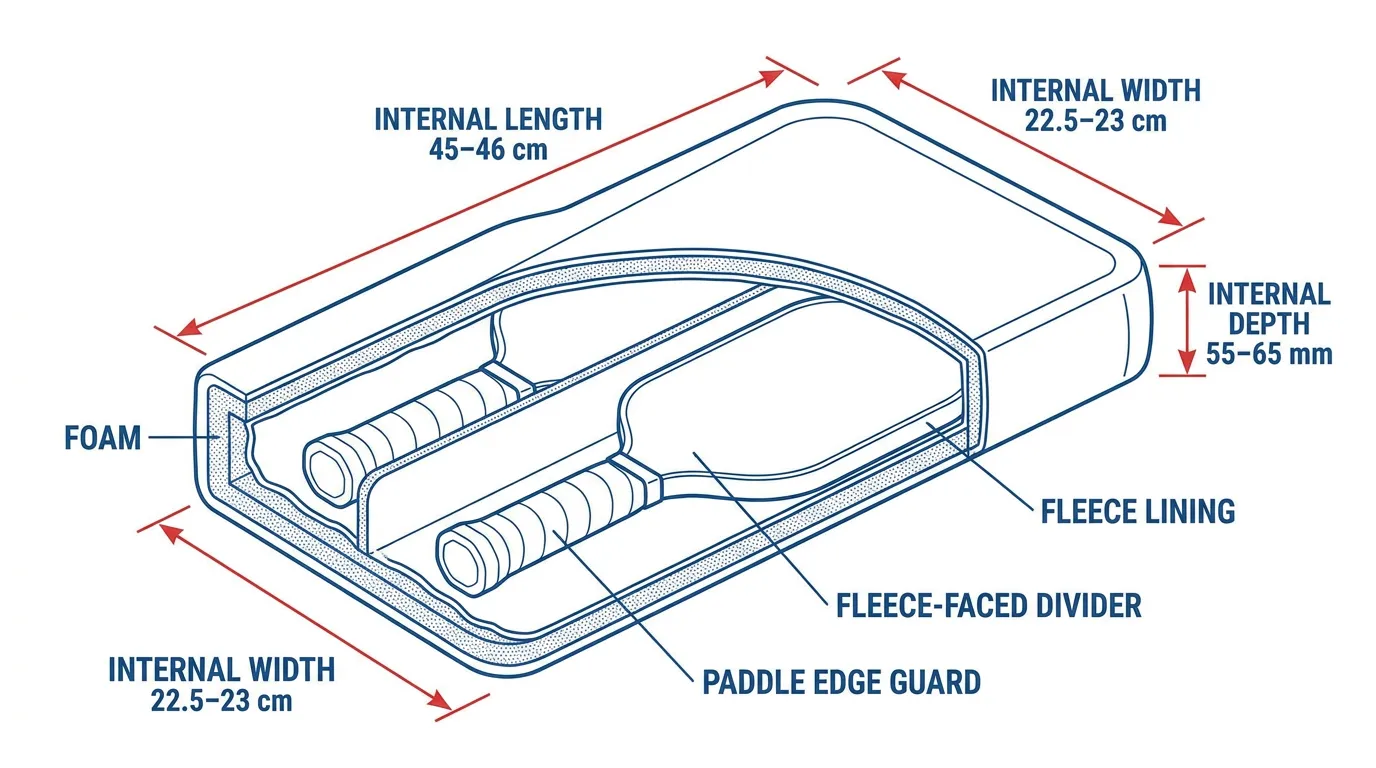
Here is how a sample room typically builds the internal dimensions for a sleeve that carries two elongated paddles with edge guards fitted, while still accepting a standard-shape paddle. The per-paddle thickness is a design allowance at the edge guard, where the paddle is thickest; confirm it by measuring the buyer’s paddle on a calliper.
Line
Input
Allowance
Internal dimension
Length
Longest legal paddle 43.2 cm (elongated is 41.9 cm)
+1.5–2.5 cm for lining, slide-in and grip end
45–46 cm
Width
Widest common paddle 20.3 cm
+2–2.5 cm for lining and zip curve at the corners
22.5–23 cm
Paddle thickness at edge guard
16 mm core plus face skins and guard
Design allowance roughly 18–22 mm per paddle
36–44 mm for two
Divider
Fleece-faced padded divider between faces
3–4 mm
+3–4 mm
Lining
Brushed fleece or felt on both walls
2–3 mm per wall
+4–6 mm
Ease
Room to slide a hand in beside the paddles
8–12 mm
+8–12 mm
Total internal depth
roughly 55–65 mm
Four-paddle version
Two more paddles plus a second divider
Add roughly 40–50 mm
roughly 95–115 mm
The sleeve then needs an opening that lets both paddles come out without the zip catching the edge guard. Most bags use a U-shaped zip running along the top and down both sides, which on a 45 × 23 cm sleeve means roughly 95–115 cm of chain with two sliders. The size of that zip, and why a #8 coil is the usual choice on a paddle sleeve, is covered in the guide to zipper gauges, buckles and webbing.
External dimensions follow from the sleeve. Add the shell, a 3–5 mm foam layer on the outer wall to protect the paddle face from impact, and the seam allowance, and a two-paddle sleeve typically grows to about 48 × 26 × 8 cm on the outside. That block is the starting point for every format in the next section.
Pickleball Bag Types Compared: Sling, Backpack, Tote, Duffel and Paddle Cover
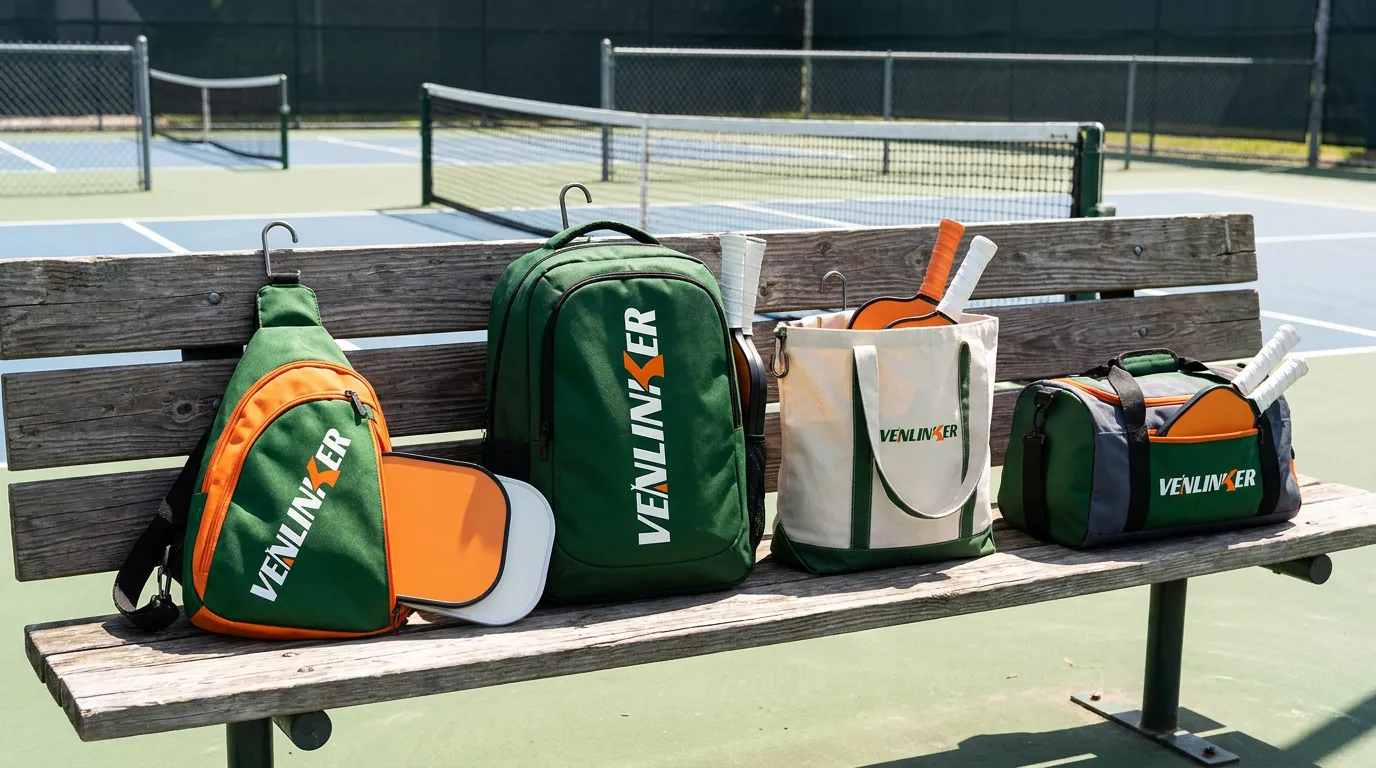
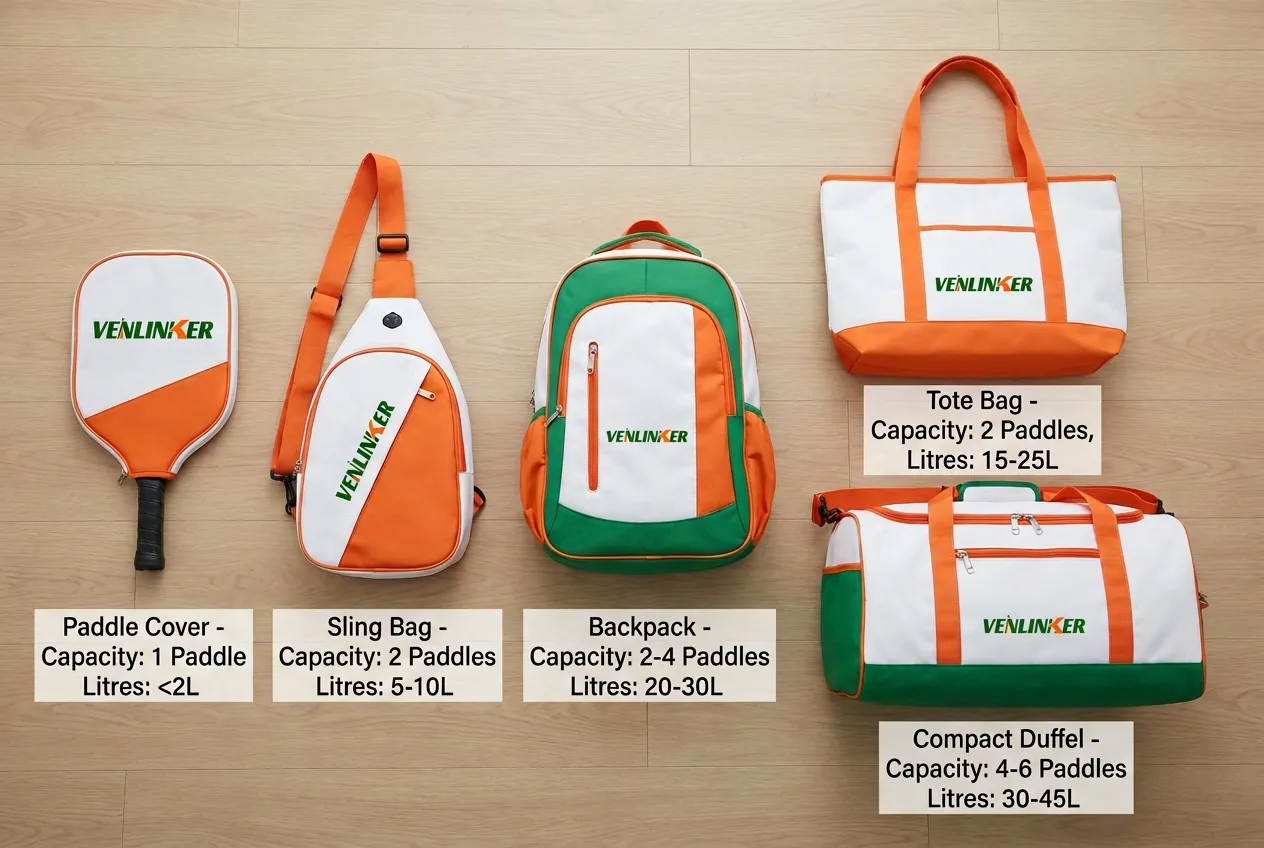
Once the sleeve is fixed, the format decides who buys the bag and at what price. Five formats cover almost all of the pickleball bag market, with a longer racket-style bag at the top for coaches and tournament players.
Format
Paddle capacity
Typical capacity
Carry style
Who buys it
Relative cost
Venlinker page
Paddle cover / sleeve
1 (double cover: 2)
Under 1 L
In hand, or inside another bag
Paddle brands as a bundle; clubs as a gift or entry item
A paddle cover is the lowest-cost entry point and the one most often ordered by paddle brands to ship in the box. It is a single-paddle envelope of neoprene, quilted polyester or padded 600D with a fleece lining, closed by a zip or a hook-and-loop flap. Because it has one panel shape and few components, it suits a first order at MOQ and a logo panel of roughly 10 × 8 cm. A double cover takes two paddles with a centre divider.
Pickleball sling bag
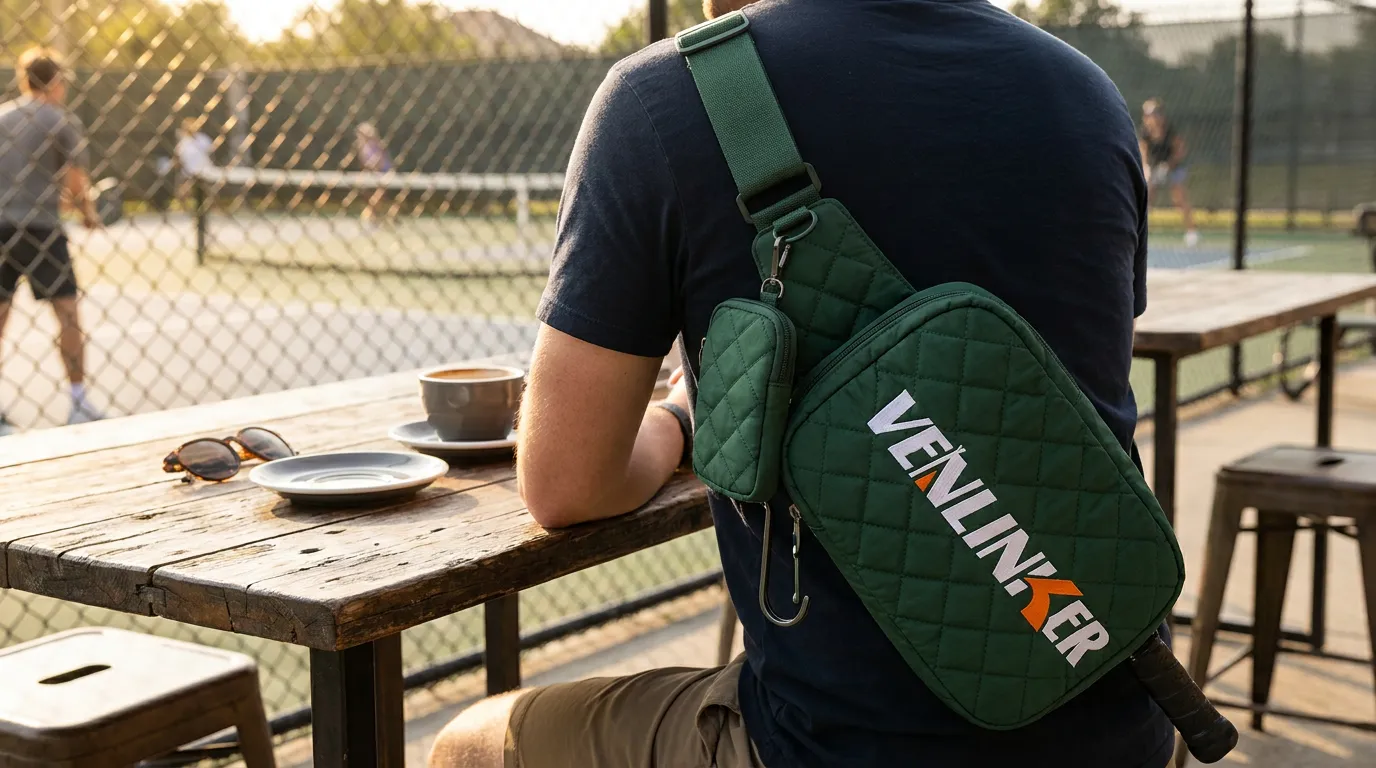
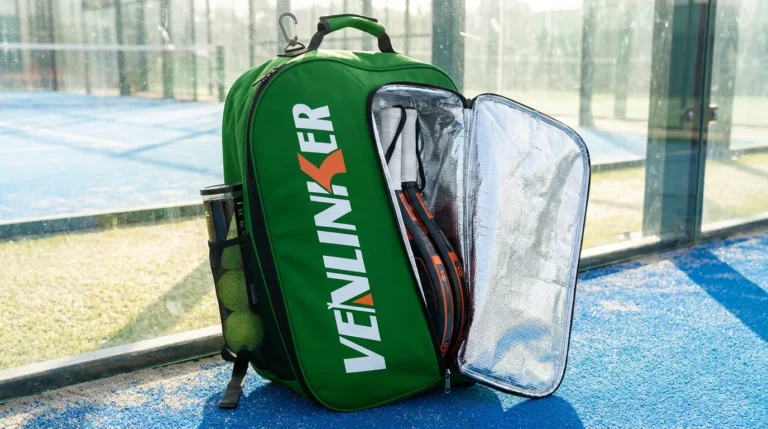
The pickleball sling bag suits lifestyle ranges because it carries a paddle and a phone without looking like sports kit. The paddle rides in a rear sleeve against the back panel, and a front zip compartment holds phone, keys, balls and a small towel. Strap length and rotation matter here, and the geometry is close to a mat sling; the crossbody sports bags range shows the strap hardware and pocket maps that carry over.
Pickleball backpack
A pickleball backpack is the volume format for core players. The paddle sleeve usually sits against the back panel or as a separate front compartment, with a ventilated shoe compartment at the base and a bottle pocket on each side. Many teens and students use the same bag for school, so a padded laptop sleeve of 14–16 in is a common addition. The sports equipment backpack patterns already carry the shoe cell and three-zone pocket layout, and a paddle sleeve replaces the ball pocket.
Tote and compact duffel
A tote with a paddle pocket carries two paddles in an external or internal sleeve and reads as an everyday bag. A compact duffel of 30–45 L suits players who travel to tournaments with a change of clothes, two pairs of shoes and four paddles. Both formats borrow most of their pattern from gym bags, which keeps sampling quick.
Players judge a pickleball bag on the court, between games, often with one hand free. The details below are the ones that come up in buyer briefs and in customer reviews, and each has a spec behind it.
Fence hook
Most courts are fenced, and players hang bags on the fence to keep them off a wet or dusty surface. A fence hook is a rigid or spring-loaded hook on the top handle or at the top of the back panel, usually moulded acetal or zinc alloy, sometimes a carabiner-style clip on a webbing loop. Specify the load (the weight of the bag fully packed, with shoes and four paddles), the hook opening (fence wire and chain-link vary, so 25–35 mm is a common opening) and where the bag hangs from, so it hangs upright with the zips facing out. Custom-moulded hooks carrying a logo add 10–15 days to the schedule; the options are listed under custom trims and hardware.
Ventilated shoe compartment
Court shoes go into the bag after play. A base compartment with its own zip, a PVC-backed or TPU-coated liner and a mesh vent keeps them away from paddles and clothes. Size it to fit shoes up to EU 46 so it works for the full player base. The construction choices, including vent methods and wipe-clean liners, are covered in detail in the guide to gym bags with shoe compartments and wet-dry separation, and a separate drawstring shoe bag is an option for slings and totes that have no room for a compartment.
Ball pocket, bottle pocket and phone pocket
A ball pocket holds three or four balls, usually in open mesh so they dry and can be counted at a glance. Put it on the outside with a zip or a drawcord top. Bottle pockets on one or both sides should take a 750 ml to 1 L insulated bottle; elastic mesh or stretch knit with a 7.5–9 cm opening covers most bottles. The phone pocket needs quick access and a soft lining: a fleece-lined top pocket that fits a 6.9 in handset and opens with one hand is a common request on buyer briefs.
Felt- or fleece-lined paddle sleeve
The paddle face carries a grit or texture that affects spin, and players do not want it scuffed. Line the sleeve with brushed polyester fleece or needle-punched felt, typically 150–250 GSM, and pad the outer wall with 3–5 mm foam. Keep zip tape and hardware away from the face: the zip should sit on the sleeve’s edge, and no rivet or D-ring should back onto the inside of the pocket.
Small details that change the review score
A key clip on a short tether inside the top pocket, a towel loop on the side, a grab handle that sits flat when not in use, and reflective piping for evening play are all low-cost additions. Each adds one or two components and a few minutes of sewing. None of them needs a new pattern.
Women’s Pickleball Bag Design: Fit, Strap Drop and Court-to-Café Styling
With women at 42.9% of US players, a women’s pickleball bag is a core line in its own right. Designing for that group means changing fit and styling at the pattern stage. A scaled-down unisex bag in a new colour rarely gets either right.
Fit and strap drop
On a backpack, the back panel length and strap placement decide comfort. A shorter back panel and a strap anchor set 2–3 cm narrower than on a unisex pattern suit a smaller frame, and a sternum strap that slides on a rail keeps straps off the chest. On a sling, a strap adjustable across roughly 70–130 cm lets the bag sit across the back during play and high on the chest when walking. On a tote, a handle drop of about 22–28 cm lets the bag sit under the arm with a coat on. The women’s gym bags range uses the same fit rules.
From court to café
Many players go from the court to lunch or to work, and they want a bag that does not look like it came from a locker room. The designs that do well here are a quilted sling in a neutral colour with the paddle sleeve hidden against the back, a structured tote with a paddle pocket that closes flat when empty, and a sling that converts to a crossbody by removing the paddle sleeve. Active crossbody bags and everyday sport totes show where that styling already sits in Venlinker’s range, and the crossbody sports bags page covers the quilted knit builds that carry over.
Details that sell to women players
Interior organisation (a key clip, a zip pouch for cards, a slip pocket for sunglasses) matters more than extra capacity. A removable pouch for a phone and card is often worn separately at the café. A fence hook that folds away keeps the court hardware out of sight. Vegan-leather-look PU trims on handles and zip pulls lift the look without changing the carry. A slim outdoor sling bag with a single-paddle sleeve is the simplest entry product for a women’s line.
Pickleball Bag Materials, Colour and Custom Branding
Pickleball bags use the same fabric families as other sports bags, with two differences: the sleeve lining becomes a specified material, and colour and branding carry more of the sale because many of these bags sell in club shops and lifestyle stores.
Shell, base and lining
Shell: 600D PU-backed polyester is the default for backpacks, duffels and totes; 300D–420D polyester or ripstop nylon for lighter slings; 8–10 mm quilted knit or quilted nylon for lifestyle slings and totes; 3 mm neoprene for paddle covers.
Base: 900D polyester or PVC-backed 600D on backpacks and duffels, because the bag is set down on concrete and court surfaces.
Paddle sleeve lining: brushed fleece or felt, typically 150–250 GSM, with 3–5 mm foam on the outer wall.
Main lining: 190T–210D polyester in a contrast colour so small items are easy to find.
Shoe compartment: PVC-backed or TPU-coated lining, with a mesh vent.
Fabric is typically 35–50% of unit cost, so the shell choice moves the quote more than any other line. The custom materials and colours page lists what is held in stock, and the guide to bag materials compares the fabric families in more depth.
Colour
Court-sport colour runs in two directions. Performance lines use bright accent colours on a dark body so the bag is easy to spot on a crowded fence. Lifestyle lines use neutrals (sand, sage, navy, black, cream) with one accent on the zip pull or trim. For teens and young adults, the highest-participation group, brands often test prints and colour-blocking alongside solids. A stock colour avoids a lab dip; a custom colour is matched by lab dip, typically in 5–7 working days, and approved before bulk fabric is dyed.
Branding for clubs and brands
Logo method follows the fabric and the order size. Embroidery works on 600D and quilted shells and reads well at 6–10 cm wide. Screen print suits large single-colour marks on flat panels. A woven or rubber patch of 4–6 cm suits lifestyle slings. Sublimation suits all-over prints on polyester paddle covers. Clubs often add a member name or a tournament date, which is easiest as a heat-transfer or embroidered name panel applied after the main run. The custom logo and branding page lists what the sample room needs in the artwork file, and the logo method guide compares methods by cost tier and durability.
A paddle brand selling a bag alongside its paddle often matches the bag’s accent colour to the paddle face and repeats the paddle logo on the sleeve zip pull. A matching paddle cover and a small organiser pouch turn a single bag into a set and raise order value.
Pickleball Bag Wholesale: Bulk Programmes for Clubs, Facilities and Retailers
Pickleball bag wholesale runs through three kinds of buyer, and each needs a different order structure.
Clubs and facilities
A club or facility buys pickleball club merchandise for three uses: resale in the pro shop, member welcome packs and tournament gifts. The pro shop wants two or three formats in one or two colourways, and the welcome pack wants the lowest-cost item that still carries the logo well, usually a paddle cover or a sling. Facility groups running several sites can standardise one style across all of them. The gym, studio and club chains page describes how multi-site programmes are usually planned, and corporate and event buyers use the same structure for tournament and sponsor bags.
Brands and retailers
Paddle brands and racket-sport brands usually run a core backpack and a sling in two or three colourways, then add a tote or duffel on the second order. Retailers and distributors want a price ladder: a cover, a sling and a backpack at three price points. The distributors and retailers page covers range planning and carton labelling, and activewear and fitness brands moving into court sports often start with the women’s sling.
MOQ and lead time by order tier
Venlinker’s MOQ is 300 pcs per style per colourway. Bulk lead time depends on quantity:
Order tier
Quantity per style
Bulk lead time after sample approval
Typical pickleball buyer
First order
300–1,000 pcs
25–35 days
Single club, new paddle brand, first lifestyle sling
Growth
1,000–5,000 pcs
30–40 days
Facility group, established paddle brand, regional retailer
Volume
5,000–20,000 pcs
35–50 days
Distributor, national retailer, multi-format brand programme
Repeat order
Any tier, same spec
20–30 days
Reorder of an approved style
Add: out-of-network fabric
+7–14 days
Specific quilted knit, specific colour not held in stock
Add: custom-moulded hardware
+10–15 days
Logo fence hook or branded zip pull
Three colourways of one style count as three MOQs of 300 pcs each. A club that wants two colours and cannot sell 600 bags can run one colour at 300 pcs and add the second on reorder. The MOQ guide sets out how styles, colours and sizes combine, and private label gym bag sets show how a bag, a shoe bag and a pouch can be ordered as one set. Retail-ready packing, hangtags and barcode labels are covered under custom packaging and FBA prep.
Timing the order to the season
In most northern-hemisphere markets, outdoor play is busiest from spring to autumn. A buyer who wants bags in a pro shop for the spring opening should work backwards: add sea freight time from their forwarder, the bulk lead time above, and 5–7 working days for the sample plus one revision. For a first order that usually means approving the sample about three months before the shelf date. Buyers ready to fix that date can contact the factory to plan the schedule backwards from it.
How to Specify a Pickleball Bag in a Tech Pack
A tech pack for a pickleball bag is a standard bag tech pack with one extra section for the paddle sleeve. The block below shows the specification for a 25 L club backpack with a two-paddle sleeve. The ranges are the typical starting values; every figure is confirmed on the sample.
Field
Specification (worked example: club pickleball backpack)
Typically 24–26 L main body, excluding sleeve and shoe compartment
External dimensions
Roughly 48 × 30 × 17 cm (H × W × D)
Paddle sleeve (internal)
45–46 × 22.5–23 cm, depth 55–65 mm; fleece-faced divider; U-shaped #8 coil zip with 2 sliders
Sleeve lining
Brushed polyester fleece, typically 150–250 GSM; 3–5 mm foam on outer wall
Shell
600D PU-backed polyester, club colour
Base
900D polyester or PVC-backed 600D, 4 corner reinforcements
Shoe compartment
Base, own #5 zip, PVC-backed liner, mesh vent, fits to EU 46
Ball pocket
Front mesh pocket for 3–4 balls, drawcord or #5 zip top
Bottle pockets
2 side pockets, stretch mesh, fit a 750 ml–1 L bottle
Phone pocket
Top fleece-lined pocket, fits a 6.9 in handset, #5 zip
Fence hook
1 moulded hook on top handle, 25–35 mm opening, rated to the full-bag load
Straps
60–70 mm padded shoulder straps, 5–8 mm foam, sliding sternum strap
Back panel
100–150 GSM air mesh over 5–8 mm foam
Logo
Front embroidery, 8 × 4 cm; woven label inside; branded zip pulls (optional)
Colourways
1 colourway at 300 pcs per style per colourway
Weight target
Typically 0.7–1.0 kg empty
Packing
Individual polybag, hangtag, export carton; carton size and weight confirmed on sample
The lines that cause most rework
The paddle sleeve dimensions and the zip path cause most revision requests, so send the paddle. A buyer who ships two paddles with edge guards to the sample room removes the guesswork on thickness and zip clearance. The second most common revision is the fence hook position, which decides whether the bag hangs upright. Mark it on the flat sketch with a measurement from the top seam.
Hardware is best written as a schedule of its own, with gauge, chain type, slider and puller for each zip; the bag tech pack guide shows the full template, including the bill of materials and measurement points. Buyers who start from a sketch and not a full tech pack can use the custom design and structure service, where the sample room drafts the pattern from a reference and a paddle.
Questions to Ask a Pickleball Bag Supplier
These questions separate a supplier who has built paddle bags from one who is adapting a tennis pattern. Ask them before the sample, and write the answers into the tech pack.
What internal sleeve dimensions will you use, and how did you arrive at them? Expect a length that allows for a 17 in paddle and a width for an 8 in standard paddle, with stated clearance.
Will you sample with my actual paddle and edge guard? A supplier who samples to a drawing alone will miss the thickness at the guard.
What lining goes inside the paddle sleeve, and at what GSM? Expect fleece or felt with a stated weight and foam on the outer wall.
Where does the zip tape sit relative to the paddle face? The answer should keep teeth and sliders off the face.
How is the fence hook attached, and what load is it tested to? Ask for the attachment method (bar-tacked webbing loop, riveted plate) and a load check on the sample.
What is the shoe compartment liner, and does it fit a men’s EU 46? A women’s-only size fails half the market.
What are MOQ and lead time per colourway? At Venlinker, 300 pcs per style per colourway and 25–35 days for a first order of up to 1,000 pcs.
Can I see the sample within a week? Venlinker’s standard is 5–7 working days with one free revision, against a refundable sample fee.
What happens at inspection? Ask whether every bag is checked, and whether the sleeve is measured at final inspection against the golden sample.
Can I commission third-party inspection? SGS, BV or TUV inspection should be welcome, commissioned and paid by the buyer.
The full question set for comparing factories is in the RFQ checklist. A sourcing manager who wants the answers in writing before sampling can request a quote with the tech pack attached.
How Venlinker Builds Custom Pickleball Bags
Venlinker is Your Trusted Custom Pickleball Bag Manufacturer in China, building paddle sleeves, slings, backpacks, totes and duffels for pickleball brands, clubs and retailers from a 5,000 m² factory in Huadu District, Guangzhou, founded in 2010.
Sample room and paddle fit
The sample room works from the buyer’s paddle. A buyer who sends two paddles with edge guards gets a sleeve patterned to their measured thickness. Samples take 5–7 working days with one free revision, against a refundable sample fee credited to the production order. The sample development page describes what to send, and 10+ in-house designers can draft the pattern from a sketch or a reference bag. The same sample room builds the longer racket bag patterns, so a brand selling pickleball and padel can run both from one supplier; the padel bag guide covers the padel side.
Fabric, lining and colour
Fabric and fleece come from a network of 200+ verified suppliers through the material sourcing team, with 600D polyester, quilted knit and fleece lining held in stock colours. Out-of-network fabrics add 7–14 days, quoted up front. Custom colours are matched by lab dip before bulk fabric is dyed.
Production, inspection and visits
Ten or more production lines turn out 50,000+ bags a month, and in-house high-frequency welding handles TPU and PVC shoe-compartment liners. Every bag passes 100% pre-shipment inspection by Venlinker’s own team, with the paddle sleeve measured against the golden sample at final inspection. Any order can carry a buyer-commissioned inspection by SGS, BV or TUV. Factory visits are welcome Monday to Saturday, about 40 minutes from Baiyun airport with pickup, and live video tours are available for buyers who cannot travel.
Order terms
MOQ starts at 300 pcs per style per colourway. Payment is 30% deposit and 70% before goods leave the factory, on FOB terms by default, with CIF or DDP on request. Free white-background product photography is included on production orders, which helps a club shop or retailer list the bag the week it arrives. Private label programmes and first-time brands follow the same OEM/ODM workflow from brief to bulk. Buyers can request a free sample, get a quote on a specific format, or contact the team to talk through a paddle sleeve before drafting the tech pack.
What size should a pickleball bag paddle compartment be?
For a sleeve that takes any common paddle, size the internal length at 45–46 cm and the width at 22.5–23 cm. That covers the 17 in (43.18 cm) maximum legal length and the 8 in (20.3 cm) width of a standard paddle, with clearance for lining. Depth for two paddles with edge guards is roughly 55–65 mm; for four, roughly 95–115 mm. Confirm the depth by sampling with the actual paddle.
What is the difference between a pickleball bag and a tennis bag?
A pickleball bag is shorter, because a paddle is at most 43.18 cm long against a tennis compartment of roughly 72–76 cm. It usually drops the thermal lining, since paddles have no strings, swaps the ball tube for a mesh ball pocket, and adds a lined sleeve to protect the paddle face. The shorter length makes slings, totes and 20–25 L backpacks practical.
Which pickleball bag format should a first order use?
For a club or brand with one style budget, a backpack with a two-paddle sleeve and a shoe compartment sells to the widest group of core players. For a women’s or lifestyle line, a sling with a single- or two-paddle sleeve is the better entry product. Both run at an MOQ of 300 pcs per style per colourway.
What is the MOQ for custom pickleball bags?
Venlinker’s MOQ is 300 pcs per style per colourway. Two colourways of the same bag are two MOQs. Bulk lead time for 300–1,000 pcs is 25–35 days after sample approval, and a repeat order of an approved style is 20–30 days. The MOQ guide explains how sizes and colourways combine.
Do pickleball bags need a thermal compartment?
In most cases, no. The foil thermal lining in tennis bags exists mainly to protect string tension from heat, and paddles have no strings. Leaving it out saves cost and weight. A buyer who wants an insulated pocket for drinks or snacks can add a small foil-lined pocket without lining the whole paddle sleeve.
What makes a good women’s pickleball bag?
Fit and styling. A shorter back panel and closer-set straps on backpacks, a wide strap adjustment range on slings, a handle drop that sits under the arm on totes, and a neutral, quilted or structured look that works away from the court. Interior organisation and a fence hook that folds away matter more than extra litres.
Can I put my club’s logo and members’ names on pickleball bags?
Yes. The club logo is usually embroidered or printed on the main panel during production. Member names are easiest as an embroidered or heat-transfer name panel applied after the main run, which keeps the bulk order to one specification. The custom logo and branding page lists artwork requirements.
Summary: Specifying a Custom Pickleball Bag
Pickleball is now a mass-participation sport, with 24.3 million US players in 2025, 7.5 million of them core players and 42.9% of them women. The bags that sell to that market start from the paddle and are built in formats a tennis racket never allowed.
Size the sleeve from the rule, then sample with the paddle. A 45–46 × 22.5–23 cm internal sleeve covers the 17 in maximum length and the 8 in standard width. Depth is roughly 55–65 mm for two paddles with edge guards. Line it with fleece or felt and keep zip teeth off the face.
Match the format to the buyer. Backpacks for core players and club shops, slings and totes for women’s and lifestyle lines, covers for paddle bundles and welcome packs, compact duffels for tournament travel.
Lock down the court-side details and the order structure. Fence hook, ventilated shoe compartment to EU 46, ball, bottle and phone pockets, then MOQ 300 per style per colourway and a lead time counted back from the season opening.
Ready to Build a Pickleball Bag Around Your Paddle?
Venlinker makes custom pickleball backpacks, slings, totes and paddle covers for paddle brands, clubs and facilities, and sporting-goods retailers, with fleece-lined paddle sleeves patterned to your paddle, samples in 5–7 working days, fabric from 200+ verified suppliers, 100% pre-shipment inspection and MOQ from 300 pcs per style per colourway.